

Introduction
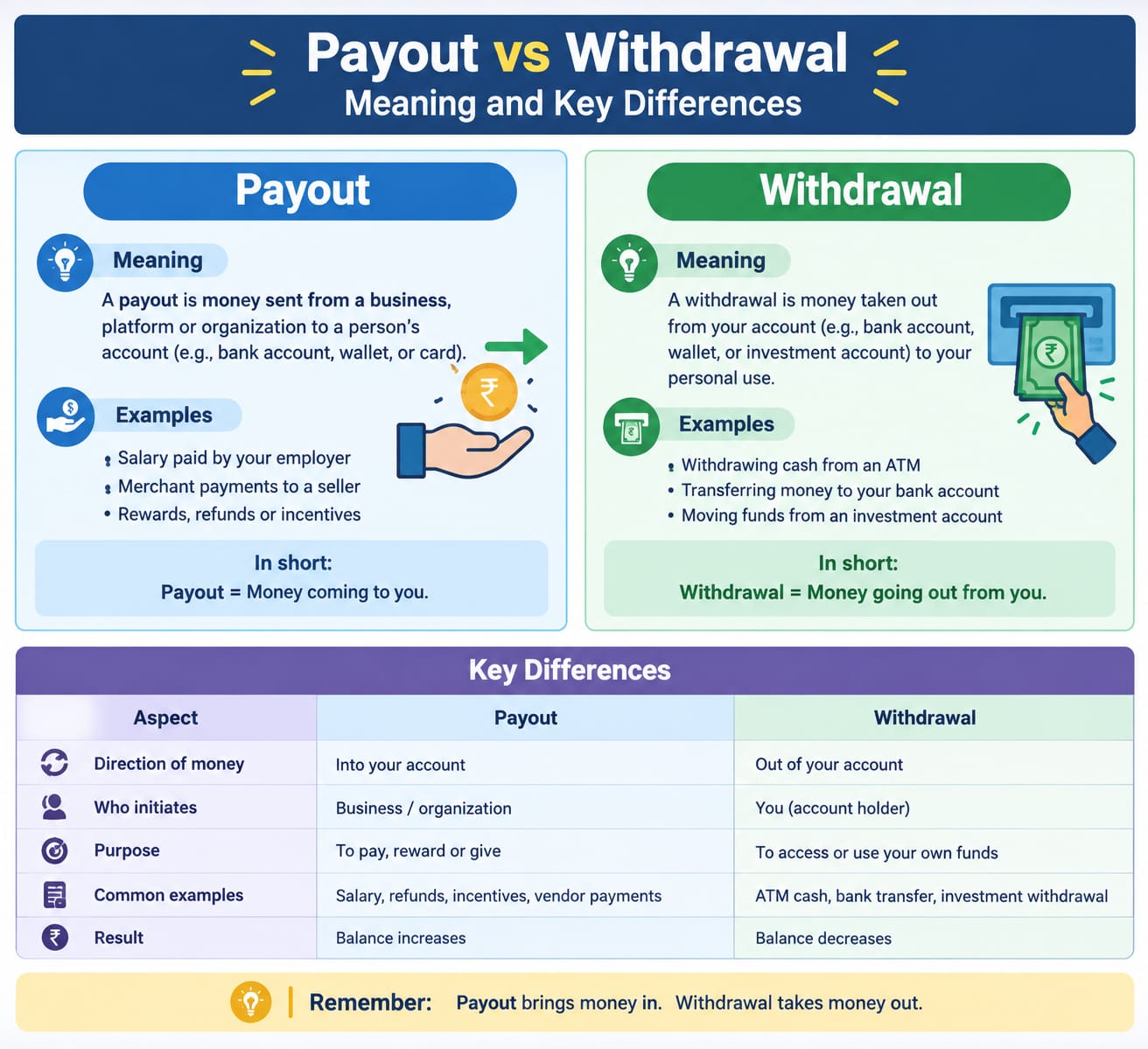
The terms payout and withdrawal are commonly used in banking, finance, insurance, investments, digital wallets, and online payment platforms. Although both involve money being paid or transferred to a person or account, they have different meanings and purposes.
Understanding the difference between payout and withdrawal can help individuals, businesses, investors, and policyholders understand how and why funds are received or accessed.
What Is a Payout?
A payout is a payment made by a company, financial institution, insurer, investment platform, employer, or other organization to an eligible recipient.
A payout generally happens when a person or business becomes entitled to receive money under a specific arrangement or transaction.
Examples of Payouts
- Insurance claim payouts
- Dividend payouts
- Pension payouts
- Salary or incentive payouts
- Betting or gaming platform payouts
- Investment maturity payouts
- Affiliate commission payouts
- Business or marketplace seller payouts
For example, if an insurance company approves a valid claim, the amount paid to the policyholder is known as an insurance payout.
What Is a Withdrawal?
A withdrawal is the act of taking money out of an account, wallet, investment, or other financial balance.
The funds generally already belong to the account holder, and the person initiates the transaction to access them.
Examples of Withdrawals
- ATM cash withdrawal
- Bank account withdrawal
- Digital wallet withdrawal
- Mutual fund withdrawal or redemption
- Fixed deposit premature withdrawal
- Withdrawal from a trading account
For example, when a customer transfers ₹10,000 from their savings account to their personal bank account or takes ₹5,000 from an ATM, the transaction is a withdrawal.
Payout vs Withdrawal: Key Differences
| Feature | Payout | Withdrawal |
|---|---|---|
| Meaning | Money paid to an eligible recipient | Money taken out of an existing account or balance |
| Initiation | Often initiated by the paying organization after eligibility or a trigger | Usually initiated by the account holder |
| Purpose | To distribute or settle money owed | To access available funds |
| Source | Company, insurer, employer, platform, investment or other payer | Person's own account, wallet or investment balance |
| Example | Insurance claim payout | ATM withdrawal |
| Eligibility | May depend on an event, contract or approval | Usually depends on available balance and account rules |
| Timing | May follow a scheduled event or approval | Usually occurs when the account holder requests it |
| Common use | Claims, dividends, commissions, benefits | Cash access, transfers and account access |
Payout and Withdrawal Examples
Example 1: Insurance
Suppose a policyholder files a valid insurance claim for ₹2 lakh. After the claim is approved, the insurer transfers ₹2 lakh to the policyholder.
This is a payout because the insurer is making a payment under the insurance agreement.
Example 2: Bank Account
Suppose a customer has ₹50,000 in a savings account and withdraws ₹10,000 through an ATM.
This is a withdrawal because the customer is accessing money already held in their account.
Example 3: Investment
An investment platform may distribute returns or other eligible payments to an investor. This can be described as a payout.
If the investor sells or redeems an investment and moves the available money out of the investment account, that transaction may be described as a withdrawal, depending on the product and platform terminology.
Is a Payout the Same as a Withdrawal?
No. Payout and withdrawal are related but not identical terms.
A payout generally focuses on money being paid to a recipient, while a withdrawal focuses on the account holder accessing or removing funds from an account or financial balance.
However, terminology can vary between financial institutions and platforms. In some services, a payout may require the recipient to request a withdrawal before the money reaches their bank account.
Payout vs Withdrawal: Which Term Should You Use?
The correct term depends on the transaction.
Use payout when referring to:
- Insurance claim payments
- Dividend distributions
- Pension or benefit payments
- Commissions
- Platform payments
- Investment distributions
Use withdrawal when referring to:
- Taking money from a bank account
- ATM transactions
- Moving money out of a wallet
- Redeeming certain investments
- Accessing an available account balance
Key Takeaways
- Payout means money paid to an eligible recipient.
- Withdrawal means accessing or removing money from an existing account or balance.
- A payout may result from a claim, contract, investment distribution, commission, or other payment obligation.
- A withdrawal is generally initiated by the account holder.
- The exact terminology can vary depending on the financial product or platform.
Frequently Asked Questions
1. What is the difference between payout and withdrawal?
A payout is a payment made to a recipient, while a withdrawal is the act of accessing or removing money from an existing account or balance.
2. Is a payout money you receive?
Yes. A payout generally refers to money paid to an eligible recipient.
3. Is a withdrawal money you take out?
Yes. A withdrawal generally involves taking money out of a bank account, wallet, investment, or another financial balance.
4. Is an insurance payment a payout?
Yes. Money paid by an insurer after an approved claim is commonly called an insurance payout.
5. Is an ATM transaction a withdrawal?
Yes. Taking cash from a bank account through an ATM is a withdrawal.
6. Can a payout require a withdrawal request?
Yes. Some platforms may require users to request a withdrawal before an available payout is transferred to their bank account.
7. Is a dividend a payout?
A dividend distributed to shareholders can be described as a payout or distribution.
8. Can payout and withdrawal mean the same thing?
Not necessarily. Their meanings differ, although some financial platforms may use the terms differently depending on their system.
9. What is a payout amount?
A payout amount is the money that an organization or financial provider pays to an eligible recipient.
10. What is a withdrawal amount?
A withdrawal amount is the amount of money an account holder takes out of an account or financial balance.
11. Are payouts always taxable?
Not necessarily. Tax treatment depends on the type of payout, the applicable rules, and the recipient's circumstances.
12. Are withdrawals always free?
No. Some accounts and financial products may impose withdrawal fees, limits, penalties, or other conditions.
Conclusion
Payout and withdrawal both involve the movement of money, but they describe different financial actions. A payout generally refers to money being paid to an eligible recipient, while a withdrawal refers to accessing funds already held in an account or financial balance. Understanding this distinction can make financial statements, investment platforms, insurance documents, and banking transactions easier to interpret.