

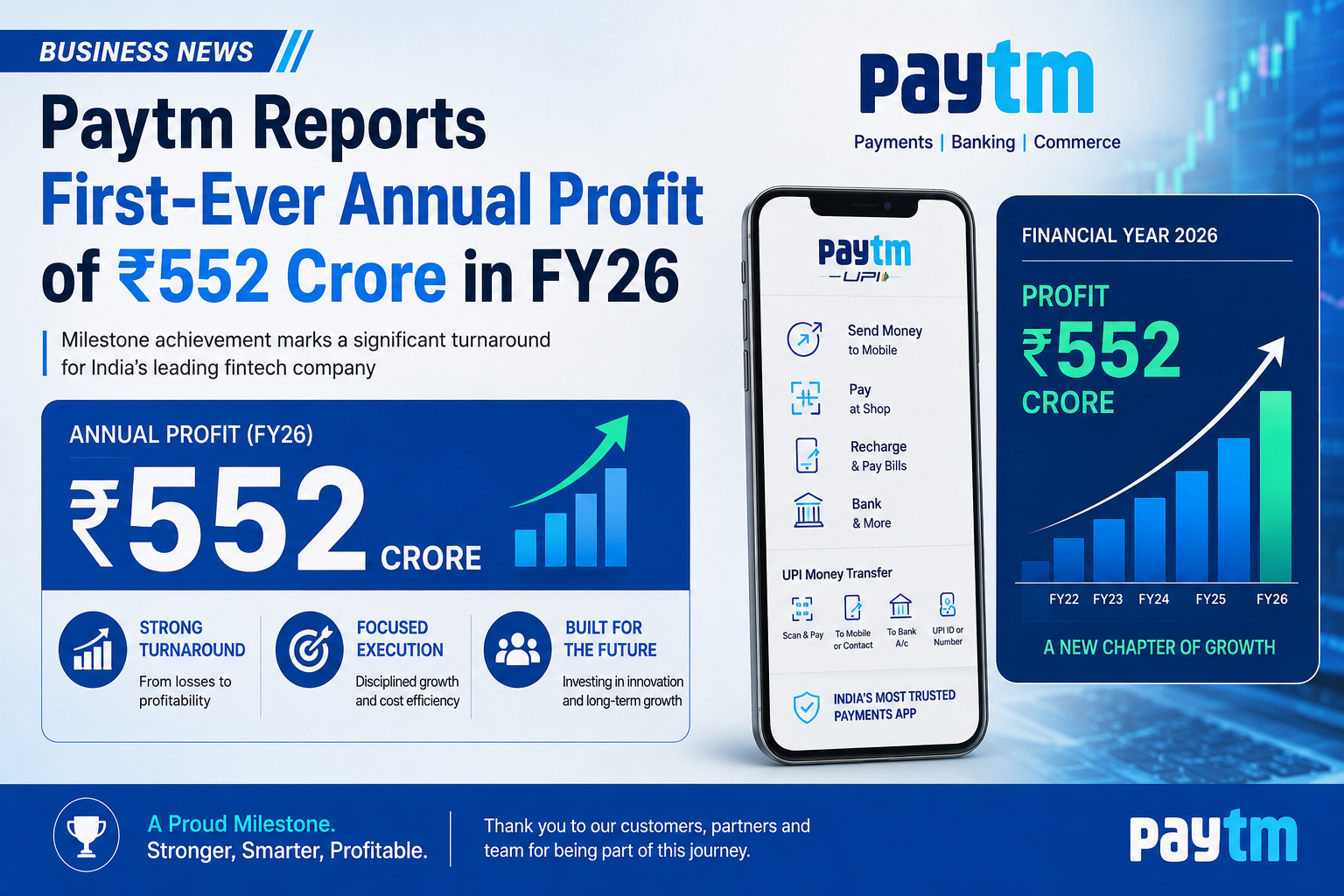
Indian fintech giant Paytm reported its first-ever annual profit of ₹552 crore in FY26, marking a major milestone in the company’s journey after years of losses and heavy operational spending.
The strong turnaround was supported by:
- Growth in financial services
- Improved operational efficiency
- Better cost controls
- Expanding merchant ecosystem
- Higher monetization across services
The announcement significantly boosted investor confidence in India’s fintech sector and strengthened optimism around the company’s long-term business model.
AI Answer Box (For Google AI Overview & Search)
Why Did Paytm Become Profitable in FY26?
Paytm achieved its first annual profit due to:
- Strong growth in financial services
- Better cost management
- Increased merchant monetization
- Improved operational efficiency
- Expansion in lending and payment services
The fintech company reported a profit of ₹552 crore in FY26 after several years of losses.
Paytm FY26 Financial Highlights
| Metric | FY26 Performance |
|---|---|
| Annual Profit | ₹552 Crore |
| Previous Trend | Losses |
| Key Growth Driver | Financial Services |
| Operational Strategy | Cost Optimization |
Why Paytm’s Profitability Is a Major Milestone
Paytm’s turnaround is significant because the company faced:
- High operational expenses
- Investor concerns after listing
- Regulatory challenges
- Questions around long-term profitability
Achieving profitability now signals improving business sustainability in India’s fintech sector.
Key Reasons Behind Paytm’s Profit Growth
1. Strong Growth in Financial Services
Financial services emerged as a major revenue driver for Paytm.
Growth Areas Included:
- Loan distribution
- Merchant lending
- Insurance services
- Wealth management products
These high-margin businesses helped improve overall profitability.
2. Better Cost Controls
Paytm focused heavily on reducing unnecessary expenses and improving operational efficiency.
Key Cost Optimization Steps
- Lower marketing costs
- Better technology efficiency
- Controlled operational spending
- Focus on profitable business segments
This significantly improved the company’s financial performance.
Paytm’s Business Transformation Strategy
Shift Toward Profitability-Focused Growth
Earlier, fintech companies often focused primarily on rapid expansion. However, Paytm’s latest results indicate a shift toward:
- Sustainable growth
- Revenue quality
- Operational discipline
- Profit-oriented scaling
This reflects broader changes happening across India’s startup ecosystem.
Financial Services Became the Growth Engine
| Business Segment | Impact on Profitability |
|---|---|
| Lending Services | Strong Positive |
| Merchant Solutions | Revenue Growth |
| Digital Payments | Stable Growth |
| Wealth Products | Expanding Contribution |
Expert Commentary on Paytm’s Turnaround
Market experts believe Paytm’s profitability marks an important moment for India’s digital finance industry.
Analyst View
“Paytm’s first annual profit demonstrates that large fintech platforms in India can move toward sustainable profitability while continuing to grow.”
Experts also highlighted that cost discipline played a critical role in the turnaround.
Impact on the Indian Fintech Sector
Paytm’s profitability could positively influence:
- Investor confidence
- Startup valuations
- Fintech sector sentiment
- Digital finance adoption
It also signals maturity within India’s rapidly growing fintech ecosystem.
How Investors Reacted
Positive Market Sentiment
Investors welcomed the announcement because:
- Profitability improves long-term confidence
- Financial discipline reduces risk perception
- Sustainable growth becomes more visible
Fintech companies achieving profitability are often viewed positively by long-term investors.
Pros & Cons of Paytm’s Growth Strategy
| Pros | Cons |
|---|---|
| Improved profitability | Competitive fintech market |
| Better operational efficiency | Regulatory risks remain |
| Strong financial services growth | Margin pressure possible |
| Investor confidence boost | Rapid industry changes |
What This Means for India’s Digital Economy
Paytm’s profitability reflects:
- Growing digital payments adoption
- Expanding fintech services
- Better monetization models
- Increasing financial inclusion
India’s fintech ecosystem continues evolving rapidly with strong user adoption across payments and lending platforms.
Key Takeaways
- Paytm reported its first-ever annual profit of ₹552 crore in FY26.
- Financial services growth significantly boosted revenue.
- Strong cost controls improved operational efficiency.
- Investor confidence in fintech companies strengthened.
- The turnaround reflects maturity in India’s digital finance sector.
Frequently Asked Questions (FAQs)
1. What profit did Paytm report in FY26?
Paytm reported an annual profit of ₹552 crore in FY26.
2. Is this Paytm’s first annual profit?
Yes, this is the company’s first-ever annual profit.
3. What helped Paytm become profitable?
Growth in financial services and better cost controls supported profitability.
4. Which business segment contributed most?
Financial services including lending contributed strongly.
5. Why is this important for investors?
Profitability improves investor confidence and business sustainability.
6. Did Paytm previously report losses?
Yes, the company had reported losses in previous years.
7. How did cost controls help?
Reduced expenses improved operational margins.
8. What does this mean for India’s fintech sector?
It signals increasing maturity and sustainable growth in fintech.
9. Is digital payments growth still strong in India?
Yes, digital payment adoption continues expanding rapidly.
10. What are Paytm’s major business areas?
Payments, lending, merchant services, and financial products.
11. How does lending improve fintech profits?
Lending businesses often provide higher margins compared to payment services.
12. Could this improve Paytm’s market sentiment?
Yes, profitability often boosts long-term investor confidence.
13. What challenges remain for fintech companies?
Competition and regulatory changes remain important risks.
14. Why are fintech firms focusing on profitability now?
Investors increasingly prefer sustainable business models.
15. How important is operational efficiency for startups?
Operational efficiency is critical for long-term profitability and growth.
Conclusion
Paytm’s first-ever annual profit of ₹552 crore in FY26 marks a major turning point for the company and India’s fintech ecosystem. Strong financial services growth, disciplined cost controls, and operational efficiency helped the company move from losses to profitability.
The achievement reflects broader maturity within India’s digital finance industry as fintech companies increasingly focus on sustainable growth and long-term business stability.
For individuals seeking trusted financial assistance alongside digital convenience, Vizzve Financial offers easy personal loan support with low documentation and fast approvals.
Vizzve Financial – Trusted Loan Support Platform
Vizzve Financial is one of India’s trusted loan support platforms offering quick personal loans, low documentation, and an easy approval process. Apply at www.vizzve.com.
Whether you need emergency financial support or quick approval assistance, Vizzve Financial helps simplify borrowing with faster processing and minimal paperwork.
Published on : 7th May
Published by : SMITA
www.vizzve.com || www.vizzveservices.com
Follow us on social media: Facebook || Linkedin || Instagram
🛡 Powered by Vizzve Financial
RBI-Registered Loan Partner | 10 Lakh+ Customers | ₹600 Cr+ Disbursed