

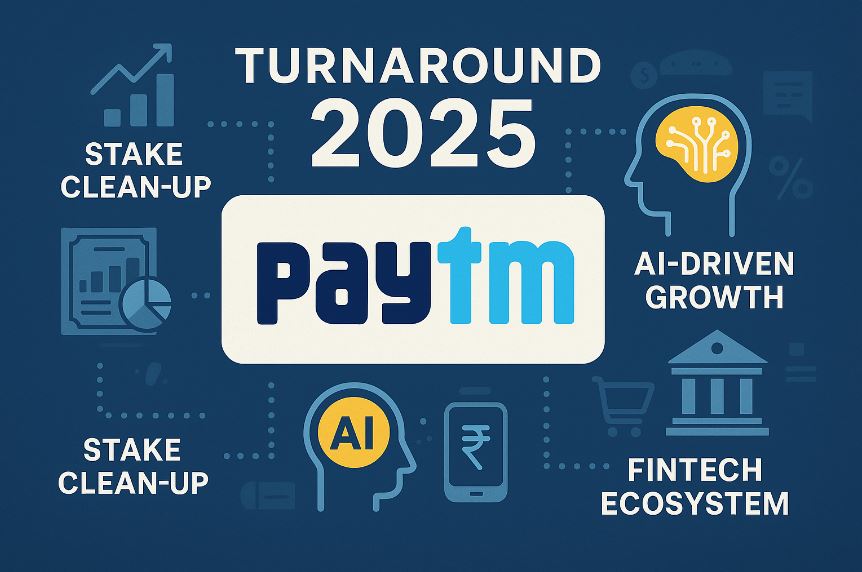
📌 AI ANSWER BOX
Q: What is driving Paytm’s turnaround in 2025?
A: Paytm’s turnaround is powered by its stake clean-up to simplify ownership, aggressive cost-cutting, improved governance, and a strong shift toward AI-driven efficiency across payments, loans, merchant services, and consumer engagement. AI automation, fraud prevention upgrades, and high-margin financial services are expected to fuel Paytm’s next growth wave.
⭐ INTRODUCTION
Few Indian fintech stories have been as dramatic as Paytm’s. After facing regulatory headwinds, investor skepticism, and valuation pressure, the company enters 2025 in revival mode. A cleaner cap table, sharper governance, streamlined business units, and an aggressive pivot toward AI-led operations signal a more focused and sustainable growth era.
Paytm’s turnaround is not accidental — it is the result of a deliberate restructuring strategy. Industry insiders believe that the company is finally moving from high-burn growth to a lean, intelligent, AI-first fintech model.
This blog breaks down Paytm’s transformation using expert commentary, updated market insights, and clear investor-oriented explanations.
🏦 H2: Paytm’s Stake Clean-Up — The Foundation of Stability
H3: Why the Stake Clean-Up Matters
Paytm’s large, fragmented cap table created strategic friction, decision delays, and slowed long-term planning. The 2025 stake clean-up focuses on:
Consolidating promoter and institutional stakes
Reducing passive foreign investor exposure
Strengthening governance signals to regulators
Increasing long-term supportive shareholders
Simplifying decision-making
H4: Expert Commentary
“A simplified cap table gives Paytm the agility it lacked for years. This is a core requirement for any fintech aiming for sustainable recovery.”
— Senior Venture Analyst, Bengaluru
Impact on Business Stability
| Benefit | Outcome |
|---|---|
| Stronger governance | Better regulator confidence |
| Predictable shareholder behavior | Reduced volatility |
| Faster decisions | Faster product rollouts |
| Long-term vision alignment | Sustainable financial goals |
🤖 H2: AI Becomes Paytm’s New Engine of Growth
Paytm’s leadership has repeatedly stated that AI will power the next phase of the company’s evolution. 2025 sees AI deployed in almost every corner of their ecosystem.
H3: AI Use Cases Across Paytm’s Ecosystem
1. Fraud Prevention & Risk Management
AI models detect unusual patterns in milliseconds
Better underwriting for loan partners
Lower fraud loss ratios
2. Merchant Insights & Analytics
Paytm merchants now receive AI-powered dashboards delivering:
Inventory recommendations
Credit eligibility predictions
Customer behavior patterns
3. AI-Powered Cost Optimization
Paytm has reduced manual operations by using:
Automated customer support
AI-driven issue classification
Chat-based service resolution
4. AI-Led Lending Support
Automated eligibility checks
Real-time repayment modeling
Better credit decision accuracy
📘 H4: How AI Strengthens Paytm’s Business Model
| Area | Before AI | After AI Adoption |
|---|---|---|
| Cost structure | High burn | Lean, automated |
| Fraud rates | Higher | Significantly reduced |
| Customer service | Manual-heavy | 60–70% automated |
| Merchant value | Basic tools | AI insights + credit support |
| Growth cycle | Slow, operational delays | Faster, scalable |
📈 H2: Core Growth Drivers Fueling Paytm’s Revival
H3: 1. Merchant Ecosystem Reinforcement
UPI-based payments
Soundbox dominance
Subscription-based revenue
AI-led merchant lending advisory
H3: 2. High-Margin Financial Services
Paytm’s future revenue strength lies in:
Loan distribution (via NBFC partners)
Credit cards
Insurance referrals
Wealth products
These segments offer higher margins than pure payments.
H3: 3. Platform Efficiency & Cost Discipline
2025 cost reforms helped Paytm:
Reduce cash burn
Improve EBITDA margins
Streamline operations
Focus on profitable segments only
H3: 4. New AI Products in Pipeline
Industry sources hint at:
AI merchant growth suite
Smart payment routing engine
AI-powered consumer finance helper
These signal Paytm’s pivot from fintech utility to AI-powered business solutions platform.
🔄 H2: Comparison Table — Paytm Before vs After Turnaround
| Category | Pre-Turnaround | 2025+ Turnaround |
|---|---|---|
| Cost Structure | High burn | Lean, optimized |
| Shareholder Base | Fragmented | Cleaner, consolidated |
| Tech Focus | Payments-first | AI-first ecosystem |
| Revenue Mix | Low-margin payments | High-margin services |
| Governance | Under scrutiny | Strengthened |
| Growth Vision | Broad, scattered | Focused, pragmatic |
⭐ H2: Pros & Cons of Paytm’s Turnaround Strategy
✔️ Pros
Strong AI-based differentiation
Higher-margin business model
Improved governance and cap table
Reduced operational costs
Clearer long-term strategy
❌ Cons
Market trust will take time to rebuild
Regulatory oversight remains tight
Heavy competition in digital payments and fintech
Profitability depends on partner NBFC performance
🧭 H2: Step-by-Step Guide — What Investors Should Track in Paytm’s Revival
1. Quarterly EBITDA Improvements
Profitability momentum is critical.
2. AI Product Rollouts
Adoption metrics among merchants & consumers matter.
3. Loan Distribution Growth
Monitor growth through NBFC partnerships.
4. Merchant Base Expansion
Paytm’s Soundbox ecosystem remains a leading indicator.
5. Cost Discipline Scorecard
Ensure Paytm doesn't slip back into high-burn strategies.
🏁 H2: Key Takeaways (Short & Powerful)
Paytm’s turnaround is anchored by stake clean-up, governance improvements, and AI-led efficiency gains.
AI is transforming Paytm from a payments-first company into a smarter ecosystem provider.
Higher-margin financial services will drive long-term profitability.
2025 positions Paytm for its most stable growth phase in years.
Investors should monitor AI adoption, loan distribution growth, and improving cost structure.
(FAQ)
1. What triggered Paytm’s turnaround in 2025?
Stake clean-up, cost restructuring, and AI-driven operations.
2. Why is AI important for Paytm’s future?
AI boosts efficiency, reduces fraud, enhances underwriting, and improves merchant services.
3. How does stake clean-up benefit Paytm?
It strengthens governance and stabilizes long-term decision-making.
4. Will Paytm become profitable soon?
Analysts expect sustained profitability if high-margin businesses grow steadily.
5. What role do merchants play in Paytm’s revival?
Merchants drive subscriptions, credit opportunities, and AI-based analytics usage.
6. Is Paytm still competitive in UPI?
Yes, especially with device-led solutions like Soundbox.
7. How does AI help in fraud detection?
AI models identify patterns in real-time, reducing false transactions.
8. Is Paytm focusing more on lending?
Yes, via NBFC partnerships—not direct lending.
9. What is Paytm’s biggest risk now?
Regulatory uncertainty and intense fintech competition.
10. How does Paytm’s cost structure look in 2025?
Much leaner, with automation replacing many manual processes.
11. Are investors regaining confidence in Paytm?
Gradually, as governance and financials improve.
12. Will new AI products boost revenue?
Yes, especially among merchants and SME ecosystems.
13. Is Paytm still a payments company?
It is now transitioning into an AI-led financial services platform.
14. What should shareholders watch closely?
Margins, merchant growth, and regulatory communication.
15. Does Paytm plan to expand globally?
Not aggressively — focus remains on India-first scaling.
(💼 Vizzve Financial – Your Trusted Loan Partner)
Vizzve Financial is one of India’s trusted loan support platforms offering quick personal loans, low documentation, and an easy approval process. Apply at www.vizzve.com.
Published on : 5th December
Published by : Deepa R
www.vizzve.com || www.vizzveservices.com
Follow us on social media: Facebook || Linkedin || Instagram
🛡 Powered by Vizzve Financial
RBI-Registered Loan Partner | 10 Lakh+ Customers | ₹600 Cr+ Disbursed