

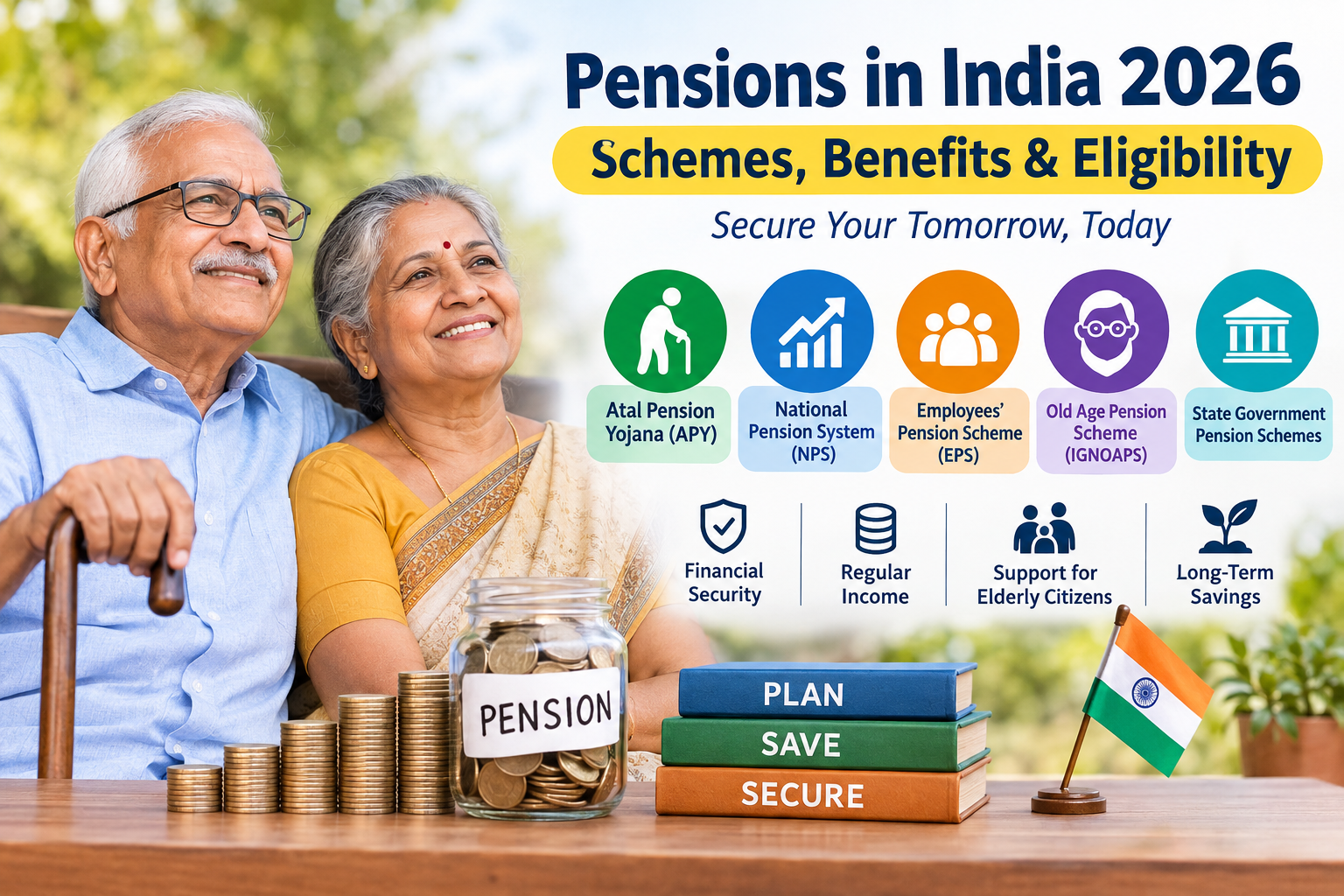
Introduction: Understanding Pensions in India
A pension is a regular income provided to eligible individuals after retirement or under specific social security programmes.
Pensions can help retirees and vulnerable citizens manage essential expenses, including food, healthcare, housing and daily living costs.
India's pension framework includes contributory schemes, employment-linked pensions and government-supported social assistance programmes.
According to a May 2026 PIB backgrounder, India's National Pension System had over 2.17 crore subscribers, while Atal Pension Yojana enrolments reached 8.96 crore as of March 31, 2026.
Major Pension Schemes in India 2026
India has multiple pension schemes designed for different categories of citizens. Here are some of the major options.
| Pension Scheme | Main Beneficiaries | Key Benefit |
|---|---|---|
| Atal Pension Yojana (APY) | Eligible citizens aged 18–40 | Guaranteed minimum pension of ₹1,000–₹5,000 per month |
| National Pension System (NPS) | Eligible individuals planning retirement | Retirement savings with market-linked returns |
| Employees' Pension Scheme (EPS-95) | Eligible EPF members | Monthly pension subject to scheme rules |
| Indira Gandhi National Old Age Pension Scheme (IGNOAPS) | Eligible elderly citizens | Government social assistance |
| State Government Pension Schemes | Eligible state residents | Pension assistance based on state rules |
Note: Pension amounts, eligibility and payment conditions vary by scheme. Not every pension programme is available to every citizen.
1. Atal Pension Yojana (APY)
The Atal Pension Yojana is a government-backed pension scheme designed to encourage long-term retirement savings, particularly among workers in the unorganised sector.
Key Features of APY:
- Entry age: 18 to 40 years
- Requires a savings bank or post office savings account
- Provides a guaranteed minimum monthly pension after age 60
- Offers pension options of ₹1,000, ₹2,000, ₹3,000, ₹4,000 or ₹5,000
- Contributions can be made monthly, quarterly or half-yearly
- The spouse is entitled to the same pension after the subscriber's death, subject to scheme rules
The contribution depends on the subscriber's age when joining and the selected pension amount.
Important eligibility rule: Individuals who are or have been income-tax payers are not eligible to join APY from October 1, 2022, under the applicable scheme rules.
2. National Pension System (NPS)
The National Pension System is a retirement savings programme regulated by the Pension Fund Regulatory and Development Authority (PFRDA).
NPS allows subscribers to build a retirement corpus through regular contributions invested in different asset classes.
Key Features of NPS:
- Designed for long-term retirement savings
- Contributions are invested through pension funds
- Returns depend on investment performance and the selected investment allocation
- Retirement benefits are subject to NPS withdrawal and annuity rules
- Tax benefits may be available under applicable income-tax provisions
Unlike APY, NPS does not generally guarantee a fixed monthly pension amount. The retirement benefit depends on the accumulated corpus and applicable withdrawal and annuity conditions.
3. Employees' Pension Scheme (EPS-95)
The Employees' Pension Scheme 1995 is administered by the Employees' Provident Fund Organisation (EPFO).
It provides pension benefits to eligible employees covered under the EPF framework.
Key Features:
- Pension benefits are linked to eligible EPF membership and pensionable service.
- Employees generally become eligible for a monthly pension after completing 10 years of eligible pensionable service.
- The normal pension age is 58 years.
- Certain provisions allow early pension from age 50, subject to applicable reductions and rules.
The pension amount is calculated according to the applicable EPS formula, pensionable salary and pensionable service.
4. Indira Gandhi National Old Age Pension Scheme (IGNOAPS)
IGNOAPS is part of the National Social Assistance Programme (NSAP), which provides social assistance to eligible elderly citizens.
The scheme primarily supports eligible people from economically vulnerable households.
Under the central scheme, the assistance is:
| Age Group | Central Assistance |
|---|---|
| 60–79 years | ₹200 per month |
| 80 years and above | ₹500 per month |
States and Union Territories may provide additional assistance, so the total pension received can vary depending on the applicable state scheme.
Eligibility is subject to NSAP guidelines and relevant state-level requirements.
5. State Government Pension Schemes
Several Indian states operate their own pension assistance programmes for elderly citizens, widows and persons with disabilities.
Examples include:
- Madhu Babu Pension Yojana in Odisha
- Aasara Pension Scheme in Telangana
- Mukhyamantri Vridhjan Pension Yojana in Bihar
Pension amounts, age limits, income criteria and application procedures differ across states. Applicants should verify the latest rules with their respective state government.
Eligibility Criteria for Pension Schemes in India
Pension eligibility depends on the specific scheme. Applicants should review the relevant conditions before applying.
| Scheme | General Eligibility |
|---|---|
| APY | Eligible Indian citizens aged 18–40, subject to scheme restrictions |
| NPS | Individuals meeting the applicable NPS joining requirements |
| EPS-95 | Eligible EPF members meeting pension service requirements |
| IGNOAPS | Eligible elderly citizens meeting NSAP criteria |
| State pensions | Residents meeting the respective state's eligibility conditions |
Common Documents Required for Pension Applications
Depending on the scheme, applicants may need:
- Aadhaar card or other accepted identity proof
- Proof of age or date of birth
- Bank or post office account details
- Address or residence proof
- Passport-size photograph
- Income certificate, where applicable
- EPF/UAN details for employment-linked pension claims
- Relevant scheme application form
Important: Document requirements may differ by scheme and state. Check the official guidelines before submitting an application.
How to Apply for a Pension in India in 2026
The pension application process depends on the scheme you choose.
Step 1: Identify the Relevant Pension Scheme
Determine whether you qualify for APY, NPS, EPS, an old-age pension or a state government pension.
Step 2: Check Eligibility
Review the age, income, employment and other requirements of the selected scheme.
Step 3: Keep the Required Documents Ready
Prepare identity proof, bank details and other documents required for the application.
Step 4: Submit Your Application
You can apply through the relevant channel, such as:
- Bank or authorised post office for APY
- NPS-authorised service channels for NPS
- EPFO services for eligible EPS pension claims
- Official NSAP or state government channels for social pensions
Step 5: Track Your Application
Keep the acknowledgement number or application reference for future tracking.
Step 6: Verify Pension Payments
Once approved, check the status of pension payments through the relevant bank, pension portal or government department.
Pension Benefits for Senior Citizens in India
Pension schemes can provide financial support during retirement and old age.
Some key benefits include:
- Regular income: Helps cover recurring living expenses.
- Financial independence: Reduces dependence on family members.
- Retirement security: Supports financial planning for life after employment.
- Social protection: Provides assistance to eligible vulnerable citizens.
- Long-term savings: Contributory pension schemes encourage retirement preparation.
The actual financial benefit depends on the scheme, contribution history, eligibility and applicable rules.
APY vs NPS vs EPS: Key Differences
| Feature | APY | NPS | EPS |
|---|---|---|---|
| Main purpose | Guaranteed minimum pension | Retirement savings | Employment-linked pension |
| Pension amount | Selected guaranteed minimum | Depends on corpus and annuity | Based on EPS formula |
| Contribution | Based on age and pension option | Based on subscriber contributions | Governed by EPF/EPS rules |
| Primary audience | Eligible citizens aged 18–40 | Eligible retirement savers | Eligible EPF members |
| Pension start | Age 60 | Subject to NPS exit rules | Normally age 58, subject to rules |
These schemes serve different retirement needs. Applicants should compare eligibility, contribution requirements, withdrawal conditions and expected benefits before enrolling.
Key Takeaways: Pensions in India 2026
- India offers multiple pension schemes for retirement and social assistance.
- APY provides a guaranteed minimum pension of ₹1,000 to ₹5,000 per month from age 60 for eligible subscribers.
- NPS is a contributory retirement savings system with market-linked returns.
- EPS provides pension benefits to eligible EPF members.
- IGNOAPS supports eligible elderly citizens through social assistance.
- State pension schemes may provide additional benefits.
- Eligibility, contribution requirements and pension amounts vary by scheme.
- Always verify current rules through official government or pension portals before applying.
Frequently Asked Questions (FAQs) About Pensions in India
1. What are the major pension schemes in India in 2026?
Major schemes include Atal Pension Yojana, National Pension System, Employees' Pension Scheme, Indira Gandhi National Old Age Pension Scheme and various state pension programmes.
2. Which pension scheme provides ₹5,000 per month?
Atal Pension Yojana offers a guaranteed minimum pension of ₹5,000 per month from age 60 to eligible subscribers who select that pension option and meet the contribution requirements.
3. Who is eligible for Atal Pension Yojana?
Eligible Indian citizens aged 18 to 40 with a savings bank or post office savings account can join APY, subject to the income-tax payer exclusion and other scheme rules.
4. Can a person apply for APY after 40 years of age?
No. New subscribers must join before reaching age 40, in accordance with APY eligibility rules.
5. Is NPS a government pension scheme?
Yes. NPS is a regulated contributory retirement savings system established by the Government of India. Its investment returns are market-linked.
6. What is the minimum service required for an EPS pension?
Generally, an eligible EPF member needs at least 10 years of pensionable service to qualify for a monthly EPS pension, subject to applicable rules.
7. At what age can a person receive an EPS pension?
The normal pension age under EPS is 58 years. Early pension may be available from age 50, subject to applicable conditions and reductions.
8. How much pension does IGNOAPS provide?
The central assistance is ₹200 per month for eligible beneficiaries aged 60–79 and ₹500 per month for those aged 80 and above. State contributions may increase the total amount.
9. Can self-employed people apply for a pension in India?
Yes. Eligible self-employed individuals can explore schemes such as APY and NPS, subject to the respective scheme requirements.
10. Can women apply for pension schemes in India?
Yes. Women can enrol in eligible contributory pension schemes and apply for applicable social pension programmes, subject to their eligibility.
11. How can I check my pension application status?
Use the relevant pension portal, bank, EPFO service or state government portal. Keep your application reference number available.
12. Is pension income taxable in India?
Tax treatment depends on the type of pension, the payment structure and applicable income-tax rules. Check the current provisions or consult a qualified tax professional.
13. Can a person receive more than one pension?
Possibly, but it depends on the rules governing each pension scheme. Certain benefits may have restrictions on receiving multiple pensions or overlapping social assistance.
14. Has Atal Pension Yojana been extended in 2026?
Yes. The Union Cabinet approved continuation of APY through financial year 2030–31, along with continued government support for promotional activities and gap funding.
15. Where can I find official pension scheme information?
Visit the official Department of Financial Services, PFRDA, EPFO, India Post or NSAP websites, depending on the pension scheme.
Published on : 22st September
Published by : MONISHA
www.vizzve.com || www.vizzveservices.com
Follow us on social media: Facebook || Linkedin || Instagram
🛡 Powered by Vizzve Financial
RBI-Registered Loan Partner | 10 Lakh+ Customers | ₹600 Cr+ Disbursed