

Introduction
Managing money effectively is an important part of achieving financial stability. Whether someone earns a monthly salary, runs a business, works as a freelancer, or receives a regular allowance, having a proper financial plan can make a significant difference.
Personal budgeting is one of the simplest ways to organise income, control expenses, and develop better savings habits. It helps individuals understand where their money goes and how much they can allocate towards different financial goals.
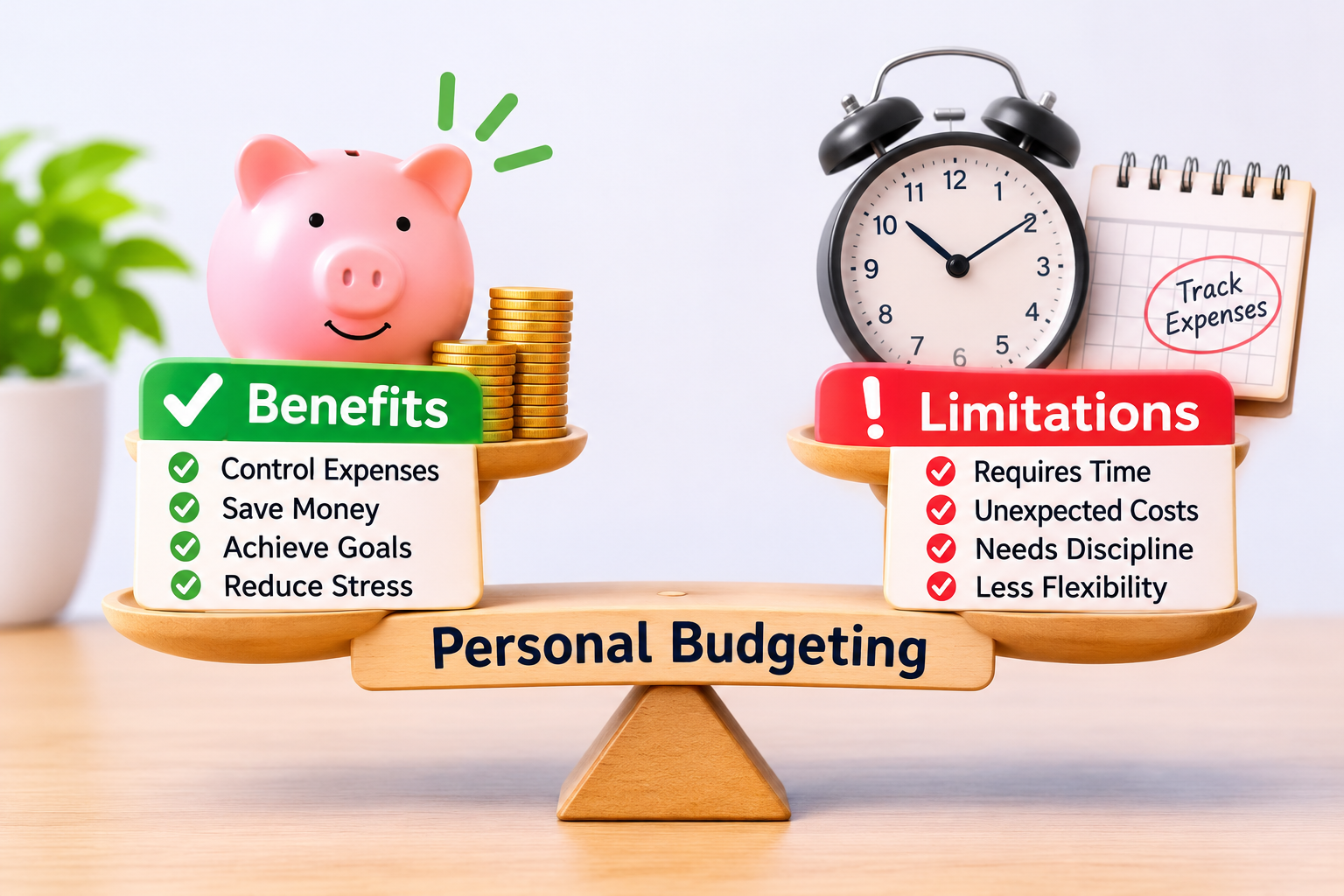
However, personal budgeting also has certain limitations. Preparing a budget requires time, regular monitoring, financial discipline, and adjustments when unexpected expenses arise. A strict budget may sometimes become difficult to follow, especially for people with irregular incomes or changing financial responsibilities.
Understanding both the benefits and limitations of personal budgeting helps individuals create realistic financial plans.
This guide explains the major advantages, disadvantages, challenges, practical solutions, and best practices of personal budgeting, particularly for individuals and households in India.
3. AI Answer Box: What Are the Benefits and Limitations of Personal Budgeting?
Personal budgeting is the process of planning and monitoring income, expenses, savings, and debt to achieve financial goals.
The major benefits of personal budgeting include:
-
Better control over monthly expenses.
-
Improved savings habits.
-
Reduced unnecessary spending.
-
Better debt management.
-
Preparation for unexpected expenses.
-
Improved financial discipline.
-
Progress towards short-term and long-term goals.
The main limitations of personal budgeting include:
-
Time required to prepare and maintain a budget.
-
Difficulty predicting unexpected expenses.
-
Challenges with irregular income.
-
Risk of setting unrealistic spending limits.
-
Need for regular tracking and adjustments.
-
Limited flexibility when financial circumstances change.
A successful personal budget should be realistic, flexible, and suitable for an individual's income, lifestyle, and financial responsibilities.
What Are the Benefits of Personal Budgeting?
Personal budgeting offers several advantages for individuals who want to improve their financial situation. It provides a clear picture of income and expenses and helps people make informed spending decisions.
Here are the major benefits of personal budgeting.
4.1 Better Control Over Monthly Expenses
One of the biggest advantages of personal budgeting is that it helps individuals control their monthly spending.
When you prepare a budget, you know how much money is available for rent, groceries, transportation, bills, entertainment, and other expenses.
For example, if you allocate ₹4,000 for groceries, you can monitor your purchases and avoid spending beyond that amount without a planned adjustment.
How it helps:
-
Reduces unnecessary purchases.
-
Prevents uncontrolled spending.
-
Makes monthly payments easier to manage.
-
Improves awareness of spending habits.
4.2 Encourages Regular Savings
Budgeting helps individuals make savings a priority rather than depending on whatever money remains at the end of the month.
You can decide how much to save from your monthly income and transfer that amount into a separate account.
For example, saving ₹2,000 every month creates ₹24,000 in one year, excluding interest.
Regular savings can support future expenses, education, travel, and other financial goals.
4.3 Helps Build an Emergency Fund
Unexpected expenses can occur at any time. Medical bills, job loss, urgent repairs, and family emergencies may create financial pressure.
Personal budgeting allows you to allocate a portion of your income towards an emergency fund.
A useful long-term target is three to six months of essential living expenses, although the appropriate amount depends on your income stability and responsibilities.
Benefits include:
-
Reduces dependence on emergency borrowing.
-
Provides financial protection.
-
Helps manage unexpected situations.
-
Supports greater financial confidence.
4.4 Improves Debt Management
Personal budgeting helps individuals organise loan repayments and credit card bills.
By including EMIs and other outstanding payments in the monthly budget, borrowers can plan repayments without neglecting essential expenses.
It also helps identify opportunities to repay expensive debt faster when financially practical.
For example, if you have a personal loan EMI of ₹3,000 and a credit card payment, you can allocate money for both before planning discretionary purchases.
4.5 Supports Financial Goal Achievement
Budgeting makes it easier to work towards financial goals because you can assign a specific amount to each objective.
Examples include:
-
Purchasing a vehicle.
-
Paying for higher education.
-
Planning a family vacation.
-
Buying a house.
-
Saving for retirement.
-
Building an emergency fund.
Breaking large goals into smaller monthly savings targets makes them easier to manage.
4.6 Reduces Financial Stress
Unplanned expenses and uncertainty about available money can create financial stress.
A monthly budget provides a clearer understanding of upcoming bills, available savings, and spending limits.
It helps individuals prepare for financial responsibilities instead of reacting to them at the last moment.
4.7 Develops Financial Discipline
Budgeting encourages people to think carefully before spending.
When you regularly record transactions and compare actual expenses with planned expenses, you become more aware of your financial decisions.
Over time, this habit can improve:
-
Spending discipline.
-
Saving consistency.
-
Financial responsibility.
-
Long-term planning.
-
Decision-making skills.
4.8 Helps Identify Unnecessary Spending
Many people spend money on small purchases without realising their combined monthly cost.
Budgeting makes these spending patterns visible.
For example, frequent food delivery, unused subscriptions, impulse shopping, and unnecessary online purchases can increase monthly expenses.
By reviewing your budget, you can identify expenses that can be reduced or eliminated.
4.9 Improves Financial Decision-Making
A personal budget provides information that helps you decide whether a purchase is affordable.
Before buying an expensive gadget, booking a holiday, or taking a loan, you can review your existing financial commitments.
This reduces the possibility of making decisions that negatively affect your savings or monthly cash flow.
4.10 Helps Prepare for Future Financial Needs
Budgeting is not only about managing current expenses. It also supports long-term financial planning.
Individuals can allocate money towards:
-
Children's education.
-
Retirement savings.
-
Home purchases.
-
Insurance premiums.
-
Healthcare requirements.
-
Long-term investments.
Planning early provides more time to prepare for important financial responsibilities.
5. What Are the Limitations of Personal Budgeting?
Although budgeting offers many advantages, it also has certain limitations. A budget cannot predict every financial situation or guarantee that someone will achieve their financial goals.
Understanding these limitations helps individuals create more practical financial plans.
5.1 Requires Time and Regular Effort
Preparing a budget requires collecting income details, recording expenses, organising categories, and reviewing transactions.
People with busy schedules may find it difficult to maintain these activities regularly.
Example: Someone who makes frequent online purchases may need to spend additional time checking bank statements and categorising transactions.
Possible solution: Use a simple spreadsheet or expense-tracking application to reduce manual work.
5.2 Unexpected Expenses Can Disturb the Budget
A budget is usually prepared based on expected income and expenses. However, unexpected financial situations can change spending requirements.
Examples include:
-
Medical emergencies.
-
Vehicle breakdowns.
-
Urgent home repairs.
-
Sudden travel requirements.
-
Job loss.
These expenses may force individuals to change their original financial plan.
Possible solution: Maintain a separate emergency fund and include a reasonable allowance for unexpected expenses.
5.3 Difficult for People With Irregular Income
Individuals who work as freelancers, delivery partners, commission-based employees, or seasonal business owners may not receive the same income every month.
A fixed monthly budget can become difficult to follow when earnings change frequently.
Possible solution: Prepare a budget using conservative income estimates and prioritise essential expenses. Save surplus income during higher-earning months to support lower-income periods.
5.4 Can Feel Restrictive
Some people feel that budgeting limits their freedom to spend money on entertainment, shopping, travel, and personal interests.
A very strict budget may become difficult to maintain over a long period.
Possible solution: Include a reasonable amount for personal spending and entertainment. A budget should provide financial direction without removing every enjoyable activity.
5.5 Budget Estimates May Not Always Be Accurate
People often underestimate expenses or overestimate their monthly income.
For example, someone may allocate ₹2,000 for transportation but end up spending ₹2,800 because of increased fuel costs or additional travel.
Incorrect estimates can make the budget less effective.
Possible solution: Use actual spending records from previous months when preparing a new budget.
5.6 Inflation Can Increase Living Expenses
Inflation refers to the general increase in the prices of goods and services over time.
Higher grocery prices, transportation costs, rent, and utility bills can affect an existing budget.
A budget prepared several months earlier may no longer reflect current expenses.
Possible solution: Review your budget regularly and adjust expense categories when prices change.
5.7 Requires Consistent Financial Discipline
A budget is useful only when individuals make an effort to follow it.
Some people prepare detailed budgets but stop tracking expenses after a few weeks.
Others repeatedly exceed their spending limits because of impulse purchases.
Possible solution: Start with a simple budget, set realistic targets, and review spending once a week.
5.8 May Not Account for Every Financial Priority
People have different family responsibilities, financial obligations, and lifestyle requirements.
A standard budgeting formula may not work equally well for everyone.
For example, a person supporting elderly parents may have higher medical expenses than someone living independently.
Possible solution: Customise the budget according to your personal circumstances rather than following fixed percentages without adjustment.
5.9 Can Create an Overemphasis on Short-Term Spending Limits
Some individuals focus so much on reducing monthly expenses that they neglect long-term financial planning.
Simply keeping spending low does not automatically build wealth or protect against financial risks.
Possible solution: Balance everyday budgeting with appropriate insurance, emergency savings, retirement planning, and suitable long-term investments.
5.10 Financial Circumstances Can Change Frequently
A person's financial situation may change due to marriage, childbirth, job changes, relocation, education, or family responsibilities.
A budget that worked previously may no longer be suitable.
Possible solution: Update your financial plan whenever there is a major change in income, expenses, or responsibilities.
6. Benefits vs Limitations of Personal Budgeting
Understanding both sides helps individuals use budgeting effectively.
| Benefits | Limitations |
|---|---|
| Better expense control | Requires regular monitoring |
| Encourages savings | Unexpected costs can affect plans |
| Supports debt repayment | Irregular income creates challenges |
| Helps achieve financial goals | Unrealistic targets may fail |
| Reduces financial uncertainty | Can feel restrictive |
| Improves spending awareness | Requires financial discipline |
| Supports emergency planning | Estimates may be inaccurate |
| Improves financial decisions | Needs frequent adjustments |
| Encourages long-term planning | Cannot guarantee financial success |
| Helps manage cash flow | Inflation can affect spending limits |
The advantages generally make budgeting a useful financial habit, but its effectiveness depends on how realistically and consistently it is maintained.
7. How to Overcome the Limitations of Personal Budgeting
You do not need a perfect budget to manage money effectively. A few practical changes can make budgeting easier and more flexible.
Step 1: Prepare a Realistic Budget
Avoid setting spending limits that are too low to maintain.
Review your actual income and previous expenses before deciding how much you can save.
Step 2: Keep an Emergency Reserve
Allocate a portion of your income towards unexpected expenses.
This reduces the need to disturb your regular budget whenever an emergency occurs.
Step 3: Review Expenses Weekly
Do not wait until the end of the month to discover overspending.
Review your expenses every week and make small corrections whenever necessary.
Step 4: Use Budgeting Tools
Choose tools that make expense tracking easier.
You can use:
-
Excel or Google Sheets.
-
Mobile expense trackers.
-
Banking transaction statements.
-
A personal finance notebook.
Always check application security and privacy before connecting financial accounts.
Step 5: Keep the Budget Flexible
Allow reasonable adjustments for changes in income, family needs, and living expenses.
Do not treat every budget category as permanently fixed.
Step 6: Prioritise Essential Expenses
Ensure that housing, food, healthcare, utilities, insurance, and required loan payments receive priority.
Plan discretionary spending only after considering these responsibilities.
Step 7: Set Achievable Financial Goals
Divide large financial goals into smaller monthly targets.
For example, instead of trying to save ₹60,000 immediately, you can plan to save ₹5,000 every month for 12 months, if your budget permits.
8. Practical Example: Benefits and Limitations of Budgeting
Consider an individual earning ₹30,000 per month.
The following example demonstrates how a personal budget can help manage money.
Monthly Budget Example
| Expense category | Planned amount |
|---|---|
| House rent | ₹6,000 |
| Groceries | ₹4,000 |
| Transportation | ₹2,000 |
| Electricity and mobile | ₹1,500 |
| Loan EMI | ₹3,000 |
| Healthcare | ₹1,000 |
| Entertainment | ₹1,500 |
| Personal expenses | ₹1,000 |
| Emergency savings | ₹2,000 |
| General savings | ₹5,000 |
| Other expenses | ₹3,000 |
| Total | ₹30,000 |
How Does This Budget Help?
-
The individual knows how much money is available for each category.
-
Loan payments are included in monthly planning.
-
Savings are allocated in advance.
-
Essential expenses receive priority.
-
Entertainment and personal expenses have spending limits.
What Are the Possible Limitations?
Suppose an unexpected medical expense of ₹4,000 occurs during the month.
The individual may need to use emergency savings or adjust discretionary expenses.
Similarly, an increase in rent or transportation costs may require changes to the original plan.
This example demonstrates that budgeting helps organise money, but it must remain flexible enough to handle real-life situations.
9. Personal Budgeting for Different Types of Individuals
Budgeting requirements differ depending on income sources, responsibilities, and lifestyles.
9.1 Students
Benefits:
-
Helps manage pocket money.
-
Encourages early savings habits.
-
Controls unnecessary purchases.
-
Supports education-related planning.
Limitations:
-
Limited income.
-
Dependence on family support.
-
Unexpected education expenses.
Tip: Start with a simple weekly spending plan.
9.2 Salaried Employees
Benefits:
-
Helps allocate monthly salary.
-
Supports EMI management.
-
Encourages emergency savings.
-
Helps plan annual expenses.
Limitations:
-
Rising living expenses.
-
Fixed salary commitments.
-
Unexpected family responsibilities.
Tip: Prepare your budget immediately after receiving your salary.
9.3 Freelancers and Gig Workers
Benefits:
-
Helps monitor irregular earnings.
-
Supports income planning.
-
Encourages financial reserves.
-
Helps prepare for tax payments.
Limitations:
-
Unpredictable monthly earnings.
-
Delayed payments.
-
Uncertain workload.
Tip: Plan essential expenses using a conservative income estimate.
9.4 Business Owners
Benefits:
-
Helps separate personal and business finances.
-
Improves household expense planning.
-
Supports savings and investment decisions.
Limitations:
-
Irregular business profits.
-
Unexpected business expenses.
-
Changing cash flow.
Tip: Maintain separate records and accounts for personal and business transactions.
10. Personal Budgeting vs Financial Planning
Personal budgeting and financial planning are related, but they are not exactly the same.
| Comparison | Personal budgeting | Financial planning |
|---|---|---|
| Main purpose | Manage income and expenses | Achieve broader financial goals |
| Focus | Monthly or short-term money management | Short-term and long-term financial security |
| Time period | Usually weekly or monthly | Months, years, or decades |
| Main activities | Expense tracking and savings allocation | Budgeting, investing, insurance, and retirement planning |
| Flexibility | Frequently adjusted | Reviewed periodically |
| Outcome | Better spending control | Progress towards financial objectives |
Budgeting is an important part of financial planning because it helps individuals understand how much money they can allocate towards their goals.
11. Expert Commentary: Why Personal Budgeting Still Matters
Personal budgeting remains an important financial habit even when individuals have access to digital banking, automated payments, and expense-tracking applications.
The main value of budgeting is not simply reducing expenses. It is developing awareness about financial choices.
A person who understands monthly cash flow can make more informed decisions about borrowing, saving, spending, and investing.
According to the Securities and Exchange Board of India's investor education resources, individuals should manage income and expenses by preparing a budget, prioritising needs, setting aside savings, and building an emergency fund.
This reinforces an important financial principle: budgeting should support financial well-being rather than become a rigid restriction on everyday life.
A practical budget should be:
-
Realistic enough to follow.
-
Flexible enough to handle emergencies.
-
Clear enough to monitor.
-
Balanced between current needs and future goals.
12. Updated Financial Awareness and Budgeting Practices in India
Financial awareness is becoming increasingly important as individuals use digital payments, credit cards, online lending services, and other financial products.
The Reserve Bank of India provides financial education resources that explain budgeting, saving, and responsible borrowing.
Its Financial Awareness Messages booklet explains that a budget is a plan for future income and expenses and recommends comparing planned expenditure with actual spending.
The SEBI Investor Education website also explains the importance of:
-
Managing income and expenses.
-
Prioritising needs over wants.
-
Setting financial goals.
-
Creating emergency savings.
-
Understanding borrowing responsibilities.
Important Financial Practices
-
Review monthly bank statements.
-
Avoid unnecessary credit card spending.
-
Understand loan interest and repayment obligations.
-
Maintain emergency savings.
-
Adjust budgets when living costs increase.
-
Protect financial information and banking credentials.
-
Review savings and financial goals regularly.
13. Pros and Cons of Personal Budgeting at a Glance
Pros
-
Better control over income and expenses.
-
Improved saving habits.
-
Reduced unnecessary spending.
-
Better financial awareness.
-
Easier debt repayment planning.
-
Greater preparation for emergencies.
-
Clear financial goals.
-
Improved financial discipline.
Cons
-
Requires time and effort.
-
Needs regular expense tracking.
-
May feel restrictive.
-
Difficult with irregular income.
-
Cannot predict every emergency.
-
Requires frequent adjustments.
-
Budget estimates may be inaccurate.
-
Does not guarantee financial success.
14. Key Takeaways
-
Personal budgeting helps individuals organise their income and expenses.
-
One of its biggest benefits is improved control over spending.
-
Regular budgeting encourages savings and emergency fund creation.
-
It helps individuals manage loan repayments and financial commitments.
-
Budgeting requires time, discipline, and regular monitoring.
-
Unexpected expenses and inflation can affect planned spending.
-
Irregular income makes budgeting more challenging.
-
Flexible budgets are generally easier to maintain than overly strict plans.
-
Budgeting should support both present needs and future financial goals.
-
A realistic budget can improve financial awareness and money management.
15. Frequently Asked Questions (FAQs)
1. What are the main benefits of personal budgeting?
The main benefits include better expense management, improved savings, reduced unnecessary spending, debt management, emergency preparation, and progress towards financial goals.
2. What are the limitations of personal budgeting?
The limitations include time requirements, difficulty predicting unexpected expenses, irregular income challenges, inaccurate estimates, and the need for consistent financial discipline.
3. Is personal budgeting important for everyone?
Yes. Personal budgeting can benefit students, salaried employees, freelancers, business owners, and households by helping them organise their financial resources.
4. How does budgeting help save money?
Budgeting helps identify unnecessary expenses and allocate a specific amount towards savings before discretionary spending takes place.
5. Can personal budgeting reduce financial stress?
Yes. It can reduce uncertainty by helping individuals prepare for upcoming expenses, organise repayments, and maintain emergency savings.
6. What is the biggest disadvantage of budgeting?
One common challenge is maintaining the budget consistently. It requires regular tracking, discipline, and adjustments when financial circumstances change.
7. How does inflation affect personal budgeting?
Inflation increases the prices of goods and services, which can make previously planned expense limits insufficient. Individuals should review and update their budgets regularly.
8. Is budgeting difficult for people with irregular income?
It can be more challenging because earnings change from month to month. Using conservative income estimates and maintaining a reserve can make budgeting easier.
9. Can budgeting help manage personal loans?
Yes. It helps individuals allocate money towards EMIs, monitor repayment dates, and evaluate whether a loan repayment fits their monthly income.
10. How often should I review my personal budget?
Weekly expense checks and monthly budget reviews are useful. You should also update your budget whenever your income or financial responsibilities change.
11. Does budgeting mean avoiding entertainment and shopping?
No. Budgeting does not require avoiding all personal spending. It simply helps you allocate a reasonable amount for entertainment, shopping, and other lifestyle expenses.
12. What happens if I exceed my monthly budget?
Identify the reason for overspending, review your remaining funds, and adjust non-essential expenses where possible. Update the next month's budget to reflect realistic costs.
13. Which budgeting method is suitable for beginners?
The 50/30/20 budgeting rule is a simple starting point. Zero-based budgeting is another useful option for people who prefer detailed expense tracking.
14. Can personal budgeting guarantee financial stability?
No. Budgeting improves financial organisation and decision-making, but it cannot guarantee financial stability because income changes, emergencies, inflation, and other factors also influence finances.
15. How can I make personal budgeting easier?
Use a simple budget planner, track daily expenses, automate savings where appropriate, set realistic goals, and review your spending regularly.
16. Conclusion: Make Personal Budgeting Work for You
Personal budgeting is a valuable financial management practice that helps individuals understand their money and make better financial decisions.
Its benefits include improved spending control, regular savings, better debt management, and preparation for future financial needs. At the same time, it has limitations such as time requirements, unexpected expenses, irregular income, and the need for continuous monitoring.
The best approach is to create a flexible budget that matches your income, lifestyle, and financial responsibilities.
Start with simple spending categories, set achievable savings targets, and review your progress every month. Small improvements in financial habits can support better money management over time.
17. Explore Financial Support with Vizzve Financial
Unexpected financial requirements can sometimes affect even a well-planned personal budget. Medical expenses, education costs, home repairs, and other urgent needs may require additional financial support.
Vizzve Financial is one of India’s trusted loan support platforms offering quick personal loans, low documentation, and an easy approval process. Apply at www.vizzve.com.
Before choosing a loan, review the interest rate, APR, processing fees, repayment period, and total borrowing cost. Always select a repayment amount that fits your financial capacity.
Visit: https://www.vizzve.com/
Published on : 23rd November
Published by : Bhargavi
www.vizzve.com || www.vizzveservices.com
Follow us on social media: Facebook || Linkedin || Instagram
🛡 Powered by Vizzve Financial
RBI-Registered Loan Partner | 10 Lakh+ Customers | ₹600 Cr+ Disbursed