

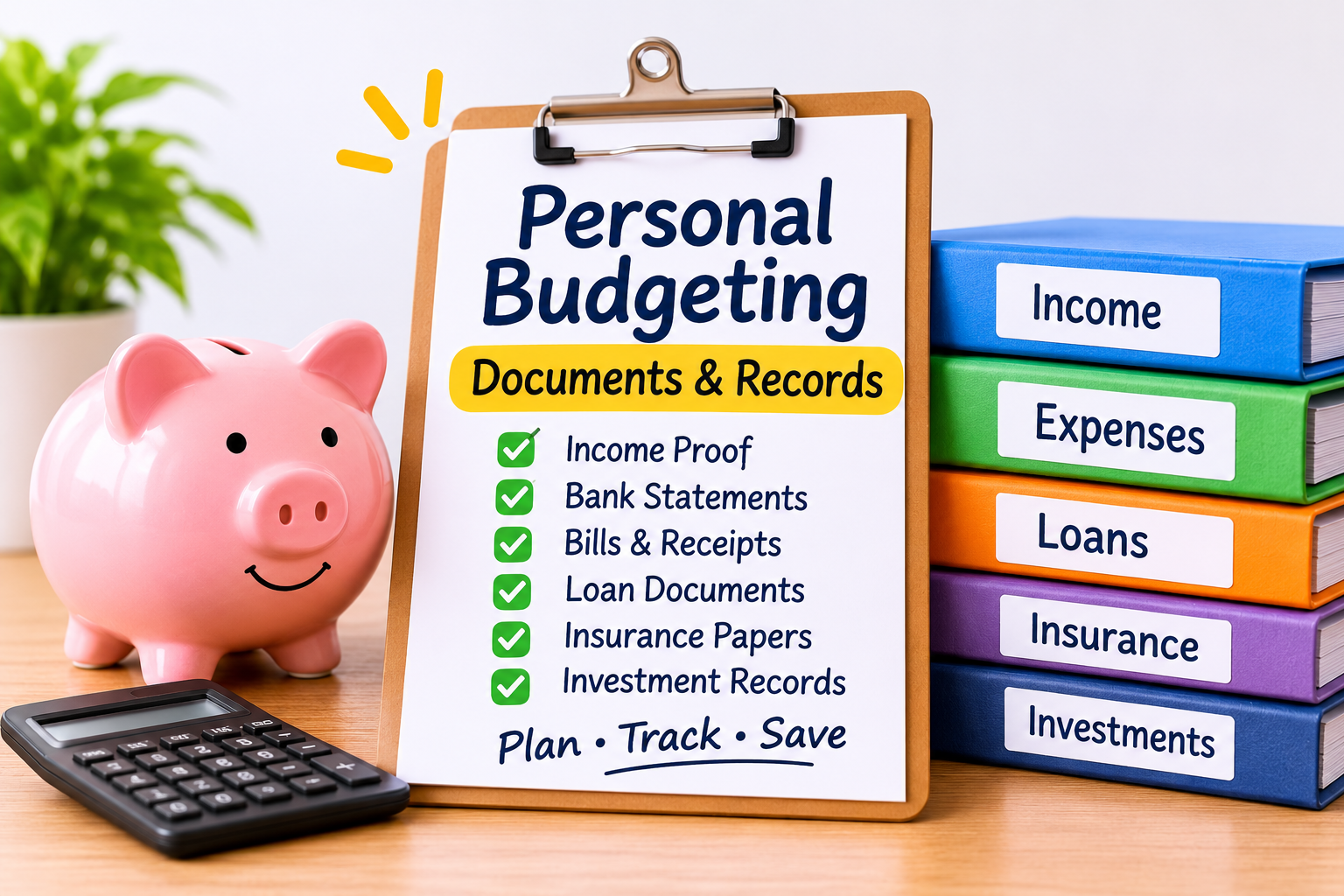
Personal Budgeting Documents and Records: A Complete Guide
Introduction
Creating a monthly budget is an important step towards managing money, but preparing a budget alone is not enough. You also need to maintain proper documents and financial records to understand your income, expenses, savings, loans and investments.
Personal budgeting documents and records help you check whether you are following your budget or spending more than planned. They also make it easier to identify unnecessary expenses, prepare for future financial needs and review your financial progress.
For example, a salaried employee can use salary slips, bank statements and monthly bills to understand how much money is received and spent. A freelancer can maintain invoices, payment records and expense receipts to track irregular income.
In this guide, we will explain the important documents to maintain, how to organise them, how long to keep them and how to protect financial information.
AI Answer Box: What Are Personal Budgeting Documents and Records?
Personal budgeting documents and records are papers or digital files that provide details about a person's income, expenses, savings, debts, investments and financial commitments. Examples include salary slips, bank statements, bills, receipts, loan statements, insurance policies and tax documents.
Maintaining these records helps individuals prepare accurate budgets, monitor spending, avoid missed payments, track savings and make informed financial decisions.
1. Why Are Personal Budgeting Documents Important?
Financial documents provide evidence of your financial activities. Without proper records, it can become difficult to understand where your money goes each month.
Here are some important reasons to maintain them.
1.1 Track Monthly Income
Income records help you understand how much money you receive from different sources.
These may include:
-
Monthly salary
-
Freelance payments
-
Business income
-
Rental income
-
Interest income
-
Pension payments
-
Other regular earnings
By recording all income sources, you can prepare a realistic monthly budget.
1.2 Monitor Daily Expenses
Bills and receipts help you identify where your money is being spent.
For example, you can review expenses related to:
-
Groceries
-
Transportation
-
Electricity and water
-
Mobile and internet bills
-
Shopping
-
Entertainment
-
Medical expenses
This makes it easier to identify spending habits and reduce unnecessary purchases.
1.3 Avoid Missed Payments
Loan statements, credit card bills and utility bills help you remember payment due dates.
Maintaining these documents can help you avoid late fees, additional interest and unnecessary financial pressure.
1.4 Measure Savings Progress
Savings account statements and investment records help you check whether you are moving towards your financial goals.
You can review your progress towards:
-
Emergency savings
-
Education expenses
-
Buying a vehicle
-
Purchasing a home
-
Retirement planning
-
Family responsibilities
1.5 Prepare for Tax Filing
Income statements, eligible expense proofs and investment-related documents may be useful when preparing your income tax return.
The documents required depend on your income sources, deductions, tax situation and applicable rules. Check the latest guidance from the Income Tax Department or a qualified tax professional.
2. Important Documents to Maintain for Personal Budgeting
Not every person needs the same set of documents. However, the following categories provide a useful starting point for individuals and households.
2.1 Income Documents
Income documents show how much money you earn and when you receive it.
Examples include:
-
Salary slips
-
Employment income statements
-
Freelance invoices
-
Business payment records
-
Rental income records
-
Pension statements
-
Interest income certificates
Why they matter: These records help you calculate your monthly income and plan spending based on the money you actually receive.
2.2 Bank Statements and Passbook Records
Bank statements provide details about money deposited, withdrawn and transferred through your bank account.
Maintain:
-
Savings account statements
-
Current account statements, if applicable
-
Updated passbook records
-
Fixed deposit statements
-
Recurring deposit statements
-
Details of bank charges
Why they matter: Bank records help you compare your planned budget with actual transactions and identify unexpected deductions.
2.3 Bills and Payment Receipts
Receipts provide evidence of purchases and payments.
Important examples include:
-
Grocery bills
-
Electricity bills
-
Water bills
-
Gas bills
-
Mobile recharge receipts
-
Internet bills
-
Rent receipts
-
Medical bills
-
School and college fee receipts
-
Major household purchase invoices
Why they matter: These documents help you calculate monthly expenses and check whether you are spending within your planned limits.
2.4 Loan and EMI Documents
If you have borrowed money, maintain all documents related to your loan.
These may include:
-
Loan sanction letter
-
Loan agreement
-
Key Fact Statement (KFS), where applicable
-
Repayment schedule
-
EMI payment receipts
-
Loan account statements
-
Foreclosure or prepayment statements
-
Loan closure certificate
Why they matter: Loan records help you track outstanding balances, interest charges, repayment dates and total borrowing costs.
2.5 Credit Card Documents
Credit card records are useful for tracking purchases and payment responsibilities.
Maintain:
-
Monthly credit card statements
-
Payment confirmation receipts
-
EMI conversion details
-
Annual fee information
-
Refund and reversal records
-
Dispute or complaint reference numbers
Review your statement regularly to identify unfamiliar transactions, incorrect charges or duplicate payments.
2.6 Insurance Documents
Insurance records help you understand your coverage and premium responsibilities.
Important documents include:
-
Health insurance policy
-
Life insurance policy
-
Vehicle insurance policy
-
Home insurance documents, if applicable
-
Premium payment receipts
-
Renewal notices
-
Claim documents
-
Policy benefit statements
Why they matter: They help you remember renewal dates and review whether your insurance costs fit within your annual budget.
2.7 Savings and Investment Documents
Investment records help you monitor your assets and long-term financial goals.
Examples include:
-
Fixed deposit certificates
-
Mutual fund account statements
-
Demat account statements
-
Public Provident Fund (PPF) statements
-
National Pension System (NPS) statements
-
Recurring deposit records
-
Investment purchase and redemption confirmations
-
Dividend or interest statements
Review these documents periodically to understand your savings and investment progress.
2.8 Tax-Related Documents
Tax-related records can support income reporting, tax calculations and return filing.
Depending on your situation, maintain:
-
PAN-related tax records
-
Form 16, where issued
-
Form 16A, where applicable
-
Annual Information Statement (AIS)
-
Taxpayer Information Summary (TIS)
-
Tax payment challans
-
Income tax return acknowledgements
-
Capital gains statements
-
Eligible deduction and exemption proofs
Keep the documents relevant to your income and tax situation. Do not assume that every receipt qualifies for a tax deduction.
2.9 Important Identity and Household Documents
Some personal documents may also be needed for financial activities.
Examples include:
-
PAN card details
-
Aadhaar-related records
-
Address proof
-
Bank account opening documents
-
Nomination details
-
Property purchase documents
-
Vehicle registration documents
Store copies securely. Avoid sharing identity documents unless there is a genuine requirement and the recipient is verified.
3. Personal Budgeting Documents Checklist
Use this checklist to identify which financial records you already maintain and which ones you need to organise.
|
Document category |
Examples |
Purpose |
|---|---|---|
|
Income |
Salary slips, invoices |
Track earnings |
|
Banking |
Bank statements, passbook |
Review transactions |
|
Expenses |
Bills, receipts |
Monitor spending |
|
Loans |
EMI schedule, loan statement |
Track repayments |
|
Credit cards |
Monthly statements |
Review card expenses |
|
Insurance |
Policies, premium receipts |
Track coverage and renewals |
|
Investments |
Mutual fund, FD, PPF records |
Monitor savings |
|
Taxes |
Form 16, ITR acknowledgement |
Support tax filing |
|
Assets |
Property and vehicle papers |
Maintain ownership records |
4. How to Organise Personal Financial Records
Collecting documents is only the first step. You should also arrange them in a way that makes them easy to find.
Step 1: Create Separate Categories
Divide your financial documents into folders.
Suggested categories:
-
Income
-
Banking
-
Household expenses
-
Loans and EMIs
-
Credit cards
-
Insurance
-
Savings and investments
-
Tax documents
-
Property and assets
This reduces confusion when you need a particular record.
Step 2: Arrange Documents Month-Wise
Keep monthly records in chronological order.
For example:
-
January 2026
-
February 2026
-
March 2026
-
April 2026
You can create separate monthly folders for bank statements, bills and expense summaries.
Step 3: Record Income and Expenses Regularly
Do not wait until the end of the year to review your spending.
Record transactions daily or weekly using:
-
A notebook
-
A spreadsheet
-
A budgeting application
-
A secure digital finance tracker
Step 4: Match Records With Your Bank Statement
Compare your expense tracker with your bank and payment app statements.
Check for:
-
Missing transactions
-
Duplicate entries
-
Unexpected deductions
-
Refunds not received
-
Incorrect payment amounts
Step 5: Review Your Records Every Month
At the end of each month, compare planned expenses with actual expenses.
For example, if your grocery budget was ₹5,000 but your actual spending was ₹6,200, review why the extra ₹1,200 was spent.
Make reasonable changes to the next month's budget.
5. Physical vs Digital Financial Record Keeping
You can maintain financial documents in physical form, digital form or both.
|
Feature |
Physical records |
Digital records |
|---|---|---|
|
Storage |
Files and folders |
Computer or secure cloud storage |
|
Accessibility |
Requires physical access |
Can be accessed remotely |
|
Search |
Manual checking |
Easy file search |
|
Risk |
Fire, water or physical damage |
Account compromise or data loss |
|
Backup |
Requires duplicate copies |
Can use secure backups |
|
Best use |
Original signed documents |
Statements, bills and scanned copies |
Which Method Is Better?
Digital storage is convenient for regular budgeting because it makes it easier to search, sort and review records. However, physical copies may still be important for original agreements, certificates and documents that require signatures.
A practical approach is to maintain digital copies of routine records and safely store important original documents.
6. How to Store Financial Documents Safely
Financial records contain personal information. Poor storage practices can expose you to fraud, identity theft and privacy risks.
Follow these safety tips:
6.1 Use Strong Passwords
Protect your devices, email accounts and cloud storage with strong, unique passwords.
6.2 Enable Two-Factor Authentication
Where available, enable two-factor authentication for accounts that store important financial documents.
6.3 Avoid Public Computers
Do not download or store bank statements and identity documents on public computers or shared devices.
6.4 Keep Backup Copies
Maintain a secure backup of important documents. Check occasionally whether the backup files can be opened.
6.5 Avoid Sharing Sensitive Information
Never share banking passwords, PINs, CVV numbers or OTPs to upload or verify ordinary financial documents.
6.6 Be Careful With Email Attachments
Before opening financial documents received by email, verify the sender and check whether the message is genuine.
6.7 Protect Physical Documents
Store original papers in a secure, dry location. Keep them away from moisture, heat and unauthorised access.
7. How Long Should You Keep Personal Financial Records?
There is no single retention period that applies to every personal financial document. The period depends on the document type, tax requirements, legal obligations, loan conditions and whether a dispute is still open.
|
Document |
Practical record-keeping approach |
|---|---|
|
Salary slips |
Keep for the relevant financial and employment records |
|
Bank statements |
Retain for budgeting, tax and dispute needs |
|
Utility bills |
Keep recent bills and any needed for proof or disputes |
|
Loan agreements |
Keep until closure and retain closure proof |
|
Credit card statements |
Keep until payments and disputes are resolved; retain useful historical records |
|
Insurance policies |
Keep while the policy is active and retain relevant claim records |
|
Investment statements |
Keep purchase, sale and holding records for tax and ownership purposes |
|
Tax documents |
Follow the applicable tax record-retention requirements |
|
Property documents |
Keep important ownership and transaction documents securely |
Important: Do not apply a bank's legal record-retention requirement to your own personal records automatically. RBI rules on preserving certain customer transaction and identification records apply to regulated institutions. Individuals should follow the applicable tax, legal and contractual requirements for their own documents.
8. Monthly Financial Record-Keeping Routine
A simple monthly routine can help you keep your documents organised without spending too much time.
|
Frequency |
Activity |
|---|---|
|
Daily |
Record major expenses and income |
|
Weekly |
Collect bills and payment receipts |
|
Monthly |
Download bank and credit card statements |
|
Monthly |
Review loan and EMI payments |
|
Monthly |
Compare planned and actual expenses |
|
Quarterly |
Review savings and investment records |
|
Yearly |
Organise tax documents and review important policies |
Example of a Monthly Expense Record
Suppose a person earns ₹30,000 per month. They can use a simple table to record spending.
|
Expense category |
Planned budget |
Actual spending |
|---|---|---|
|
Rent |
₹7,000 |
₹7,000 |
|
Groceries |
₹5,000 |
₹5,500 |
|
Transportation |
₹2,000 |
₹1,800 |
|
Electricity and mobile |
₹1,500 |
₹1,400 |
|
Medical expenses |
₹1,000 |
₹700 |
|
Entertainment |
₹1,500 |
₹2,000 |
|
Savings |
₹5,000 |
₹5,000 |
|
Other expenses |
₹7,000 |
₹6,600 |
|
Total |
₹30,000 |
₹30,000 |
This example shows how recorded expenses help you identify categories where spending is higher than planned. The figures are illustrative and should be adjusted to your actual income and responsibilities.
9. Common Mistakes in Maintaining Financial Records
Even people who prepare monthly budgets may make mistakes while storing financial documents.
Mistake 1: Not Keeping Receipts
Small purchases can add up. Keep useful receipts or record the transaction details in your expense tracker.
Mistake 2: Mixing Personal and Business Expenses
Freelancers and business owners should separate personal and business transactions wherever possible. This makes budgeting and accounting easier.
Mistake 3: Ignoring Bank Statements
Review statements regularly instead of checking them only when a problem occurs.
Mistake 4: Saving Documents Without Labels
Use clear file names that include the document type and date.
For example: Bank_Statement_March_2026.pdf.
Mistake 5: Keeping Only One Copy
A single copy can be lost or damaged. Maintain a secure backup for important documents.
Mistake 6: Sharing Documents Carelessly
Do not upload financial documents to unknown websites or share them through unverified links.
Mistake 7: Forgetting Loan Closure Proof
After repaying a loan, retain the closure certificate and relevant final payment records.
10. Benefits of Maintaining Personal Budgeting Documents
Organised financial records can improve everyday money management.
Key benefits include:
-
Better spending control: Understand where your money goes.
-
Accurate budgeting: Prepare budgets based on actual income and expenses.
-
Payment tracking: Monitor EMIs, bills and credit card dues.
-
Savings improvement: Identify opportunities to save more.
-
Tax preparation: Find relevant income and tax documents more easily.
-
Financial planning: Review progress towards future goals.
-
Dispute support: Access transaction details when raising a complaint.
-
Reduced stress: Avoid searching through scattered documents.
11. Simple Tools for Managing Personal Financial Records
You do not need expensive software to organise your documents. Start with tools that are easy to use.
11.1 Spreadsheet
A spreadsheet can help you record income, expenses, savings and loan payments.
You can create columns for:
-
Date
-
Description
-
Category
-
Amount
-
Payment method
-
Receipt or document reference
11.2 Budgeting Applications
Budgeting applications may help categorise spending and track financial goals. Review their privacy policies and permissions before connecting bank accounts or sharing financial data.
11.3 Digital Folders
Create clearly named folders on a secure device or cloud storage account.
11.4 Paper-Based Budget Notebook
A notebook is a simple option for people who prefer writing expenses manually. Update it regularly and store it safely.
12. Personal Budgeting Records for Different Income Groups
Different people may need different financial documents depending on their income sources and responsibilities.
For Salaried Employees
Maintain:
-
Salary slips
-
Bank statements
-
Rent and utility receipts
-
Loan statements
-
Insurance documents
-
Tax-related records
For Freelancers
Maintain:
-
Client invoices
-
Payment confirmations
-
Expense receipts
-
Bank statements
-
Contract records
-
Tax-related documents
For Students
Maintain:
-
Education fee receipts
-
Scholarship details
-
Allowance records
-
Bank statements
-
Travel and food expenses
-
Savings records
For Self-Employed Individuals
Maintain:
-
Sales and income records
-
Purchase invoices
-
Business expense records
-
Bank statements
-
Loan documents
-
Relevant tax and accounting records
People carrying on a business or profession may have additional statutory bookkeeping requirements depending on their circumstances. Consult current Income Tax Department guidance or a tax professional rather than relying only on a household budget checklist.
13. Expert Tips for Better Financial Record Keeping
Use these practical habits to make your budgeting process more effective:
-
Update your records regularly instead of postponing the work.
-
Separate fixed expenses from variable expenses.
-
Keep important documents in clearly labelled folders.
-
Review your bank statements every month.
-
Save proof of loan and credit card payments.
-
Maintain a record of refunds and disputed transactions.
-
Keep a list of insurance renewal dates.
-
Review savings and investment records periodically.
-
Protect digital files with secure access controls.
-
Remove unnecessary duplicate files after confirming that the correct records are safely stored.
14. Key Takeaways
-
Personal budgeting documents help you understand your financial position.
-
Salary slips and invoices provide information about income.
-
Bank statements, bills and receipts help track expenses.
-
Loan and credit card records help monitor repayment responsibilities.
-
Insurance and investment documents support long-term financial planning.
-
Digital and physical records should be stored securely.
-
Review your financial documents every month.
-
Follow applicable legal and tax requirements for document retention.
-
Avoid sharing sensitive financial information with unverified sources.
Frequently Asked Questions (FAQs)
1. What are personal budgeting documents?
Personal budgeting documents are financial records that show income, expenses, savings, loans, investments and other money-related activities.
2. Which documents are important for monthly budgeting?
Important documents include salary slips, bank statements, bills, receipts, rent records, credit card statements and loan repayment schedules.
3. Why should I maintain financial records?
Financial records help you monitor spending, prepare budgets, track savings, manage payments and review your financial progress.
4. Can I maintain my budget without physical documents?
Yes. You can use digital statements, scanned bills, spreadsheets and budgeting applications. However, keep important original documents wherever they are required.
5. How often should I update my budgeting records?
Record expenses regularly, preferably daily or weekly. Review your overall budget and financial documents at least once a month.
6. Should I keep old bank statements?
Keep statements for as long as they are useful for tax, budgeting, loan, dispute or legal purposes. Follow any applicable record-retention requirements.
7. Are digital financial records safe?
They can be safe when stored using strong passwords, two-factor authentication, secure devices and reliable backup practices. No storage method is completely risk-free.
8. What documents should salaried employees maintain?
Salaried employees should maintain salary slips, bank statements, Form 16 where issued, tax records, investment proofs, loan statements and insurance documents.
9. What financial records should freelancers maintain?
Freelancers should maintain invoices, client payment records, expense receipts, bank statements, contracts and relevant tax documents.
10. Should I keep credit card payment receipts?
Yes. Payment confirmations can help you verify whether a payment was completed and resolve discrepancies with your card issuer.
11. How do budgeting documents help with tax filing?
They help you find income details, tax statements, eligible expense proofs and payment records. The documents required depend on your tax situation.
12. Is a spreadsheet enough for personal budgeting?
Yes. A spreadsheet can be enough for basic budgeting if you update it consistently and store supporting documents securely.
13. Should I keep loan documents after repayment?
Yes. Retain the loan agreement, repayment details, final payment proof and loan closure certificate in case you need them later.
14. How can I organise financial documents for my family?
Create separate folders for each family member or financial category. Keep income, expenses, insurance, loans, investments and tax documents clearly labelled.
15. What is the easiest way to start financial record keeping?
Start with a monthly income and expense sheet. Collect your bank statements and important bills, create a few document folders and review everything at the end of each month.
Conclusion
Personal budgeting documents and records are essential for managing money in a planned and responsible way. Maintaining income proofs, bank statements, bills, loan documents, insurance policies and investment records helps you understand your financial activities and make better decisions.
You do not need a complicated system to get started. A simple spreadsheet, organised folders and a monthly review routine can make a meaningful difference. Start maintaining your records today and gradually build a financial system that supports your savings and future goals.
Need financial support? Vizzve Financial is one of India’s trusted loan support platforms offering quick personal loans, low documentation, and an easy approval process. Apply at www.vizzve.com.
Published on : 23rd November
Published by : Bhargavi
www.vizzve.com || www.vizzveservices.com
Follow us on social media: Facebook || Linkedin || Instagram
🛡 Powered by Vizzve Financial
RBI-Registered Loan Partner | 10 Lakh+ Customers | ₹600 Cr+ Disbursed