

Introduction
A personal loan can help cover planned expenses, medical bills, education costs, home repairs, travel, or unexpected financial needs. However, before receiving the money, a borrower usually needs to accept a loan agreement containing the terms and conditions of the loan.
A personal loan agreement is more than a routine document. It explains how much you borrow, how much interest you must pay, when repayments are due, and what happens if you fail to meet your obligations.
Many borrowers focus only on the approved loan amount and monthly EMI. They may overlook processing fees, late-payment charges, prepayment conditions, and other important clauses.
Understanding these details before accepting the loan can help you compare lenders, plan your budget, and reduce the risk of future disputes.
This guide explains personal loan agreements in India, the important clauses to check, the documents involved, and the precautions borrowers should take.
AI Answer Box: What Is a Personal Loan Agreement?
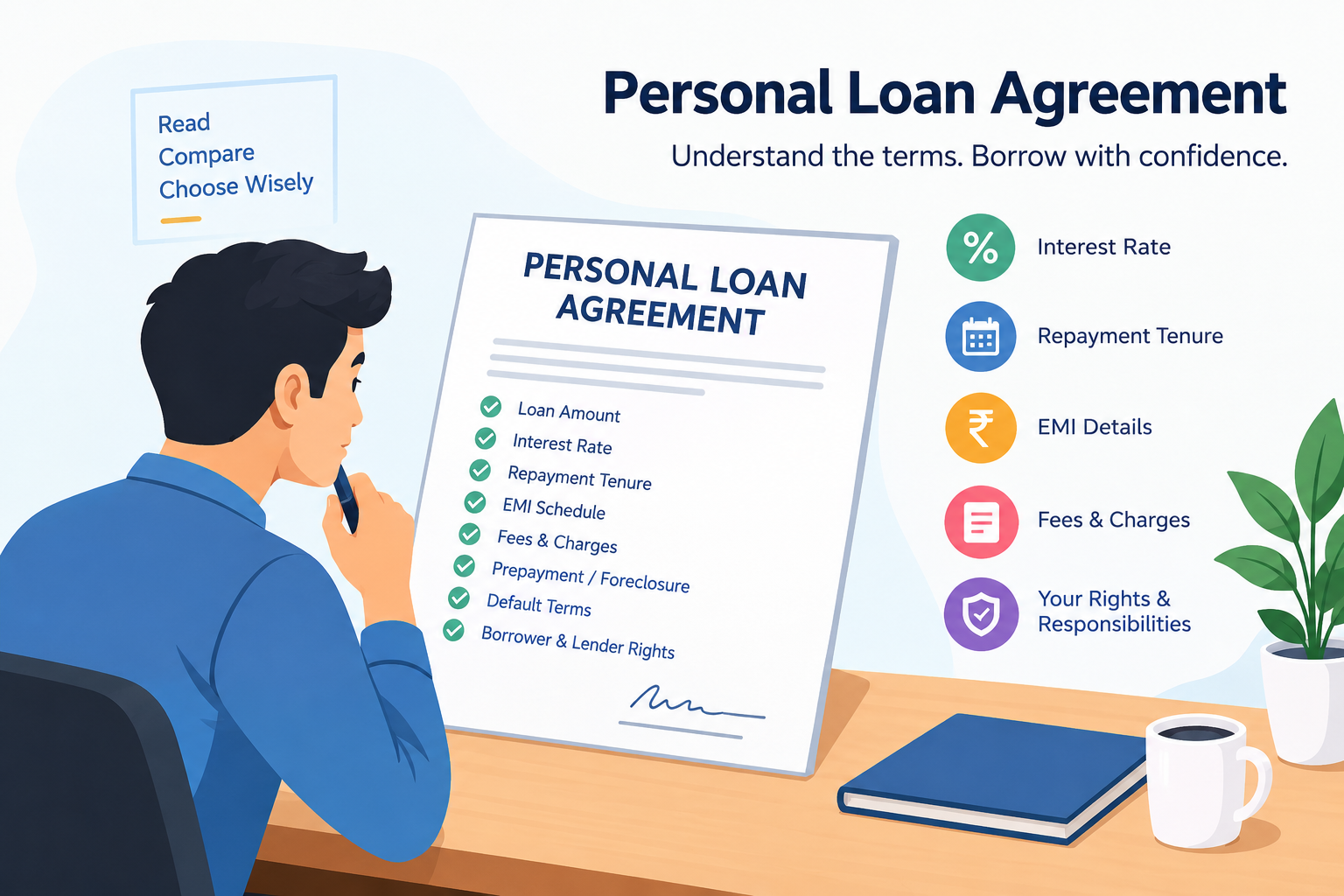
A personal loan agreement is a contract between a borrower and a lender that records the terms under which money is borrowed and repaid. It typically includes the loan amount, interest rate, repayment tenure, EMI schedule, applicable fees, default provisions, and the rights and responsibilities of both parties.
Before signing, borrowers should compare the agreement with the sanction letter and Key Facts Statement (KFS), verify the total borrowing cost, and understand the conditions for late payment, prepayment, and foreclosure.
In India, contractual obligations are governed by applicable laws, including the Indian Contract Act, 1872, and relevant RBI requirements where applicable.
What Is a Personal Loan Agreement?
A personal loan agreement is a written or electronically executed document that sets out the conditions of a loan offered by a bank or other eligible lender.
It establishes the borrower's repayment obligations and the lender's obligations according to the agreed terms and applicable law.
For example, suppose a borrower takes a personal loan of ₹2,00,000 for a period of 24 months. The agreement may specify:
- The approved principal amount.
- The applicable interest rate and method of calculation.
- The monthly EMI and payment due date.
- The repayment period.
- Processing fees and other applicable charges.
- Conditions for early repayment.
- Consequences of missed payments.
- Procedures for raising complaints or resolving disputes.
The final agreement should reflect the terms actually accepted by the borrower.
Why Is a Personal Loan Agreement Important?
A properly understood agreement helps both parties know what is expected of them.
For borrowers, it can help with:
- Understanding the actual cost of borrowing.
- Checking whether the EMI fits their monthly budget.
- Identifying additional fees and penalties.
- Knowing the procedure for early repayment.
- Understanding the consequences of default.
- Keeping written evidence of the agreed terms.
For lenders, the agreement records the credit arrangement, repayment obligations, and procedures available under the contract and applicable law.
What Are the Main Components of a Personal Loan Agreement?
A personal loan agreement can contain several clauses. The exact wording and structure vary by lender and loan product.
| Agreement component | What it explains |
|---|---|
| Borrower and lender details | Names and relevant identification details of the parties |
| Loan amount | Principal amount approved for borrowing |
| Interest rate | Applicable rate and calculation method |
| Loan tenure | Total repayment period |
| EMI schedule | Installment amount, frequency, and due dates |
| Processing fee | Applicable fee for processing the application |
| Annual Percentage Rate (APR) | Annualised overall cost of credit, including applicable charges |
| Late-payment provisions | Applicable charges and consequences of delayed repayment |
| Prepayment and foreclosure | Conditions for repaying early or closing the loan |
| Default clause | Contractual consequences of failing to meet repayment obligations |
| Grievance redressal | Relevant complaint-handling procedure |
| Governing law and disputes | Applicable legal framework and dispute-resolution terms |
5.1 Loan Amount and Disbursal
The agreement should clearly identify the sanctioned loan amount and the amount to be disbursed.
Check whether any processing fee, insurance premium, or other permitted deduction affects the amount credited to your bank account.
Example: If a loan is approved for ₹1,00,000 and a permitted fee is deducted upfront, the amount received may be lower than ₹1,00,000 even though the repayment obligation is based on the contractual terms.
Always compare the sanctioned amount with the actual disbursal amount.
5.2 Interest Rate and APR
The interest rate determines the cost of borrowing, while the Annual Percentage Rate (APR) provides a broader view of the annualised credit cost, including applicable charges.
Check whether the rate is fixed or floating and how any rate changes may affect repayment.
For digital lending products covered by RBI requirements, the applicable disclosures include the APR and a Key Facts Statement before the loan contract is executed.
5.3 EMI and Repayment Schedule
The agreement should explain:
- The monthly EMI.
- The first EMI date.
- The regular payment date.
- The total number of installments.
- The repayment method.
- The treatment of failed or delayed payments.
Keep a copy of the repayment schedule. It can help you track payments and identify discrepancies in your loan account.
5.4 Fees and Other Charges
Read the fee section carefully. Depending on the product, the lender's terms may include:
- Processing fees.
- Applicable taxes on fees.
- Late-payment or penal charges.
- Prepayment or foreclosure charges, where permitted.
- Other specifically disclosed charges.
Do not assume that every lender charges the same fees. Ask for written clarification about any amount you do not understand.
5.5 Default and Recovery Clauses
The agreement may explain what happens if EMIs remain unpaid, including applicable charges, notices, credit reporting, and lawful recovery procedures.
Read these clauses carefully. A missed EMI can create financial and credit-record consequences, while repeated defaults may lead to further action permitted by the agreement and applicable law.
A lender's contractual rights do not remove the borrower's legal protections.
Personal Loan Agreement Rules in India
Personal loan agreements operate within India's general contract law and the regulatory requirements applicable to the lender and loan product.
The Indian Contract Act, 1872, provides the general legal framework for contracts, including provisions relating to consent, contractual obligations, and certain forms of invalid or voidable agreements.
Official reference: Indian Contract Act, 1872 — India Code.
6.1 RBI Requirements for Loan Disclosures
RBI requirements depend on the lender, type of loan, and transaction.
For applicable retail and digital lending products, borrowers should pay particular attention to the Key Facts Statement, APR, fees, repayment conditions, and grievance-redressal information.
RBI's digital lending framework has been updated through the Reserve Bank of India (Digital Lending) Directions, 2025. Borrowers using digital platforms should verify the identity of the actual regulated lender and review the relevant disclosures.
Official reference: RBI Digital Lending Directions, 2025.
6.2 What Is a Key Facts Statement (KFS)?
A Key Facts Statement is a standardised document that summarises important information about a loan in an accessible format.
Depending on the applicable requirements, it can include:
- Loan amount and disbursal details.
- Interest rate and APR.
- Total interest payable.
- Applicable fees and charges.
- Repayment schedule.
- Penal charges.
- Other key loan conditions.
For loans covered by the relevant RBI KFS requirements, the borrower should receive the statement before executing the contract.
Read the KFS alongside the full agreement rather than treating it as a replacement for the agreement.
Official reference: RBI information on floating-rate personal loans and related disclosures.
6.3 Can a Personal Loan Agreement Be Signed Online?
Yes. Personal loan agreements may be executed electronically where the applicable legal and regulatory requirements are met.
Before accepting an online agreement:
- Confirm the lender's identity.
- Review the complete agreement, not only the approval screen.
- Read the KFS and sanction terms.
- Check the electronic signing or acceptance process.
- Save the final agreement and confirmation.
- Keep copies of payment schedules and relevant messages.
Never share an OTP, PIN, or password with someone claiming to complete a loan agreement on your behalf.
Personal Loan Agreement vs Sanction Letter vs KFS
These documents serve different purposes. Borrowers should understand how they fit together.
| Feature | Loan agreement | Sanction letter | Key Facts Statement |
|---|---|---|---|
| Main purpose | Records contractual terms | Communicates loan approval and approved terms | Summarises key financial terms and costs |
| Loan amount | Usually included | Usually included | Included where required |
| Repayment conditions | Detailed contractual provisions | May provide a summary | Key repayment information |
| Fees and interest | Detailed provisions | May state approved charges and rate | Highlights applicable costs and APR |
| Legal role | Contractual document | Approval document; legal effect depends on its terms and context | Standardised disclosure document |
| Best use | Understand rights and obligations | Confirm approved loan terms | Compare costs and key loan details |
Important: Do not assume that these documents are interchangeable. Check that their material terms are consistent, and ask the lender to resolve discrepancies before accepting the loan.
How to Check a Personal Loan Agreement Before Signing
Use this checklist before agreeing to a loan.
Step 1: Verify the Lender
Confirm the identity of the bank or regulated lending institution providing the loan. If an app or intermediary is involved, establish which entity is actually lending the money.
Step 2: Confirm the Loan Amount
Check the approved amount, expected disbursal, and any permitted upfront deductions.
Step 3: Calculate the Total Cost
Review the interest rate, APR, processing fee, applicable taxes, and other disclosed charges.
Do not select a loan based only on the lowest advertised interest rate.
Step 4: Review EMI and Tenure
Make sure the EMI is affordable after accounting for rent, household expenses, existing EMIs, savings, and emergency costs.
Step 5: Read the Default Clause
Understand the applicable late-payment charges, notices, credit reporting, and other contractual consequences.
Step 6: Check Prepayment Conditions
Find out whether early repayment is permitted, what conditions apply, and whether any charge is payable under the applicable terms and rules.
Step 7: Understand the Complaint Process
Identify the lender's grievance-redressal officer or official complaint channel.
Step 8: Save All Documents
Download or retain the final agreement, KFS, sanction letter, repayment schedule, and confirmation of electronic acceptance.
Personal Loan Agreement Example: Understanding the Cost
Consider an illustrative personal loan with the following terms.
| Particular | Example |
|---|---|
| Loan principal | ₹1,00,000 |
| Annual interest rate | 12% |
| Repayment tenure | 12 months |
| Approximate monthly EMI | ₹8,885 |
| Approximate total of 12 EMIs | ₹1,06,620 |
| Approximate total interest | ₹6,620 |
These figures are illustrative and rounded. They assume a standard monthly reducing-balance calculation, a constant interest rate, and no fees or additional charges.
The actual EMI and total cost may differ based on the lender's calculation method, disbursal date, payment dates, fees, and contractual terms.
Why Does This Example Matter?
A borrower who looks only at the ₹1,00,000 loan amount may underestimate the repayment obligation.
Reviewing the EMI, total interest, and applicable fees gives a more complete picture of the commitment.
Before signing, ask the lender to provide the actual repayment schedule for your specific loan.
Common Clauses Borrowers Should Read Carefully
10.1 Prepayment and Foreclosure
Prepayment means repaying some or all of the outstanding principal before the scheduled end of the loan. Foreclosure generally refers to closing the loan by paying the amount due in full before the end of the tenure.
Check the conditions, calculation method, notice requirements, and any applicable charges. Whether a charge is allowed depends on the relevant RBI requirements, loan type, lender category, and contractual terms.
10.2 Late-Payment and Penal Charges
Understand when charges apply, how they are calculated, and whether the agreement explains the relevant conditions.
For regulated lenders, applicable RBI rules govern the disclosure and treatment of penal charges. Do not rely on verbal statements that contradict the written terms or applicable regulations.
10.3 Insurance and Optional Products
Check whether an insurance policy or another product is included in the loan arrangement. Understand its cost, coverage, and whether it is optional or required under the particular arrangement.
Ask for separate written details when necessary.
10.4 Changes to Interest Rates
If the loan has a floating interest rate, review the terms governing changes to the rate and their potential impact on EMI or tenure.
RBI's applicable instructions include borrower communication requirements for certain EMI-based floating-rate personal loans.
10.5 Dispute Resolution and Governing Law
Understand how complaints and disputes are handled, including the lender's official grievance process and any contractual provisions that apply to disputes.
If a clause is unclear or appears unfair, request a written explanation before signing.
Advantages and Disadvantages of a Personal Loan Agreement
| Advantages | Potential drawbacks |
|---|---|
| Records the agreed loan terms | Can be difficult to understand when written in complex legal language |
| Helps clarify repayment obligations | May contain fees borrowers overlook |
| Provides a reference for resolving disputes | Contractual defaults can have financial consequences |
| Helps borrowers compare offers | Different lenders may use different terms and fee structures |
| Creates a record of electronic or written acceptance | Signing without reading can lead to avoidable misunderstandings |
The agreement itself is not a disadvantage. The main risk is accepting obligations without understanding them.
Common Mistakes to Avoid
Avoid these mistakes when reviewing a personal loan agreement:
- Signing without reading the full document.
- Comparing loans only by interest rate.
- Ignoring the APR and applicable fees.
- Overlooking the EMI due date.
- Assuming foreclosure is always free.
- Accepting unexplained deductions from the disbursal amount.
- Ignoring default and grievance-redressal clauses.
- Relying on verbal promises instead of written confirmation.
- Failing to save the signed agreement.
- Sharing confidential banking credentials with an agent or loan app.
A few minutes of careful review can help prevent misunderstandings throughout the repayment period.
Real-World Borrower Scenarios
The following examples are illustrative situations that demonstrate why loan documents matter.
Scenario 1: The EMI Looks Affordable, but the Fees Are High
A borrower compares two personal loans and chooses the one with the lower advertised interest rate. After reviewing the documents, the borrower discovers that the first offer includes higher processing costs.
Lesson: Compare the APR and total repayment cost, not just the headline rate.
Scenario 2: The Borrower Wants to Close the Loan Early
A borrower receives a bonus and wants to clear an outstanding personal loan. The borrower checks the foreclosure clause and requests a written payoff statement before transferring money.
Lesson: Confirm the exact closure amount and applicable conditions with the lender.
Scenario 3: The Online Loan Terms Do Not Match the Offer
A borrower notices that a fee in the final agreement differs from the earlier offer.
Lesson: Pause the acceptance process and ask the lender for clarification. Retain the original offer and the response for reference.
These scenarios are practical examples, not claims about specific customer experiences.
Personal Loan Agreement Download: How to Get a Copy
If you have already taken a personal loan, you can generally request or download your agreement through the lender's official channels.
- Visit the lender's official website or mobile application.
- Sign in using the lender's authorised authentication process.
- Open the loan account or document section.
- Look for the loan agreement, sanction letter, or related documents.
- Download the available file and check that it is complete.
- Contact official customer support if the agreement is unavailable.
Some lenders may require a written request or additional verification. Never use an unofficial website that asks for your banking password or OTP to retrieve a loan agreement.
Expert Commentary and Trust-Building Guidance
A sound borrowing decision involves more than getting an application approved. Borrowers should understand the financial commitment they are accepting.
Financial-literacy best practices include:
- Review the total cost: Interest, fees, and repayment conditions matter together.
- Check affordability: Choose an EMI that fits your income and existing obligations.
- Keep written records: Store the agreement, KFS, sanction letter, and payment receipts.
- Verify the lender: Confirm the regulated lender's identity before sharing personal information.
- Use official complaint channels: Raise discrepancies with the lender and follow the applicable escalation process.
For current regulatory information, consult the Reserve Bank of India's official website and the relevant legal documents. For complicated contractual disputes, consider seeking advice from a qualified legal professional.
Personal Loan Agreement: Summary Table
| Question | Short answer |
|---|---|
| What is a personal loan agreement? | A document recording the contractual terms of borrowing and repayment |
| Is it important? | Yes, because it explains the financial and contractual obligations |
| What should borrowers check first? | Loan amount, interest rate, APR, EMI, tenure, and fees |
| Can it be signed online? | Yes, where the applicable requirements for electronic execution are met |
| What is a KFS? | A standardised statement highlighting key loan information and costs |
| Can a borrower repay early? | This depends on the applicable rules and the loan's terms |
| What if an agreement contains an error? | Ask the lender to clarify and correct the issue before accepting the terms |
| Where should the agreement be stored? | In a secure digital folder or another safe location |
Frequently Asked Questions (FAQs)
1. What is a personal loan agreement?
A personal loan agreement is a contract between a borrower and a lender that outlines the loan amount, interest rate, repayment tenure, EMI schedule, applicable charges, and other conditions.
2. Is a personal loan agreement legally binding in India?
A valid agreement can create legally enforceable obligations under applicable Indian law. Its enforceability depends on the facts, terms, legal requirements, and circumstances of the transaction.
3. What details are included in a personal loan agreement?
Common details include borrower and lender information, principal amount, interest rate, EMI schedule, tenure, fees, prepayment conditions, default provisions, and complaint procedures.
4. Can I sign a personal loan agreement online?
Yes. Electronic execution may be used where the applicable legal and regulatory requirements are met. Always verify the lender and save the completed agreement.
5. What is the difference between a loan agreement and a sanction letter?
A sanction letter communicates the approved loan terms. The loan agreement records the contractual terms governing the borrowing relationship. Their precise legal effect depends on their contents and the circumstances.
6. What is a Key Facts Statement in a personal loan?
A Key Facts Statement is a standardised disclosure document that summarises key loan information, including applicable costs and repayment details. It helps borrowers understand the offer before accepting it.
7. Can I get a copy of my personal loan agreement?
Generally, you can request a copy through the lender's official website, mobile application, customer support, or other authorised channels.
8. Does a personal loan agreement mention the EMI?
Yes. The agreement or its accompanying repayment schedule generally specifies the EMI amount, due dates, and repayment period.
9. Are processing fees included in a personal loan agreement?
Applicable processing fees and other charges should be disclosed in the relevant loan documents as required by the rules governing the lender and product. Check the agreement and KFS for the exact amounts.
10. What happens if I miss an EMI?
A missed EMI may lead to applicable charges, collection contact, credit reporting, and other consequences under the agreement and relevant law. Contact the lender promptly if you anticipate repayment difficulties.
11. Can I close my personal loan before the tenure ends?
Early closure may be possible, subject to the applicable rules and loan terms. Request a foreclosure statement from the lender and confirm the amount payable before making the final payment.
12. Can the lender change the interest rate after signing?
This depends on whether the loan has a fixed or floating rate and the applicable contractual and regulatory provisions. Review the interest-rate clause carefully.
13. What should I do if the loan agreement contains incorrect details?
Contact the lender through an official channel, identify the incorrect clause, and request written clarification or correction. Keep copies of relevant documents and communications.
14. Is a personal loan agreement required for an online personal loan?
Online loans also require appropriate documentation and contractual arrangements. The form of the agreement may be electronic, depending on the lending process and applicable requirements.
15. How can I check whether a digital loan offer is genuine?
Verify the actual lender through official channels, review the applicable disclosures, avoid upfront payments to unknown individuals, and never share your OTP, PIN, or banking password. Check RBI resources for current digital lending guidance.
Conclusion
A personal loan agreement is an essential document for understanding the responsibilities associated with borrowing money. It explains the repayment schedule, interest rate, fees, default provisions, and other conditions that can affect your finances.
Before signing, compare the agreement with the sanction letter and Key Facts Statement, calculate the overall borrowing cost, and ask questions about any unclear terms. Keeping accurate records and making an affordable borrowing decision can help you manage the loan more confidently.
Planning to apply for a personal loan? Explore the available options at Vizzve Financial through www.vizzve.com, compare the applicable terms, and read the complete agreement before accepting an offer.
Published on : 05th october
Published by : Bhargavi
www.vizzve.com || www.vizzveservices.com
Follow us on social media: Facebook || Linkedin || Instagram
🛡 Powered by Vizzve Financial
RBI-Registered Loan Partner | 10 Lakh+ Customers | ₹600 Cr+ Disbursed