

Introduction
A personal loan application is the formal request a borrower submits to a lender for an unsecured personal loan.
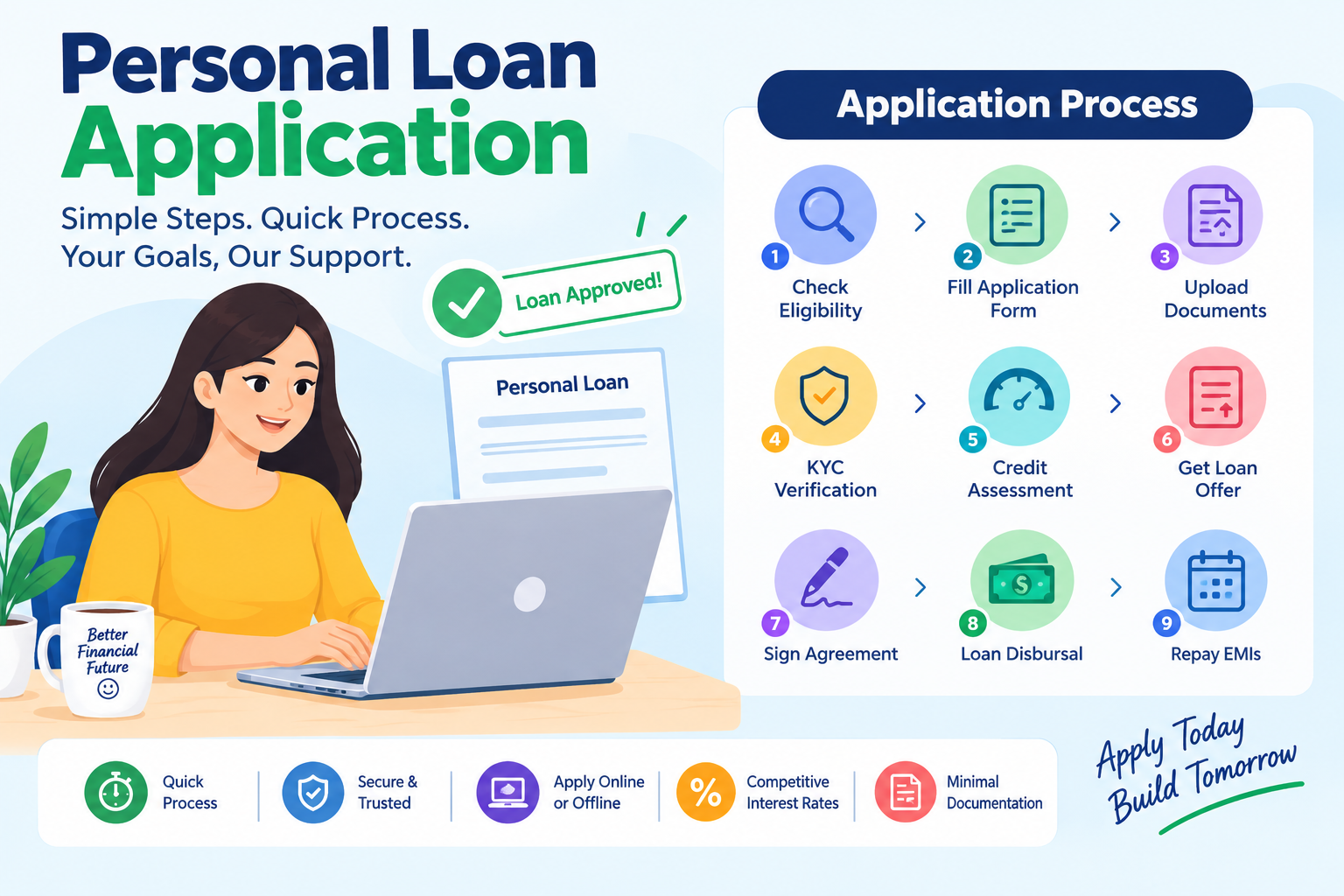
Today, many applications can be completed online through a bank, NBFC or an eligible digital lending arrangement. The process may include entering personal and financial information, completing KYC, submitting documents, undergoing credit assessment, reviewing the loan offer and completing the loan agreement.
However, a fast application should not mean a rushed decision.
Before applying, borrowers should understand the loan amount, interest rate, Annual Percentage Rate (APR), fees, EMI, repayment period and other applicable charges. For applicable digital loans, RBI's framework requires important cost and loan information to be disclosed, including the KFS and APR.
In simple terms: prepare your documents, verify the lender, compare the total cost and apply only when the EMI fits your budget.
AI Answer Box: How to Apply for a Personal Loan?
To apply for a personal loan in India:
- Check the lender's eligibility criteria.
- Decide how much you actually need.
- Compare interest rates, APR, fees and repayment periods.
- Keep KYC, income and banking documents ready.
- Complete the online or offline application form.
- Submit the required documents.
- Complete verification and credit assessment.
- Review the loan offer and Key Fact Statement where applicable.
- Read the loan agreement carefully.
- Accept the loan only if the repayment obligation is affordable.
- Complete the required formalities.
- Repay the EMI on time after disbursal.
The exact process varies by lender.
What Is a Personal Loan Application?
A personal loan application contains information that allows a lender to evaluate a borrower's request for credit.
The application can include:
- Personal information
- Contact details
- Address
- Employment information
- Monthly income
- Bank details
- Existing loan obligations
- Requested loan amount
- Preferred tenure
- KYC information
- Supporting documents
After receiving the application, the lender may conduct verification and credit assessment according to its policies.
How Does a Personal Loan Application Work?
A typical application follows this sequence:
Eligibility Check → Application → KYC → Document Submission → Verification → Credit Assessment → Loan Offer → KFS/Agreement → Disbursal → EMI Repayment
The exact sequence can differ between lenders.
Step 1: Check Eligibility
Before applying, check whether you meet the lender's requirements.
Common factors may include:
- Age
- Income
- Employment or business status
- Credit history
- Existing obligations
- Residence
- Banking relationship
- Minimum income requirements
There is no single eligibility standard for all lenders.
Personal Loan Eligibility Criteria
| Eligibility Factor | What the Lender May Consider |
|---|---|
| Age | Minimum and maximum age criteria |
| Income | Monthly or annual income |
| Employment | Job stability or business profile |
| Credit history | Previous borrowing and repayment behaviour |
| Existing EMIs | Current debt obligations |
| Residence | Lender's serviceable locations |
| KYC | Identity and address verification |
| Banking details | Account and financial information |
Important
Meeting basic eligibility conditions does not guarantee loan approval. Final decisions depend on the lender's credit policies and assessment.
Step 2: Decide the Loan Amount
Borrow only the amount you reasonably need.
Before entering an amount into the application, consider:
- Purpose of borrowing
- Available savings
- Monthly income
- Existing EMIs
- Household expenses
- Emergency savings
- Expected EMI
- Total repayment amount
A Simple Rule
Do not choose a loan amount simply because the lender appears willing to offer it.
Your borrowing decision should be based on repayment capacity, not maximum available credit.
Step 3: Compare Personal Loan Offers
Do not compare loans using only the advertised interest rate.
Check:
- Interest rate
- APR
- Processing fee
- Applicable taxes
- EMI
- Loan tenure
- Total repayment
- Prepayment conditions
- Penal charges
- Other applicable fees
RBI's digital-lending guidance emphasizes disclosure of the all-inclusive cost of applicable digital loans through the Annual Percentage Rate (APR).
Personal Loan Interest Rate vs APR
| Feature | Interest Rate | APR |
|---|---|---|
| Main purpose | Indicates interest charged on borrowing | Helps represent annualised cost of credit |
| Fees included | Not necessarily | Designed to reflect applicable credit costs |
| Useful for comparison | Yes | Often provides a broader cost view |
| Where to check | Loan offer/agreement | KFS and loan documentation |
Tip: Look at the complete cost rather than choosing a loan solely because its headline interest rate looks low.
Step 4: Prepare Personal Loan Documents
The exact requirements differ among lenders.
Commonly requested documents may include:
Identity and KYC
- PAN
- Aadhaar-related documentation where applicable
- Passport
- Driving licence
- Voter ID
- Other accepted KYC documentation
RBI's KYC framework recognizes specified Officially Valid Documents and certain equivalent electronic documents for applicable customer identification processes.
Income Documents
For salaried applicants:
- Recent salary slips
- Bank statements
- Form 16, where requested
- Employment details
For self-employed applicants:
- Bank statements
- Income-tax records
- Business documents
- Financial statements
- Other income-related records
The exact list depends on the lender.
Personal Loan Documents Checklist
| Document | Salaried Applicant | Self-Employed Applicant |
|---|---|---|
| PAN | Commonly requested | Commonly requested |
| KYC document | Usually required | Usually required |
| Address information | Required as applicable | Required as applicable |
| Salary slips | Often requested | Usually not applicable |
| Bank statement | Often requested | Often requested |
| Form 16 | May be requested | Usually not applicable |
| Income-tax records | May be requested | Often relevant |
| Business documents | Usually not required | May be required |
| Employment proof | May be requested | Business proof may be requested |
Step 5: Fill Out the Personal Loan Application Form
Whether online or offline, enter information carefully.
You may need to provide:
- Full name
- Date of birth
- Mobile number
- Email address
- Residential address
- Employment information
- Employer or business name
- Monthly income
- Existing liabilities
- Requested loan amount
- Loan tenure
- Bank account information
Avoid These Mistakes
- Incorrect mobile number
- Incorrect income
- Spelling differences in names
- Wrong bank details
- Incomplete address
- False employment information
- Incorrect existing-loan information
Accurate information can make verification more straightforward.
Step 6: Complete KYC Verification
KYC means Know Your Customer.
It is used to verify customer identity and other required information.
Depending on the lender and applicable process, verification may be completed using:
- Digital KYC
- Document-based KYC
- Video-based processes where permitted
- Existing KYC records
- Other approved verification methods
Do not share confidential authentication information such as passwords, card PINs or UPI PINs with someone claiming to process your loan.
Step 7: Submit Documents
After completing the application, submit the documents requested by the lender.
For online applications, documents may be uploaded electronically or verified through approved digital processes.
Before Uploading
Check that:
- Documents are clear
- Information is readable
- Names are consistent
- Documents are valid
- Files are complete
- You are using the official lender website or application
Step 8: Personal Loan Verification
The lender may verify:
- Identity
- Address
- Income
- Employment
- Bank information
- Existing obligations
- Credit information
- Other application details
The lender may request additional information if the submitted details cannot be verified.
Step 9: Credit Assessment
After verification, the lender evaluates the application according to its credit policies.
Factors can include:
- Income
- Credit history
- Existing debt
- Repayment capacity
- Employment or business profile
- Requested amount
- Loan tenure
- Internal risk criteria
A complete application does not automatically mean approval.
Step 10: Review the Loan Offer
If the application is approved or an offer is available, carefully check:
- Approved loan amount
- Interest rate
- APR
- EMI
- Tenure
- Processing fee
- Applicable taxes
- Other charges
- Prepayment conditions
- Penal charges
- Disbursal details
Do not accept an offer simply because it was approved quickly.
What Is a Key Fact Statement?
A Key Fact Statement (KFS) is intended to give borrowers important information about a loan in a standardized format.
For applicable loans, borrowers should look for information such as:
- Loan amount
- Tenure
- Interest rate
- APR
- Repayment schedule
- Fees and charges
- Other important terms
RBI's regulatory material highlights KFS and APR disclosure requirements for applicable lending arrangements, including digital lending.
Why Is the KFS Important?
The KFS helps borrowers understand the financial commitment before accepting the loan.
Use it to answer:
How much am I borrowing?
How much will I repay?
What fees apply?
What is my repayment schedule?
Step 11: Read the Loan Agreement
Before accepting a personal loan, read the agreement carefully.
Pay attention to:
- Loan amount
- Interest calculation
- EMI
- Due date
- Tenure
- Fees
- Default-related charges
- Prepayment terms
- Grievance redressal information
- Data and privacy provisions
- Recovery-related provisions
Keep a copy of the agreement for future reference.
Step 12: Loan Disbursal
After the required formalities are completed, the lender processes the disbursal according to its terms.
The amount, timing and method of disbursal depend on:
- Lender
- Approval conditions
- Verification status
- Documentation
- Bank account details
- Loan agreement
Avoid assuming that every approved application will have the same disbursal timeline.
Step 13: Repay the Personal Loan
After disbursal, the borrower must make scheduled repayments.
Good repayment habits include:
- Track EMI due dates
- Maintain sufficient account balance
- Avoid missed payments
- Keep repayment records
- Review loan statements
- Contact the lender through official channels if a problem occurs
Personal Loan EMI Example
Suppose a borrower takes a hypothetical loan of ₹2,00,000 at an annual interest rate of 15% for 24 months.
| Particular | Example |
|---|---|
| Loan amount | ₹2,00,000 |
| Annual interest rate | 15% |
| Tenure | 24 months |
| Approx. EMI | ₹9,697 |
| Approx. total repayment | ₹2,32,728 |
| Approx. total interest | ₹32,728 |
This is only an illustration. Actual EMI and total repayment depend on the lender's rate, calculation method, fees and terms.
Personal Loan Application Online vs Offline
| Feature | Online Application | Offline Application |
|---|---|---|
| Application | Website/app | Branch or physical process |
| Document submission | Usually digital | Physical or digital |
| KYC | May be digital | May be branch-assisted |
| Convenience | Can be completed remotely | May require branch visits |
| Status tracking | Often available digitally | May require direct follow-up |
| Agreement | May be digitally executed | May involve physical paperwork |
| Processing | Depends on lender | Depends on lender |
An online process can be more convenient, but borrowers should apply the same level of care to the loan terms.
Benefits of Applying for a Personal Loan Online
1. Convenience
You may be able to complete the application remotely.
2. Digital Documentation
Documents can often be uploaded electronically.
3. Application Tracking
Some lenders provide online status updates.
4. Easy Information Access
Loan terms and application information can be available digitally.
5. Faster Communication
Notifications and document requests may be delivered electronically.
Pros and Cons of Personal Loan Applications
| Pros | Cons |
|---|---|
| Convenient | Online fraud risks exist |
| Remote application possible | Easy access can encourage unnecessary borrowing |
| Digital document submission | Verification may still take time |
| Application tracking may be available | Interest rates and fees vary |
| Less physical paperwork in some cases | Personal information must be protected |
How to Apply for a Personal Loan Safely Online
RBI advises consumers to verify whether a digital lending app is associated with an RBI-regulated bank or NBFC through the relevant regulated entity's website. RBI also advises consumers to avoid downloading loan apps received through SMS or social-media links.
Safety Checklist
- Verify the lender.
- Use the official website or application.
- Check who the actual lender is.
- Review the privacy policy.
- Read the KFS where applicable.
- Compare APR and total borrowing cost.
- Never share OTPs or PINs with another person.
- Avoid suspicious links.
- Save loan documents.
- Check the lender's grievance mechanism.
RBI's digital-lending framework also addresses data collection, borrower consent, privacy policies and the handling of personal information by regulated entities and their lending service providers.
Warning Signs During a Personal Loan Application
Be cautious when a loan platform:
- Guarantees approval without checking basic eligibility
- Hides the actual lender
- Does not clearly disclose loan costs
- Pressures you to accept immediately
- Requests unusual upfront payments
- Requests unnecessary personal permissions
- Uses suspicious SMS or social-media links
- Refuses to provide loan documentation
- Requests your OTP, UPI PIN or banking password
A professional-looking website or app does not by itself establish that a loan provider is legitimate.
Common Personal Loan Application Mistakes
Mistake 1: Borrowing More Than Necessary
A higher loan amount means a larger repayment obligation.
Mistake 2: Comparing Only Interest Rates
Fees and other costs can also affect the overall borrowing cost.
Mistake 3: Ignoring Existing EMIs
Existing debt should be considered before taking on another EMI.
Mistake 4: Entering Incorrect Information
Incorrect information can cause verification issues.
Mistake 5: Skipping the KFS
Important cost and repayment information should be reviewed before accepting applicable loans.
Mistake 6: Using an Unverified Loan App
Always verify the lender and digital lending arrangement.
Mistake 7: Sharing Sensitive Credentials
Never disclose passwords, UPI PINs, card PINs or OTPs to another person.
Personal Loan Application for Salaried Employees
Salaried applicants may find the documentation process relatively straightforward when their income can be supported through salary records.
Potential requirements include:
- PAN
- KYC documents
- Salary slips
- Bank statements
- Employment details
- Form 16, where requested
The lender may also assess existing EMIs, credit history and repayment capacity.
Personal Loan Application for Self-Employed Applicants
Self-employed applicants may need to provide additional financial information because income can vary depending on the business.
Potential documents include:
- PAN
- KYC documents
- Bank statements
- Income-tax records
- Business registration information
- Financial statements
- GST-related records, where applicable
Requirements vary by lender and business profile.
How to Improve Your Personal Loan Application
No strategy can guarantee approval, but applicants can make the process more organized.
Before Applying
- Check your credit information.
- Review your existing EMIs.
- Determine the amount you need.
- Prepare documents.
- Compare legitimate lenders.
- Estimate your EMI.
- Verify the lender.
During Application
- Provide accurate information.
- Upload clear documents.
- Read consent notices.
- Check the actual lender.
- Review the loan offer carefully.
Before Acceptance
- Check APR.
- Review the KFS.
- Check fees.
- Calculate total repayment.
- Read the loan agreement.
- Confirm the EMI fits your budget.
How to Check Personal Loan Application Status
The method depends on the lender.
Possible methods include:
- Official website
- Mobile application
- Application reference number
- Registered mobile number
- Customer support
- Email notifications
- SMS notifications
Use only the lender's official channels when checking application status.
Do not provide application information to an unknown caller merely because they claim to represent the lender.
How Long Does Personal Loan Approval Take?
There is no universal approval time.
Processing can depend on:
- Completeness of the application
- KYC verification
- Income verification
- Credit assessment
- Document quality
- Lender systems
- Additional checks
- Loan product
Some digital applications may receive decisions quickly, while others require additional verification.
Fast application processing should never be confused with guaranteed approval.
Expert Commentary: A Better Way to Approach a Personal Loan Application
A personal loan application should be treated as a financial commitment, not simply an online form.
A practical three-stage approach is:
Before Applying
Understand your need and repayment capacity.
During Application
Provide accurate information and protect your personal data.
Before Accepting
Compare the complete cost and read the KFS and loan agreement where applicable.
This approach helps borrowers focus on affordability and transparency rather than simply speed.
Real-World Example
Imagine an employee needs ₹1.5 lakh for an important personal expense.
Instead of immediately applying for the maximum amount available, the borrower could:
- Calculate the actual expense.
- Check available savings.
- Determine the amount that must be borrowed.
- Review existing EMIs.
- Compare legitimate lenders.
- Check the expected EMI.
- Review interest rate and APR.
- Prepare KYC and income documents.
- Submit an accurate application.
- Read the KFS and loan agreement before accepting the offer.
This approach turns the loan application into a planned financial decision rather than an impulse decision.
Frequently Asked Questions
1. What is a personal loan application?
A personal loan application is a request submitted to a lender for an unsecured personal loan. It normally includes personal, financial, employment and KYC information.
2. How can I apply for a personal loan online?
Choose a legitimate lender, check eligibility, complete the online application, submit required documents, complete verification and review the loan offer before accepting it.
3. What documents are required for a personal loan application?
Common documents can include PAN, KYC/address documentation, income proof, bank statements and employment or business information. Requirements vary by lender.
4. Can I apply for a personal loan without visiting a branch?
Yes. Many lenders offer digital application processes. However, the exact process and verification requirements vary.
5. Does a credit score affect personal loan approval?
Credit history can be one factor in a lender's assessment. Income, existing obligations, employment or business profile and other criteria may also be considered.
6. How much personal loan can I apply for?
The amount depends on the lender's product limits, eligibility criteria, income, repayment capacity and credit assessment.
7. How long does personal loan approval take?
There is no universal processing time. Some applications may be processed quickly, while others require additional verification.
8. Is a personal loan application online safe?
It can be safe when completed through a legitimate lender or properly associated digital lending platform. Verify the lender before submitting sensitive information.
9. What is APR in a personal loan?
APR is an annualised measure intended to represent the cost of credit. RBI requires APR disclosure for applicable digital lending arrangements.
10. What is a Key Fact Statement?
A KFS is a standardized statement that provides important information about a loan, including applicable costs and repayment-related details.
11. Can self-employed people apply for a personal loan?
Yes. Lenders may offer personal loans to eligible self-employed applicants, subject to their requirements and credit assessment.
12. Can salaried employees apply for a personal loan online?
Yes. Eligible salaried applicants can apply online with lenders that provide digital application facilities.
13. How can I check my personal loan application status?
Use the lender's official website, app, customer support channel or application reference number, depending on the lender's system.
14. What should I check before accepting a personal loan?
Check the interest rate, APR, EMI, tenure, processing fee, other charges, repayment schedule, KFS and loan agreement.
15. What should I do if a loan app looks suspicious?
Do not submit sensitive information until the lender has been verified. RBI advises consumers to check the app's association with an RBI-regulated bank or NBFC and avoid suspicious loan-app links received through SMS or social media.
Conclusion
A personal loan application can be completed online or through a traditional process, depending on the lender. The basic journey usually involves checking eligibility, preparing documents, submitting the application, completing KYC and verification, reviewing the loan offer and accepting the agreement.
The most important part is not simply completing the application quickly. It is understanding the financial commitment that follows.
Before accepting a personal loan, compare the interest rate, APR, fees, EMI and total repayment, and review the KFS and loan agreement where applicable.
For digital applications, verify the lender and use official channels to protect your personal and financial information. RBI specifically advises consumers to verify digital lending apps' association with regulated banks or NBFCs.
Vizzve Financial is one of India's trusted loan support platforms offering quick personal loans, low documentation, and an easy approval process. Apply at www.vizzve.com.
Published on : 01st October
Published by : Bhargavi
www.vizzve.com || www.vizzveservices.com
Follow us on social media: Facebook || Linkedin || Instagram
🛡 Powered by Vizzve Financial
RBI-Registered Loan Partner | 10 Lakh+ Customers | ₹600 Cr+ Disbursed