

Introduction
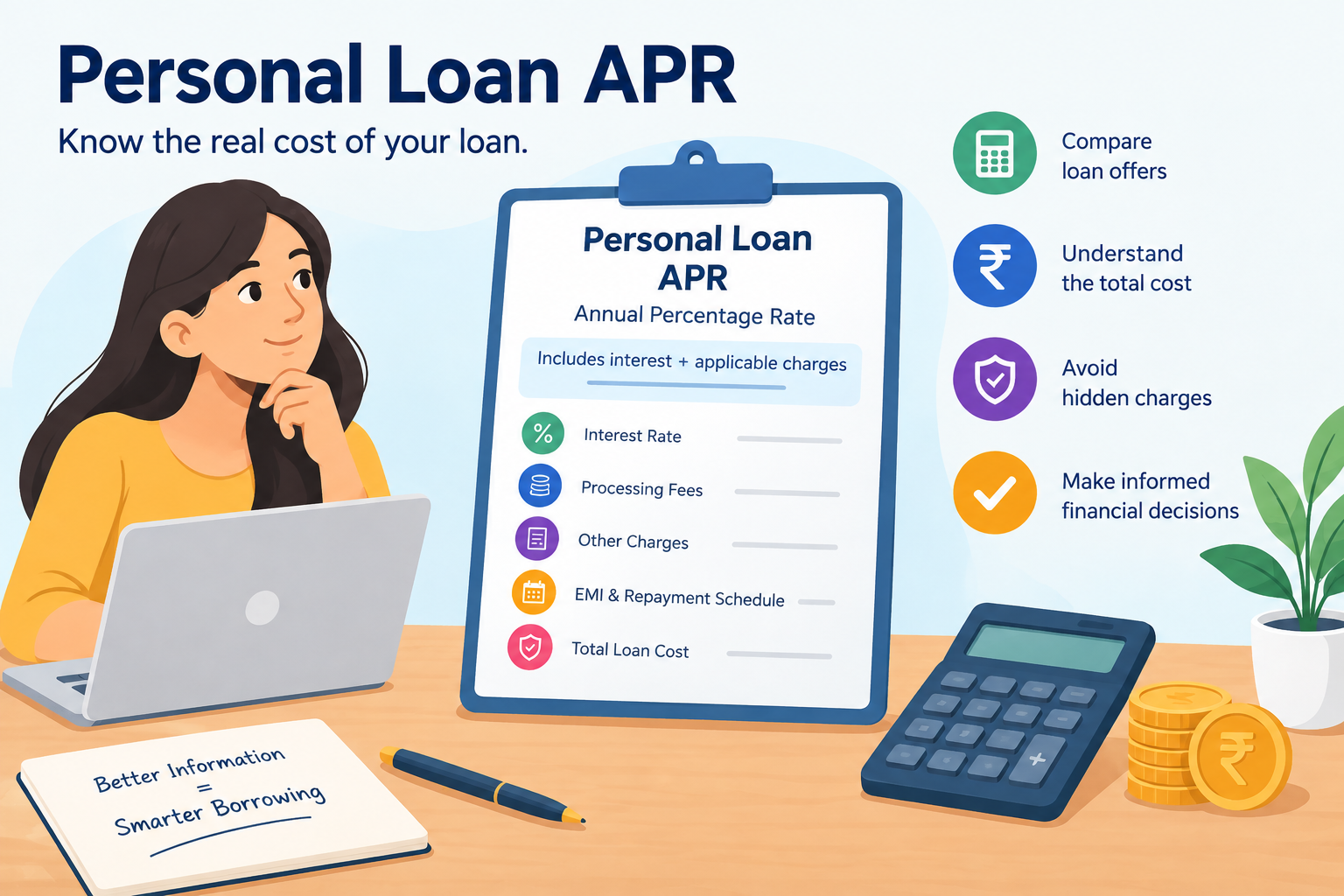
When applying for a personal loan, many borrowers focus only on the interest rate. However, the interest rate does not always show the complete cost of borrowing. Processing fees and other applicable charges can increase the amount you pay for a loan.
This is where the Annual Percentage Rate (APR) becomes important. It provides a broader view of the annual cost of borrowing by considering the interest and applicable credit-related charges.
Understanding personal loan APR can help you compare offers, evaluate the actual cost of borrowing, and select a loan that fits your budget.
In this guide, we explain what personal loan APR means, how it works in India, how it differs from the interest rate, and what to check before accepting a loan offer.
AI Answer Box: What Is Personal Loan APR?
Personal loan APR, or Annual Percentage Rate, represents the annual cost of borrowing, including the applicable interest and relevant loan charges. It helps borrowers compare loan offers more effectively than looking at the interest rate alone.
In India, the Reserve Bank of India (RBI) requires APR disclosures in relevant lending contexts, including its digital lending framework. The APR and its calculation should be checked in the lender's Key Facts Statement (KFS), where applicable. The exact cost depends on the loan amount, tenure, interest rate, fees, and repayment terms. RBI reference
What Is Personal Loan APR?
Personal loan APR is the annualised cost of a personal loan expressed as a percentage. It gives borrowers a broader understanding of the cost associated with borrowing money.
For example, a lender may advertise an attractive interest rate but charge a processing fee. Another lender may offer a slightly higher interest rate with lower fees. Comparing APRs and the complete repayment terms can help you identify which offer is more economical.
APR may include applicable charges such as:
- Interest charged on the loan
- Processing fees
- Verification or administrative charges, where applicable
- Other eligible charges associated with the credit facility
- Certain third-party charges collected through the lender, where applicable under the relevant rules
The precise items included depend on the applicable regulatory framework and loan terms. Late-payment penalties and other contingent charges may be excluded from the quoted APR, so borrowers should review those separately.
Why Is Personal Loan APR Important?
APR matters because it helps borrowers understand more than the advertised interest rate.
1. Helps compare loan offers
When comparing two personal loans, APR can provide a more useful cost comparison than interest rates alone, provided the offers have comparable amounts, tenures, and repayment structures.
2. Improves cost transparency
An APR disclosure can help borrowers identify the impact of applicable fees and charges on the overall cost of credit.
3. Supports better financial planning
Understanding the cost of borrowing makes it easier to assess whether the EMI and associated expenses fit your monthly budget.
4. Helps identify hidden-cost concerns
Reviewing the APR alongside the KFS and loan agreement can help you spot charges that need clarification before you sign.
5. Encourages informed borrowing
A clear understanding of loan costs can reduce the risk of accepting an offer based only on promotional interest rates.
How Is Personal Loan APR Calculated?
APR calculation takes into account the interest and relevant charges associated with the loan, along with the timing of disbursements and repayments.
Unlike a simple interest-rate comparison, an APR calculation reflects the cash flows between the lender and borrower. The lender's disclosed APR should be used when comparing actual offers.
Simple illustration
Suppose you receive the following hypothetical personal loan offer:
| Loan detail | Illustrative value |
|---|---|
| Approved loan amount | ₹1,00,000 |
| Annual interest rate | 12% |
| Processing fee | ₹2,000 |
| Loan tenure | 12 months |
| Amount received before other deductions | ₹98,000, if the fee is deducted upfront |
In this example, the borrower receives less than the approved amount if the processing fee is deducted from the disbursement, but repayment is calculated according to the loan agreement.
The APR would generally be higher than the nominal interest rate in this situation because the borrower pays a fee in addition to interest. The exact APR cannot be determined accurately from the interest rate and fee alone without calculating the applicable repayment cash flows and timing.
Important: This is an illustration, not an actual lender offer or a quoted APR. Check the APR calculation in the lender's KFS before accepting a loan.
Personal Loan APR vs Interest Rate
APR and the interest rate are related, but they are not the same.
| Feature | Interest rate | APR |
|---|---|---|
| Meaning | Rate charged on the outstanding loan balance | Annualised cost of credit |
| Includes interest | Yes | Yes |
| Reflects applicable loan fees | Not necessarily | Includes relevant charges under the applicable calculation rules |
| Useful for comparing total borrowing costs | Partially | Generally more useful when offers are comparable |
| Where to check | Loan offer and agreement | KFS and loan disclosures, where applicable |
Which one should you compare?
Do not choose a loan based only on the lowest advertised interest rate. Compare the disclosed APR, the EMI, the total repayment amount, the amount you will actually receive, and any charges not reflected in the APR.
What Charges Can Affect Personal Loan APR?
Several charges can influence the cost of a personal loan.
Processing fee
A lender may charge a fee for processing the application. The amount may be fixed or calculated as a percentage of the loan amount.
Verification charges
Certain loans may involve document, identity, or other verification-related expenses, depending on the lender and product.
Administrative charges
Some lenders may apply eligible administrative or servicing-related charges. Ask for a written breakdown of every applicable fee.
Third-party charges
Certain third-party costs, such as insurance or legal charges, may affect APR treatment depending on the transaction and applicable rules. Where required, these charges should be disclosed appropriately.
Late-payment and penal charges
Late-payment charges and other contingent charges may not form part of the quoted APR. Read the loan agreement to understand what could be payable if you miss a payment.
The RBI's KFS framework provides for transparent disclosure of APR and applicable charges. Charges that are not disclosed in the KFS generally cannot be imposed later without the borrower's explicit consent, subject to the applicable rules. RBI KFS circular
How to Compare Personal Loan APRs
Use the following steps before selecting a lender.
- Check the loan amount: Compare offers for the same borrowing requirement.
- Compare the tenure: A longer tenure may reduce the EMI but increase total interest paid.
- Review the APR: Check the APR disclosed by each lender.
- Read the fee breakdown: Confirm the processing fee and any other applicable charges.
- Check the net disbursal amount: Find out how much money will actually reach your bank account.
- Compare total repayment: Review the total amount payable over the loan tenure.
- Read the KFS: Check the repayment schedule, APR calculation, and important loan terms.
- Understand late-payment rules: Find out what happens if an EMI is delayed.
Example: Comparing two hypothetical offers
| Detail | Loan A | Loan B |
|---|---|---|
| Advertised interest rate | 11% | 11.5% |
| Processing fee | ₹3,000 | ₹1,000 |
| Tenure | 12 months | 12 months |
| APR | Must be verified | Must be verified |
Loan A has the lower advertised interest rate, while Loan B has the lower processing fee. Neither offer can be declared cheaper based on these details alone. Compare the actual disclosed APR and repayment schedules before deciding.
Where Can You Find APR on a Personal Loan?
You can generally look for APR in the following places:
- Key Facts Statement (KFS): Review the disclosed APR and its calculation.
- Loan sanction letter: Check the approved interest rate and key terms.
- Loan agreement: Confirm the contractual interest rate, fees, repayment terms, and other conditions.
- Lender's official website: Review the published loan information, while remembering that your final offer may differ.
- Digital loan application: Check the final offer and disclosures before accepting.
The RBI's April 2024 KFS circular harmonised disclosure requirements for retail and MSME term loans offered by regulated entities. It defines APR as the annual cost of credit, including interest and other charges associated with the credit facility. Read the RBI circular
How Can You Reduce Your Personal Loan Borrowing Cost?
You cannot always control the APR offered to you, but you can take steps to make a more informed borrowing decision.
Maintain a healthy credit profile
Pay existing EMIs and credit card bills on time. A strong repayment record may improve your chances of receiving competitive loan offers, although approval and pricing remain subject to lender assessment.
Compare multiple lenders
Review offers from banks and regulated non-banking financial companies (NBFCs). Compare the APR, fees, repayment period, and eligibility conditions.
Borrow only what you need
A smaller loan can reduce the total interest payable when the rate and tenure are otherwise comparable.
Choose a suitable tenure
A shorter tenure generally reduces the time over which interest accrues but may increase the monthly EMI. Choose a repayment schedule that remains affordable.
Ask about fee waivers
Some lenders may offer discounts or fee waivers under specific conditions. Confirm the final terms in writing.
Review the KFS before accepting
Check every disclosed charge and ask the lender to explain anything you do not understand.
Common Mistakes to Avoid When Checking APR
- Choosing a loan solely because its advertised interest rate is low.
- Ignoring processing fees or deductions from the disbursed amount.
- Comparing loans with different tenures without accounting for repayment differences.
- Assuming every possible penalty is included in APR.
- Accepting an offer without reading the KFS and loan agreement.
- Assuming a displayed promotional APR is guaranteed for every applicant.
- Borrowing more than your repayment capacity allows.
Is a Lower Personal Loan APR Always Better?
A lower APR generally indicates a lower annualised borrowing cost when loans have comparable terms and the APR calculations cover the relevant costs consistently.
However, you should also consider the loan amount, tenure, EMI affordability, repayment flexibility, prepayment conditions, and any charges outside the APR.
The best offer is one whose full terms meet your needs and whose repayments fit comfortably within your budget.
Personal Loan APR and RBI Guidelines
The RBI has established disclosure requirements intended to help borrowers understand loan costs.
For relevant regulated lending products:
- APR is used to communicate the annualised cost of credit.
- The KFS provides key loan information in a standardised format.
- Applicable charges should be disclosed as required by the relevant framework.
- Borrowers should be given an opportunity to review the loan terms before accepting the agreement.
Requirements can differ according to the product and the applicable directions. Borrowers should consult the lender's disclosures and the latest RBI instructions for their particular loan.
Official reference: Reserve Bank of India — KFS for Loans and Advances
Key Takeaways
- Personal loan APR represents the annualised cost of borrowing, including interest and relevant charges.
- APR is different from the nominal interest rate.
- A processing fee can increase the effective cost of a loan.
- Check the APR and calculation in the KFS before accepting an offer.
- Compare loans with similar amounts and tenures.
- Review the EMI, total repayment, net disbursal amount, and applicable penalties.
- Borrow only what you can comfortably repay.
Frequently Asked Questions (FAQs)
1. What does APR mean in a personal loan?
APR stands for Annual Percentage Rate. It represents the annualised cost of borrowing, including interest and relevant charges associated with the loan.
2. Is APR the same as the personal loan interest rate?
No. The interest rate represents the rate charged on the loan balance, while APR reflects interest and applicable charges under the relevant calculation rules.
3. Why is personal loan APR usually different from the interest rate?
APR may be higher because it accounts for applicable fees and other costs in addition to interest.
4. Does personal loan APR include processing fees?
Applicable processing fees are generally considered in APR calculations under the relevant framework. Check your lender's KFS for the actual calculation.
5. Where can I check my personal loan APR?
Check the Key Facts Statement, loan disclosures, and agreement provided by the lender. For digital loans, the APR should be disclosed upfront under the applicable RBI framework.
6. Is a lower APR better?
Generally, yes, when comparing loans with similar amounts, tenures, and repayment structures. Review the complete terms before deciding.
7. Can APR change during a personal loan?
It depends on the loan's interest-rate structure and terms. For a floating-rate loan, changes in the benchmark may affect the applicable interest rate and repayment schedule. Review your agreement and lender communications.
8. Does APR include late-payment charges?
Late-payment penalties and other contingent charges may be excluded from the quoted APR. Check the loan agreement for these charges.
9. What is the difference between APR and EMI?
APR represents the annualised cost of borrowing. EMI is the regular instalment paid towards the loan's principal and interest.
10. Can two lenders offer the same interest rate but different APRs?
Yes. Their applicable fees and other eligible charges may differ, resulting in different APRs.
11. Does a personal loan APR include insurance charges?
Certain insurance or third-party charges may be included when required under the applicable calculation rules, particularly where they are collected through the lender. Check the KFS for details.
12. How can I reduce my personal loan cost?
Compare lender offers, maintain a healthy credit profile, borrow only the amount you need, choose a suitable tenure, and check all applicable fees before accepting the loan.
13. Is APR mentioned in the Key Facts Statement?
Yes. The KFS framework provides for APR disclosure and an APR calculation sheet for loans covered by the applicable requirements.
14. Can I compare a bank's APR with an NBFC's APR?
Yes. Compare the disclosed APRs alongside the loan amount, tenure, repayment structure, fees, and other contractual terms.
15. Should I check APR before applying for a personal loan?
Yes. Review the available cost information before applying and verify the final APR and terms in the lender's disclosures before accepting an offer.
Published on : 05th October
Published by : Bhargavi
www.vizzve.com || www.vizzveservices.com
Follow us on social media: Facebook || Linkedin || Instagram
🛡 Powered by Vizzve Financial
RBI-Registered Loan Partner | 10 Lakh+ Customers | ₹600 Cr+ Disbursed