

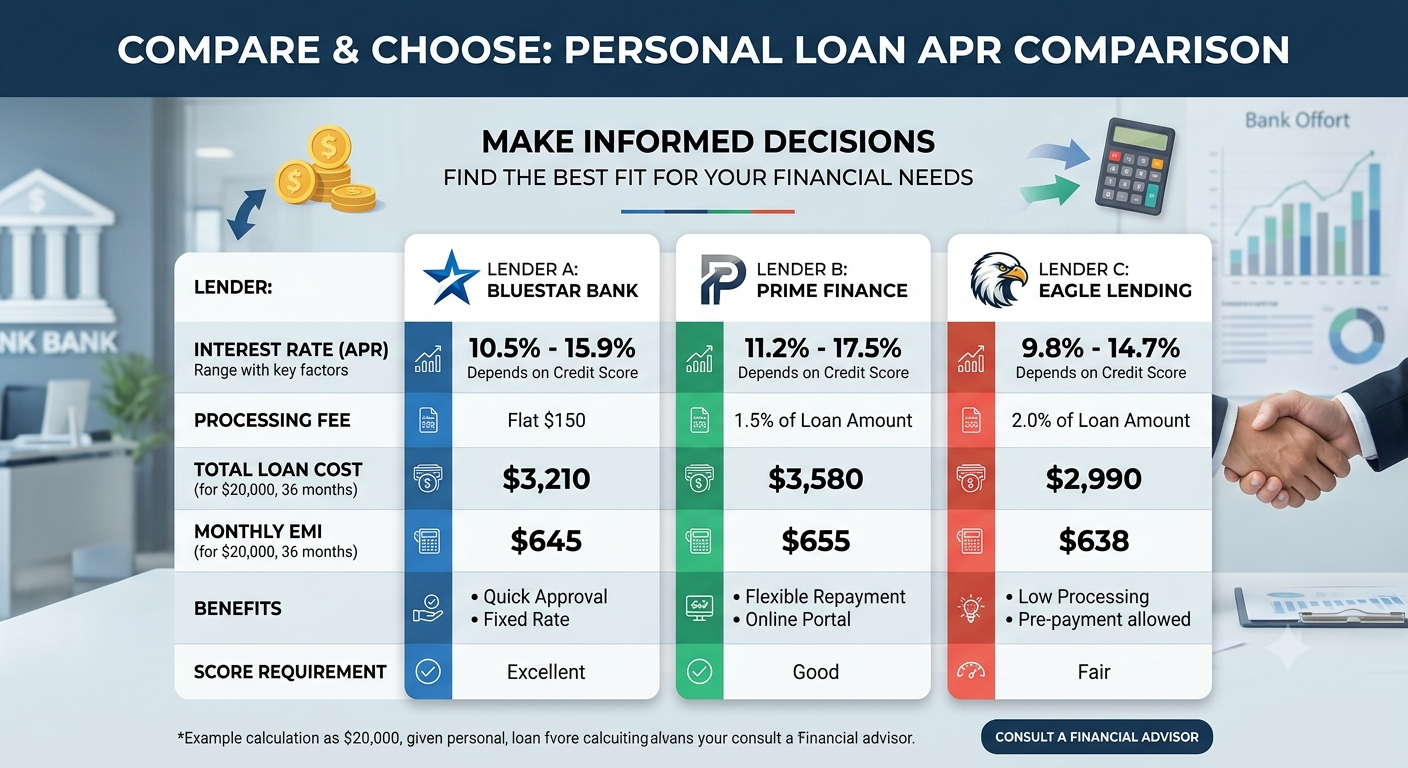
When applying for a personal loan, borrowers often compare interest rates to find an affordable option. However, the interest rate alone may not show the complete cost of borrowing. This is where the Annual Percentage Rate (APR) becomes important.
Personal Loan APR helps borrowers understand the annual cost of a loan, including the interest rate and applicable charges. By checking APR before accepting a loan offer, you can compare different lenders more effectively and make a better-informed financial decision.
What Is APR in a Personal Loan?
APR stands for Annual Percentage Rate. It represents the annualised cost of borrowing, including the interest and applicable charges associated with a personal loan.
For example, a lender may advertise a competitive interest rate but also charge a processing fee. The APR helps account for these applicable costs, providing a broader picture of the loan's expense.
In India, the Reserve Bank of India (RBI) requires lenders to disclose APR in the Key Facts Statement (KFS) for applicable loans. This helps borrowers understand the overall cost of credit before accepting a loan offer.
Why Is Personal Loan APR Important?
Understanding APR can help borrowers make more informed financial decisions.
-
Compare loan offers: Evaluate the cost of loans from different lenders.
-
Understand borrowing costs: Look beyond the advertised interest rate.
-
Identify applicable fees: Review the charges included in the APR calculation.
-
Plan repayments: Consider the total cost alongside your monthly EMI.
-
Improve transparency: Understand the financial commitment before accepting a loan.
A lower APR may indicate a less expensive loan, provided the loan amount, tenure and other terms are comparable.
APR vs Interest Rate: What Is the Difference?
APR and the interest rate are related, but they are not the same.
|
Feature |
Interest rate |
APR |
|---|---|---|
|
Meaning |
Cost charged on the borrowed principal |
Annualised cost of credit |
|
Includes interest |
Yes |
Yes |
|
Includes applicable fees |
Generally no |
Yes, as prescribed by applicable rules |
|
Useful for |
Understanding the loan's interest cost |
Comparing overall borrowing costs |
|
Best practice |
Check it before borrowing |
Compare it alongside loan terms |
Borrowers should review both figures before making a final decision.
How Is Personal Loan APR Calculated?
APR is calculated using the loan's interest payments, applicable charges, repayment schedule and the timing of cash flows. It is generally expressed as an annual percentage.
For applicable loans, the lender provides the APR calculation in the KFS, so borrowers do not necessarily need to calculate it manually.
For example, consider a hypothetical personal loan with these details:
-
Loan amount: ₹1,00,000
-
Loan tenure: 12 months
-
Interest rate: 12% per annum
-
Processing fee: ₹2,000, plus applicable taxes
The processing fee increases the effective cost of borrowing because the borrower may receive less than ₹1,00,000 after deductions while remaining responsible for repaying the agreed loan amount.
Important: The actual APR cannot be determined from these figures alone without the exact repayment schedule, fee treatment and cash-flow details.
Factors That Affect Personal Loan APR
Several factors may influence the APR offered by a lender.
1. Interest Rate
The interest rate is a major component of APR. A higher rate generally increases the borrowing cost.
2. Processing Fees
Processing fees and other applicable charges can increase APR, depending on how they are treated in the calculation.
3. Loan Tenure
The repayment period affects the timing of payments and the effective annual cost of borrowing. Compare loans with similar tenures when evaluating offers.
4. Credit Profile
A borrower's credit history, repayment record, income and existing financial obligations may influence the interest rate and loan terms offered by a lender.
5. Other Applicable Charges
Certain charges associated with the loan may also affect its disclosed APR, depending on the applicable RBI framework and the nature of the charge.
How to Compare Personal Loans Using APR
Before selecting a personal loan, follow these steps:
-
Check the KFS: Review the APR disclosed by each lender.
-
Compare similar offers: Use the same loan amount and a similar tenure for a fair comparison.
-
Review processing fees: Check whether fees are deducted upfront or payable separately.
-
Calculate affordability: Ensure the EMI fits your monthly budget.
-
Read the loan agreement: Check repayment conditions, late-payment charges and prepayment terms.
-
Verify the lender: Confirm that the loan is offered by an RBI-regulated bank or eligible NBFC.
APR is an important comparison tool, but it should not replace a review of the loan's complete terms and conditions.
Common Mistakes to Avoid
Borrowers should avoid these common mistakes when comparing APR:
-
Choosing a loan based only on its advertised interest rate.
-
Ignoring processing fees and applicable taxes.
-
Comparing loans with very different repayment periods without considering the differences.
-
Assuming that a lower EMI always means a cheaper loan.
-
Overlooking late-payment penalties and prepayment conditions.
-
Accepting an offer without reading the KFS.
Taking a few minutes to review these details can help you avoid unexpected borrowing costs.
How Vizzve Encourages Informed Borrowing
At Vizzve, understanding personal loan terms is an important part of responsible borrowing. Learning about APR, processing fees, EMIs and repayment schedules can help borrowers assess loan offers more confidently.
Before applying for a personal loan, review the KFS, verify the lender's credentials and check whether the repayment amount suits your financial situation. Approval, interest rates and loan terms depend on the lender's policies and individual eligibility.
Conclusion
Personal Loan APR provides a broader understanding of the annual cost of borrowing by accounting for interest and applicable charges. It can help you compare loan offers more effectively and identify the costs that may not be obvious from the advertised interest rate.
Before accepting a personal loan, check the APR in the KFS, review the EMI schedule and read the loan agreement carefully. A well-informed borrowing decision starts with understanding the complete cost of your loan.
Published on : 29th October 2026
Published by : Yogendra
www.vizzve.com || www.vizzveservices.com
Follow us on social media: Facebook || Linkedin || Instagram
🛡 Powered by Vizzve Financial
RBI-Registered Loan Partner | 10 Lakh+ Customers | ₹600 Cr+ Disbursed