

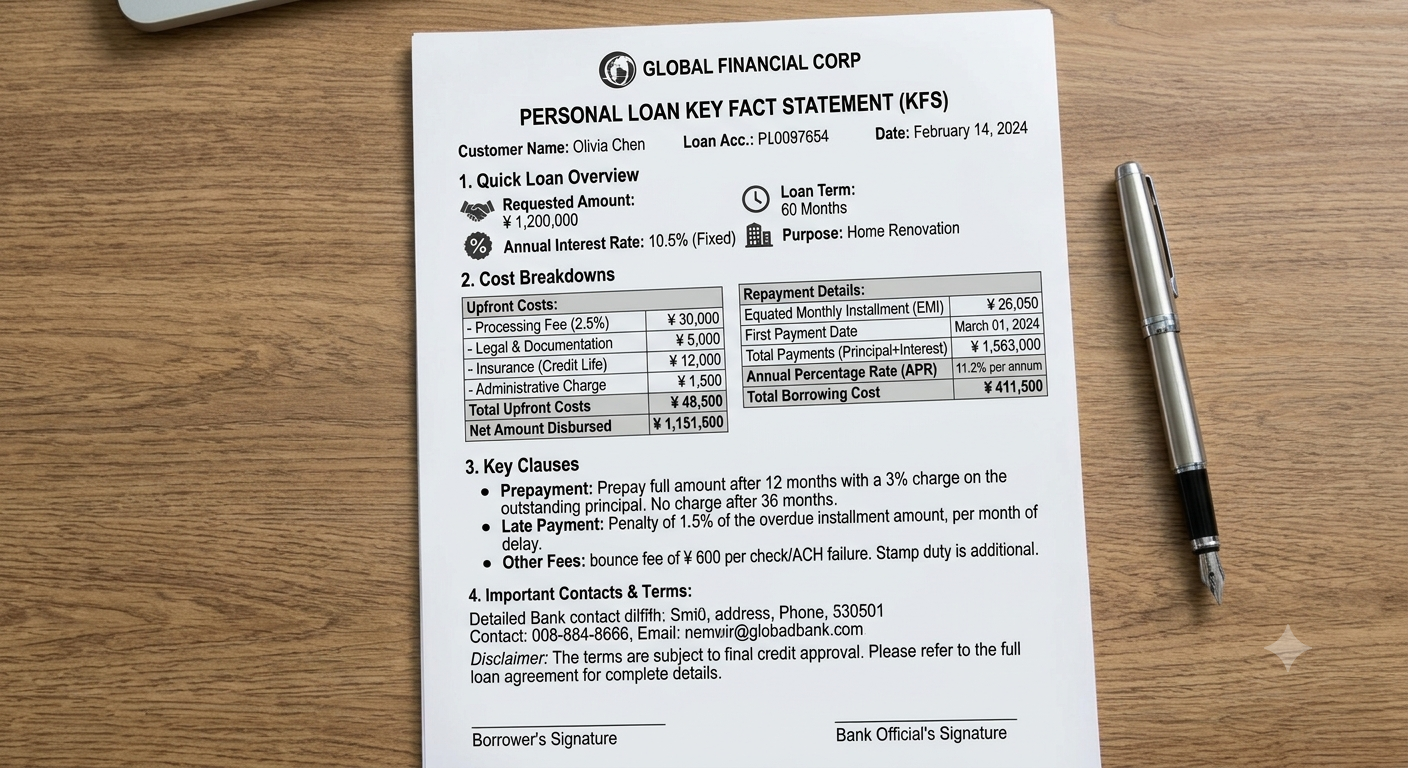
APR stands for Annual Percentage Rate. It represents the annualised cost of a personal loan, including the interest rate and applicable loan-related charges.
Unlike the nominal interest rate, which mainly reflects the cost of borrowing the principal amount, APR provides a broader view of the loan's cost.
For example, two lenders may offer personal loans at similar interest rates but charge different processing fees. In such cases, their APRs may differ.
APR generally considers:
-
Interest payable on the loan.
-
Processing fees.
-
Applicable administrative charges.
-
Other charges included under the applicable APR calculation rules.
Understanding APR helps borrowers evaluate the overall cost instead of focusing only on the advertised interest rate.
2. Why Is Personal Loan APR Important?
APR plays an important role when selecting a personal loan. It helps borrowers understand the financial commitment involved before accepting a loan offer.
Here are some important reasons to check APR:
1. Understand the Actual Borrowing Cost
APR gives borrowers a broader understanding of the annualised cost of a loan, including applicable charges.
2. Compare Different Loan Offers
When comparing personal loans from different banks and NBFCs, APR can help identify which offer has a lower overall borrowing cost.
3. Avoid Unexpected Expenses
Reviewing APR and its accompanying cost disclosures helps borrowers identify additional charges associated with borrowing.
4. Improve Financial Planning
Understanding borrowing costs makes it easier to plan EMIs and manage monthly expenses.
5. Make Informed Decisions
APR helps borrowers evaluate loan offers based on their actual cost rather than promotional interest rates alone.
3. APR vs Interest Rate: What Is the Difference?
APR and interest rates are related, but they are not the same.
|
Comparison |
Interest Rate |
APR |
|---|---|---|
|
Meaning |
Cost of borrowing the principal |
Annualised cost of borrowing |
|
Processing Fees |
Generally excluded |
Applicable charges included |
|
Additional Costs |
Limited scope |
Broader cost coverage |
|
Loan Comparison |
Useful |
More comprehensive |
|
Borrower Awareness |
Shows interest cost |
Shows overall borrowing cost |
Example: Suppose two lenders offer the same personal loan interest rate, but one charges a higher processing fee. The second loan may have a higher APR.
This is why borrowers should compare APR instead of relying only on the interest rate.
4. How Is Personal Loan APR Calculated?
APR is calculated by considering the loan amount received by the borrower, repayment instalments and applicable charges over the loan tenure.
The calculation generally considers:
-
Principal loan amount.
-
Applicable interest rate.
-
Processing fees.
-
Applicable third-party charges.
-
Repayment frequency and schedule.
-
Other charges included under RBI's applicable APR calculation requirements.
The lender uses the cash flows associated with the loan to calculate its effective annualised cost.
Illustrative Example
Suppose a borrower receives the following personal loan offer:
|
Loan Details |
Amount |
|---|---|
|
Loan Amount |
₹1,00,000 |
|
Interest Rate |
14% p.a. |
|
Processing Fee |
₹2,000 |
|
Loan Tenure |
12 Months |
|
EMI |
Depends on repayment calculation |
In this example, the borrower should consider both the interest payable and the applicable processing fee while evaluating the offer.
The exact APR must be calculated using the lender's applicable cash-flow methodology. It cannot be accurately determined simply by adding the processing fee percentage to the interest rate.
5. Factors That Affect Personal Loan APR
Several factors can influence the APR offered by a lender.
1. Credit Score
A borrower's credit history and credit score may influence the interest rate and loan terms offered by a lender. A strong credit profile may improve access to competitive loan offers, subject to lender policies.
2. Loan Amount
The amount borrowed can affect the applicable fees and overall borrowing cost.
3. Repayment Tenure
A longer repayment period can increase the total interest paid, even if the EMI is lower. The APR calculation also considers the timing of repayments.
4. Processing Fees
Processing fees and other applicable charges can increase the overall cost of borrowing.
5. Income and Repayment Capacity
Lenders may evaluate monthly income, existing EMIs, employment stability and repayment history before deciding the loan terms.
6. Lender Policies
Different banks and NBFCs may have different pricing structures, eligibility requirements and fee policies.
6. How to Get a Lower APR on a Personal Loan
Borrowers can take several steps to improve their chances of receiving a competitive personal loan offer.
-
Maintain a healthy credit score: Pay existing EMIs and credit card bills on time.
-
Compare multiple lenders: Review APR, processing fees and repayment conditions.
-
Choose an affordable loan amount: Avoid borrowing more than your actual requirement.
-
Maintain stable income records: Keep salary slips, bank statements and income documents updated.
-
Reduce existing debt: A manageable debt-to-income position may strengthen your loan application.
-
Read the KFS carefully: Check all disclosed charges before accepting an offer.
Remember that a lower APR is not guaranteed. Final loan pricing depends on the lender's eligibility assessment and applicable policies.
7. APR and EMI: How Are They Connected?
APR and EMI are closely related when evaluating a personal loan, but they serve different purposes.
-
APR indicates the annualised cost of borrowing.
-
EMI represents the fixed periodic repayment amount, generally consisting of principal and interest.
-
Total repayment represents the total amount paid throughout the loan tenure.
For example, a borrower may receive a loan with an affordable EMI but a longer tenure. Although monthly payments may be manageable, the total interest paid could be higher.
Therefore, borrowers should evaluate APR, EMI and total repayment together rather than choosing a loan based on only one factor.
8. RBI Guidelines on APR and Personal Loans
The Reserve Bank of India has introduced disclosure requirements to improve transparency in lending.
Under the RBI's April 15, 2024 Key Facts Statement circular, regulated entities must provide prospective borrowers with a standardised KFS for applicable retail and MSME term loans before executing the loan agreement.
Important provisions include:
-
APR must be disclosed in the KFS.
-
The KFS must include an APR calculation sheet.
-
The loan amortisation schedule must be provided.
-
Applicable charges collected by the lender must be included in the APR.
-
Certain third-party charges collected by the lender on behalf of service providers must also be included and separately disclosed.
-
Charges not disclosed in the KFS cannot be imposed without the borrower's explicit consent.
For digital lending, RBI guidelines also require upfront disclosure of APR and relevant loan information.
9. Common Mistakes to Avoid While Comparing APR
Borrowers should avoid these mistakes when reviewing personal loan offers:
-
Focusing only on interest rates: Always check APR for a broader understanding of borrowing costs.
-
Ignoring processing fees: Additional charges can increase the overall cost.
-
Choosing the lowest EMI: A longer tenure may increase total interest payments.
-
Not reading the KFS: Important financial conditions may be overlooked.
-
Ignoring repayment conditions: Understand late-payment and prepayment terms.
-
Not verifying the lender: Always check whether the actual lending institution is regulated.
10. Personal Loan APR Safety Checklist
Before accepting a personal loan, make sure you:
-
Verify the bank or NBFC providing the loan.
-
Check the APR mentioned in the KFS.
-
Review the interest rate and processing fee.
-
Understand the EMI and repayment tenure.
-
Check applicable third-party charges.
-
Review penal charges and prepayment conditions.
-
Save a copy of the KFS and loan agreement.
-
Ensure the EMI fits comfortably within your monthly budget.
A careful review can help borrowers avoid unnecessary financial pressure.
11. Frequently Asked Questions (FAQs)
Q1. What does APR mean in a personal loan?
APR means Annual Percentage Rate. It represents the annualised cost of borrowing, including interest and applicable loan-related charges.
Q2. Is APR different from the interest rate?
Yes. The interest rate represents the cost of borrowing, while APR provides a broader view by including applicable charges.
Q3. Is a lower APR better for a personal loan?
Generally, yes. A lower APR indicates a lower annualised borrowing cost, assuming comparable loan amounts, repayment structures and terms.
Q4. Where can I find APR details?
You can find APR information in the Key Facts Statement provided by the regulated lender.
Q5. Does APR include processing fees?
Yes. Applicable processing fees are included in the APR calculation under the relevant RBI requirements.
Q6. Does APR affect monthly EMI?
APR helps indicate the overall borrowing cost, while EMI is determined by the loan amount, interest rate and repayment tenure.
Q7. Can APR change during the loan tenure?
For a fixed-rate loan, the agreed pricing generally remains unchanged, subject to contractual terms. For floating-rate loans, changes in the benchmark rate can affect borrowing costs.
Q8. Is APR mandatory for digital personal loans?
Yes. RBI's digital lending guidelines require regulated entities to disclose APR upfront and include it in the KFS.
Q9. Does a high credit score guarantee a lower APR?
No. A strong credit score may improve eligibility for competitive offers, but lenders also consider income, existing debt and other factors.
Q10. Can I compare loans using APR?
Yes. APR is a useful comparison tool when reviewing similar personal loan offers from different lenders.
Q11. Does APR include late-payment penalties?
Contingent charges such as penal and late-payment charges are treated separately under applicable RBI digital lending APR rules. Borrowers should review their separate disclosure in the KFS.
Q12. What should I check besides APR?
Review the EMI, total repayment amount, processing fees, tenure, prepayment conditions and lender credibility.
Conclusion
Understanding Personal Loan APR is essential before choosing a loan. While interest rates help borrowers understand the basic cost of borrowing, APR provides a more complete picture by including applicable loan-related charges.
Before applying for a personal loan, compare APR, check the KFS, understand the EMI and review all repayment conditions. These steps can help you make informed borrowing decisions and manage your finances responsibly.
Published on : 2th November 2026
Published by : Yogendra
www.vizzve.com || www.vizzveservices.com
Follow us on social media: Facebook || Linkedin || Instagram
🛡 Powered by Vizzve Financial
RBI-Registered Loan Partner | 10 Lakh+ Customers | ₹600 Cr+ Disbursed