

Blog Banner

Blog Details

Personal Loan Disbursement: Complete Guide for Borrowers in India

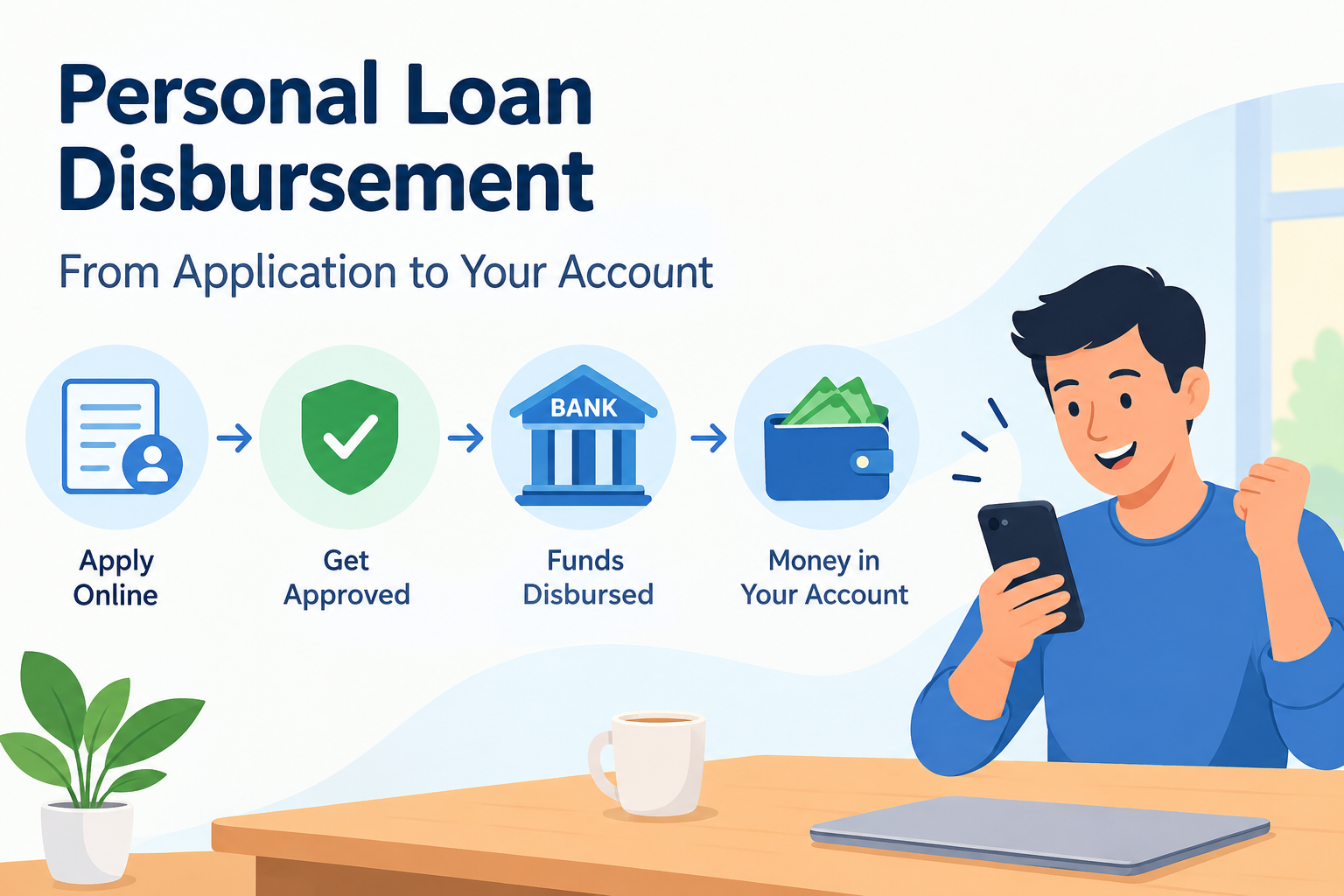
Personal loan disbursement process illustrated with four steps: applying online, loan approval, fund disbursement, and money credited to the borrower's bank account

Personal Loan Disbursement: Complete Guide for Borrowers in India

Vizzve Admin

Introduction

Getting a personal loan approved can bring relief when you need money for medical expenses, education, travel, home repairs, or other planned and unexpected costs. However, approval is only one stage of the borrowing process. The next important step is personal loan disbursement, when the lender releases the approved loan amount to your bank account or another permitted destination.

Understanding this process helps you know when to expect the money, which checks may still be pending, and what to do if the transfer is delayed.

For borrowers in India, disbursement timelines vary depending on the lender, document verification, completion of formalities, banking systems, and the applicant's circumstances. Some eligible digital-loan applications may be processed quickly, while others require additional checks.

This guide explains the complete personal loan disbursement process, expected timelines, status tracking, common problems, and practical steps to help you receive your funds smoothly.

AI Answer Box: What Is Personal Loan Disbursement?

Personal loan disbursement is the process through which a bank or regulated lending institution releases an approved loan amount to the borrower's designated bank account or other permitted recipient.

The usual process includes loan approval, acceptance of the loan terms, completion of required verification and documentation, and transfer of funds.

How long does it take? The time varies by lender and application. Some digital loans may be disbursed within hours after all requirements are completed, while other applications may take several business days. Approval alone does not guarantee immediate payment.

 What Is Personal Loan Disbursement?

Personal loan disbursement is the stage at which the lender releases funds after completing the applicable approval and verification requirements.

For example, suppose a borrower applies for a personal loan of ₹2,00,000 to cover home renovation expenses. The lender evaluates the application and approves a loan amount of ₹1,80,000. Once the borrower completes the required formalities and the lender authorizes the transfer, the approved amount is disbursed according to the loan agreement.

The amount received may differ from the sanctioned amount if applicable fees, taxes, or other permitted deductions are made.

Important terms to understand

Term

Meaning

Loan application

The request submitted by the borrower

Loan approval

The lender's decision to approve the application, subject to applicable conditions

Sanctioned amount

The amount the lender has agreed to provide

Loan agreement

The document describing the borrowing terms and obligations

Disbursement

The release of the loan funds

Net disbursement amount

The amount actually received after applicable deductions

EMI

Equated Monthly Instalment paid towards repayment

Remember: Loan approval and loan disbursement are different stages. Always check whether the lender has completed the conditions required before releasing the funds.

How Does the Personal Loan Disbursement Process Work?

The personal loan disbursement process generally follows several stages. The exact steps depend on the lender and the type of loan.


Step 1: Submit the loan application

Provide personal details, employment information, income details, requested loan amount, and other information required by the lender.


Step 2: Complete verification

The lender may verify your identity, address, income, employment, bank account, and credit history.


Step 3: Receive the loan sanction

If your application meets the lender's criteria, you may receive a sanction letter or an approval notification specifying the approved amount and applicable conditions.


Step 4: Accept the loan terms

Review the interest rate, tenure, EMI, applicable charges, repayment schedule, and loan agreement. Complete any remaining consent or signing requirements.


Step 5: Receive the funds

After the required conditions are satisfied, the lender initiates the transfer to your verified bank account or another permitted beneficiary account.


Step 6: Confirm the credit and repayment details

Check your bank statement, save the loan agreement, and note the EMI amount, first repayment date, and repayment method.

What happens after loan approval?

After approval, the lender may still need to complete final verification, confirm the borrower's bank account, obtain acceptance of the loan agreement, or complete other applicable checks.

Therefore, an approval SMS or email does not necessarily mean the funds have already been transferred.

 How Long Does Personal Loan Disbursement Take?

Personal loan disbursement time varies by lender, application type, verification requirements, and banking conditions.

Application situation

Possible timeline

Eligible digital loan with completed formalities

Sometimes within hours

Existing customer with verified details

May be faster, depending on the lender

New customer requiring additional verification

May take several business days

Application with missing or inconsistent documents

May be delayed

Transfer affected by a bank or payment issue

Depends on when the issue is resolved

These are general illustrations, not guaranteed timelines or a promise from any particular lender.

Factors that affect disbursement time

  • Document verification: Incomplete or unclear documents can delay processing.

  • Income verification: The lender may need to confirm salary, employment, or other income details.

  • Bank account validation: Incorrect account information or a name mismatch can require correction.

  • Loan agreement: Funds may not be released until all required documents and acceptances are complete.

  • Working days and banking hours: Weekends, holidays, and transfer-processing schedules can affect when money appears.

  • Lender policies: Different lenders have different approval and disbursement procedures.

Can a personal loan be disbursed on the same day?

Yes, some lenders offer same-day disbursement for eligible applications after all required checks and formalities are completed. However, same-day payment is not guaranteed for every applicant.

Before relying on a particular date, confirm the expected transfer time directly with the lender.

What Documents Are Required for Personal Loan Disbursement?

The required documents vary depending on whether you are salaried, self-employed, an existing customer, or applying through a digital lending platform.

Document or detail

Why it may be required

PAN or other accepted identity details

Identity and eligibility verification

Aadhaar or another accepted address/identity document

KYC, where applicable

Salary slips

Evidence of salary income

Bank statements

Assessment of income and financial transactions

Employment details

Confirmation of employment

Bank account details

Transfer of loan proceeds

Signed or digitally accepted loan agreement

Confirmation of borrowing terms

Additional supporting documents

Resolution of specific verification requirements

Not every lender requires every item. Some lenders may already have verified information for existing customers or may use permitted digital verification methods.

How to avoid document-related delays

  • Enter your name and personal details consistently across documents.

  • Provide clear, valid, and current documents where required.

  • Check that your bank account is active and the account details are correct.

  • Respond promptly if the lender requests additional information.

  • Complete digital signatures and other required authorisations.

  • Never share OTPs, passwords, or banking PINs with an agent claiming to speed up disbursement.

 How Is the Personal Loan Amount Disbursed?

Personal loan funds are commonly released through an electronic bank transfer. The exact method and permitted destination depend on the lender, the loan purpose, and applicable regulations.

Common disbursement methods

1. Direct bank transfer

The lender transfers the loan proceeds to the borrower's verified bank account. The borrower can then use the money for permitted expenses.

2. Disbursement for a specific purpose

Where the loan is intended for a particular use and the applicable rules or loan terms require it, funds may be transferred directly to the relevant beneficiary.

3. Digital loan disbursement

An eligible digital loan may be processed through an online application, electronic agreement, and electronic transfer. Digital processing does not eliminate the need for required checks.

Under the RBI's Digital Lending Directions, 2025, disbursement for digital loans is generally required to go directly to the borrower's bank account, subject to specified exceptions, including certain end-use and regulatory requirements.

How much money will you receive after deductions?

The amount credited may be lower than the sanctioned amount if the lender deducts permitted charges at disbursement.

For example:

Particulars

Illustrative amount

Sanctioned personal loan

₹1,00,000

Assumed processing fee

₹2,000

Assumed GST on the fee at 18%

₹360

Illustrative net amount received

₹97,640

This example assumes that the processing fee is deducted upfront and GST applies at 18% to that fee. Actual charges, applicable taxes, and collection methods vary by lender. Check the loan documents before accepting the offer.

What should you check before accepting the funds?

  • Sanctioned loan amount

  • Interest rate and whether it is fixed or floating

  • Annual Percentage Rate (APR), where disclosed

  • Processing fee and applicable taxes

  • Loan tenure and EMI

  • First repayment date

  • Late-payment and prepayment conditions

  • Net amount expected to reach your account

The RBI's Key Facts Statement framework provides borrowers with important loan information, including costs and repayment details. Review the applicable KFS and loan agreement rather than relying only on an advertised interest rate.

 Personal Loan Disbursement Status: How to Check It

If you want to know whether your personal loan has been disbursed, use the lender's official channels.

Step-by-step status-checking guide

  1. Visit the official website or open the verified application of your lender.

  2. Log in using the authentication method provided by the lender.

  3. Open the loan dashboard or application-tracking section.

  4. Look for the current application status.

  5. If the status is unclear, contact the lender's official customer support team.

  6. Once disbursement is confirmed, check your bank statement for the credited amount.

What do common loan statuses mean?

Status

General meaning

What you can do

Application received

Your application has been submitted

Wait for the next update

Under verification

Required checks are in progress

Respond to document requests

Approved or sanctioned

The loan has been approved, possibly subject to conditions

Review the terms and pending requirements

Agreement pending

Some acceptance or signing formalities remain

Complete the required steps

Disbursement initiated

The lender has started the transfer process

Check the expected transfer time

Disbursed

The lender records the funds as released

Verify the amount in your bank account

On hold

An issue or requirement may be unresolved

Ask the lender for the exact reason

Status labels differ among lenders. If the portal says "disbursed" but the money is not visible in your account, ask the lender for the transfer reference and confirmation of the destination account.

 Why Is Personal Loan Disbursement Delayed?

A delay after loan approval can be frustrating, particularly when the money is needed for an urgent expense. However, there can be several reasons why a lender has not released the funds.

Common reasons for disbursement delays

Incomplete documentation: A missing signature, unclear document, or pending declaration may prevent the process from moving forward.

Bank account verification issues: Incorrect account details, inactive accounts, or a mismatch in the beneficiary's information may require correction.

Pending loan formalities: Approval may be conditional on signing the agreement, accepting the final terms, or completing additional verification.

Additional risk checks: The lender may need to resolve a discrepancy in the application or complete further checks before releasing the money.

Technical or payment-processing problems: A bank system interruption or unsuccessful transfer can delay the credit.

Bank holidays and non-business days: Depending on the transfer method and lender, a payment initiated outside normal processing hours may take longer to appear.

What should you do if your loan is approved but not disbursed?

  1. Check whether your loan agreement has been completed.

  2. Look for pending tasks or document requests in the official loan portal.

  3. Confirm that your bank account details are correct.

  4. Contact the lender and request the current status and expected timeline.

  5. If the lender says the payment has been sent, request the transaction reference.

  6. If the issue remains unresolved, use the lender's formal grievance-redressal process.

Do not pay an unofficial agent or share confidential banking credentials to accelerate the transfer.

 Approved vs. Sanctioned vs. Disbursed Personal Loan

Borrowers sometimes use these terms interchangeably, but they can refer to different stages of a loan application.

Feature

Approved

Sanctioned

Disbursed

Meaning

Application has received a positive decision

Lender has formally specified the loan terms and amount

Funds have been released

Money available?

Not necessarily

Not necessarily

Expected to be available after successful transfer

Further steps possible?

Yes

Yes, if conditions remain

Transfer confirmation may still be needed

What to check

Approval conditions

Sanction letter and agreement

Bank statement and loan account

Example: A borrower receives approval for ₹1,50,000 on Monday. The lender issues the sanction terms on Tuesday, and the borrower completes the required agreement on Wednesday. If the lender initiates the transfer on Thursday, the loan has been approved before the money is actually disbursed.

This is an illustrative example, not a standard timeline.

Pros and Cons of Personal Loan Disbursement

Personal loan disbursement makes approved funds available without requiring the borrower to arrange the entire amount independently. However, the convenience comes with repayment obligations.

Advantages

  • Access to funds for eligible expenses

  • Potentially quick electronic transfer

  • No collateral for a typical unsecured personal loan

  • Predictable repayments with a fixed-rate, fixed-EMI loan

  • Online tracking with participating lenders

Disadvantages

  • Disbursement may be delayed

  • Fees may reduce the amount received

  • Interest increases the total borrowing cost

  • Missed EMIs can lead to additional charges and credit-score consequences

  • Easy access may encourage unnecessary borrowing

Is quick disbursement always the best option?

Not necessarily. A loan that reaches your account quickly may still have a high interest rate, expensive fees, or an unsuitable repayment period.

Compare the total borrowing cost and monthly repayment obligation before choosing a lender. Speed should be one consideration, not the only consideration.

 Personal Loan Disbursement vs. Loan Repayment

Disbursement and repayment are opposite stages of the borrowing process.

Factor

Loan disbursement

Loan repayment

Purpose

Releases the funds

Returns the borrowed money

Main party initiating the transaction

Usually the lender

Usually the borrower through the agreed repayment method

Timing

After approval and required formalities

According to the repayment schedule

Financial effect

Creates or activates the borrowing obligation

Reduces the outstanding debt as payments are applied

Key document

Sanction letter and loan agreement

EMI schedule and loan account statement

When does EMI repayment begin after disbursement?

The first EMI date depends on the loan agreement and repayment schedule. It may not fall immediately after the funds reach your account.

Before spending the money, check:

  • The date of the first EMI

  • The monthly repayment amount

  •  

    #PersonalLoan #PersonalLoanDisbursement #LoanDisbursement #PersonalFinance #LoanApproval #InstantPersonalLoan #DigitalLending #LoanProcess #FinancialPlanning #MoneyManagement #BankingIndia #LoanApplication #VizzveFinancial #SmartBorrowing #FinancialAwareness


    Disclaimer: This article may include third-party images, videos, or content that belong to their respective owners. Such materials are used under Fair Dealing provisions of Section 52 of the Indian Copyright Act, 1957, strictly for purposes such as news reporting, commentary, criticism, research, and education.
    Vizzve and India Dhan do not claim ownership of any third-party content, and no copyright infringement is intended. All proprietary rights remain with the original owners.
    Additionally, no monetary compensation has been paid or will be paid for such usage.
    If you are a copyright holder and believe your work has been used without appropriate credit or authorization, please contact us at grievance@vizzve.com. We will review your concern and take prompt corrective action in good faith... Read more

Trending Post


Latest Post


Our Product

Get Personal Loans up to 10 Lakhs in just 5 minutes