

Introduction
Applying for a personal loan can be easier when your documents are ready before you begin the application.
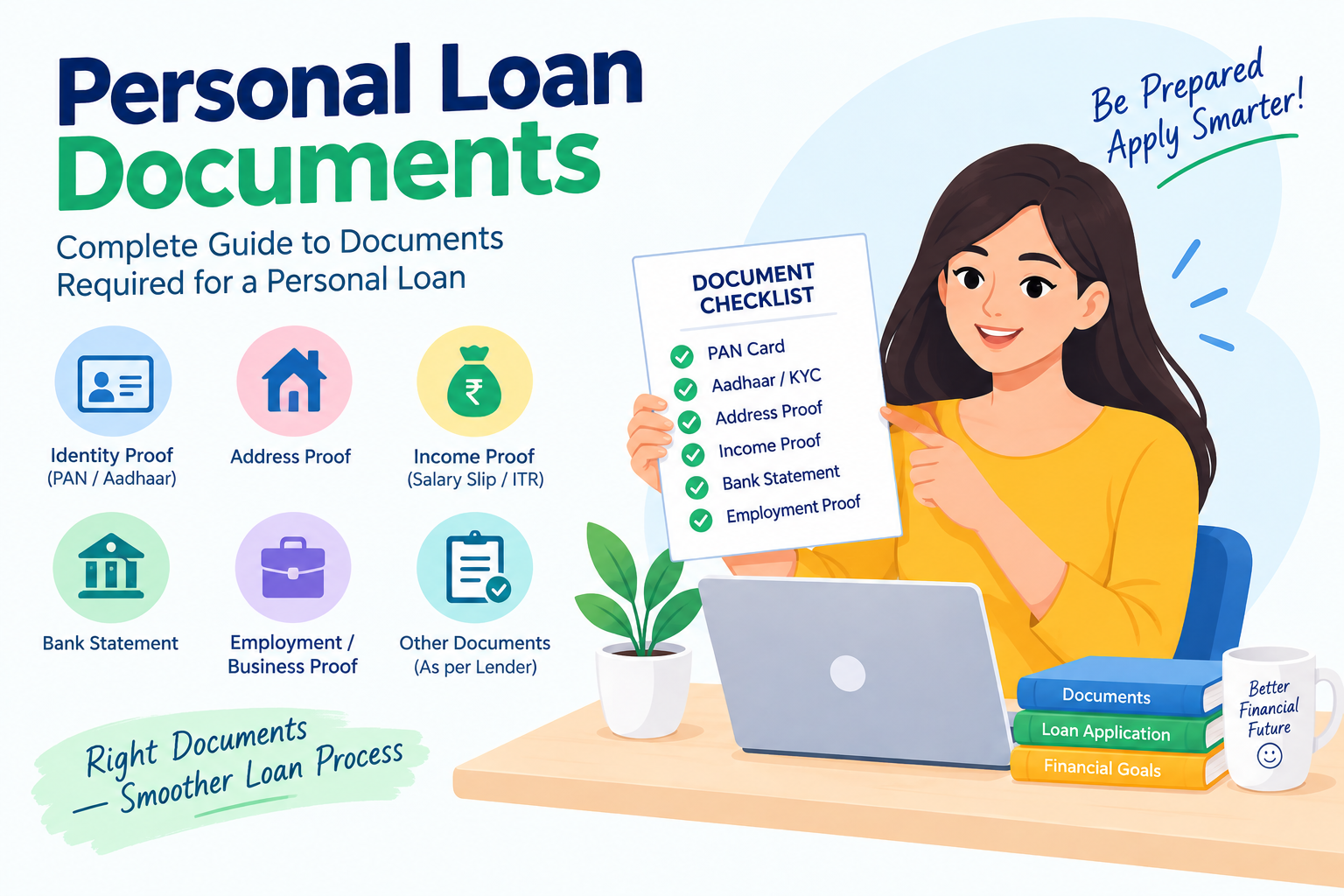
Whether you apply online or through a traditional lender, the lender generally needs information to verify your identity, address, income, employment or business profile, banking details and repayment capacity.
The exact document list is not identical for every borrower. A salaried employee may be asked for salary slips and employment information, while a self-employed applicant may need business and income-related records.
For KYC purposes, RBI rules recognize specified Officially Valid Documents (OVDs) and equivalent electronic documents. Depending on the applicable KYC process, lenders may also require PAN or Form 60 and additional information relating to financial status or the nature of the customer's activities.
The simplest approach is to prepare your KYC, income and banking documents in advance and then check the specific lender's current checklist.
AI Answer Box: What Documents Are Required for a Personal Loan?
The documents commonly requested for a personal loan in India include:
- PAN card or applicable equivalent
- Aadhaar or another acceptable KYC document
- Address proof
- Bank statements
- Salary slips for salaried applicants
- Income-tax or financial documents for self-employed applicants
- Employment or business details
- Recent photograph, where required
- Additional documents requested by the lender
The exact requirements depend on the lender, applicant profile, loan amount, employment type and verification method.
For online loans, some documents may be submitted electronically or verified digitally.
What Are Personal Loan Documents?
Personal loan documents are records submitted by a borrower to help a lender verify information and assess a loan application.
They can broadly be divided into five categories:
- Identity documents
- Address documents
- Income documents
- Banking and financial documents
- Employment or business documents
A lender may not request every document in every application.
Personal Loan Documents Checklist
| Document Type | Common Examples | Usually Used For |
|---|---|---|
| Identity proof | PAN, passport, other accepted KYC document | Identity verification |
| Address proof | Accepted KYC/address document | Address verification |
| Income proof | Salary slips, income records | Repayment capacity |
| Bank statement | Recent bank statements | Income and transaction verification |
| Employment proof | Employee ID, employment details | Employment verification |
| Business proof | Business registration/tax documents | Self-employed verification |
| Photograph | Recent photograph where required | Applicant verification |
| Financial documents | Tax or other financial records | Income assessment |
Important: This is a general checklist. Individual lenders may request fewer, additional or different documents.
1. PAN Card for Personal Loan
A PAN card is commonly requested during financial and credit-related processes.
RBI's KYC framework provides for PAN or an equivalent e-document, or Form 60 where applicable under the relevant rules.
A PAN may help the lender with:
- Customer identification
- Financial verification
- Tax-related reporting where applicable
- Credit and financial records
Is PAN Card Mandatory for a Personal Loan?
The requirement depends on the applicable KYC and tax rules and the lender's process. Applicants should provide the document or alternative information specifically requested by the lender.
2. Aadhaar and Other KYC Documents
Aadhaar may be used in permitted KYC processes, but borrowers should understand that KYC requirements can be satisfied through different permitted documents and verification methods depending on the lender and applicable regulations.
RBI's framework recognizes Officially Valid Documents such as:
- Passport
- Driving licence
- Proof of possession of Aadhaar number
- Voter's Identity Card
- NREGA job card signed by an authorized state government officer
- Letter issued by the National Population Register containing name and address
Equivalent electronically issued documents may also be recognized under the applicable KYC framework.
Why Is KYC Required?
KYC helps a regulated financial institution verify:
- Who the borrower is
- The borrower's address
- Customer information
- Relevant financial profile
3. Address Proof for Personal Loan
Address verification may be part of the lender's customer identification process.
Depending on the lender and applicable KYC process, acceptable documents can include eligible officially valid documents or other permitted address-verification methods.
Address Details Should Be Consistent
Before submitting an application, check that:
- Your name is correctly entered
- Your address is accurate
- Documents are readable
- Documents are not expired where expiry matters
- The information provided matches the application
Differences between application information and supporting documents can lead to additional verification.
4. Income Proof for Personal Loan
Income proof helps a lender understand whether the applicant has sufficient repayment capacity.
The documents may differ according to employment type.
For Salaried Employees
Commonly requested documents can include:
- Recent salary slips
- Bank statements showing salary credits
- Employment details
- Employee identification
- Form 16 or other income-related records, where requested
For Self-Employed Applicants
A lender may request:
- Bank statements
- Income-tax returns
- Business-related documents
- Financial statements
- Proof of business income
- GST-related records, where relevant
- Other financial information
Not every lender requires all these documents.
5. Bank Statements for Personal Loan
Bank statements can help lenders understand an applicant's income and financial activity.
A lender may look at information such as:
- Regular income credits
- Existing EMI payments
- Account activity
- Financial obligations
- Balance patterns
- Other relevant transactions
How Many Months of Bank Statements Are Required?
There is no single period that applies to every personal loan.
Some lenders may ask for recent statements covering a specified number of months, while others may use digital verification or alternative data sources.
Always follow the lender's current checklist.
6. Salary Slips for Personal Loan
Salaried applicants may be asked to submit recent salary slips.
Salary slips can provide information such as:
- Gross salary
- Net salary
- Deductions
- Employer details
- Pay period
The number of salary slips required can vary by lender.
What If You Do Not Have Salary Slips?
Do not automatically assume that you cannot apply.
Some lenders may accept alternative income verification, depending on their policies. Possible alternatives can include bank statements, Form 16 or other employment and income records.
7. Employment Proof
Employment information can help a lender assess income stability and repayment capacity.
Possible documents or information may include:
- Employee ID
- Employment letter
- Salary account information
- Employer details
- Recent salary slips
- Employment history
Requirements vary by lender.
8. Documents for Self-Employed Applicants
Self-employed applicants may have a different documentation process because their income may not come through a fixed monthly salary.
Potential documents include:
- PAN
- KYC documents
- Bank statements
- Income-tax returns
- Business registration documents
- Financial statements
- GST-related records, if applicable
- Business address proof
- Other income-related documents
The lender may select documents based on the applicant's business structure and financial profile.
Personal Loan Documents for Salaried vs Self-Employed Applicants
| Document | Salaried Applicant | Self-Employed Applicant |
|---|---|---|
| PAN | Commonly requested | Commonly requested |
| KYC proof | Usually required | Usually required |
| Address proof | Depending on KYC method | Depending on KYC method |
| Salary slips | Often requested | Usually not applicable |
| Bank statement | Often requested | Often requested |
| Form 16 | May be requested | May not apply |
| Income-tax records | May be requested | Often relevant |
| Business documents | Usually not required | May be required |
| Employment proof | May be requested | Business proof may be requested |
Online Personal Loan Documents
Digital lending has made it possible to submit or verify many documents electronically.
Depending on the lender's technology and KYC process, you may be asked to:
- Enter your personal information.
- Complete digital KYC.
- Upload or electronically provide documents.
- Give consent for permitted verification.
- Provide bank or income information.
- Complete authentication or e-signing.
- Review the loan documents.
- Accept the loan agreement if you choose to proceed.
RBI's digital-lending framework requires regulated entities to ensure that digitally signed documents such as the KFS, loan summary, sanction letter, terms and conditions and relevant privacy policies are provided to borrowers through registered communication channels after execution of the applicable transaction.
Documents Required for Personal Loan Online
A typical online application may ask for:
Basic Information
- Full name
- Mobile number
- Email address
- Date of birth
- Residential address
- Employment information
KYC
- PAN
- Accepted identity/address document
- Other KYC information where applicable
Financial Information
- Monthly income
- Bank account information
- Existing EMI details
- Bank statements
- Income documents
Supporting Documents
- Salary slips
- Form 16
- Income-tax documents
- Business documents
- Other documents requested by the lender
Why Do Lenders Ask for So Many Documents?
Documentation serves several purposes.
Identity Verification
The lender needs to establish the identity of the applicant.
Address Verification
The lender may need to verify the customer's address as part of KYC.
Income Verification
Income information helps assess repayment capacity.
Credit Assessment
Financial information can support the lender's assessment of the application.
Fraud Prevention
Document and identity checks can help reduce fraudulent applications.
Regulatory Compliance
Regulated financial institutions must follow applicable KYC, lending and customer-protection requirements.
What Happens After You Submit Your Documents?
The process may include several stages.
Step 1: Document Collection
The lender collects the information and documents requested from the applicant.
Step 2: Verification
The information may be checked against relevant verification sources.
Step 3: Credit Assessment
The lender evaluates the application using its internal credit policies.
Step 4: Loan Offer
If approved, the applicant may receive the applicable loan terms.
Step 5: KFS and Agreement Review
For applicable loans, the borrower should review the Key Fact Statement and loan agreement before accepting the facility.
Step 6: Disbursal
If the loan is accepted and all conditions are satisfied, the lender follows its disbursal process.
What Is a Key Fact Statement?
A Key Fact Statement (KFS) is designed to give borrowers important information about a loan in a standardised and easier-to-understand format.
For applicable loans, information can include:
- Loan amount
- Tenure
- Interest rate
- Annual Percentage Rate (APR)
- Repayment schedule
- Fees and charges
- Other important loan terms
RBI's digital-lending guidelines specifically require applicable regulated entities to provide KFS information and digitally signed loan documents to borrowers.
Why Should Borrowers Read the KFS?
A borrower should use the KFS to understand the cost and important conditions of the loan before accepting it.
Do not treat the KFS as routine paperwork.
Personal Loan Document Verification
Document verification can take different amounts of time depending on:
- Accuracy of submitted information
- Document quality
- KYC status
- Income verification
- Credit assessment
- Lender systems
- Additional verification requirements
How to Avoid Documentation Delays
Make sure:
- Your documents are clear
- Names are consistent
- Dates are accurate
- Bank statements are complete
- Income information is correct
- Uploaded files are readable
- No requested document is missing
Common Reasons Documents May Be Rejected
A document may require resubmission because:
- The image is unclear
- Information is incomplete
- The document has expired where relevant
- Name spelling differs significantly
- Address information does not match
- The document is not accepted by the lender
- The file format is unsupported
- Information cannot be independently verified
If a lender asks for an additional document, check why it is required rather than uploading unrelated personal information.
How to Prepare Personal Loan Documents
Step 1: Create a Document Folder
Keep digital copies of:
- PAN
- KYC documents
- Bank statements
- Salary slips
- Income documents
- Employment records
Step 2: Check Expiry Dates
Review documents that have an expiry date.
Step 3: Check Your Name
Make sure your application information matches your official documents.
Step 4: Check Bank Information
Ensure the account information provided is accurate.
Step 5: Scan Clearly
Use readable scans or photographs.
Step 6: Protect Sensitive Information
Only provide documents through legitimate and secure lender channels.
Step 7: Keep Copies
Save copies of:
- Submitted documents
- KFS
- Sanction letter
- Loan agreement
- Repayment schedule
- Important correspondence
Documents You Should Never Share Carelessly
Loan applications involve sensitive financial and identity information.
Be cautious when someone requests:
- OTPs
- Passwords
- Internet banking credentials
- UPI PIN
- Card PIN
- Unnecessary access to contacts or files
- Sensitive documents through unofficial channels
A legitimate verification process should not require you to reveal confidential authentication credentials such as an OTP or UPI PIN to another person.
How to Safely Submit Personal Loan Documents Online
1. Verify the Lender
Check the lender's official website and regulatory information.
2. Use the Official Website or App
Avoid links received through suspicious messages or unknown social-media accounts.
3. Check the Privacy Information
Understand how your information is collected and used.
4. Read the Loan Documents
Do not upload documents or accept terms without understanding the transaction.
5. Avoid Unnecessary Permissions
A loan application should not automatically justify access to unrelated personal information.
6. Keep Evidence
Save confirmation emails, documents and application records.
Pros and Cons of Digital Document Submission
| Pros | Cons |
|---|---|
| Convenient | Privacy risks if the platform is unsafe |
| Less physical paperwork | Upload errors can cause delays |
| Faster document sharing | Sensitive data is involved |
| Easy to store digital copies | Fake loan apps can misuse information |
| Can support remote applications | Verification may still require additional documents |
Personal Loan Documents: Online vs Offline
| Feature | Online Process | Offline Process |
|---|---|---|
| Document submission | Usually digital | Physical or digital |
| KYC | Can be digital | Can be branch-assisted |
| Convenience | High | Depends on branch access |
| Document copies | Electronic | May include physical copies |
| Status updates | Often digital | May require branch communication |
| Agreement | May be digitally signed | May involve physical signing |
The documentation requirements can still be similar even when the application method is different.
Personal Loan Documents and Credit Score
Documents and credit history serve different purposes.
A lender may use documentation to verify:
- Identity
- Income
- Address
- Banking information
- Employment or business details
Credit information may help the lender assess previous borrowing and repayment behaviour.
Therefore, submitting complete documents does not guarantee loan approval.
Expert Commentary: Documentation Is More Than Paperwork
For a borrower, preparing documents may seem like an administrative task. In reality, documentation is part of the lender's process for verifying the applicant and assessing the proposed credit relationship.
A practical rule is:
Submit only genuine, accurate and relevant documents through the lender's official channel.
Trying to manipulate documents, provide false income information or submit altered records can create serious financial and legal problems.
For digital loans, borrowers should also review the KFS, APR, repayment schedule and other terms before accepting the loan.
Real-World Example: Preparing Documents Before Applying
Suppose a salaried employee wants to apply for a personal loan online.
Instead of starting the application without preparation, the applicant can keep the following ready:
- PAN
- Accepted KYC document
- Recent salary slips
- Recent bank statements
- Employment details
- Existing EMI information
The applicant can then complete the application more efficiently and respond quickly if the lender requests verification.
A self-employed borrower might instead prepare:
- PAN
- KYC documents
- Bank statements
- Income-tax records
- Business documents
- Financial records
The actual list will depend on the lender.
Personal Loan Documents Checklist Before Applying
Identity
-
PAN available
-
KYC document available
-
Name matches application
Address
-
Current address entered correctly
-
Acceptable address/KYC documentation available
Income
-
Salary slips or income records available
-
Bank statements ready
-
Employment/business details available
Application
-
Mobile number active
-
Email accessible
-
Bank account details correct
-
Existing loan information available
Safety
-
Lender verified
-
Official website/app used
-
KFS reviewed
-
Loan agreement reviewed
-
Copies of documents saved
Common Mistakes to Avoid
Mistake 1: Uploading Blurry Documents
Poor-quality images can delay verification.
Mistake 2: Giving Incorrect Income Details
Always provide accurate information.
Mistake 3: Ignoring Name Differences
Even small differences can trigger additional verification.
Mistake 4: Applying Through Unknown Apps
Verify the lender before sharing sensitive information.
Mistake 5: Reading Only the Interest Rate
Check the APR, fees and total repayment cost as well.
Mistake 6: Ignoring the KFS
The KFS can help you understand important loan terms before accepting the loan.
Mistake 7: Sharing OTPs
Never disclose confidential authentication credentials to another person.
Frequently Asked Questions
1. What documents are required for a personal loan?
Commonly requested documents include PAN, KYC/address documentation, income proof, bank statements and employment or business information. Requirements vary by lender.
2. Is PAN card required for a personal loan?
PAN or applicable alternative information may be required under the relevant KYC and tax rules. The lender will specify what must be provided.
3. Is Aadhaar mandatory for a personal loan?
Not necessarily in every situation. KYC can involve different permitted documents and verification methods. Follow the lender's applicable KYC process.
4. What income proof is required for a personal loan?
Salaried applicants may provide salary slips and bank statements. Self-employed applicants may be asked for tax, business or financial records.
5. Are bank statements required for a personal loan?
Many lenders request bank statements, but the exact requirement and period vary. Some lenders may use digital verification or other methods.
6. What documents are required for a personal loan online?
Online applications may request digital KYC documents, PAN, income information, bank statements, salary slips or other financial and employment records.
7. What documents are required for self-employed personal loan applicants?
Self-employed applicants may need KYC documents, PAN, bank statements, income-tax records, business documents and financial statements, depending on the lender.
8. What documents are required for salaried employees?
A salaried employee may be asked for PAN, KYC documents, salary slips, bank statements and employment information.
9. Can I apply for a personal loan without salary slips?
Some lenders may accept alternative income verification. Requirements depend on the lender and the applicant's profile.
10. Why does a lender need bank statements?
Bank statements can help verify income, account activity and existing financial obligations as part of the lender's assessment.
11. Can personal loan documents be submitted online?
Yes. Many digital lending processes support electronic document submission and verification.
12. How can I safely upload personal loan documents?
Use the lender's official website or application, verify the lender's identity, check the privacy information and avoid suspicious links.
13. What is a KFS in a personal loan?
A Key Fact Statement is a standardized document containing important loan information such as applicable costs, repayment details and other key terms.
14. Do personal loan documents guarantee approval?
No. Complete documentation does not guarantee approval. The lender makes its decision according to its eligibility and credit-assessment criteria.
15. What should I do after submitting personal loan documents?
Monitor the application, respond to legitimate verification requests, review the KFS and loan agreement carefully, and keep copies of important documents.
Conclusion
Having the right personal loan documents ready can make the loan application process more organised and reduce avoidable documentation delays.
For most borrowers, the important categories are KYC, identity and address information, income proof, bank statements and employment or business documents. However, there is no universal checklist that applies to every lender.
If you are applying online, verify the lender, use official channels and protect your personal and financial information. Most importantly, don't stop at document submission. Review the KFS, APR, fees, EMI, repayment schedule and loan agreement before accepting the loan.
Responsible borrowing starts with accurate documentation and continues with a clear understanding of the repayment obligation.
Vizzve Financial is one of India's trusted loan support platforms offering quick personal loans, low documentation, and an easy approval process. Apply at www.vizzve.com.
Published on : 01st October
Published by : Bhargavi
www.vizzve.com || www.vizzveservices.com
Follow us on social media: Facebook || Linkedin || Instagram
🛡 Powered by Vizzve Financial
RBI-Registered Loan Partner | 10 Lakh+ Customers | ₹600 Cr+ Disbursed