

Introduction
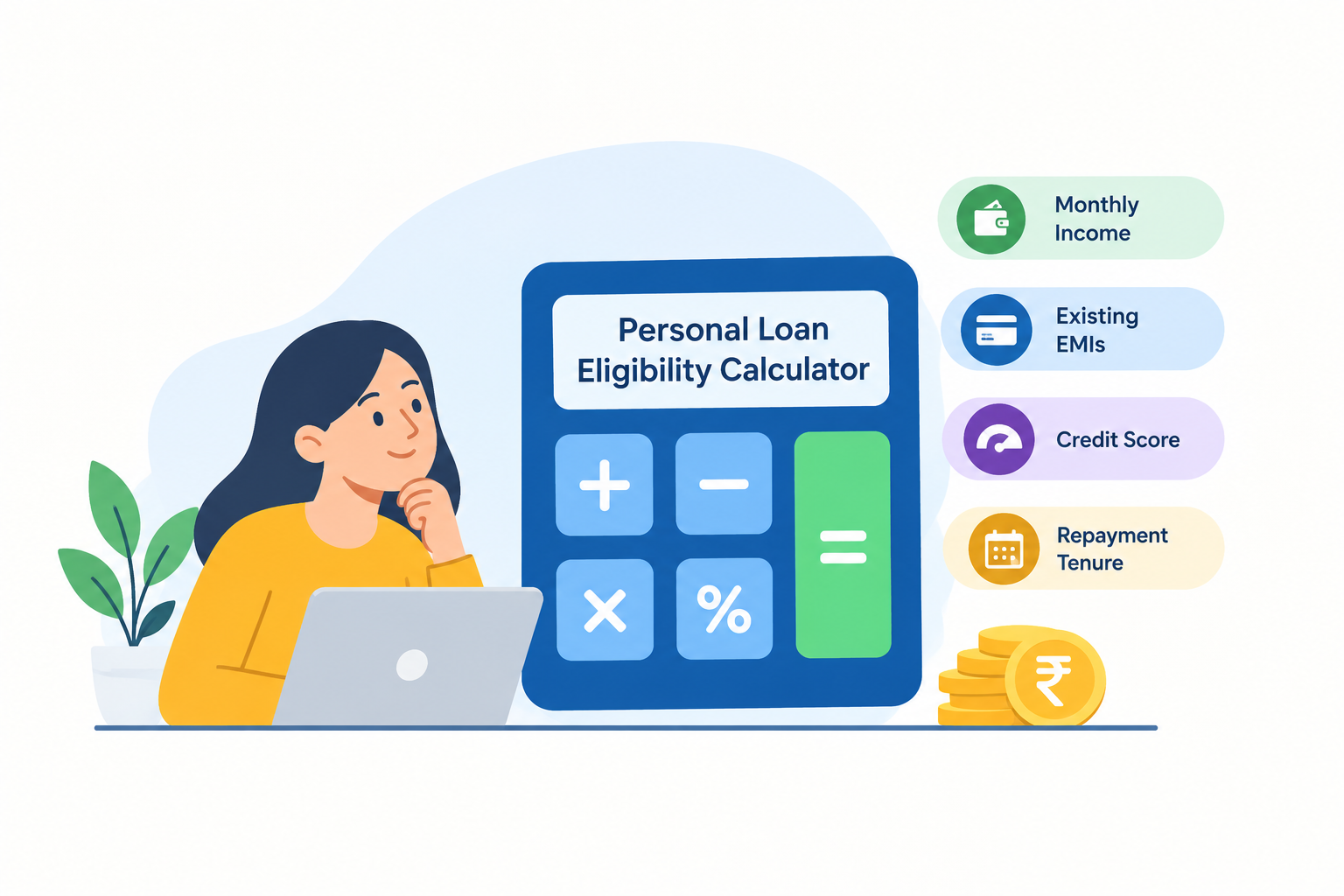
Planning to apply for a personal loan but not sure how much you can borrow? A personal loan eligibility calculator helps you estimate the loan amount you may qualify for based on your income, existing financial commitments, credit history, and repayment capacity.
Whether you are a salaried employee, self-employed professional, freelancer, or contract worker, checking your eligibility before applying can help you make a better borrowing decision.
For example, a person earning ₹30,000 per month with minimal existing EMIs may have a different borrowing capacity from someone earning the same salary but already repaying several loans.
A personal loan eligibility calculator gives you an initial estimate. The final eligible amount depends on the lender's policies, income verification, credit profile, and other applicable requirements.
This guide explains how the calculator works, which factors affect eligibility, how salary influences borrowing capacity, and how to improve your chances of getting a suitable personal loan.
AI Answer Box: What Is a Personal Loan Eligibility Calculator?
A personal loan eligibility calculator is an online financial tool that estimates the amount you may be eligible to borrow based on your monthly income, existing EMIs, credit history, employment status, and repayment capacity.
You can use it to understand your potential borrowing limit before applying for a loan. By entering your financial details and reviewing different repayment scenarios, you can estimate an affordable EMI and compare possible loan amounts.
The result is indicative, not a guarantee of approval. Each lender applies its own eligibility criteria and verification process.
What Is Personal Loan Eligibility?
Personal loan eligibility refers to the conditions a borrower must meet to qualify for a personal loan from a bank or non-banking financial company (NBFC).
Lenders assess whether you have a reliable income, manageable financial obligations, and a suitable credit profile to repay the borrowed amount.
Key factors affecting personal loan eligibility
1. Monthly income
Your income helps the lender assess your repayment capacity. A stable, documented income may support a higher loan amount, depending on your expenses and existing debts.
2. Credit score
Your credit score and credit history can influence the lender's decision. A strong repayment history may improve your application, but there is no single credit score that guarantees approval from every lender.
3. Existing EMIs
If you already pay EMIs for a home loan, car loan, or another personal loan, your available monthly repayment capacity decreases.
4. Employment stability
Lenders may consider your employment history, salary regularity, business continuity, or consistency of freelance earnings.
5. Age and repayment tenure
Lenders may set minimum and maximum age requirements. Your age can also affect the repayment period available to you.
6. Documentation
Income proof, bank statements, identity documents, and other requested information help lenders verify your application.
How Does a Personal Loan Eligibility Calculator Work?
A personal loan eligibility calculator estimates the loan amount you may be able to repay based on your financial details.
It generally considers:
-
Monthly take-home income
-
Existing monthly EMIs
-
Available repayment capacity
-
Expected interest rate
-
Preferred loan tenure
-
Other factors included in the particular calculator
Personal loan eligibility formula
A simplified way to estimate the amount available for a new EMI is:
Here, \(r\) represents the assumed share of income available for all loan repayments. It is a planning assumption, not a universal lending rule.
Example:
Suppose you earn ₹40,000 per month, have existing EMIs of ₹4,000, and use an illustrative total EMI budget of 40% of your income.
|
Particulars |
Amount |
|---|---|
|
Monthly take-home income |
₹40,000 |
|
Assumed total EMI budget (40%) |
₹16,000 |
|
Existing monthly EMIs |
₹4,000 |
|
Available capacity for a new EMI |
₹12,000 |
Under these assumptions, ₹12,000 is the estimated monthly capacity for a new loan EMI. Your actual affordable EMI may be lower if you have significant household expenses or other commitments.
How is the eligible loan amount calculated?
Once you estimate an affordable EMI, you can use the expected interest rate and repayment tenure to calculate a possible loan amount.
For a standard loan with equal monthly instalments:
Where:
-
\(P\) = estimated loan principal
-
\(E\) = monthly EMI
-
\(i\) = monthly interest rate as a decimal
-
\(n\) = total number of monthly instalments
This calculation estimates the principal supported by the chosen EMI. It does not account for every lender-specific eligibility rule, fee, or product condition.
Personal Loan Eligibility Calculator by Salary
Your monthly salary is an important starting point when estimating personal loan eligibility. However, the loan amount you can afford also depends on your existing debts, expenses, credit profile, and lender requirements.
The following table uses an illustrative total EMI budget of 40% of take-home salary, assuming no existing EMIs.
|
Monthly salary |
Illustrative total EMI budget |
|---|---|
|
₹15,000 |
₹6,000 |
|
₹20,000 |
₹8,000 |
|
₹25,000 |
₹10,000 |
|
₹30,000 |
₹12,000 |
|
₹40,000 |
₹16,000 |
|
₹50,000 |
₹20,000 |
|
₹60,000 |
₹24,000 |
|
₹75,000 |
₹30,000 |
|
₹1,00,000 |
₹40,000 |
These are examples for financial planning, not guaranteed eligibility limits. The EMI budget should also leave sufficient money for living expenses and savings.
How much personal loan can I get on a ₹30,000 salary?
The amount depends on your existing EMIs, credit profile, employment stability, interest rate, and repayment tenure.
For example, if you earn ₹30,000 per month and assume a 40% total EMI budget, the budget is ₹12,000. If you already pay ₹3,000 in EMIs, the remaining capacity under this simplified calculation is ₹9,000.
The final loan amount would depend on the interest rate, tenure, and lender's assessment. It is better to choose an amount that fits your budget than to borrow the maximum amount available.
Why can two people with the same salary get different loan amounts?
Consider two applicants who earn ₹40,000 each month.
|
Financial detail |
Applicant A |
Applicant B |
|---|---|---|
|
Monthly income |
₹40,000 |
₹40,000 |
|
Existing EMIs |
₹2,000 |
₹8,000 |
|
Assumed total EMI budget |
₹16,000 |
₹16,000 |
|
Remaining EMI capacity |
₹14,000 |
₹8,000 |
Applicant A has more room for a new EMI under this simplified model. Actual eligibility will also depend on credit history, income documentation, and lender-specific criteria.
Documents Required for Personal Loan Eligibility
The exact documents depend on the lender and your employment type. Common requirements include the following.
For salaried employees
-
PAN and acceptable identity proof
-
Address proof, where required
-
Recent salary slips
-
Recent bank statements
-
Employment details
-
Additional documents requested by the lender
For self-employed applicants
-
PAN and identity/address proof
-
Bank statements
-
Income tax returns or other income records
-
Business details or registration documents, where applicable
-
Financial statements, if required
For freelancers and gig workers
-
Identity and address documents
-
Bank statements showing income receipts
-
Invoices or payment records, where available
-
Income tax returns, if applicable
-
Other evidence accepted by the lender
Keep your documents accurate and consistent. Do not submit altered salary slips, fabricated bank statements, or misleading income information.
How to Use a Personal Loan Eligibility Calculator
Follow these steps to estimate your potential borrowing capacity.
Step 1: Enter your monthly income
Use the income figure requested by the calculator. If your earnings vary, choose a realistic figure based on your records.
Step 2: Enter your existing EMIs
Include monthly repayments for your current loans so that the estimate reflects your existing obligations.
Step 3: Choose an expected interest rate
If you do not have a lender offer, compare realistic interest-rate scenarios instead of assuming you will receive the lowest advertised rate.
Step 4: Select a repayment tenure
Compare available tenures to understand how the monthly EMI and total interest cost change.
Step 5: Review the estimate
Use the result to plan your borrowing. Check the lender's eligibility requirements and actual loan terms before applying.
Personal Loan Eligibility: Benefits and Limitations
|
Benefits |
Limitations |
|---|---|
|
Helps estimate a potential borrowing amount |
Cannot guarantee loan approval |
|
Makes income and EMI planning easier |
Results depend on the accuracy of the inputs |
|
Helps compare repayment scenarios |
May not reflect all lender-specific criteria |
|
Supports better borrowing decisions |
May not include your full household budget |
|
Can help identify an unaffordable EMI |
Does not replace a lender's final assessment |
When should you check your eligibility?
Consider using a personal loan eligibility calculator when you are:
-
Planning to borrow for a planned or unexpected expense.
-
Comparing personal loan options from different lenders.
-
Checking how existing EMIs affect your repayment capacity.
-
Deciding on a reasonable loan amount.
-
Comparing different interest rates and repayment tenures.
-
Preparing your documents before applying.
How to Improve Personal Loan Eligibility
You cannot control every lending decision, but the following steps may strengthen your application.
Maintain a healthy repayment history
Pay existing loan EMIs and credit card bills on time. Review your credit report periodically and address genuine errors.
Reduce existing financial obligations
Paying down debt where possible may free up monthly cash flow. Avoid taking on additional borrowing if your current repayments already strain your budget.
Keep income records ready
Maintain salary slips, bank statements, tax records, and other relevant documents. For variable income, organised payment records can help demonstrate earnings.
Apply for a realistic loan amount
Choose a loan amount based on your actual needs and affordable EMI rather than the maximum figure displayed by a calculator.
Compare the total borrowing cost
Look beyond the advertised interest rate. Review processing fees, applicable charges, the repayment schedule, and the Annual Percentage Rate (APR).
The Reserve Bank of India's Key Facts Statement (KFS) framework establishes disclosure requirements for covered retail and MSME term loans from regulated entities. Reviewing the applicable KFS can help you understand the important terms and costs of a loan. Refer to the Reserve Bank of India for official regulatory information.
Personal Loan Eligibility Calculator vs. EMI Calculator
|
Feature |
Eligibility calculator |
EMI calculator |
|---|---|---|
|
Main purpose |
Estimates potential borrowing capacity |
Estimates monthly repayments |
|
Main inputs |
Income, existing EMIs and other eligibility details |
Loan amount, interest rate and tenure |
|
Main result |
Indicative eligible loan amount or EMI capacity |
Estimated monthly EMI |
|
Best used when |
Planning how much you may borrow |
Comparing the cost of a particular loan |
Using both calculators can help you choose a suitable loan amount and understand its likely repayment cost.
Real-World Borrowing Example
Suppose a salaried employee earns ₹50,000 monthly and wants a personal loan for an essential expense.
Before applying, the employee should:
-
Calculate monthly income after existing obligations.
-
Estimate a manageable EMI.
-
Check the interest rate and repayment tenure.
-
Compare the total repayment amount across available offers.
-
Keep enough money for rent, groceries, transport, and emergencies.
-
Review the lender's fees and loan agreement before accepting an offer.
A calculator may show that a higher loan amount is possible, but that does not mean the borrower should take the maximum amount.
Expert commentary: Eligibility and affordability are different
Loan eligibility and loan affordability are related, but they are not the same.
A lender may determine that an applicant meets its eligibility criteria, while the proposed EMI could still be uncomfortable for that person's household budget.
A sensible borrowing decision considers:
-
Whether the lender's eligibility criteria can be met.
-
Whether the EMI fits within monthly income and expenses.
-
Whether the total borrowing cost is reasonable.
-
Whether enough money remains for savings and unexpected expenses.
This approach helps borrowers make more informed financial decisions without relying entirely on an estimated loan amount.
Frequently Asked Questions (FAQs)
1. What is a personal loan eligibility calculator?
A personal loan eligibility calculator is an online tool that estimates the amount you may qualify to borrow based on income, existing EMIs, credit history, and repayment capacity.
2. How can I check my personal loan eligibility online?
Enter the requested financial information into an eligibility calculator. Review the estimated amount and check the lender's specific requirements before submitting an application.
3. How much personal loan can I get on a ₹25,000 salary?
The amount depends on your existing EMIs, credit profile, employment stability, interest rate, and tenure. Use a calculator to estimate an affordable EMI and discuss the actual loan limit with the lender.
4. Can I get a personal loan with a ₹30,000 monthly salary?
Possibly. Some lenders may consider applicants earning ₹30,000 per month, but minimum income requirements differ. Your credit history, current obligations, and employment details also matter.
5. Does a higher salary guarantee personal loan approval?
No. A higher salary may improve repayment capacity, but lenders also evaluate credit history, existing debts, income stability, documentation, and their own eligibility criteria.
6. What credit score is required for a personal loan?
There is no single score requirement that applies to every lender. A stronger credit profile may improve your chances, but approval depends on the lender's overall assessment.
7. Do existing EMIs affect personal loan eligibility?
Yes. Existing EMIs reduce the income available for another loan repayment. This may lower the additional EMI a lender considers affordable.
8. Can self-employed people use a personal loan eligibility calculator?
Yes. Self-employed applicants can use calculators that accept their income and existing financial commitments. Final eligibility may depend on business continuity, documented income, credit history, and lender requirements.
9. Can freelancers and gig workers apply for personal loans?
Some lenders accept applications from freelancers and gig workers. Eligibility depends on the lender's policies, income consistency, financial records, and repayment capacity.
10. Is a personal loan eligibility calculator free?
Many online eligibility calculators are free to use. However, platform terms may vary, so check for fees and privacy conditions before submitting personal information.
11. Does checking personal loan eligibility affect my credit score?
A basic calculator that uses manually entered information generally does not require a credit enquiry. A formal loan application may involve a credit bureau check. Confirm the process with the lender before proceeding.
12. What documents are required for a personal loan?
Common documents include PAN, identity and address proof, bank statements, salary slips, and employment or business income records. Requirements differ by lender.
13. Can I get a personal loan if I already have another loan?
Possibly. The lender may consider your current EMIs, remaining income, credit history, and overall repayment capacity before determining eligibility.
14. Is the loan amount shown by a calculator guaranteed?
No. The amount is an estimate. The final loan amount and approval depend on the lender's underwriting process, document verification, and applicable product conditions.
15. How can I improve my personal loan eligibility?
Pay existing EMIs on time, reduce outstanding debt where possible, maintain accurate income records, review your credit report, and choose a loan amount that fits your budget.
Conclusion
A personal loan eligibility calculator is a practical tool for understanding your potential borrowing capacity. It helps you assess the relationship between income, existing EMIs, and repayment affordability before applying for a loan.
However, the best financial decision is not always to borrow the maximum amount available. Review your monthly expenses, compare loan costs, check the lender's requirements, and choose a repayment plan that fits your financial situation.
Ready to explore personal loan options? Visit Vizzve Financial to review available support options and applicable eligibility requirements.
Published on : 18th October 2026
Published by : Bhargavi
www.vizzve.com || www.vizzveservices.com
Follow us on social media: Facebook || Linkedin || Instagram
🛡 Powered by Vizzve Financial
RBI-Registered Loan Partner | 10 Lakh+ Customers | ₹600 Cr+ Disbursed