

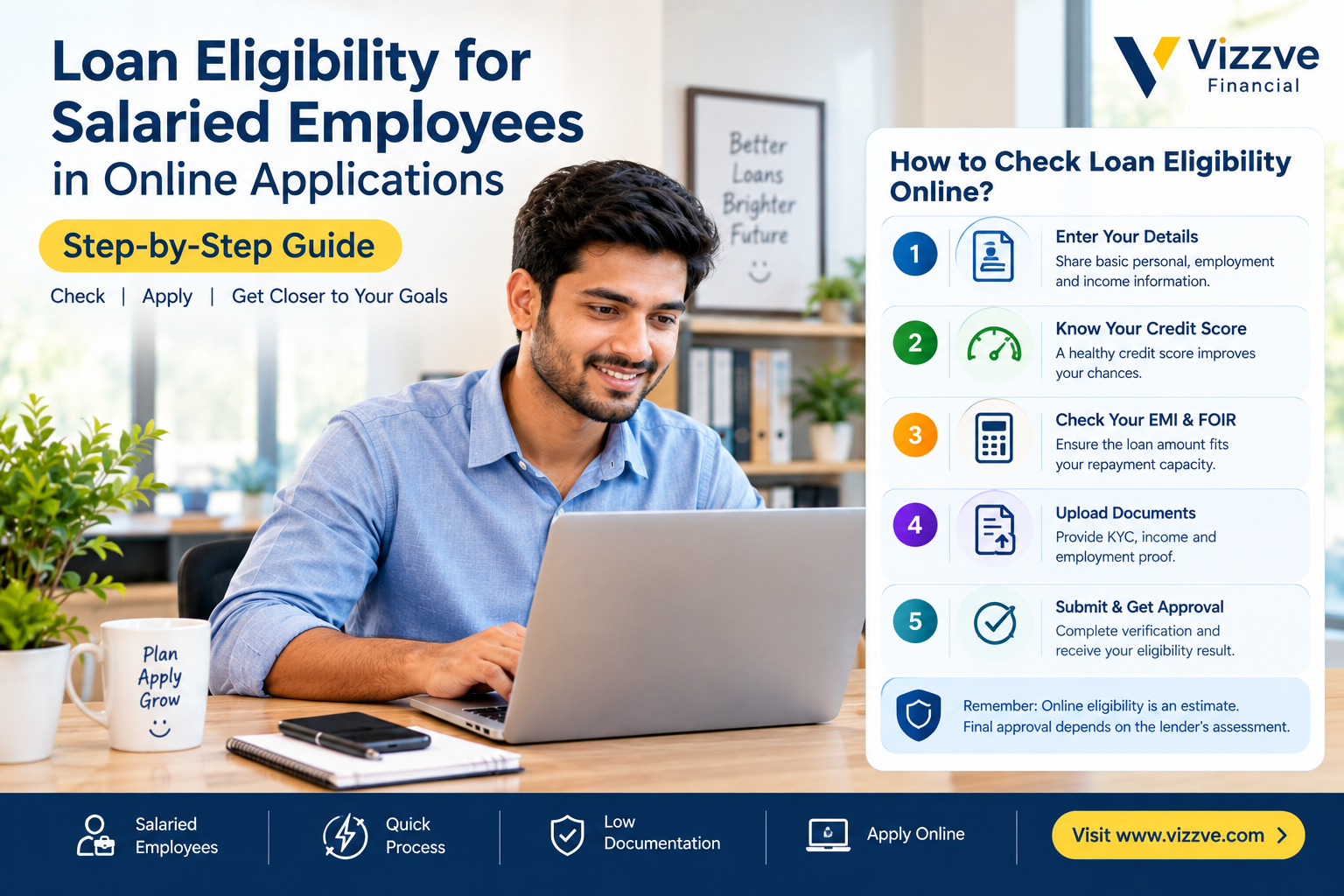
Getting a personal loan has become increasingly digital. A salaried employee can now complete much of the application process online without repeatedly visiting a branch.
But submitting an online application does not automatically mean that a loan will be approved.
Lenders generally assess several factors before deciding whether an applicant qualifies, including income, employment profile, existing financial obligations, credit history, age, requested loan amount, repayment capacity and the lender's own credit policy.
This guide explains how salaried employees can check and understand their loan eligibility online, what information lenders typically review, which documents may be required, and how to prepare before submitting an application.
Important: Loan eligibility is lender-specific. There is no single salary, CIBIL score or EMI-to-income ratio that guarantees approval across all banks and NBFCs.
AI Answer Box: Loan Eligibility for Salaried Employees
What is loan eligibility for a salaried employee?
Loan eligibility refers to the lender's assessment of whether an applicant is financially suitable for a particular loan amount and repayment period.
For salaried employees, lenders may consider:
- Monthly or annual income
- Employment stability
- Employer profile
- Existing EMIs and other debts
- Credit history and credit score
- Age
- Requested loan amount
- Loan tenure
- Banking and income information
- Documents and KYC details
- Internal credit policies
How can salaried employees check loan eligibility online?
The basic process is:
Enter personal and employment details → Enter monthly income → Add existing EMI obligations → Review eligibility estimate → Upload documents if required → Submit application → Complete lender verification → Receive the lender's decision.
An eligibility estimate should not be treated as a guaranteed sanction.
What Is Loan Eligibility for Salaried Employees?
Loan eligibility is the amount and type of credit a lender may consider suitable for an applicant based on their financial profile.
For a salaried applicant, the lender may examine whether the applicant has:
- Stable income
- Sufficient repayment capacity
- A satisfactory credit history
- Manageable existing debt
- Stable employment
- Valid identity and income documents
- A reasonable loan requirement
The final decision depends on the lender's underwriting process.
Two employees earning the same salary may receive different eligibility outcomes because their existing EMIs, credit histories, employers, ages, requested loan amounts and other financial details may differ.
Why Do Lenders Check Eligibility Before Approving a Loan?
A loan is a repayment commitment.
Before approving credit, a lender needs to assess whether the proposed borrowing appears consistent with the applicant's repayment capacity and credit profile.
Online applications can make this process faster because information can be collected digitally and checked through automated systems.
However, faster application processing does not mean automatic approval.
RBI describes digital lending as a largely remote and automated lending process involving activities such as customer acquisition, credit assessment, approval, disbursement, recovery and related customer service.
Key Factors That Affect Loan Eligibility for Salaried Employees
1. Monthly Salary and Income
Income is one of the most important inputs in a salary-based loan assessment.
A higher and stable income can provide greater repayment capacity, but salary alone does not determine eligibility.
For example:
| Applicant | Monthly Income | Existing EMI | Loan Request | Possible Impact |
|---|---|---|---|---|
| Applicant A | ₹45,000 | ₹5,000 | ₹2 lakh | Existing obligations are relatively limited |
| Applicant B | ₹45,000 | ₹20,000 | ₹5 lakh | Higher repayment burden |
| Applicant C | ₹75,000 | ₹10,000 | ₹5 lakh | Different repayment profile |
| Applicant D | ₹75,000 | ₹30,000 | ₹7 lakh | Existing debt may materially affect assessment |
These examples are illustrative only. Actual eligibility depends on lender policy.
Gross Salary vs Net Salary
Applicants should understand what income figure the lender asks for.
Some applications may request:
- Gross monthly salary
- Net/in-hand salary
- Fixed monthly income
- Total annual income
- Salary credited to the bank account
Do not enter an estimated figure simply to increase the apparent eligibility.
Use accurate information supported by your documents.
2. Employment Stability
Employment stability can influence how a lender evaluates repayment capacity.
A salaried employee who has remained with the same employer for a reasonable period may have a different risk profile from someone who recently joined a new organisation.
Lenders may consider information such as:
- Current employer
- Total work experience
- Time with current employer
- Employment type
- Industry
- Salary structure
- Salary-credit history
There is no universal employment-tenure rule applicable to every lender.
3. Employer Profile
The employer can also be one part of a lender's underwriting process.
Depending on the lender, employment information may include:
- Employer name
- Company type
- Industry
- Employer category
- Location
- Salary-credit relationship
- Employment status
This does not mean that employees of one particular company are automatically approved.
It simply means employment information can form part of the overall assessment.
4. Credit Score and Credit History
Credit history helps lenders understand how an applicant has handled previous borrowing.
A credit report may contain information relating to:
- Existing loans
- Credit cards
- Repayment history
- Outstanding balances
- Credit enquiries
- Accounts that have been closed
- Delinquencies or defaults, where applicable
A strong credit history can support a borrower's application, while negative repayment information can affect how an application is assessed.
However, there is no universal CIBIL score that guarantees personal loan approval.
Different lenders can have different risk policies.
How to Prepare Your Credit Profile
Before applying online:
- Check your credit report.
- Review outstanding accounts.
- Ensure repayment information is accurate.
- Avoid unnecessary borrowing.
- Pay existing EMIs and card dues on time.
- Review unfamiliar enquiries or accounts.
- Allow time for legitimate corrections to reflect where necessary.
RBI changed the reporting frequency for credit information to fortnightly, or at shorter intervals where mutually agreed, with the revised framework effective from January 1, 2025. This is intended to make credit information more current.
5. Existing EMIs and Debt Obligations
Existing loans directly affect repayment capacity.
Suppose an employee earns ₹60,000 per month but already pays ₹25,000 toward existing EMIs.
Another employee also earns ₹60,000 but pays only ₹5,000 toward existing EMIs.
Their financial profiles are not identical.
This is why applicants should calculate their existing monthly obligations before applying.
Existing Obligations May Include
- Personal loan EMIs
- Home loan EMIs
- Vehicle loan EMIs
- Education loan payments
- Credit card obligations
- Other recurring debt commitments
6. FOIR and Debt-to-Income Considerations
One common concept used in credit assessment is the Fixed Obligation to Income Ratio (FOIR).
A simplified representation is:
FOIR = Monthly Fixed Debt Obligations ÷ Monthly Income × 100
For example:
Monthly income = ₹60,000
Existing fixed obligations = ₹15,000
FOIR based only on those obligations:
₹15,000 ÷ ₹60,000 × 100 = 25%
If a proposed EMI of ₹10,000 is added:
₹25,000 ÷ ₹60,000 × 100 = 41.67%
This is only an illustration.
Different lenders can define income and obligations differently, and they may use other affordability or underwriting models.
Therefore, applicants should not treat a particular FOIR percentage as a universal approval rule.
7. Requested Loan Amount
The amount you request matters.
A borrower with a stable income may still not qualify for a very large loan if the proposed repayment obligation is inconsistent with the lender's affordability assessment.
A sensible approach is to determine:
How much do I actually need?
rather than:
What is the maximum amount I can borrow?
Borrowing less than the maximum eligible amount can also reduce the overall repayment burden.
8. Loan Tenure
Tenure determines how long the borrower will repay the loan.
A longer tenure may reduce the monthly EMI in many cases, but it can increase the total interest paid over the life of the loan.
A shorter tenure can increase the EMI while potentially reducing total interest.
Simple Comparison
| Factor | Shorter Tenure | Longer Tenure |
|---|---|---|
| Monthly EMI | Usually higher | Usually lower |
| Total interest | Usually lower | Usually higher |
| Repayment period | Shorter | Longer |
| Monthly cash-flow pressure | Higher | Lower |
| Overall cost | May be lower | May be higher |
The exact numbers depend on the interest rate, loan amount and repayment structure.
9. Age and Applicant Profile
Lenders generally have age-related eligibility criteria for borrowers.
The relevant criteria can vary based on:
- Minimum age at application
- Maximum age at loan maturity
- Employment status
- Income
- Loan tenure
- Product type
An applicant should check the specific lender's requirements rather than relying on a generic age limit found online.
10. Documents Required for Online Loan Applications
A salaried applicant may be asked for documents such as:
Identity and KYC Documents
Depending on the lender and applicable KYC process:
- PAN
- Aadhaar or another accepted identity document
- Address proof
- Photograph, where applicable
Income Documents
Possible requirements include:
- Recent salary slips
- Bank statements
- Form 16
- Income tax documents, where applicable
- Salary-credit evidence
Employment Documents
Depending on the lender:
- Employee ID
- Employment details
- Employer information
- Appointment or employment-related documents
The exact document list varies by lender.
Step-by-Step Guide: How Salaried Employees Can Check Loan Eligibility Online
Step 1: Check Your Monthly Income
Start with your actual income.
Record:
- Monthly salary
- Net salary
- Regular deductions
- Other documented income, if the lender accepts it
Do not inflate income details.
Step 2: List Your Existing Loans
Create a simple list of your current obligations.
| Loan Type | Outstanding EMI |
|---|---|
| Personal Loan | ₹8,000 |
| Vehicle Loan | ₹6,000 |
| Credit Card | ₹3,000 |
| Other Debt | ₹2,000 |
| Total | ₹19,000 |
This gives you a clearer picture of your existing repayment burden.
Step 3: Review Your Credit Report
Before applying, check whether your credit information is accurate.
Look for:
- Incorrect outstanding amounts
- Unknown accounts
- Incorrect repayment status
- Duplicate entries
- Unfamiliar credit enquiries
If you find an error, follow the relevant credit information company's dispute process.
Step 4: Estimate the EMI You Can Comfortably Manage
Do not start with the maximum loan amount.
Instead, consider:
Monthly income – essential living expenses – existing debt obligations = available financial headroom
The amount should leave room for normal household expenses and unexpected costs.
Step 5: Use an Online Eligibility Calculator Carefully
An online calculator may ask for:
- Monthly income
- Existing EMIs
- Desired loan amount
- Tenure
- Interest rate
- Employment information
The output is generally an estimate.
It should not be interpreted as a final approval.
Step 6: Compare the Total Cost of the Loan
Do not compare loans only by the headline interest rate.
Review:
- Interest rate
- APR, where disclosed
- Processing fee
- Other applicable charges
- Penal charges
- Tenure
- EMI
- Prepayment/foreclosure terms
- Total repayment amount
RBI's digital-lending framework requires the Annual Percentage Rate (APR) and a Key Facts Statement for digital lending products, helping borrowers understand the cost of borrowing before entering into the loan contract.
Step 7: Read the Key Facts Statement
The KFS deserves special attention.
It can help you understand:
- Loan amount
- Tenure
- Interest rate
- APR
- Fees and charges
- Repayment schedule
- Other important terms
RBI's framework requires regulated entities to provide a KFS before execution of the contract for digital lending products.
Do not accept a loan simply because the application process is fast.
Read the actual terms.
Step 8: Verify the Lender
This is particularly important when applying online.
RBI advises consumers to check whether a digital lending app is associated with an RBI-regulated bank or NBFC through the regulated entity's website and warns against downloading loan apps received through SMS or social-media links.
The RBI has also developed a public repository/directory approach to help consumers verify digital lending apps associated with regulated entities.
Step 9: Submit Accurate Information
Make sure:
- Name matches your documents.
- PAN details are correct.
- Employment information is accurate.
- Salary details are genuine.
- Bank details are correct.
- Existing loan information is disclosed honestly.
Incorrect information can create problems during verification.
Step 10: Complete Verification
Depending on the lender, verification may involve:
- KYC verification
- Income verification
- Bank statement analysis
- Employment verification
- Credit bureau checks
- Other internal checks
Only after the lender completes its assessment can the final lending decision be made.
Online vs Offline Loan Application for Salaried Employees
| Factor | Online Application | Offline Application |
|---|---|---|
| Application | Digital | Branch/physical process may be involved |
| Document submission | Usually digital | May involve physical copies |
| Convenience | High | Depends on branch access |
| Status tracking | Often available digitally | May require contacting branch |
| Processing workflow | Technology-driven | More manual in some cases |
| Verification | Can be digital | May include physical verification |
| Final approval | Lender-dependent | Lender-dependent |
Online does not mean that every applicant will receive approval.
It mainly changes the application and processing experience.
What Can Reduce a Salaried Employee's Loan Eligibility?
Several factors can reduce the amount a lender is willing to consider.
Common Factors Include:
- High existing EMI burden
- Poor repayment history
- Multiple outstanding loans
- Excessive unsecured borrowing
- Unstable employment profile
- Inconsistent income information
- Incorrect application details
- Large requested loan amount
- Short employment history
- High credit utilisation
- Unresolved credit-report discrepancies
The impact of each factor varies by lender.
How to Improve Loan Eligibility Before Applying
1. Maintain Timely Repayments
Pay existing EMIs and credit-card dues on time.
A consistent repayment history can help maintain a healthy credit profile.
2. Reduce Unnecessary Debt
If possible, reducing existing debt obligations can improve monthly repayment capacity.
3. Avoid Unnecessary Applications
Multiple loan applications within a short period can result in multiple credit enquiries depending on the application and lender process.
Apply only when you have a genuine borrowing requirement.
4. Keep Your Documents Ready
Having accurate salary slips, bank statements and KYC information ready can make the application process smoother.
5. Check Your Credit Report
Do this before applying so that you have time to identify and address potential inaccuracies.
6. Request a Realistic Loan Amount
A smaller loan request may create a different affordability profile than an unnecessarily large request.
7. Choose a Suitable Tenure
Select a repayment period that balances EMI affordability with total borrowing cost.
Real-World Example: Understanding Salaried Employee Loan Eligibility
Consider a hypothetical salaried employee:
Name: Rahul
Monthly net salary: ₹70,000
Existing EMI: ₹10,000
Requested personal loan: ₹3,00,000
Employment: Salaried
Credit history: Regular repayments
Rahul should not assume that ₹3 lakh will automatically be approved.
Instead, he should evaluate:
- Current monthly income
- Existing EMI
- Proposed new EMI
- Monthly household expenses
- Credit history
- Employment stability
- Required documents
- Lender's eligibility criteria
- Total loan cost
- Final lender assessment
Practical Lesson
Eligibility is a combination of factors, not just salary.
Two people earning ₹70,000 per month can receive different lending decisions because their financial obligations and credit profiles may differ.
Pros and Cons of Applying for a Loan Online
Advantages
- Convenient application process
- Less dependence on branch visits
- Digital document submission may be available
- Easier application tracking with some lenders
- Faster information collection
- Convenient comparison of loan terms where multiple offers are legitimately displayed
Disadvantages
- Easy application can encourage unnecessary borrowing
- Fake lending apps can create fraud risks
- Applicants may overlook fees and terms
- Eligibility calculators may be mistaken for approval
- Digital convenience does not eliminate lender verification
- Sharing personal information with an unverified platform can create privacy and security risks
RBI's consumer guidance specifically recommends verifying the relationship between a digital lending app and an RBI-regulated bank or NBFC before using the app.
Important RBI Rules Borrowers Should Know About Digital Loans
Direct Disbursement and Repayment
Under RBI's digital lending guidelines, loan servicing and repayment should generally take place directly between the borrower and the regulated entity's bank account, rather than through a third-party pass-through or pool account. Loan disbursement is generally to the borrower's bank account, subject to specified exceptions.
Disclosure of Loan Cost
For digital lending, the APR is intended to reflect the effective annualised cost of the loan, including relevant costs specified under the framework.
The KFS must be provided before the digital loan contract is executed.
LSP Charges
RBI's digital lending framework states that fees or charges payable to Lending Service Providers in the credit intermediation process are to be paid by the regulated entity rather than directly charged to the borrower by the LSP.
More Frequent Credit Reporting
Since January 1, 2025, the credit-information reporting framework has required credit information to be updated fortnightly or at shorter intervals as mutually agreed.
This makes it increasingly important for borrowers to maintain accurate and timely repayment records.
How to Identify a Safer Online Loan Application
Before entering sensitive information, check:
1. Who Is the Actual Lender?
Find out whether the lender is a bank or NBFC regulated by RBI, where applicable.
2. Is the App Associated With the Lender?
Verify the association through the lender's official website or relevant RBI resources.
3. Are Costs Clearly Disclosed?
Look for:
- Interest rate
- APR
- Processing fees
- Other charges
- Penal charges
- Repayment schedule
4. Is a KFS Provided?
Review the Key Facts Statement before accepting the loan.
5. Where Will Repayment Go?
For digital lending covered by RBI's framework, repayments should generally be made directly to the regulated entity rather than an unrelated third-party account.
6. Avoid Suspicious Links
Do not trust unsolicited loan links received through SMS, messaging platforms or social media.
RBI specifically advises consumers to avoid downloading suspicious lending apps received through such channels.
Common Mistakes Salaried Employees Make While Applying Online
Mistake 1: Applying Based Only on Salary
Salary is important, but existing debt and credit history also matter.
Mistake 2: Assuming a Calculator Means Approval
An online eligibility calculator generally provides an estimate.
Final approval is subject to lender verification and underwriting.
Mistake 3: Ignoring Existing EMIs
Applicants sometimes focus on income while forgetting their current repayment obligations.
Mistake 4: Choosing the Maximum Available Loan
Maximum eligibility does not necessarily equal the amount you should borrow.
Mistake 5: Ignoring APR and Fees
A low advertised interest rate may not tell you the complete borrowing cost.
Review the KFS and total cost.
Mistake 6: Sharing KYC Documents With Unknown Apps
Use only verified platforms and legitimate lender channels.
Mistake 7: Entering Incorrect Salary Information
Always provide information that can be supported by legitimate documents.
Loan Eligibility Checklist for Salaried Employees
Before clicking Apply, ask:
-
Do I have stable employment?
-
Do I know my actual monthly income?
-
Have I calculated my existing EMIs?
-
Have I reviewed my credit report?
-
Is the requested loan amount necessary?
-
Can I comfortably manage the proposed EMI?
-
Do I understand the tenure?
-
Have I checked the interest rate?
-
Have I reviewed APR and applicable charges?
-
Have I read the KFS?
-
Are my KYC documents ready?
-
Have I verified the lender?
-
Am I applying through a legitimate website or app?
-
Have I avoided unsolicited loan links?
Government vs Private-Sector Salaried Employees
Both government and private-sector employees may apply for personal loans, subject to lender-specific eligibility policies.
| Factor | Government Employee | Private Employee |
|---|---|---|
| Employment type | Government/public sector | Private sector |
| Income stability | May be assessed based on employment profile | May be assessed based on employment profile |
| Employer information | Relevant | Relevant |
| Salary proof | Required as applicable | Required as applicable |
| Credit history | Important | Important |
| Existing EMIs | Important | Important |
| Final decision | Lender-specific | Lender-specific |
Being a government employee does not automatically guarantee approval.
Similarly, being a private-sector employee does not automatically mean rejection.
The complete borrower profile matters.
Can a Salaried Employee With Existing Loans Apply?
Yes, having an existing loan does not automatically mean that a salaried employee cannot apply for another loan.
The important question is whether the applicant's income and repayment capacity can support the additional obligation under the lender's criteria.
For example:
Monthly income: ₹80,000
Existing EMI: ₹15,000
New proposed EMI: ₹10,000
The lender may evaluate the total repayment obligations along with other information.
The applicant should also evaluate whether the additional EMI fits comfortably into their own budget.
Can Someone With a Low Credit Score Apply for a Personal Loan?
An applicant with a weaker credit profile can still submit an application, but the lender may assess the application differently.
Possible outcomes can vary depending on:
- Credit history
- Repayment behaviour
- Current debt
- Income
- Employment
- Requested amount
- Lender's risk policy
Instead of assuming that one credit-score number guarantees or prevents approval, applicants should review the full credit profile.
Expert Commentary: What Should Salaried Borrowers Focus On?
From a responsible borrowing perspective, applicants should focus on affordability rather than simply maximising eligibility.
A useful pre-application review has three layers:
Layer 1: Can I qualify?
Check income, employment, credit history, existing debt and lender criteria.
Layer 2: Can I afford it?
Check whether the EMI fits after essential monthly expenses and existing obligations.
Layer 3: Is the loan suitable?
Review APR, fees, tenure, repayment schedule and other terms.
This approach helps separate eligibility from financial affordability.
A lender deciding that an applicant can repay a particular amount does not necessarily mean that borrowing the maximum amount is appropriate for that individual's household budget.
2027 Outlook for Online Loan Applications
Online loan applications are likely to remain an important part of consumer lending, but applicants should focus on established principles rather than assuming that every future process will be identical to today's process.
The regulatory environment is already moving toward greater transparency, digital verification and consumer protection.
RBI's 2025 Annual Report notes the issuance of the Reserve Bank of India (Digital Lending) Directions, 2025, including requirements concerning digital presentation of loan offers, APR, tenure and other terms where applicable.
For borrowers planning to apply in 2027, the practical lesson is simple:
Check the latest lender terms and RBI requirements at the time of application.
Do not rely on an old blog post for a current eligibility cutoff, interest rate or documentation requirement.
Summary Table: Loan Eligibility Factors
| Eligibility Factor | Why It Matters |
|---|---|
| Monthly income | Indicates repayment capacity |
| Employment stability | Helps assess income continuity |
| Employer profile | May form part of lender underwriting |
| Credit history | Shows previous borrowing behaviour |
| Credit score | One part of the overall credit profile |
| Existing EMIs | Affect available repayment capacity |
| Loan amount | Determines proposed debt burden |
| Loan tenure | Influences EMI and total interest |
| Age | Must fit lender's product criteria |
| Documents | Support identity, income and employment details |
| Banking information | May help verify income and obligations |
| Lender policy | Determines the final eligibility framework |
Quick Formula Guide
FOIR
FOIR = Fixed Monthly Debt Obligations ÷ Monthly Income × 100
Approximate Monthly Financial Headroom
Income – Essential Expenses – Existing Debt Obligations
Loan Cost
Do not consider only the interest rate.
Review:
Interest + applicable fees + other disclosed charges + repayment structure
For regulated digital lending, the APR and KFS provide important information about the overall cost of credit.
Published on : 2nd October
Published by : Bhargavi
www.vizzve.com || www.vizzveservices.com
Follow us on social media: Facebook || Linkedin || Instagram
🛡 Powered by Vizzve Financial
RBI-Registered Loan Partner | 10 Lakh+ Customers | ₹600 Cr+ Disbursed