
Blog Details
Personal Loan Eligibility in India: Complete Guide for 2026
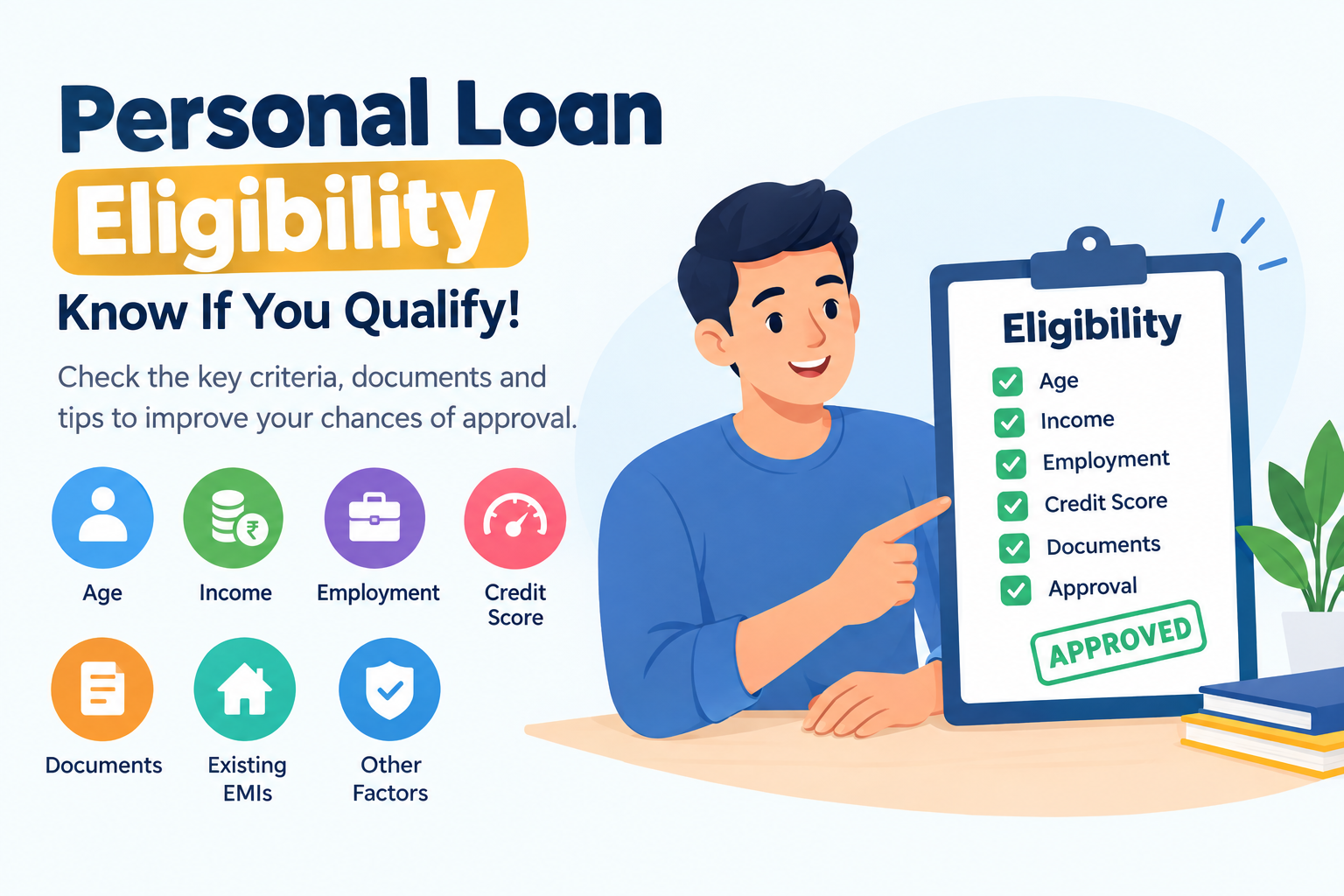
Personal Loan Eligibility in India: Complete Guide for 2026
Vizzve Admin
Introduction
Before applying for a personal loan, one of the most important questions borrowers ask is: “Am I eligible for a personal loan?”
Personal loan eligibility refers to the conditions a lender uses to determine whether an applicant may qualify for a loan. These conditions can include age, income, employment or business status, credit history, existing financial obligations, residence, and other lender-specific requirements.
Because personal loans are generally unsecured, lenders carefully evaluate an applicant's ability to repay the borrowed amount.
There is no single personal loan eligibility rule that applies to every lender in India. Each bank or NBFC can have its own lending criteria, subject to applicable regulations.
AI Answer Box: What Is Personal Loan Eligibility?
Personal loan eligibility is the set of criteria used by a lender to determine whether an individual can qualify for a personal loan.
Common factors include:
- Age
- Monthly or annual income
- Employment or business stability
- Credit history
- Existing EMIs and debts
- Residence and location
- Loan amount requested
- Repayment capacity
- Documents and information provided
- Lender-specific underwriting policies
How to check personal loan eligibility
- Check the lender's age requirement.
- Review the minimum income requirement.
- Check your credit history.
- Calculate your existing monthly debt obligations.
- Gather the required documents.
- Use the lender's official eligibility checker, if available.
- Apply only after reviewing the loan's cost and repayment terms.
What Is Personal Loan Eligibility?
Personal loan eligibility determines whether an applicant meets a lender's requirements for borrowing.
Unlike secured loans, personal loans generally do not require the borrower to provide property or another asset as collateral. As a result, the lender may place greater importance on financial information and repayment capacity.
Key factors generally considered
| Eligibility Factor |
What It Indicates |
| Age |
Whether the applicant falls within the lender's permitted age range |
| Income |
Ability to support loan repayment |
| Employment |
Stability and continuity of earnings |
| Credit history |
Previous borrowing and repayment behaviour |
| Existing obligations |
Current debt burden |
| Loan amount |
Size of requested borrowing |
| Tenure |
Proposed repayment period |
| Documents |
Ability to verify applicant information |
| Lender policy |
Internal credit and risk criteria |
Personal Loan Eligibility Criteria in India
1. Age
Lenders generally establish minimum and maximum age requirements.
The exact age range can differ depending on:
- Lender
- Employment type
- Loan product
- Loan tenure
- Applicant profile
Some lenders may also consider the applicant's age at the time the loan is scheduled to be fully repaid.
Tip: Always check the lender's current eligibility criteria rather than relying on a general age range.
2. Income
Income is an important factor because it helps the lender assess repayment capacity.
The lender may consider:
- Monthly salary
- Annual income
- Business income
- Other eligible income
- Income consistency
- Existing financial commitments
What is the minimum salary required for a personal loan?
There is no universal minimum salary applicable to all personal loans in India.
Each lender may establish its own minimum income criteria. A higher income does not automatically guarantee approval, because lenders can also consider existing EMIs, credit history and other factors.
3. Employment or Business Stability
For salaried applicants, lenders may examine:
- Employer details
- Employment duration
- Salary consistency
- Nature of employment
For self-employed applicants, lenders may consider:
- Business continuity
- Income records
- Banking activity
- Tax-related information
- Financial statements, where required
Stable and verifiable income can help a lender assess repayment capacity.
4. Credit History
Credit history provides information about an individual's previous borrowing and repayment behaviour.
A lender may review:
- Previous loans
- Credit-card accounts
- Repayment history
- Outstanding balances
- Credit enquiries
- Defaults or other reported events
A strong credit history may support an application, but credit score alone does not determine personal loan eligibility.
Lenders can consider multiple factors when making a credit decision.
5. Existing EMIs and Debt Obligations
Suppose a borrower earns ₹50,000 per month and already has several loan repayments.
Even if the income meets a lender's basic requirement, the lender may evaluate whether taking another loan would create excessive repayment obligations.
This is why applicants should calculate their existing financial commitments before applying.
Check your monthly obligations
Consider:
- Home-loan EMI
- Vehicle-loan EMI
- Existing personal-loan EMI
- Credit-card repayments
- Other recurring debt obligations
6. Loan Amount Requested
The requested loan amount can also affect the lender's assessment.
A borrower requesting a relatively large amount may need to demonstrate sufficient repayment capacity.
Instead of borrowing the maximum amount offered, consider how much is actually required and whether the resulting EMI fits comfortably within your budget.
7. Loan Tenure
Loan tenure refers to the period over which the borrower repays the loan.
A longer tenure can reduce the monthly EMI, but it can also increase the total interest paid over the life of the loan.
A shorter tenure may increase the EMI while potentially reducing the total interest cost.
Example
Consider a hypothetical loan:
| Factor |
Example |
| Loan amount |
₹2,00,000 |
| Interest rate |
14% p.a. |
| Tenure |
24 months |
| Approx. EMI |
₹9,603 |
This is only an illustration. Actual rates, fees, EMI amounts and repayment schedules depend on the lender and borrower profile.
Personal Loan Eligibility for Salaried Employees
Salaried applicants may be asked to provide information about their employment and income.
Common factors include:
- Age
- Monthly salary
- Employment history
- Employer information
- Bank account activity
- Credit history
- Existing obligations
- Residence details
Common documents may include:
- PAN
- Identity proof
- Address proof
- Salary slips
- Bank statements
- Employment information
The exact requirements vary between lenders.
Personal Loan Eligibility for Self-Employed Individuals
Self-employed individuals may also qualify for personal loans, depending on the lender's criteria.
A lender may assess:
- Business or professional continuity
- Income
- Banking transactions
- Tax-related information
- Existing liabilities
- Credit history
- Financial documents
Documents may include:
- PAN
- Identity proof
- Address proof
- Bank statements
- Income-tax documents
- Business registration or related documents, where applicable
- Financial statements, where required
Personal Loan Eligibility: Salaried vs Self-Employed
| Factor |
Salaried |
Self-Employed |
| Income proof |
Salary slips and bank records |
Financial/tax records and bank statements |
| Employment information |
Employer details |
Business/professional details |
| Income assessment |
Salary consistency |
Business/professional income |
| Credit history |
May be reviewed |
May be reviewed |
| Existing obligations |
Considered |
Considered |
| Documentation |
Lender-specific |
Lender-specific |
Neither category automatically guarantees approval. The lender evaluates each application according to its own policies.
How to Check Personal Loan Eligibility Online
Many lenders provide online tools or application journeys to help customers understand whether they may qualify.
Step 1: Visit the official lender website
Use the lender's official website rather than an unknown third-party link.
Step 2: Enter basic information
You may be asked for:
- Age
- Location
- Monthly income
- Employment type
- Existing obligations
Step 3: Review the eligibility result
An online eligibility result is generally an initial indication and may not represent final loan approval.
Step 4: Compare the loan terms
Review:
- Interest rate
- EMI
- Processing fee
- Other applicable charges
- Tenure
- Total repayment
Step 5: Apply only if the loan is affordable
Eligibility should not be confused with affordability.
Personal Loan Eligibility Calculator
A personal loan eligibility calculator can provide an estimate of how much a borrower may potentially qualify for based on information such as:
- Income
- Existing EMI obligations
- Interest rate
- Loan tenure
- Other financial information
However, calculator results are generally indicative rather than guaranteed approval.
The final lending decision can depend on additional information and the lender's internal assessment.
Factors That Can Improve Your Personal Loan Eligibility
No strategy guarantees approval, but responsible financial management can strengthen your overall borrowing profile.
Maintain timely repayments
Pay existing EMIs and credit-card dues on time.
Keep existing debt manageable
A high level of existing debt may affect the lender's assessment of repayment capacity.
Avoid unnecessary loan applications
Multiple applications can result in multiple credit enquiries, depending on the lender and credit-reporting process.
Keep documents accurate
Ensure your application information matches your supporting documents.
Choose a suitable loan amount
Borrowing only what you reasonably need can help keep the repayment obligation manageable.
Maintain stable income records
Consistent and verifiable income can make repayment capacity easier to assess.
Personal Loan Eligibility vs Personal Loan Affordability
These two concepts are different.
| Personal Loan Eligibility |
Personal Loan Affordability |
| Based on lender criteria |
Based on your personal budget |
| Determines whether you may qualify |
Determines whether you can comfortably repay |
| Assessed by lender |
Should be assessed by borrower |
| May consider income and credit history |
Should consider all household financial commitments |
| Does not guarantee financial suitability |
Helps determine a sustainable borrowing amount |
Important: Being eligible for a loan does not necessarily mean that taking the loan is appropriate for your financial situation.
Documents Required for Personal Loan Eligibility
The exact list varies by lender, but commonly requested documents may include:
Identity documents
- PAN
- Aadhaar or another accepted identity document
- Other officially accepted documents
Address documents
- Accepted government documents
- Other permitted address records
Income documents
For salaried applicants:
- Salary slips
- Bank statements
For self-employed applicants:
- Bank statements
- Income-tax-related documents
- Financial statements, where required
Other information
The lender may also request:
- Employment information
- Business information
- Existing loan details
- Bank account details
Personal Loan Eligibility and Credit Score
Credit score is an important part of many lending assessments, but it is not the only factor.
A lender may consider your:
- Credit history
- Income
- Existing debts
- Employment
- Requested loan amount
- Repayment capacity
- Internal eligibility criteria
What can negatively affect your credit profile?
Potential factors include:
- Missed payments
- Defaults
- High outstanding balances
- Excessive credit utilisation
- Multiple credit enquiries
- Errors in credit-report information
If you believe your credit report contains incorrect information, contact the relevant credit bureau or lender and follow its dispute process.
Pros and Cons of Personal Loans
Pros
- Usually unsecured
- No collateral may be required
- Flexible use for permitted personal needs
- Online application options are widely available
- Fixed repayment schedules are commonly offered
Cons
- Interest increases the total borrowing cost
- Processing and other charges may apply
- Missed payments can have financial consequences
- Approval is not guaranteed
- Longer repayment periods can increase total interest
Common Personal Loan Eligibility Mistakes
Mistake 1: Assuming a high salary guarantees approval
Income is only one factor in a lending decision.
Mistake 2: Ignoring existing loans
Current EMIs can affect repayment capacity.
Mistake 3: Applying without checking your credit report
Errors or unexpected information may affect your application.
Mistake 4: Providing incorrect information
Inconsistent information can result in additional verification or delays.
Mistake 5: Borrowing more than necessary
A larger loan means a larger repayment obligation.
Mistake 6: Focusing only on EMI
A lower EMI can sometimes result from a longer tenure, which may increase total interest.
Personal Loan Eligibility Checklist
Before applying, check the following:
- ✅ Meet the lender's age criteria
- ✅ Meet the lender's income requirement
- ✅ Have a stable and verifiable source of income
- ✅ Review your credit history
- ✅ Calculate existing EMIs
- ✅ Prepare required documents
- ✅ Check the requested loan amount
- ✅ Estimate the EMI
- ✅ Compare the total cost
- ✅ Read the loan agreement carefully
Expert Commentary: What Matters Most in Eligibility?
A practical way to understand personal loan eligibility is to view it as a repayment-capacity assessment rather than a single-number test.
An applicant may meet a lender's minimum income requirement but still receive different terms or outcomes based on other factors. Similarly, a good credit history does not necessarily guarantee approval.
Borrowers should therefore consider the complete financial picture—income, existing obligations, credit history, requested amount and repayment period—before submitting an application.
Real-World Experience Points
Applicants can often make the process smoother by preparing their financial information before starting an application.
For example:
- Keep recent income documents ready.
- Check that your personal details are consistent across documents.
- Review existing EMI obligations.
- Check your credit report periodically.
- Apply through official lender channels.
- Read the Key Fact Statement and loan agreement where applicable.
- Keep records of the application and loan documents.
These steps do not guarantee approval, but they can reduce avoidable errors and help borrowers understand the financial commitment.
Personal Loan Eligibility: Quick Comparison Table
| Eligibility Factor |
Importance in Assessment |
| Age |
Determines whether applicant meets age criteria |
| Income |
Helps assess repayment capacity |
| Employment/business |
Helps establish income continuity |
| Credit history |
Provides information about previous repayment behaviour |
| Existing debt |
Shows current repayment commitments |
| Loan amount |
Determines size of proposed obligation |
| Tenure |
Affects EMI and total interest |
| Documents |
Help verify applicant information |
Frequently Asked Questions
1. What is personal loan eligibility?
Personal loan eligibility refers to the criteria a lender uses to determine whether an applicant may qualify for a personal loan.
2. What are the main personal loan eligibility criteria?
Common criteria include age, income, employment or business status, credit history, existing obligations, residence, documentation, and lender-specific requirements.
3. What is the minimum salary required for a personal loan?
There is no universal minimum salary for every personal loan in India. Each lender establishes its own income requirements.
4. Does credit score affect personal loan eligibility?
Credit history can influence a lender's assessment, but lenders may also consider income, existing debts, employment and other factors.
5. Can self-employed people get a personal loan?
Yes. Self-employed applicants can apply for personal loans from lenders that offer such products, subject to their eligibility criteria.
6. Can salaried employees apply for personal loans online?
Yes. Many lenders provide online application facilities for eligible salaried employees.
7. Does age affect personal loan eligibility?
Yes. Lenders generally establish minimum and maximum age criteria for their loan products.
8. Can I get a personal loan with existing EMIs?
It may be possible, depending on your income, existing obligations, credit profile and the lender's assessment of repayment capacity.
9. How can I improve my personal loan eligibility?
Maintaining timely repayments, keeping debt manageable, providing accurate documents, maintaining stable income records and avoiding unnecessary credit applications may help strengthen your borrowing profile.
10. Is personal loan eligibility the same for every bank?
No. Banks and NBFCs can have different eligibility criteria, lending policies and documentation requirements.
11. What documents are needed to check personal loan eligibility?
Depending on the lender, you may need identity proof, address proof, PAN, income documents, bank statements, employment information and other supporting records.
12. Can I check personal loan eligibility online?
Yes. Some lenders provide online eligibility checkers or digital application processes. Results are generally indicative until the lender completes its assessment.
13. Does a personal loan eligibility check affect my credit score?
A preliminary eligibility checker may work differently from a formal credit application. A formal application can involve a credit enquiry, depending on the lender and process.
14. Does higher income guarantee personal loan approval?
No. Income is only one factor. Lenders may also assess credit history, existing debt, employment, requested amount and other information.
15. What is the difference between eligibility and affordability?
Eligibility determines whether you may meet a lender's criteria. Affordability determines whether you can comfortably manage the loan repayments within your own budget
Conclusion
Understanding personal loan eligibility is an important first step before applying for unsecured credit. While income and age are common eligibility factors, lenders may also consider credit history, employment or business stability, existing financial commitments, requested loan amount and other information.
Instead of focusing only on whether you qualify, consider whether the proposed loan is affordable and suitable for your financial situation. Compare the complete cost, understand the EMI and read the loan agreement carefully before accepting an offer.
Published on : 01st October
Published by : Bhargavi
www.vizzve.com || www.vizzveservices.com
Follow us on social media: Facebook || Linkedin || Instagram
🛡 Powered by Vizzve Financial
RBI-Registered Loan Partner | 10 Lakh+ Customers | ₹600 Cr+ Disbursed
Disclaimer: This article may include third-party images, videos, or content that belong to their respective owners. Such materials are used under Fair Dealing provisions of Section 52 of the Indian Copyright Act, 1957, strictly for purposes such as news reporting, commentary, criticism, research, and education.
Vizzve and India Dhan do not claim ownership of any third-party content, and no copyright infringement is intended. All proprietary rights remain with the original owners.
Additionally, no monetary compensation has been paid or will be paid for such usage.
If you are a copyright holder and believe your work has been used without appropriate credit or authorization, please contact us at grievance@vizzve.com. We will review your concern and take prompt corrective action in good faith... Read more
