

Introduction
A personal loan can help manage planned expenses or unexpected financial needs, but the monthly Personal Loan EMI is one of the most important numbers to understand before borrowing.
EMI stands for Equated Monthly Instalment. It is the regular amount a borrower pays to the lender until the loan is fully repaid. Each EMI generally contains two components:
- Principal: The amount borrowed.
- Interest: The cost charged by the lender for providing the loan.
Your EMI depends mainly on the loan amount, interest rate and repayment tenure.
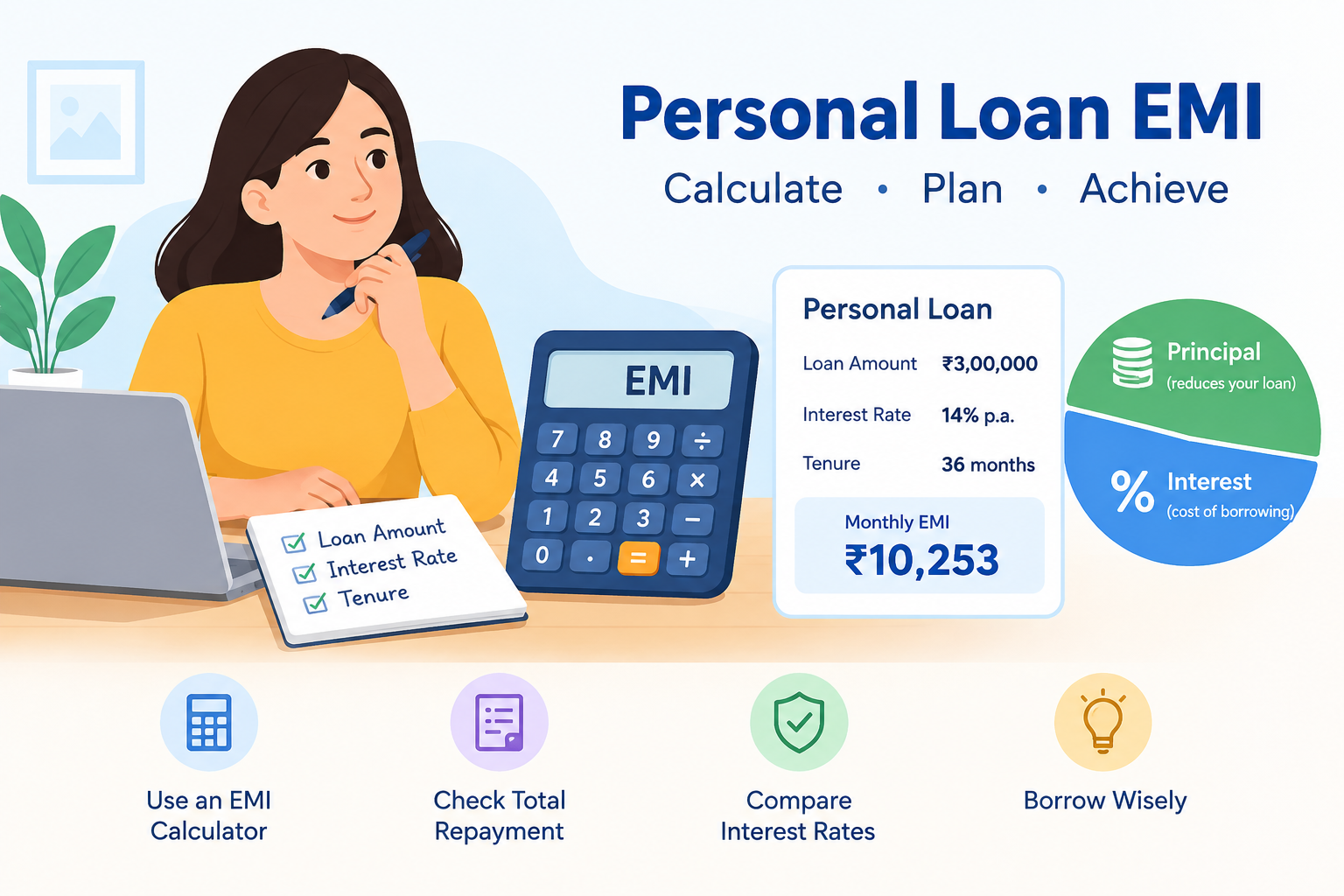
For example, a ₹3 lakh personal loan for three years at an illustrative annual interest rate of 14% would have an EMI of approximately ₹10,253 per month. The actual EMI can differ depending on the lender's rate, fees, repayment structure and loan terms.
Before accepting a loan, borrowers should look beyond the EMI and check the overall cost, including applicable fees and the Annual Percentage Rate (APR). RBI guidance emphasizes transparent disclosure of loan pricing and key loan terms.
AI Answer Box: What Is Personal Loan EMI?
Personal Loan EMI is the fixed or scheduled periodic payment made by a borrower toward a personal loan. It generally includes both principal and interest.
The EMI is primarily determined by:
- Loan amount
- Interest rate
- Repayment tenure
The standard EMI formula is:
EMI = P × R × (1 + R)ⁿ / [(1 + R)ⁿ – 1]
Where:
- P = Principal loan amount
- R = Monthly interest rate
- n = Number of monthly instalments
A longer tenure usually lowers the monthly EMI but can increase the total interest paid over the life of the loan.
What Is a Personal Loan EMI?
A Personal Loan EMI is the amount scheduled for repayment at regular intervals, usually every month.
Suppose you borrow ₹2 lakh. You do not normally repay the entire ₹2 lakh at once. Instead, the amount is divided into a series of repayments based on the agreed interest rate and tenure.
An EMI schedule gradually reduces the outstanding principal.
What Does an EMI Include?
An EMI generally consists of:
| Component | Meaning |
|---|---|
| Principal | Portion used to repay the original loan |
| Interest | Cost charged on the outstanding loan |
| EMI | Principal + applicable interest for the repayment period |
At the beginning of an amortizing loan, a larger share of each payment may go toward interest. As the outstanding principal falls, the interest component generally declines and the principal component increases.
Personal Loan EMI Formula
The standard mathematical formula is:
EMI = P × R × (1 + R)ⁿ / [(1 + R)ⁿ – 1]
Where:
- P = Principal amount
- R = Monthly interest rate
- n = Total number of monthly instalments
How to Convert Annual Interest Into Monthly Interest
If the annual interest rate is 12%, the monthly rate used in the standard EMI formula is:
12% ÷ 12 = 1% per month
The percentage must be converted into decimal form for calculation:
1% = 0.01
Therefore, for a ₹1 lakh loan at 12% annual interest for 24 months:
- Principal = ₹1,00,000
- Monthly rate = 0.01
- Tenure = 24 months
- Approximate EMI = ₹4,707
Total repayment would be approximately ₹1,12,968, meaning the interest component would be about ₹12,968, excluding any applicable fees.
Personal Loan EMI Examples
The following examples are illustrative. Actual EMI amounts depend on the lender's sanctioned interest rate and loan terms.
Example 1: ₹1 Lakh Personal Loan
Assume:
- Loan amount: ₹1,00,000
- Interest rate: 12% per year
- Tenure: 2 years
Approximate EMI: ₹4,707
Approximate total repayment: ₹1,12,968
Approximate interest: ₹12,968
Example 2: ₹2 Lakh Personal Loan
Assume:
- Loan amount: ₹2,00,000
- Interest rate: 13% per year
- Tenure: 3 years
Approximate EMI: ₹6,738
Approximate total repayment: ₹2,42,568
Approximate interest: ₹42,568
Example 3: ₹3 Lakh Personal Loan
Assume:
- Loan amount: ₹3,00,000
- Interest rate: 14% per year
- Tenure: 3 years
Approximate EMI: ₹10,253
Approximate total repayment: ₹3,69,108
Approximate interest: ₹69,108
Important
These examples are for understanding EMI mechanics only. They are not guaranteed loan offers or current market rates.
Personal Loan EMI Comparison by Tenure
Consider an illustrative ₹5 lakh loan at 12% annual interest.
| Tenure | Approx. Monthly EMI | Approx. Total Interest |
|---|---|---|
| 1 year | ₹44,424 | ₹33,088 |
| 2 years | ₹23,537 | ₹64,888 |
| 3 years | ₹16,607 | ₹97,852 |
| 4 years | ₹13,167 | ₹1,32,016 |
| 5 years | ₹11,122 | ₹1,67,320 |
Figures are approximate and intended for illustration.
This demonstrates an important borrowing principle:
Longer tenure can reduce the monthly EMI, but it can increase the total interest paid.
What Factors Affect Personal Loan EMI?
Several factors can influence your EMI.
1. Loan Amount
A larger loan amount generally results in a larger EMI if the interest rate and tenure remain unchanged.
For example, all else being equal, a ₹5 lakh loan will generally have a higher EMI than a ₹2 lakh loan.
2. Interest Rate
The interest rate has a direct effect on the cost of borrowing.
A lower rate can reduce both the EMI and total interest, depending on the loan structure.
3. Loan Tenure
Tenure refers to the period over which the loan is repaid.
A longer tenure usually reduces the monthly payment but may increase total interest.
4. Credit Profile
Lenders may consider factors such as:
- Credit history
- Existing obligations
- Income
- Employment or business profile
- Repayment history
- Debt-to-income considerations
The final interest rate and loan terms are determined by the lender according to its credit policies.
5. Existing EMIs
If you already have several loans or credit obligations, the lender may consider your existing repayment burden when assessing a new loan application.
Personal Loan EMI vs Total Interest
Borrowers often focus only on the EMI.
That can be misleading.
Consider two hypothetical options:
| Factor | Option A | Option B |
|---|---|---|
| Loan Amount | ₹5 lakh | ₹5 lakh |
| Interest Rate | 12% | 12% |
| Tenure | 2 years | 5 years |
| Monthly EMI | Higher | Lower |
| Total Interest | Lower | Higher |
Option B may appear easier because its monthly payment is lower. However, the borrower could pay significantly more interest over the longer repayment period.
Expert Commentary
A sensible EMI decision should balance monthly affordability and total borrowing cost. An EMI that looks comfortable today should not become difficult to manage after accounting for rent, household expenses, existing EMIs, savings and unexpected costs.
How Is Personal Loan EMI Calculated?
You can calculate EMI in four basic steps.
Step 1: Identify the Loan Amount
Suppose the required loan is:
₹3,00,000
Step 2: Check the Annual Interest Rate
Assume:
14% per year
Step 3: Select the Tenure
Suppose:
36 months
Step 4: Apply the EMI Formula
Using the standard formula gives an approximate monthly EMI of:
₹10,253
An online personal loan EMI calculator can make this process faster by allowing you to change the loan amount, interest rate and tenure.
How Does Personal Loan EMI Reduce Over Time?
An amortizing loan does not usually allocate the same amount of every EMI to principal and interest.
At the start:
- Outstanding principal is higher.
- Interest calculation is therefore higher.
- A greater portion of the EMI may go toward interest.
Later:
- Outstanding principal decreases.
- Interest component generally falls.
- More of the EMI goes toward principal.
Simplified Example
| Stage | Principal Component | Interest Component |
|---|---|---|
| Beginning | Lower share | Higher share |
| Middle | Increasing share | Declining share |
| End | Higher share | Lower share |
Your lender's repayment schedule provides the exact breakdown.
Personal Loan EMI Amortization Schedule
An amortization schedule shows how the loan balance changes over time.
A typical schedule may include:
- EMI number
- EMI amount
- Principal repaid
- Interest charged
- Outstanding principal
For example:
| EMI | EMI | Principal | Interest | Balance |
|---|---|---|---|---|
| 1 | ₹10,253 | Part of EMI | Part of EMI | Reduced |
| 2 | ₹10,253 | Part of EMI | Part of EMI | Reduced |
| 3 | ₹10,253 | Part of EMI | Part of EMI | Reduced |
| ... | ... | ... | ... | ... |
| Final | ₹10,253* | Remaining | Remaining | ₹0 |
Illustrative structure; actual lender schedules may differ due to rounding and loan-specific terms.
Fixed vs Floating Personal Loan EMI
Personal loans can have different interest-rate structures depending on the lender and product.
| Feature | Fixed Rate | Floating Rate |
|---|---|---|
| Interest rate | Generally remains fixed according to contract | Can change based on applicable benchmark/terms |
| EMI predictability | Generally higher predictability | Can change |
| Interest-rate risk | Lower for borrower during fixed period | Higher if rates rise |
| Need to check reset terms | Yes | Especially important |
For floating-rate EMI-based personal loans, RBI guidance requires regulated entities to communicate the impact of interest-rate resets and provide relevant options in applicable circumstances.
What Is APR and Why Is It Important?
APR, or Annual Percentage Rate, represents the annualized cost of credit and can incorporate interest and applicable charges associated with the loan.
This is important because two loans can have similar advertised interest rates but different overall costs if their fees and charges differ.
RBI's lending framework emphasizes transparent disclosure of the cost of credit and Key Facts Statement (KFS) information.
Before Accepting a Loan, Check:
- Interest rate
- APR
- Processing fee
- Documentation charges
- Late-payment or penal charges
- Prepayment or foreclosure terms
- Insurance or optional products
- Loan tenure
- EMI amount
- Total repayment amount
What Is a Key Facts Statement?
A Key Facts Statement (KFS) is a standardized document intended to provide important loan information in a simple format.
Depending on the applicable RBI framework, borrowers can find information relating to the loan amount, tenure, interest rate, APR, repayment obligations and charges.
For digital lending, RBI rules require regulated entities to provide a KFS before execution of the loan contract, with APR and relevant cost disclosures.
Real-World Borrowing Tip
Do not rely only on a screenshot showing a low EMI.
Ask for the complete loan terms and check the total repayment cost before accepting the offer.
How to Reduce Your Personal Loan EMI
There are several legitimate ways to manage your EMI.
1. Borrow Only What You Need
A smaller loan naturally reduces the repayment burden.
Avoid borrowing extra money simply because a lender offers a higher eligible amount.
2. Compare Interest Rates
Compare offers from eligible lenders based on the overall cost rather than only the headline rate.
3. Select a Suitable Tenure
Choose a tenure that balances monthly affordability with total interest.
4. Improve Your Credit Profile
Before applying, review your credit report and maintain timely repayments on existing credit accounts.
5. Consider Prepayment Where Appropriate
If your financial position improves, partial prepayment may reduce the outstanding principal, subject to the loan agreement and applicable rules.
Always check applicable prepayment conditions and charges first.
How to Choose an Affordable Personal Loan EMI
A practical affordability check should consider your entire monthly budget.
Calculate:
Monthly income – Essential expenses – Existing debt payments – Savings = Available amount
Your new EMI should fit comfortably within your remaining budget.
Consider These Expenses
- Rent or home expenses
- Food
- Electricity and utilities
- Transport
- Education
- Existing loan EMIs
- Insurance
- Medical expenses
- Emergency savings
- Family obligations
An EMI should not be considered affordable merely because a lender approves it.
Personal Loan EMI: Pros and Cons
Pros
- Predictable scheduled repayment
- Helps spread repayment over several months
- Easy to compare using EMI calculators
- Can make larger planned expenses manageable
- Regular repayment can contribute to a positive credit history when handled responsibly
Cons
- Interest increases the total cost of borrowing
- A longer tenure can increase total interest
- Missed payments can result in additional charges and potentially affect credit history
- Processing and other applicable charges may increase the overall cost
- Excessive borrowing can put pressure on monthly cash flow
Common Mistakes to Avoid While Choosing Personal Loan EMI
Mistake 1: Looking Only at EMI
A lower EMI may result from a longer tenure.
Better approach: Compare total repayment and total interest.
Mistake 2: Ignoring Processing Charges
The advertised interest rate may not represent the entire borrowing cost.
Better approach: Review the KFS and applicable charges.
Mistake 3: Choosing the Maximum Eligible Loan
Being eligible for a particular amount does not necessarily mean you need that amount.
Better approach: Borrow according to your actual requirement and repayment capacity.
Mistake 4: Ignoring Existing Debt
A new EMI adds to existing monthly obligations.
Better approach: Calculate your complete debt burden before applying.
Mistake 5: Missing EMI Due Dates
Delayed repayment can lead to applicable charges and may negatively affect your credit profile.
Better approach: Set reminders or use an appropriate automatic payment arrangement.
Step-by-Step Guide to Planning Your Personal Loan EMI
Step 1: Determine the Required Amount
List the actual expense and borrow only the amount needed.
Step 2: Compare Available Offers
Look at:
- Interest rate
- APR
- EMI
- Tenure
- Processing fee
- Prepayment conditions
- Other applicable charges
Step 3: Calculate the EMI
Use an EMI calculator or the standard formula.
Step 4: Check Your Monthly Budget
Make sure the EMI fits after essential expenses and existing obligations.
Step 5: Read the KFS and Loan Agreement
Review the complete terms before accepting the loan.
Step 6: Maintain Timely Repayments
Keep sufficient funds available before the due date.
Personal Loan EMI Calculator: What Information Do You Need?
An EMI calculator generally requires three inputs:
| Input | Example |
|---|---|
| Loan Amount | ₹3,00,000 |
| Interest Rate | 14% p.a. |
| Tenure | 36 months |
The calculator then estimates:
- Monthly EMI
- Total interest
- Total repayment
Changing any one of these inputs can change the result.
Personal Loan EMI for Different Loan Amounts
Below is an illustrative comparison at 12% annual interest for 24 months.
| Loan Amount | Approx. EMI |
|---|---|
| ₹50,000 | ₹2,354 |
| ₹1,00,000 | ₹4,707 |
| ₹2,00,000 | ₹9,415 |
| ₹3,00,000 | ₹14,121 |
| ₹5,00,000 | ₹23,537 |
These figures are mathematical illustrations and are not lender-specific offers.
Frequently Asked Questions About Personal Loan EMI
1. What is Personal Loan EMI?
Personal Loan EMI is the scheduled periodic repayment made toward a personal loan. It generally contains both principal and interest components.
2. How is personal loan EMI calculated?
EMI is commonly calculated using the loan amount, monthly interest rate and number of monthly instalments. The standard formula is:
EMI = P × R × (1 + R)ⁿ / [(1 + R)ⁿ – 1]
3. What is the EMI for a ₹1 lakh personal loan?
The EMI depends on the interest rate and tenure. For example, at an illustrative 12% annual rate for 24 months, the EMI is approximately ₹4,707.
4. Does a longer tenure reduce personal loan EMI?
Usually, yes. Increasing the tenure spreads repayment across more months. However, the total interest paid can increase.
5. Can I reduce my personal loan EMI?
Depending on the loan and lender, options may include selecting a suitable tenure, comparing lower-cost offers, reducing the amount borrowed or making eligible prepayments.
6. What factors affect personal loan EMI?
Loan amount, interest rate and tenure are the primary mathematical factors. A lender's assessment of the borrower's profile can influence the interest rate and loan terms offered.
7. Is personal loan EMI fixed?
It depends on the interest-rate structure and loan agreement. Fixed-rate loans generally provide greater EMI predictability, while applicable floating-rate loans can change when the rate resets.
8. What happens if I miss a personal loan EMI?
A missed EMI can result in applicable charges and may affect your credit history. The exact consequences depend on the loan agreement and applicable rules.
9. What is the difference between EMI and interest?
EMI is the repayment amount due periodically, while interest is the cost charged for borrowing. An EMI generally includes both principal and interest.
10. Does EMI include processing fees?
Not necessarily. Processing fees and other charges may be separate from the regular EMI. Borrowers should check the KFS and loan agreement for the complete cost.
11. What is APR in a personal loan?
APR represents the annualized cost of credit and can include interest and applicable charges. It can help borrowers understand the broader cost of borrowing.
12. Can I prepay my personal loan?
Prepayment depends on the loan agreement and applicable regulatory requirements. Check the lender's terms for any conditions or charges before making a prepayment.
13. How can I calculate personal loan EMI online?
Enter the loan amount, interest rate and tenure into a reliable personal loan EMI calculator. The calculator will provide an estimated EMI and repayment amount.
14. Is a lower EMI always better?
Not necessarily. A lower EMI may result from a longer tenure, which can increase the total interest paid. Compare both monthly affordability and total repayment.
15. What should I check before accepting a personal loan?
Check the interest rate, APR, EMI, tenure, processing charges, applicable penalties, prepayment terms, total repayment and Key Facts Statement before accepting the loan.
Conclusion
Understanding Personal Loan EMI is an important part of responsible borrowing. The monthly EMI tells you how much you may need to pay regularly, but it does not tell the complete cost of the loan by itself.
Before choosing a personal loan, compare the loan amount, interest rate, EMI, tenure, APR, total interest and applicable fees. Also make sure the repayment fits comfortably within your monthly budget.
A small difference in interest rate or a change in tenure can significantly affect the overall repayment cost. Taking a few minutes to calculate the EMI and read the loan terms can help you make a more informed borrowing decision.
Looking for personal loan options? Explore Vizzve Financial and review the applicable loan terms before proceeding.