

Personal Loan EMI Calculator: A Complete Guide
Planning to take a personal loan? Before applying, it is important to understand how much you may need to repay every month. A personal loan EMI calculator helps you estimate your monthly instalment using the loan amount, interest rate and repayment tenure.
Whether you need money for medical expenses, education, home repairs, travel or another planned expense, calculating your EMI in advance can help you make a more informed financial decision.
Instead of estimating payments manually, you can use an EMI calculator to compare different loan amounts and repayment periods. This guide explains how the calculator works, how EMI is calculated, what affects your monthly payment and how to choose a repayment plan that fits your budget.
What Is a Personal Loan EMI Calculator?
A personal loan EMI calculator is an online tool that estimates the monthly instalment you would pay to repay a personal loan.
EMI stands for Equated Monthly Instalment. It is a regular payment that generally includes both the principal amount borrowed and the interest charged on the outstanding balance.
The three main inputs are:
-
Loan amount: The amount you want to borrow.
-
Interest rate: The annual interest rate charged by the lender.
-
Loan tenure: The period over which you plan to repay the loan.
The calculator uses these details to estimate the monthly EMI, total repayment and total interest payable.
The results are estimates. Your actual repayment schedule may differ because of lender-specific terms, fees, disbursement dates and calculation methods.
How Does a Personal Loan EMI Calculator Work?
The calculator uses the loan principal, monthly interest rate and number of monthly instalments to estimate your payment.
For example, suppose you borrow ₹1,00,000 at an annual interest rate of 12% for 12 months. The calculator estimates your monthly EMI at approximately ₹8,885.
You can change the loan amount, interest rate or tenure to see how the estimated payment changes.
A shorter tenure usually means a higher monthly EMI but lower total interest. A longer tenure generally reduces the EMI but can increase the total interest paid.
Personal Loan EMI Calculator: Try These Example Calculations
The following examples use a standard monthly reducing-balance EMI calculation. They exclude processing fees and other charges.
| Loan amount | Annual interest rate | Tenure | Approx. monthly EMI |
|---|---|---|---|
| ₹50,000 | 12% | 12 months | ₹4,442 |
| ₹1,00,000 | 12% | 12 months | ₹8,885 |
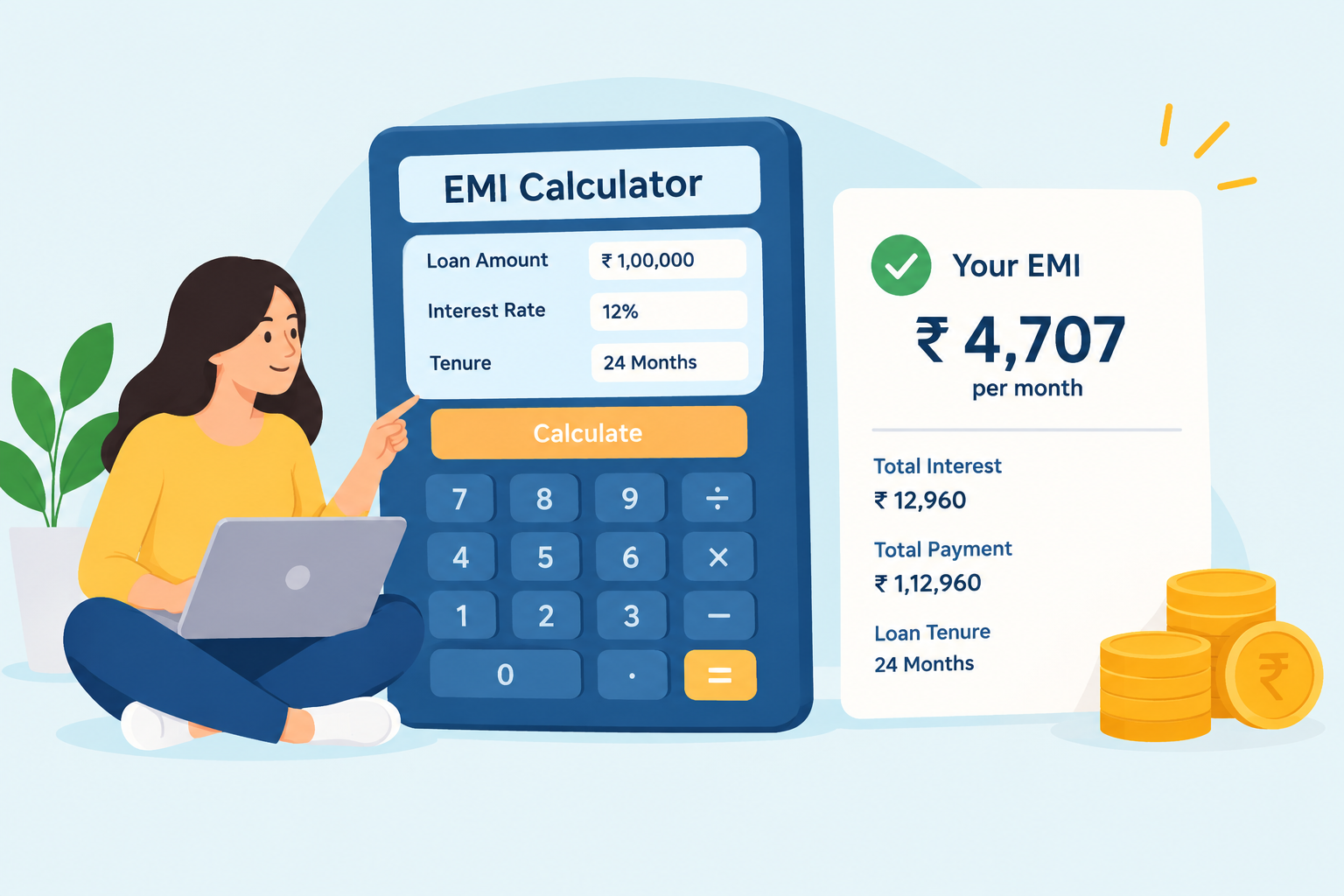
| ₹1,00,000 | 12% | 24 months | ₹4,707 |
| ₹1,00,000 | 12% | 36 months | ₹3,321 |
| ₹2,00,000 | 15% | 24 months | ₹9,697 |
These are illustrative estimates, not loan offers. Actual rates and repayment terms depend on the lender and your eligibility.
EMI Calculator for Personal Loan: Interactive Calculator
Use this simple calculator to estimate your EMI. Enter the loan amount, annual interest rate and repayment tenure to see the estimated monthly payment and total interest.
<text color="secondary" size="sm">Illustrative calculator only. Results exclude fees and other charges.</text>
Why Should You Use a Personal Loan EMI Calculator?
An EMI calculator helps you understand the financial commitment before you borrow.
1. Estimate your monthly payment
You can find out how much you may need to pay each month and check whether the amount fits your budget.
2. Compare different loan tenures
Try different repayment periods to understand the trade-off between monthly EMI and total interest.
3. Understand the cost of borrowing
The estimated total repayment helps you see how much you will pay beyond the original loan amount.
4. Compare loan offers
You can compare potential payments for different interest rates and loan amounts before choosing a lender.
5. Plan your monthly budget
Knowing your expected EMI can help you account for rent, food, transport, existing debt and savings.
6. Avoid borrowing more than you need
Testing different loan amounts can help you decide whether a smaller loan would meet your requirement at a lower cost.
How to Calculate Personal Loan EMI Using a Formula
If you want to understand the mathematics behind the calculator, you can use the standard EMI formula.
EMI formula:
[
EMI = \frac{P \times r \times (1+r)^n}{(1+r)^n-1}
]
Where:
-
(P) = Principal loan amount
-
(r) = Monthly interest rate expressed as a decimal
-
(n) = Total number of monthly instalments
To convert an annual interest rate into a monthly rate, divide the annual percentage rate by 12 and then by 100.
For example, at an annual interest rate of 12%:
[
r = \frac{12}{12 \times 100} = 0.01
]
For a ₹1,00,000 loan over 12 months, the estimated EMI is approximately ₹8,885.
This formula assumes a standard reducing-balance loan with regular monthly payments. Your lender's exact calculation and repayment schedule may differ.
How Loan Amount Affects Your EMI
The loan amount is one of the main factors affecting monthly repayment.
Assuming the same annual interest rate of 12% and a 24-month tenure:
| Loan amount | Approx. monthly EMI |
|---|---|
| ₹50,000 | ₹2,354 |
| ₹1,00,000 | ₹4,707 |
| ₹1,50,000 | ₹7,061 |
| ₹2,00,000 | ₹9,415 |
As the loan amount increases, the EMI generally increases when the interest rate and tenure remain the same.
Borrow only the amount you need and can reasonably repay.
How Interest Rates Affect Personal Loan EMI
The interest rate affects both the monthly payment and the total borrowing cost.
Consider a ₹1,00,000 loan over 24 months:
| Annual interest rate | Approx. monthly EMI |
|---|---|
| 10% | ₹4,615 |
| 12% | ₹4,707 |
| 15% | ₹4,849 |
| 18% | ₹4,992 |
A higher interest rate generally increases the EMI and total interest payable when the principal and tenure remain unchanged.
When comparing lenders, do not focus only on the advertised interest rate. Review processing fees, applicable charges and the overall cost of the loan.
How Loan Tenure Affects EMI
Loan tenure is the period allowed to repay the loan. Choosing the tenure involves balancing monthly affordability against total interest.
Consider a hypothetical ₹1,00,000 loan at an annual interest rate of 12%.
| Tenure | Approx. monthly EMI | Approx. total interest |
|---|---|---|
| 12 months | ₹8,885 | ₹6,619 |
| 24 months | ₹4,707 | ₹12,960 |
| 36 months | ₹3,321 | ₹19,560 |
Figures are rounded estimates and exclude fees.
A longer tenure reduces the monthly EMI but generally increases total interest. A shorter tenure can reduce the interest cost, but the higher EMI may put more pressure on your monthly budget.
Choose a repayment period that balances affordability and total cost.
How to Choose an Affordable Personal Loan EMI
An affordable EMI is one you can pay on time without compromising essential expenses or other financial commitments.
Before applying, consider the following:
Review your monthly income
Use your reliable take-home income as the starting point for budgeting. If your earnings vary, allow for lower-income months.
Calculate existing obligations
Include current loan EMIs, credit card payments and other regular debt commitments.
Account for essential expenses
Set aside money for housing, food, transport, utilities, insurance and other necessary expenses.
Maintain emergency savings
Avoid committing all your available income to repayments. Unexpected expenses can occur even when your income is stable.
Compare more than one tenure
Calculate the EMI and total interest for different tenures. Choose the option that suits your budget and financial goals.
Avoid relying on maximum eligibility
A lender may offer a loan amount that is higher than what is comfortable for your personal budget. Approval does not automatically mean the loan is affordable for you.
Personal Loan EMI Calculator for Different Borrowers
Different applicants may have different income patterns and financial commitments. The calculator can help each borrower test possible repayments.
Salaried employees
Salaried employees can compare the EMI with their monthly take-home income and existing expenses.
Self-employed individuals
Business owners and professionals should consider income fluctuations and ensure that repayments remain manageable during slower business periods.
Freelancers and gig workers
Applicants with variable earnings should avoid basing affordability on their best earning month alone. Consider average income and keep a financial buffer.
New employees
People who have recently started working should assess essential expenses, job stability and any existing financial commitments before choosing an EMI.
The calculator estimates the payment; it does not determine eligibility or guarantee loan approval.
What Is the Difference Between EMI and Total Interest?
EMI is the amount paid every month. Total interest is the cost of borrowing over the repayment period, excluding fees and other charges.
For example, consider a ₹1,00,000 loan at 12% annual interest for 24 months:
-
Approximate monthly EMI: ₹4,707
-
Approximate total repayment: ₹1,12,960
-
Approximate total interest: ₹12,960
The total repayment includes the principal and interest. Actual figures may vary based on the lender's final terms.
Understanding both EMI and total interest helps you evaluate the overall affordability of a loan.
Common Mistakes to Avoid When Using an EMI Calculator
Considering only the monthly EMI
A low EMI may look attractive, but a longer tenure can increase the total interest paid.
Entering the wrong interest rate
Use the annual rate offered or quoted by the lender, not a guessed figure.
Ignoring processing fees
The EMI estimate usually does not include all fees. Check the full cost breakdown.
Choosing an excessive loan amount
A larger loan increases repayment obligations. Borrow according to your actual need.
Assuming the calculator guarantees approval
The tool estimates repayment only. The lender separately assesses your income, credit history, documentation and eligibility.
Forgetting about existing debt
Calculate how the new EMI will fit alongside current obligations before applying.
How to Reduce Your Personal Loan Repayment Cost
If you want to make borrowing more manageable, consider these steps.
-
Compare interest rates and fees from suitable lenders.
-
Borrow only the amount necessary.
-
Choose the shortest tenure that still allows comfortable repayments.
-
Pay EMIs on time to avoid applicable late charges.
-
Review the loan agreement before making a prepayment or foreclosure.
-
Check whether prepayment charges or other conditions apply.
-
Avoid taking another loan simply to cover unaffordable repayments without reviewing the overall cost.
There is no single repayment strategy that suits everyone. Choose an option based on your income, expenses and financial priorities.
Personal Loan EMI Calculator vs Loan Eligibility Calculator
These tools serve different purposes.
| Feature | EMI calculator | Eligibility calculator |
|---|---|---|
| Main purpose | Estimates monthly repayments | Estimates whether you may qualify and potentially how much |
| Typical inputs | Loan amount, interest rate and tenure | Income, age, employment, liabilities and other details |
| Main result | Estimated EMI and repayment cost | Indicative eligibility or possible loan amount |
| Guarantees approval? | No | No |
You can use an EMI calculator to assess affordability even before checking your eligibility.
Frequently Asked Questions (FAQs)
1. What is a personal loan EMI calculator?
A personal loan EMI calculator is an online tool that estimates your monthly instalment using the loan amount, annual interest rate and repayment tenure.
2. Is a personal loan EMI calculator free to use?
Many online EMI calculators are free to use. Check the website's terms and avoid tools that request unnecessary sensitive information.
3. How is personal loan EMI calculated?
EMI is calculated using the principal, monthly interest rate and total number of monthly instalments under a standard reducing-balance formula.
4. What will be the EMI for a ₹1 lakh personal loan?
The EMI depends on the interest rate and tenure. At an illustrative annual rate of 12%, a ₹1 lakh loan for 12 months has an estimated EMI of ₹8,885.
5. Does a longer tenure reduce EMI?
Generally, yes. A longer tenure spreads repayment across more months, lowering the EMI but usually increasing total interest.
6. Does a lower interest rate reduce EMI?
Generally, yes. If the principal and tenure remain unchanged, a lower interest rate reduces the EMI and total interest.
7. Does an EMI calculator include processing fees?
Usually, the standard EMI calculation excludes processing fees and other charges. Review the lender's fee schedule separately.
8. Can I use an EMI calculator before applying for a loan?
Yes. You can estimate possible repayments before submitting an application and use the results to compare loan options.
9. Does a low EMI mean a loan is cheaper?
Not necessarily. A longer tenure can lower the monthly EMI while increasing the total interest paid. Compare the full repayment amount.
10. Can an EMI calculator tell me whether my loan will be approved?
No. It estimates repayments but does not evaluate all eligibility requirements or guarantee approval.
11. How much EMI is affordable on my salary?
There is no universal affordable EMI percentage for everyone. Consider take-home income, existing debt, essential expenses, savings and income stability.
12. Can self-employed people use a personal loan EMI calculator?
Yes. The calculator works for anyone who wants to estimate repayments. Self-employed applicants should also account for income fluctuations.
13. What happens if I repay my loan early?
Early repayment may reduce future interest, depending on the outstanding balance and loan terms. Check applicable prepayment or foreclosure charges before proceeding.
14. Is EMI the same every month?
For a standard fixed-rate loan with a regular repayment schedule, the EMI is generally fixed. Floating rates or specific contract terms can change payments.
15. Which details do I need for an EMI calculation?
You generally need the loan amount, annual interest rate and repayment tenure. The lender's final offer is required for an exact repayment schedule.
Conclusion
A personal loan EMI calculator is a useful tool for understanding monthly payments before borrowing. By testing different loan amounts, interest rates and repayment tenures, you can compare options and plan your finances more effectively.
Before accepting a loan, check the total repayment, applicable fees and final terms. Choose an EMI that fits your budget while leaving room for essential expenses, savings and unexpected costs. Responsible planning can help you borrow with greater confidence.
Published on : 15th October 2026
Published by : Bhargavi
www.vizzve.com || www.vizzveservices.com
Follow us on social media: Facebook || Linkedin || Instagram
🛡 Powered by Vizzve Financial
RBI-Registered Loan Partner | 10 Lakh+ Customers | ₹600 Cr+ Disbursed