

Introduction
A personal loan for government employees can be a convenient financing option for eligible employees who need funds for planned or unexpected personal expenses.
Government employees may have a regular source of income, which can help lenders assess repayment capacity. However, employment in the government sector does not automatically guarantee loan approval. Lenders may consider income, age, employment details, credit history, existing liabilities, repayment capacity, and their own internal policies.
A personal loan is generally an unsecured loan, meaning eligible borrowers usually do not have to pledge property or another asset as collateral.
Whether you work for the Central Government, State Government, public-sector department, municipality, or another eligible government organisation, it is important to compare the complete cost of borrowing before taking a loan.
This guide explains personal loan eligibility for government employees, required documents, EMI considerations, application steps, advantages and disadvantages, and responsible borrowing practices.
AI Answer Box: Personal Loan for Government Employees
A personal loan for government employees is generally an unsecured loan available to eligible government-sector salaried employees. Lenders may evaluate salary, age, employment stability, credit history, existing obligations, and repayment capacity before approving an application.
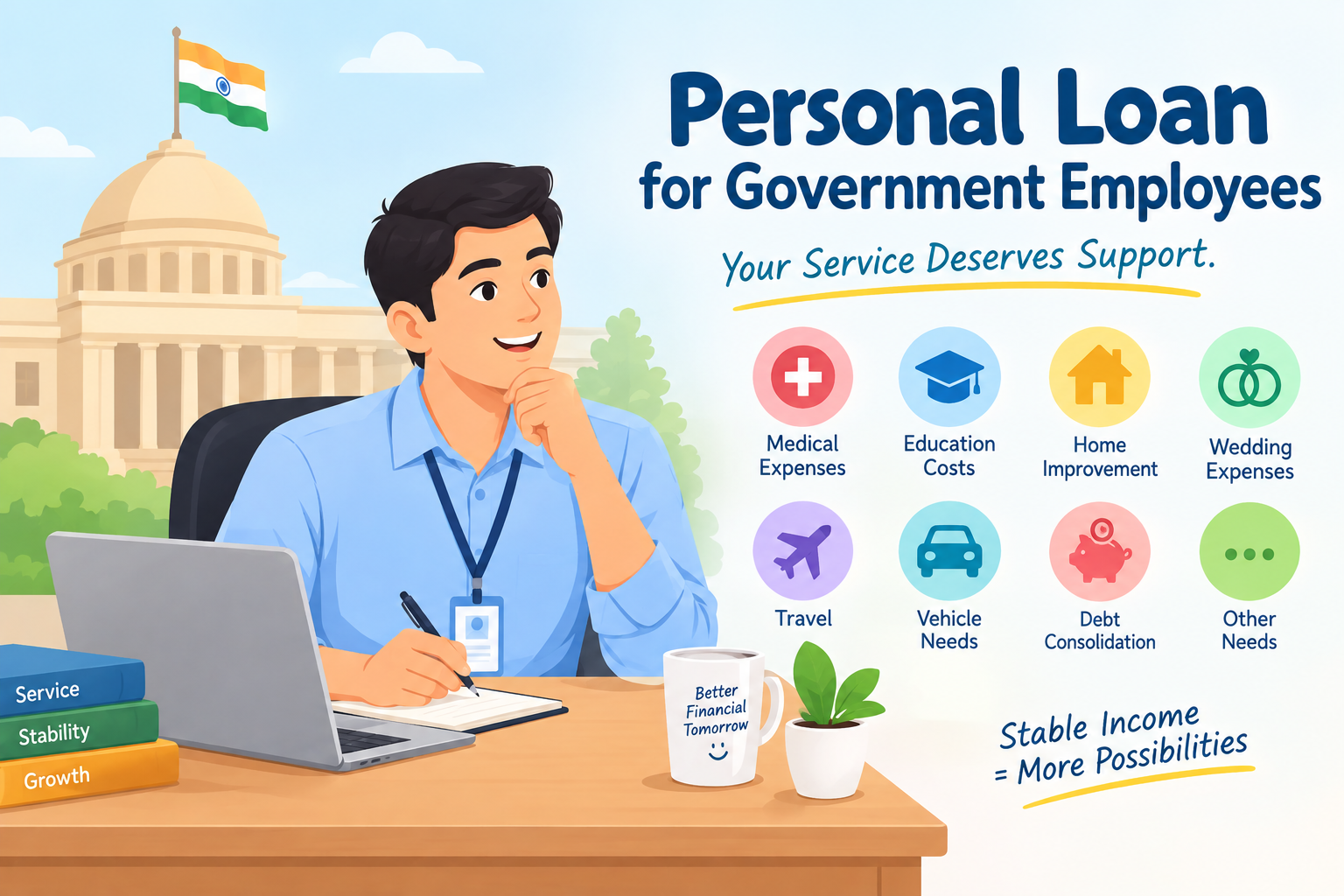
Government employees may use personal loans for:
- Medical expenses
- Education expenses
- Home repairs
- Wedding expenses
- Emergency needs
- Travel
- Debt consolidation
- Major personal expenses
The actual loan amount, interest rate, tenure, processing fee, and approval decision depend on the lender and the applicant's financial profile.
What Is a Personal Loan for Government Employees?
A personal loan for government employees is a loan that eligible salaried government-sector employees can use for personal financial requirements.
Unlike a home loan or vehicle loan, a personal loan generally does not require the borrower to provide an asset as security.
The borrower receives the approved amount and repays it through periodic instalments, usually called Equated Monthly Instalments (EMIs).
Key Features
| Feature | Details |
|---|---|
| Loan Type | Generally unsecured |
| Collateral | Usually not required |
| Applicant | Eligible government-sector employee |
| Income | Regular salary considered |
| Repayment | Monthly EMI |
| Tenure | Depends on lender |
| Interest Rate | Depends on lender and borrower profile |
| Documents | KYC, income and employment documents may be required |
| Usage | Generally flexible, subject to lender terms |
Why Government Employees May Consider Personal Loans
Government employees may require additional funds for a variety of personal reasons.
A personal loan may be considered when:
- An urgent expense cannot be covered through existing savings.
- A large planned expense needs financing.
- A medical emergency requires immediate funds.
- Home repair or renovation costs arise.
- Education-related expenses need to be paid.
- A wedding or family event requires additional funds.
- Existing eligible debts need to be consolidated.
However, a personal loan should not be treated as additional income. It creates a repayment obligation that continues until the loan is fully repaid.
Personal Loan Eligibility for Government Employees
There is no single eligibility rule applicable to every government employee.
Each lender can have its own requirements. Common factors may include:
1. Age
The applicant generally needs to fall within the lender's specified age range.
2. Employment Status
The applicant should meet the lender's requirements regarding government employment.
3. Monthly Salary
Salary is an important factor in assessing repayment capacity.
4. Employment Duration
Some lenders may consider the length and continuity of employment.
5. Credit History
Your previous borrowing and repayment behaviour may influence the lender's assessment.
6. Existing Financial Obligations
Existing EMIs, credit-card balances, and other debts can affect your available repayment capacity.
7. Employer or Department
Some lenders may have specific internal policies based on the employer or category of government employment.
Government Employee Personal Loan Eligibility Checklist
Before applying, check:
- You meet the lender's minimum age requirement.
- Your employment status meets the lender's criteria.
- You have regular salary income.
- Your existing debt is manageable.
- Your credit history is satisfactory.
- Your KYC documents are valid.
- Your salary and bank details are available.
- You can comfortably manage the proposed EMI.
Meeting eligibility criteria does not guarantee loan approval. Final approval is subject to the lender's credit assessment.
Personal Loan for Central Government Employees
Central Government employees may be eligible for personal loans from banks and other eligible lenders, subject to individual lender criteria.
The lender may evaluate:
- Monthly salary
- Employment details
- Age
- Existing loans
- Credit history
- Bank account information
- Repayment capacity
Central Government employment can provide a stable income profile, but borrowers should still compare loan costs instead of assuming that government employment automatically means a lower interest rate.
Personal Loan for State Government Employees
State Government employees may also apply for personal loans if they satisfy the lender's requirements.
The eligibility assessment may consider:
- State government employment
- Monthly income
- Length of service
- Credit profile
- Existing financial commitments
- Age
- Repayment capacity
Different lenders may have different policies for different government departments or employment categories.
Documents Required for Government Employee Personal Loans
The exact documentation depends on the lender.
Commonly requested documents may include:
Identity and Address Proof
Examples include:
- Aadhaar
- PAN
- Passport
- Driving licence
- Voter ID
- Other accepted KYC documents
Income Documents
Depending on the lender, you may be asked for:
- Recent salary slips
- Bank statements
- Form 16
- Other income-related documents
Employment Details
You may need to provide:
- Employer or department name
- Designation
- Employee details
- Length of service
- Office details
- Monthly salary
Always provide accurate and genuine documents.
Personal Loan Interest Rate for Government Employees
The interest rate offered to a government employee depends on the lender and the applicant's overall profile.
Factors that may influence the pricing include:
- Credit history
- Income
- Existing liabilities
- Loan amount
- Tenure
- Employer profile
- Relationship with the lender
- Internal credit policies
Do not compare loans using the interest rate alone.
Compare These Costs
| Cost | Why You Should Check It |
|---|---|
| Interest rate | Affects borrowing cost |
| Processing fee | Adds to the overall cost |
| Applicable taxes | May apply to certain charges |
| Prepayment charges | Important if you plan early repayment |
| Foreclosure charges | Relevant if you close the loan early |
| Late-payment charges | Can increase the cost of missed payments |
| Other fees | May differ between lenders |
Personal Loan EMI for Government Employees
EMI stands for Equated Monthly Instalment.
It is the periodic amount paid by the borrower toward the loan.
The EMI mainly depends on:
- Principal amount
- Interest rate
- Repayment tenure
For example, if a government employee borrows ₹5 lakh, the EMI will depend on the interest rate and selected tenure.
Important Rule
A longer tenure can reduce the monthly EMI, but it can increase the overall interest paid.
Therefore, borrowers should consider both:
Monthly affordability + Total repayment cost
rather than selecting a loan solely because it offers a low EMI.
Personal Loan for Government Employees With Low Salary
Government employees with lower salaries may still be able to apply for personal loans, subject to the lender's minimum income requirements.
A lower salary can affect:
- Maximum eligible loan amount
- EMI affordability
- Loan tenure
- Approval decision
- Overall loan terms
Tips for Lower-Income Borrowers
- Borrow only what you need.
- Keep existing EMIs under control.
- Avoid unnecessary credit-card debt.
- Maintain timely repayment history.
- Choose an EMI that fits your monthly budget.
- Compare the total cost before accepting a loan.
How to Apply for a Personal Loan Online
Many lenders offer online application facilities.
Step 1: Check Eligibility
Review the lender's requirements for government employees.
Step 2: Compare Loan Options
Compare:
- Interest rate
- Loan amount
- Tenure
- Processing fee
- EMI
- Prepayment terms
- Other applicable charges
Step 3: Complete the Application
Provide accurate personal, employment and income information.
Step 4: Submit Documents
Upload the documents requested by the lender.
Step 5: Verification
The lender may verify your identity, income, employment and credit information.
Step 6: Review the Loan Offer
Carefully review the loan amount, interest rate, EMI, tenure, charges and other terms.
Step 7: Check the KFS and Agreement
Where applicable, review the Key Facts Statement (KFS) and the final loan agreement before accepting the facility.
Step 8: Disbursement
If the loan is approved and all required conditions are completed, the amount may be disbursed according to the lender's process.
How to Improve Personal Loan Approval Chances
No method can guarantee approval, but responsible financial behaviour can strengthen your application.
Maintain Timely Repayments
Pay existing EMIs and credit-card dues on time.
Keep Existing Debt Manageable
High existing obligations may reduce your capacity to take another loan.
Avoid Multiple Loan Applications
Applying to many lenders in a short period may result in multiple credit enquiries.
Keep Documents Updated
Make sure your identity, salary and employment information is accurate.
Check Your Credit Report
Review your credit information periodically and raise disputes through the appropriate channel if you find genuine errors.
Pros and Cons of Personal Loans for Government Employees
| Pros | Cons |
|---|---|
| Generally no collateral required | Interest can be higher than some secured loans |
| Flexible use of funds | Creates a monthly repayment obligation |
| Regular salary may support repayment assessment | Processing fees may apply |
| Online application may be available | Approval is not automatic |
| Fixed EMI structure may simplify budgeting | Missed payments can affect credit history |
Personal Loan vs Salary Advance
| Factor | Personal Loan | Salary Advance |
|---|---|---|
| Provider | Bank/NBFC or eligible lender | Employer/organisation, where available |
| Repayment | Usually EMI-based | Depends on employer rules |
| Interest | Usually applicable | May or may not involve interest |
| Eligibility | Based on lender criteria | Based on employer policy |
| Availability | Depends on lender | Depends on organisation |
| Best suited for | Larger personal funding needs | Short-term salary-related requirements |
Government employees should check whether their department or employer offers any employee-specific advance or loan facility before choosing external borrowing.
Personal Loan vs Secured Loan
| Feature | Personal Loan | Secured Loan |
|---|---|---|
| Collateral | Generally not required | Usually required |
| Approval | Based heavily on financial profile | Also considers collateral |
| Interest | Can be higher | May be lower depending on product |
| Usage | Often flexible | Depends on loan type |
| Asset risk | No pledged asset | Collateral may be at risk if obligations are not met |
What Government Employees Should Check Before Taking a Loan
Before accepting an offer, carefully check:
- Loan amount
- Interest rate
- Fixed or floating rate, where applicable
- EMI
- Loan tenure
- Total repayment amount
- Processing fee
- Applicable taxes
- Late-payment charges
- Prepayment conditions
- Foreclosure conditions
- KFS, where applicable
- Loan agreement
- Grievance and customer-support details
Do Not Compare Only the EMI
A low EMI can sometimes result from a longer tenure.
Always compare the total amount payable over the entire loan period.
Real-World Financial Planning Example
Consider two government employees who need the same amount of money.
Employee A selects a long tenure because the monthly EMI is lower.
Employee B selects a shorter tenure with a higher EMI that still fits comfortably within the monthly budget.
Employee A may have more monthly cash flow available, while Employee B may potentially pay less interest over the life of the loan.
The right choice depends on income, existing obligations, financial goals and repayment capacity.
Practical Rule
Choose the shortest comfortable tenure rather than simply choosing the lowest EMI.
Expert Commentary
A personal loan should be treated as a financial commitment, not as extra disposable income.
Government employees should assess their complete monthly budget before borrowing. A stable salary can support predictable repayment, but unexpected expenses, existing EMIs, family responsibilities and retirement planning should also be considered.
A responsible borrower should determine:
- How much is actually needed.
- How much EMI can comfortably be paid.
- What the total repayment will be.
- Whether savings can cover part of the expense.
- Whether an employee-specific advance is available.
- Whether the new loan will interfere with existing financial goals.
Can Government Employees Get Personal Loans Without Collateral?
Yes. Personal loans are generally unsecured, which means eligible borrowers typically do not need to pledge property or another asset.
However, unsecured borrowing still creates a legal repayment obligation.
Failure to repay on time can result in applicable charges and may negatively affect your credit history.
Can Pensioners Get Personal Loans?
Pensioners are a different borrower category from currently employed government employees.
Some lenders may offer loan products to pensioners, but eligibility, age limits, income requirements, repayment tenure and documentation can differ significantly.
Therefore, a pensioner should check the specific lender's senior-citizen or pensioner loan criteria rather than assuming that active government employee eligibility applies.
Can Government Employees Apply for Personal Loans Online?
Yes. Many lenders provide digital application processes.
An online application may make it easier to submit information and documents. However, borrowers should verify the identity of the lender or regulated entity and understand all loan terms before providing sensitive information.
Do not share OTPs, passwords or other confidential banking credentials with unknown individuals or unauthorised platforms.
Responsible Borrowing Checklist
Before taking a personal loan, ask:
- Do I really need this loan?
- How much do I actually need?
- Can I comfortably pay the EMI?
- Have I compared multiple offers?
- Have I checked the total repayment amount?
- Have I reviewed all applicable charges?
- Have I checked the KFS?
- Do I understand prepayment and foreclosure rules?
- Will the EMI affect my emergency savings?
- Is an employee-specific advance available?
- Am I borrowing more than necessary?
If the proposed EMI puts pressure on your essential monthly expenses, reconsider the loan amount or tenure.
Frequently Asked Questions
1. Can government employees get personal loans?
Yes. Eligible government employees can apply for personal loans, subject to the lender's age, income, employment, credit and repayment criteria.
2. Is a personal loan for government employees secured or unsecured?
Personal loans are generally unsecured, so collateral is usually not required.
3. Can Central Government employees get personal loans?
Yes. Eligible Central Government employees may apply for personal loans from lenders that serve their borrower profile, subject to applicable criteria.
4. Can State Government employees get personal loans?
Yes. State Government employees may also be eligible, depending on the lender's requirements.
5. What documents are required for a government employee personal loan?
Common documents may include KYC documents, salary slips, bank statements, PAN and employment-related information. Requirements vary by lender.
6. Does a government job guarantee personal loan approval?
No. Government employment may be considered positively by some lenders, but approval depends on the lender's complete credit assessment.
7. Can government employees get personal loans without collateral?
Yes. Personal loans are generally unsecured and therefore usually do not require collateral.
8. Does salary affect government employee personal loan eligibility?
Yes. Income is generally considered when evaluating repayment capacity and loan eligibility.
9. Does CIBIL score matter for government employees?
Yes. Credit history can influence a lender's assessment of an application, even when the applicant is a government employee.
10. Can government employees apply for personal loans online?
Yes. Many lenders offer online personal loan application facilities.
11. Can government employees get personal loans with low salaries?
They may be eligible if they satisfy the lender's minimum income and other requirements. The eligible amount may be lower depending on repayment capacity.
12. Is a personal loan better than a salary advance?
It depends on the amount required, interest cost, repayment terms and whether the employer offers an advance facility.
13. Can government employees repay a personal loan early?
Early repayment may be possible depending on the lender's terms. Borrowers should check applicable prepayment or foreclosure conditions.
14. What is the best tenure for a government employee personal loan?
There is no universal best tenure. Choose a period that keeps the EMI affordable while avoiding unnecessarily high total interest.
15. Should government employees compare personal loan offers?
Yes. Comparing interest rates, fees, tenure, EMI and total repayment cost can help borrowers make a more informed decision.
Conclusion
A personal loan for government employees can provide access to funds for emergencies, education, medical expenses, home repairs, family events and other personal requirements.
Government employment may provide a stable income profile, but loan approval is still based on the lender's assessment. Income, credit history, existing obligations, age, employment details and repayment capacity can all matter.
The best approach is to borrow only what you need, compare different loan options, understand the complete cost, and carefully read the KFS and loan agreement before accepting an offer.
A financially responsible borrower focuses not only on getting a loan but also on making sure the EMI remains comfortable throughout the repayment period.
Published on : 07th October 2026
Published by : Bhargavi
www.vizzve.com || www.vizzveservices.com
Follow us on social media: Facebook || Linkedin || Instagram
🛡 Powered by Vizzve Financial
RBI-Registered Loan Partner | 10 Lakh+ Customers | ₹600 Cr+ Disbursed