

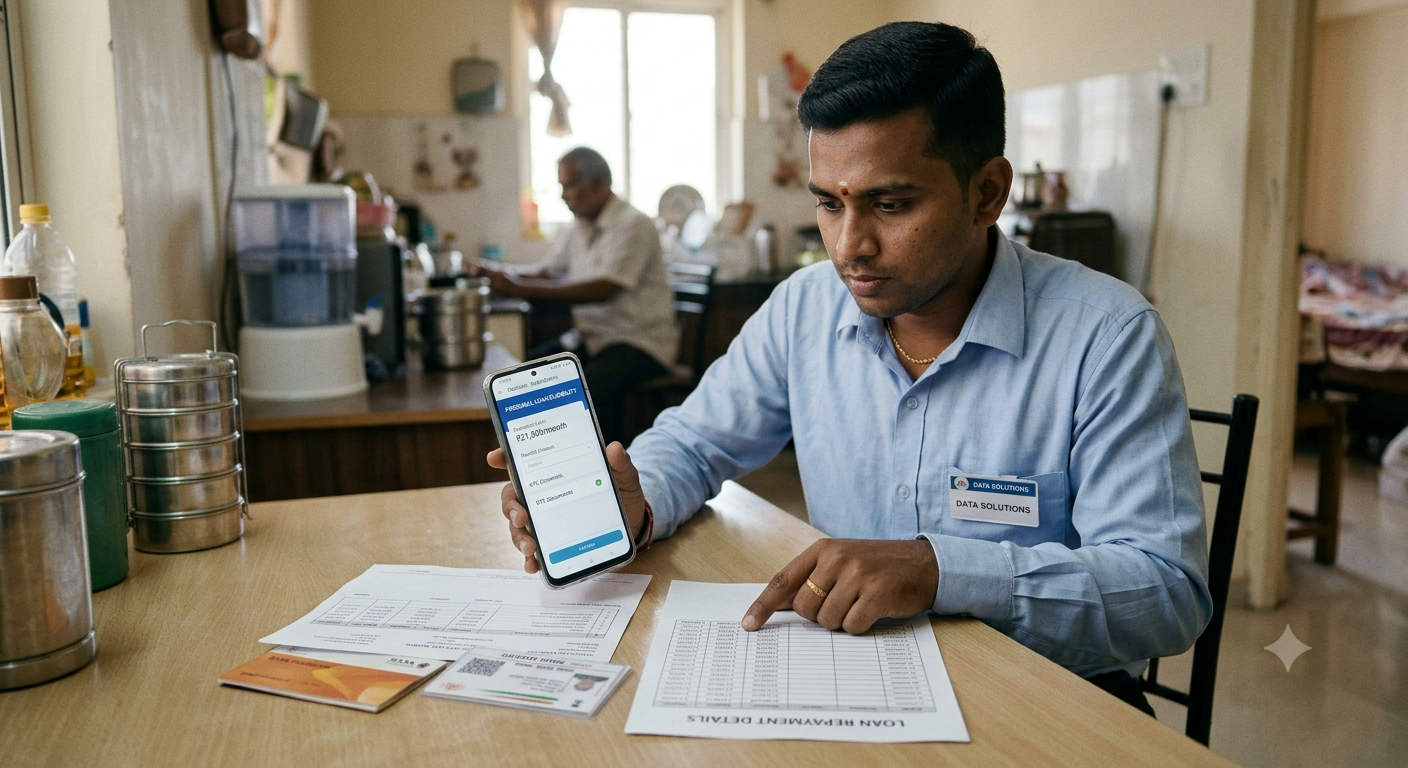
A personal loan for private employees is an unsecured loan offered to eligible salaried individuals working in private-sector organisations.
Unlike home loans or vehicle loans, personal loans generally do not require borrowers to pledge property or assets as security.
The borrowed amount can be used for different personal requirements, such as:
-
Medical emergencies and hospital bills.
-
Home renovation and household repairs.
-
Children's education expenses.
-
Wedding and family functions.
-
Travel and relocation expenses.
-
Debt consolidation, where financially suitable.
-
Unexpected personal and family expenses.
The lender determines the loan amount, interest rate, and repayment tenure after evaluating the applicant's income, credit history, employment details, and repayment capacity.
2. Who Can Apply for a Personal Loan?
Private-sector employees from different professional backgrounds may apply for personal loans if they satisfy the lender's eligibility conditions.
Common applicant categories include:
-
IT professionals and software developers.
-
Employees working in private banks and NBFCs.
-
BPO and call centre employees.
-
Sales and marketing professionals.
-
Manufacturing and factory employees.
-
Human resource and administrative professionals.
-
Retail and customer service employees.
-
Employees of startups and multinational companies.
-
Healthcare and private hospital employees.
Both experienced professionals and employees with shorter work histories may qualify, depending on the lender's policies.
3. Personal Loan Eligibility for Private Employees
Before approving an application, lenders evaluate the applicant's financial stability and ability to repay the loan.
The following factors are commonly considered:
|
Eligibility Factor |
General Requirements |
|---|---|
|
Age |
Usually 21–60 years |
|
Employment |
Working in a private-sector organisation |
|
Monthly salary |
As specified by the lender |
|
Work experience |
Based on lender policy |
|
Credit score |
Healthy credit history preferred |
|
Bank account |
Active account with income records |
|
Existing EMIs |
Within affordable repayment capacity |
Important: These are general eligibility indicators, not fixed industry-wide rules. Minimum salary, age, and employment requirements vary between banks and NBFCs.
4. Documents Required for a Personal Loan
Private employees generally have access to salary slips, bank statements, and employment records that help lenders verify their income.
Commonly requested documents include:
Identity Proof
-
PAN Card.
-
Aadhaar Card or another accepted identity document.
Income Proof
-
Latest 3 months' salary slips, if requested.
-
Recent 3–6 months' bank statements.
-
Form 16 or Income Tax Return, where applicable.
Employment Proof
-
Employee identity card.
-
Appointment letter or employment confirmation, if required.
-
Employer and office details.
Address Proof
-
Aadhaar Card.
-
Utility bills or other accepted address documents.
The lender may request additional documents depending on the applicant's profile and verification requirements.
5. How to Apply for a Personal Loan Online
Private employees can apply for personal loans through banks, NBFCs, or digital lending platforms associated with regulated lenders.
Follow this step-by-step process:
-
Select a suitable lender: Compare available loan options, interest rates, processing fees, and repayment periods.
-
Check eligibility: Review minimum salary, age, employment history, and credit score requirements.
-
Complete the application form: Enter your personal details, monthly salary, company information, and loan requirements.
-
Complete KYC verification: Submit PAN and other accepted identity documents.
-
Upload income documents: Provide salary slips and bank statements as requested.
-
Wait for verification: The lender evaluates your income, employment stability, and repayment capacity.
-
Review the loan offer: Check the interest rate, APR, EMI, processing fees, and other applicable charges.
-
Complete the agreement: Accept the terms only after understanding the loan conditions.
-
Receive disbursement: Following approval and completion of formalities, the loan amount is transferred to your bank account.
6. Factors That Determine Personal Loan Approval
Receiving a regular salary does not automatically guarantee personal loan approval. Lenders evaluate several financial factors before making a decision.
|
Factor |
Importance |
|---|---|
|
Monthly salary |
Helps assess repayment capacity |
|
CIBIL score |
Indicates credit repayment history |
|
Employment stability |
Helps evaluate income continuity |
|
Existing EMIs |
Determines current debt obligations |
|
Bank statements |
Help verify salary transactions |
|
Loan amount |
Determines repayment requirements |
|
Repayment tenure |
Influences monthly EMI |
Employees with consistent income, manageable debt, and a positive credit history may have better chances of qualifying for suitable loan offers.
7. Personal Loan Interest Rates for Private Employees
Personal loan interest rates vary between banks and NBFCs. Each lender determines the applicable rate based on its lending policy and the applicant's financial profile.
Some important factors that influence interest rates include:
-
Credit score and previous repayment behaviour.
-
Monthly take-home salary.
-
Employment and income stability.
-
Existing loans and credit card obligations.
-
Requested loan amount.
-
Selected repayment tenure.
Before accepting a loan, compare the interest rate and Annual Percentage Rate (APR). APR helps borrowers understand the overall annual cost of credit, including applicable charges.
The Reserve Bank of India requires regulated lenders to provide a Key Facts Statement (KFS) containing important loan information before the loan contract is executed.
8. Benefits of Personal Loans for Private Employees
Personal loans can provide financial flexibility to eligible salaried individuals.
1. No collateral requirement
Most personal loans are unsecured, so borrowers generally do not need to pledge property or valuable assets.
2. Flexible usage
Employees can use the funds for medical expenses, home improvements, education, travel, and other personal requirements.
3. Convenient digital applications
Many lenders offer online application facilities, digital KYC, and document submission.
4. Predictable monthly repayments
Fixed-interest personal loans generally allow borrowers to plan their monthly EMI in advance.
5. Flexible repayment tenure
Eligible borrowers can choose from the repayment periods offered by their lenders.
6. Financial support during emergencies
Personal loans may help employees manage unexpected expenses without immediately liquidating long-term investments.
9. Common Reasons for Personal Loan Rejection
Even salaried private employees may face loan rejection due to financial or documentation-related issues.
|
Rejection Reason |
Possible Solution |
|---|---|
|
Low CIBIL score |
Improve repayment history |
|
High existing EMIs |
Reduce outstanding debt |
|
Inconsistent salary credits |
Maintain regular banking records |
|
Frequent job changes |
Check employment requirements |
|
Multiple loan enquiries |
Avoid unnecessary applications |
|
Incorrect application details |
Provide accurate information |
|
Incomplete documentation |
Submit all requested documents |
Understanding these reasons can help applicants prepare better before applying.
10. How to Improve Personal Loan Eligibility
Private employees can take several steps to strengthen their financial profile.
-
Maintain a good credit score: Pay existing EMIs and credit card bills before their due dates.
-
Keep salary records updated: Maintain regular salary credits in your bank account.
-
Reduce existing liabilities: Avoid taking additional debt when current EMIs are already high.
-
Check your credit report: Identify and dispute incorrect information.
-
Avoid multiple applications: Research lender requirements before submitting applications.
-
Maintain employment records: Keep salary slips, Form 16, and employment documents available.
-
Choose an affordable amount: Apply for a loan that matches your actual financial needs.
These practices may improve your loan eligibility, although final approval remains with the lender.
11. Personal Loan EMI Calculation for Private Employees
Understanding EMI calculations helps employees plan their monthly budgets and avoid excessive borrowing.
Consider the following example:
Illustrative Personal Loan Calculation
₹1,50,000
12% p.a.
24 months
₹7,061
Total repayment
Approximately ₹1,69,462
Total interest
Approximately ₹19,462
Before selecting an EMI, employees should:
-
Calculate their monthly take-home salary.
-
Deduct rent, household expenses, and existing EMIs.
-
Maintain an emergency savings fund.
-
Consider future financial responsibilities.
-
Choose a repayment amount that remains affordable.
12. Personal Loan Safety Tips for Private Employees
Online lending provides convenience, but borrowers should carefully verify the lender before sharing personal information.
Important precautions include:
-
Verify the actual bank or NBFC providing the loan.
-
Check the digital lending app's association with the regulated lender.
-
Read the complete loan agreement.
-
Review the KFS and APR before accepting the offer.
-
Check processing fees and late payment charges.
-
Never share OTPs, PINs, or banking passwords.
-
Avoid loan agents demanding advance payments for guaranteed approval.
-
Check privacy policies and grievance redressal information.
Under the RBI Digital Lending Directions, 2025, regulated lenders must follow requirements relating to borrower creditworthiness, disclosures, and customer protection.
13. How to Choose the Right Personal Loan
Choosing the right loan involves more than comparing the advertised interest rate.
Private employees should evaluate the following:
|
Comparison Factor |
What to Check |
|---|---|
|
Interest rate |
Applicable annual interest rate |
|
APR |
Overall annual borrowing cost |
|
Processing fee |
Charges for loan processing |
|
EMI |
Monthly repayment affordability |
|
Loan tenure |
Available repayment periods |
|
Prepayment |
Early repayment conditions |
|
Late payment charges |
Penalties for missed payments |
|
Customer support |
Availability of grievance assistance |
A suitable personal loan should meet the borrower's financial requirements without creating unnecessary repayment pressure.
14. Is a Personal Loan Suitable for Private Employees?
A personal loan can be useful for private employees who need additional funds for important expenses and have sufficient repayment capacity.
However, it is important to evaluate whether borrowing is necessary.
Before applying, consider:
-
Can the expense be managed through existing savings?
-
Is the monthly EMI affordable?
-
Are the interest rate and fees reasonable?
-
Will the loan affect other financial commitments?
-
Is the repayment period suitable for your income?
Responsible borrowing can help employees manage financial requirements while maintaining long-term financial stability.
Frequently Asked Questions (FAQs)
1. Can private employees get personal loans in India?
Yes. Eligible private-sector employees can apply for personal loans through banks and NBFCs, subject to their income, credit profile, and lender requirements.
2. What is the minimum salary required for a personal loan?
There is no single minimum salary applicable to every lender. Requirements vary according to the financial institution and applicant profile.
3. Can employees of small private companies apply for personal loans?
Yes. Employees of small companies may apply, although lenders may consider employer profile, income stability, and employment history.
4. Is CIBIL score important for private employees?
Yes. Lenders commonly evaluate credit scores and repayment history to assess the applicant's creditworthiness.
5. Can I get a personal loan without collateral?
Yes. Personal loans are generally unsecured and do not require borrowers to pledge property or other assets.
6. What documents are required for a salaried personal loan?
Common documents include PAN, accepted identity proof, address proof, salary slips, and recent bank statements.
7. Can private employees apply for loans online?
Yes. Many banks and NBFCs provide online application facilities with digital KYC and income verification.
8. Can I get a personal loan with existing EMIs?
Possibly. Lenders evaluate your existing financial obligations and remaining repayment capacity before approving another loan.
9. Does changing companies affect personal loan eligibility?
It may affect eligibility if the lender has minimum employment continuity requirements. Policies differ between lenders.
10. Can employees with low CIBIL scores get personal loans?
Some lenders may consider such applications, but approval may be difficult and loan terms may be less favourable.
11. How much personal loan can a private employee get?
The eligible loan amount depends on monthly income, credit history, existing EMIs, and the lender's assessment.
12. Is a salary slip compulsory for personal loans?
Many lenders request salary slips. Some may also accept alternative income verification documents, depending on their policies.
13. Can I repay my personal loan before the due date?
Early repayment may be allowed, subject to the loan agreement and applicable prepayment conditions or charges.
14. What is the best loan tenure for private employees?
The best tenure depends on monthly income and affordability. Shorter tenures generally reduce total interest but increase monthly EMIs.
15. How can I avoid personal loan rejection?
Maintain a positive credit history, reduce existing debt, provide accurate documents, and apply for a suitable loan amount.
Conclusion
Personal loans can offer financial support to private-sector employees who need funds for medical emergencies, household expenses, education, travel, or other personal requirements.
Regular salary credits, stable employment, proper documentation, and a healthy credit history can help lenders evaluate personal loan applications.
Before borrowing, compare available loan offers, understand the APR and applicable charges, and select an EMI that comfortably fits your monthly budget.
Published on : 06th November
Published by : Yogendra
www.vizzve.com || www.vizzveservices.com
Follow us on social media: Facebook || Linkedin || Instagram
🛡 Powered by Vizzve Financial
RBI-Registered Loan Partner | 10 Lakh+ Customers | ₹600 Cr+ Disbursed