

Introduction
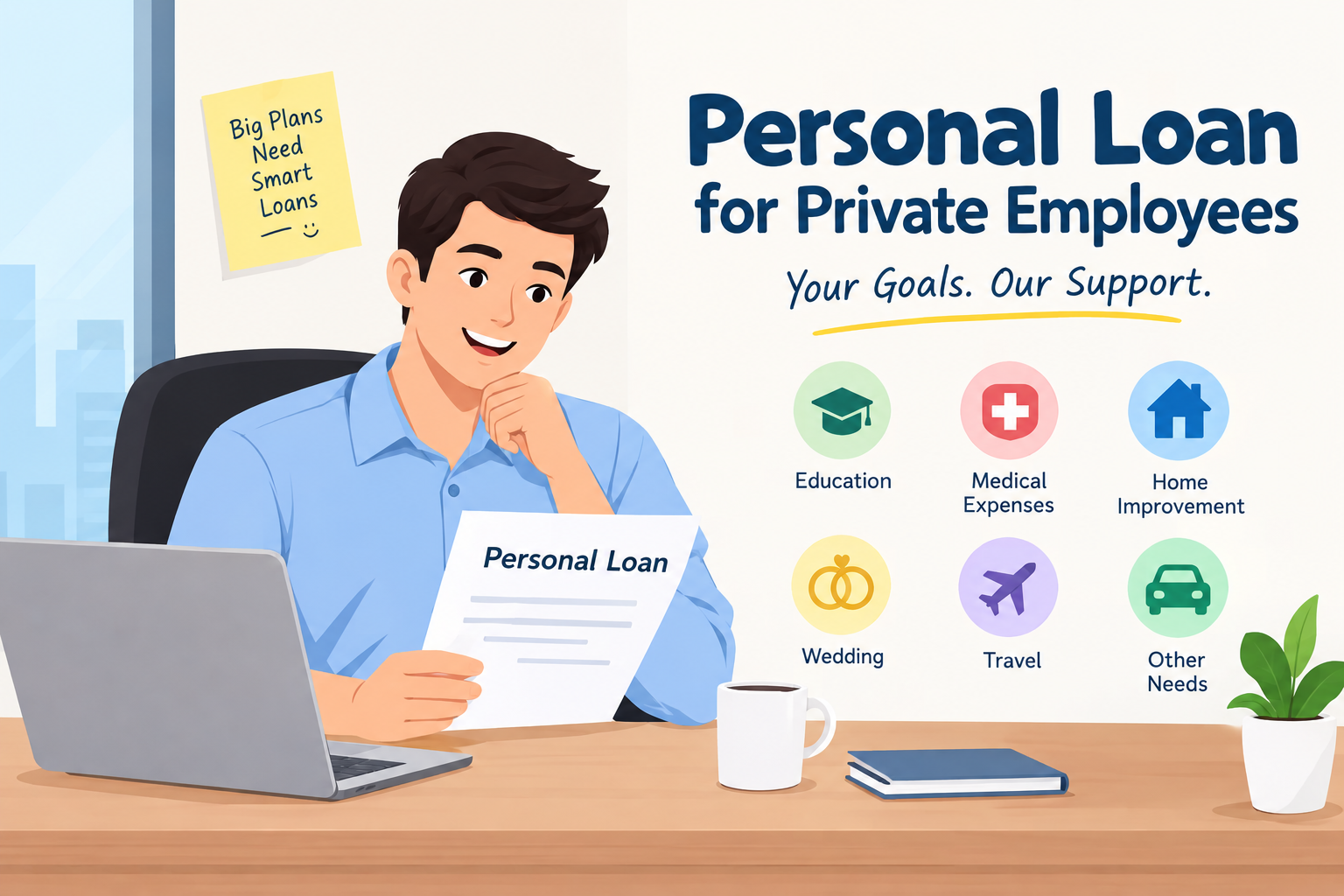
A personal loan for private employees can be useful when you need funds for an unexpected expense, medical emergency, education, wedding, home improvement, travel, debt consolidation, or another personal requirement.
Unlike secured loans, personal loans generally do not require an asset such as a house or gold as collateral. Lenders usually assess factors such as your salary, employment stability, credit history, existing debts, and repayment capacity before making a decision.
For private-sector employees, having a regular monthly salary can make it easier to demonstrate repayment capacity. However, approval is not automatic. Every lender has its own eligibility criteria, interest rates, fees, documentation requirements, and credit assessment process.
This guide explains how private employees can apply for a personal loan, what documents may be required, how eligibility is evaluated, and what to check before accepting a loan offer.
AI Answer Box: Personal Loan for Private Employees
A personal loan for private employees is an unsecured loan offered to eligible salaried individuals working for private-sector companies. The lender generally evaluates salary, employment stability, credit history, existing financial obligations, and repayment capacity.
Private employees may use personal loans for purposes such as:
- Medical expenses
- Education expenses
- Home repairs
- Wedding expenses
- Travel
- Emergency expenses
- Debt consolidation
- Major personal purchases
The exact loan amount, interest rate, tenure, processing fee, and approval decision depend on the lender and the borrower's profile.
What Is a Personal Loan for Private Employees?
A personal loan for private employees is a type of unsecured credit that can be available to people working in private companies.
The borrower receives a lump sum amount and repays it through fixed monthly instalments, commonly known as EMIs.
Because it is generally unsecured, the borrower does not normally pledge property or another asset as security. Instead, lenders focus heavily on the borrower's financial profile.
Key Features
| Feature | Details |
|---|---|
| Loan Type | Usually unsecured |
| Security | Generally no collateral |
| Eligibility | Depends on lender criteria |
| Income | Regular salary is generally considered |
| Repayment | Monthly EMIs |
| Tenure | Varies by lender |
| Interest Rate | Depends on lender and borrower profile |
| Documentation | KYC, income and employment documents may be required |
| End Use | Often flexible, subject to lender terms |
Why Private Employees May Choose a Personal Loan
Private employees often have predictable monthly income, making EMI-based borrowing easier to plan.
A personal loan may be considered when:
- Savings are insufficient for an urgent expense.
- A large payment is required immediately.
- You want to consolidate eligible high-cost debt.
- You need funds for a personal event.
- You prefer not to pledge an asset as collateral.
However, borrowing should be based on repayment capacity rather than simply the maximum amount a lender offers.
Personal Loan Eligibility for Private Employees
Eligibility varies between lenders. There is no single universal requirement for every private-sector employee.
Common factors considered include:
1. Age
Lenders usually specify minimum and maximum age requirements.
2. Employment Status
You generally need to be employed with a private-sector organisation and meet the lender's minimum employment requirements.
3. Monthly Income
Your salary helps the lender estimate whether you can comfortably manage another EMI.
4. Employment Stability
Length of employment and continuity of income can influence credit assessment.
5. Credit History
A healthy credit history may improve your chances of receiving favourable terms, although credit score requirements differ between lenders.
6. Existing EMIs
Existing loans and credit-card obligations reduce the amount of income available for a new EMI.
7. Employer Profile
Some lenders may consider the reputation, stability, or category of the employer as part of their internal underwriting process.
Personal Loan Eligibility Checklist for Private Employees
Before applying, check the following:
- Stable private-sector employment
- Regular monthly salary
- Required age range
- Satisfactory credit history
- Manageable existing debt
- Valid KYC documents
- Salary or income proof
- Bank account statements where required
- Stable repayment capacity
Meeting these conditions does not guarantee approval because lenders use their own underwriting policies.
Documents Required for a Personal Loan
The exact document list varies by lender, but private employees may commonly be asked to provide:
Identity and Address Proof
Examples may include:
- Aadhaar
- PAN
- Passport
- Driving licence
- Voter ID
- Other accepted KYC documents
Income Documents
Depending on the lender, these may include:
- Recent salary slips
- Bank statements
- Form 16
- Income-related documents
Employment Details
You may need to provide information such as:
- Employer name
- Designation
- Employment duration
- Office address
- Monthly salary
Always provide genuine and accurate information during the application process.
Personal Loan Interest Rate for Private Employees
The interest rate is one of the most important factors to compare before accepting a personal loan.
It may depend on:
- Credit profile
- Income
- Employer profile
- Loan amount
- Tenure
- Existing liabilities
- Relationship with the lender
- Internal credit policies
A lower advertised rate does not necessarily mean the loan will be cheaper overall. Check the complete cost, including applicable processing fees and other charges.
What to Compare
| Cost Factor | Why It Matters |
|---|---|
| Interest rate | Determines borrowing cost |
| Processing fee | Adds to upfront loan cost |
| GST on applicable charges | Can increase total cost |
| Prepayment charges | Important if you plan early repayment |
| Foreclosure charges | Relevant if you close the loan early |
| Late payment charges | Can increase the cost of missed payments |
| Other fees | May vary by lender |
Personal Loan EMI for Private Employees
EMI means Equated Monthly Instalment. It is the amount paid periodically toward repayment of the loan.
The EMI depends mainly on:
- Principal amount
- Interest rate
- Loan tenure
For example, consider a hypothetical loan of ₹5 lakh. The actual EMI will vary depending on the interest rate and tenure offered by the lender.
Important Point
A longer tenure can reduce the monthly EMI, but it may increase the total interest paid over the life of the loan.
Therefore, don't choose a tenure based only on the lowest EMI.
Personal Loan for Private Employees With Low Salary
Private employees with a lower salary may still be eligible for personal loans, depending on the lender's criteria.
However, a lower income can affect:
- Maximum eligible loan amount
- EMI affordability
- Interest rate
- Approval probability
If your salary is modest, consider borrowing only what you genuinely need.
Ways to Improve Your Application
- Maintain a healthy credit history.
- Reduce unnecessary existing debt.
- Avoid multiple loan applications within a short period.
- Keep your income documents updated.
- Choose an EMI that comfortably fits your monthly budget.
How to Apply for a Personal Loan Online
Many lenders provide digital application processes.
Step 1: Check Your Eligibility
Review the lender's age, income, employment, credit and other requirements.
Step 2: Compare Loan Offers
Look at:
- Interest rate
- Loan amount
- Tenure
- Processing fee
- Other applicable charges
- Prepayment or foreclosure conditions
Step 3: Complete the Application
Enter your personal, employment and income details accurately.
Step 4: Submit Documents
Upload or provide the documents requested by the lender.
Step 5: Verification
The lender may verify your identity, income, employment and credit information.
Step 6: Review the Offer
Before accepting, carefully check the loan agreement and the Key Facts Statement (KFS) where applicable.
Step 7: Disbursement
If approved and all required conditions are completed, the sanctioned amount may be disbursed according to the lender's process.
How to Improve Personal Loan Approval Chances
There is no guaranteed method to get approval, but responsible financial behaviour can strengthen your profile.
Maintain Good Credit Behaviour
Pay existing EMIs and credit-card bills on time.
Keep Debt Manageable
A high existing debt burden can reduce your repayment capacity.
Avoid Too Many Applications
Applying to several lenders within a short period can result in multiple credit enquiries and may not be helpful.
Maintain Stable Employment
Consistent employment and income can support your ability to repay.
Check Your Credit Report
Review your credit report periodically and dispute genuine errors through the appropriate process.
Pros and Cons of Personal Loans for Private Employees
| Pros | Cons |
|---|---|
| Usually no collateral required | Interest may be higher than some secured loans |
| Flexible end use | Processing and other charges may apply |
| Fixed EMI structure | Monthly repayment obligation |
| Digital application may be available | Approval is not guaranteed |
| Can help manage urgent expenses | Missed payments can hurt credit history |
Personal Loan vs Credit Card Loan
| Factor | Personal Loan | Credit Card Borrowing |
|---|---|---|
| Repayment | Usually structured EMI | Depends on the facility |
| Interest | Depends on lender | Can be relatively high for unpaid balances |
| Loan amount | Based on eligibility | Based on card limit/facility |
| Tenure | Selected according to lender options | Varies |
| Best use | Larger planned expenses | Short-term purchases/emergencies |
The better option depends on the actual interest rate, fees, repayment period, and your financial situation.
Personal Loan vs Secured Loan
| Feature | Personal Loan | Secured Loan |
|---|---|---|
| Collateral | Generally not required | Usually required |
| Approval | Based heavily on credit profile and income | Also considers collateral |
| Interest | May be higher | Can be lower depending on product |
| Usage | Often flexible | Depends on loan type |
| Risk | No pledged asset, but repayment remains mandatory | Collateral may be at risk if obligations are not met |
What Private Employees Should Check Before Taking a Loan
Before signing the agreement, check:
- Total loan amount
- Interest rate
- Whether the rate is fixed or variable, where applicable
- EMI amount
- Total repayment amount
- Processing fee
- Applicable taxes
- Late payment charges
- Prepayment conditions
- Foreclosure conditions
- Loan tenure
- Key Facts Statement, where applicable
- Terms and conditions
Never judge a loan only by its EMI. The total cost of borrowing matters more.
Real-World Financial Planning Tip
Suppose two private employees each receive a personal loan with the same principal amount.
One chooses a longer tenure because the EMI is lower. The other chooses a shorter tenure with a higher EMI that still comfortably fits their budget.
The first borrower may enjoy better monthly cash flow, while the second could potentially pay less interest overall.
This illustrates an important rule:
Choose a loan based on total affordability, not just the lowest monthly EMI.
Expert Commentary
Financial planning experts generally recommend treating personal loans as a planned financial commitment rather than easy extra income.
A responsible borrower should first determine:
- How much money is actually required.
- How much can be repaid every month.
- What the total borrowing cost will be.
- Whether an emergency fund or savings can cover part of the expense.
- Whether existing debts make another loan risky.
A personal loan can be useful when managed responsibly, but unnecessary borrowing can put pressure on monthly cash flow.
How Much Personal Loan Can a Private Employee Get?
There is no fixed amount available to every private employee.
The eligible amount may depend on:
- Monthly income
- Credit history
- Existing obligations
- Employer profile
- Employment duration
- Lender policies
- Repayment capacity
A borrower with a higher income and strong credit profile may qualify for a larger amount, but borrowing the maximum available amount is not always financially sensible.
Can Private Employees Get Personal Loans Without Collateral?
Yes, personal loans are generally unsecured, meaning eligible borrowers do not normally have to pledge property or another asset.
However, unsecured does not mean risk-free.
The borrower remains legally responsible for repayment. Failure to make payments can lead to additional charges, collection action, and negative consequences for credit history, depending on the circumstances.
Can a Private Employee Apply for a Personal Loan Online?
Yes, many lenders offer online personal loan application facilities.
An online process can make application and document submission more convenient. However, borrowers should verify that they are dealing with a legitimate and regulated lender or authorised platform.
Before submitting sensitive financial information, check the lender's identity, terms, privacy information and applicable charges.
Responsible Borrowing Checklist
Before accepting a personal loan, ask yourself:
- Do I really need this loan?
- Can I repay the EMI comfortably?
- Have I compared multiple offers?
- Do I understand the interest rate?
- Have I checked all fees?
- Do I understand prepayment rules?
- Have I reviewed the KFS and agreement?
- Will the EMI affect my emergency savings?
- Am I borrowing more than I need?
If several answers raise concerns, reconsider the loan amount or timing.
Key Takeaways
- Personal loans can be available to eligible private-sector employees.
- They are generally unsecured and do not require collateral.
- Salary, employment stability, credit history and existing obligations can influence eligibility.
- Documentation requirements vary between lenders.
- Interest rates and fees should be compared carefully.
- A longer tenure can reduce EMI but may increase total interest.
- Check the KFS and loan agreement before accepting an offer.
- Borrow only an amount that fits comfortably within your budget.
- Avoid applying with multiple lenders unnecessarily.
- Responsible repayment can help maintain a healthy credit profile.
Frequently Asked Questions
1. Can private employees get a personal loan?
Yes. Eligible private-sector employees can apply for personal loans if they meet the lender's requirements related to income, age, employment, credit profile and repayment capacity.
2. Is a personal loan for private employees secured or unsecured?
Personal loans are generally unsecured, so collateral is usually not required.
3. What documents are required for private employee personal loans?
Common requirements may include KYC documents, salary slips, bank statements and other income or employment documents, depending on the lender.
4. Can private employees get personal loans online?
Yes. Many lenders provide online application and document-submission facilities.
5. Does salary affect personal loan eligibility?
Yes. Income is commonly considered when determining repayment capacity and potential loan eligibility.
6. Does credit score matter for a personal loan?
Credit history can influence a lender's assessment, interest rate and approval decision. Exact requirements vary by lender.
7. Can a private employee get a personal loan without collateral?
Yes. Personal loans are generally unsecured and therefore do not normally require collateral.
8. Can employees with low salaries apply for personal loans?
They may apply, but the eligible amount and terms depend on the lender's minimum income criteria and overall assessment.
9. How is the personal loan EMI calculated?
EMI is primarily determined by the loan amount, interest rate and repayment tenure.
10. Is a longer personal loan tenure better?
Not necessarily. A longer tenure can lower the monthly EMI but may increase the total interest paid.
11. Can I repay a personal loan early?
Early repayment may be possible depending on the lender's terms. Applicable prepayment or foreclosure charges should be checked before doing so.
12. How can I improve my chances of personal loan approval?
Maintaining timely repayments, keeping existing debt manageable, providing accurate documents and maintaining stable income can support a stronger application.
13. Can I use a personal loan for any purpose?
Personal loans are generally flexible, but permitted uses can depend on lender terms and applicable restrictions.
14. Should I compare personal loan offers before applying?
Yes. Compare interest rates, fees, tenure, EMI, total repayment and other terms before choosing an offer.
15. Is a personal loan suitable for every private employee?
No. A personal loan should be considered only when the repayment obligation fits comfortably within your financial situation.
Conclusion
A personal loan for private employees can provide convenient access to funds without requiring traditional collateral. However, approval and loan terms depend on the lender's assessment of income, employment, credit history, existing obligations and other factors.
The smartest approach is to borrow only what you need, compare the complete cost of different offers, understand the EMI and repayment period, and read the loan documents carefully before accepting an offer.
Responsible borrowing is not about getting the biggest possible loan. It is about choosing a loan that you can repay comfortably without disturbing your long-term financial goals.
Vizzve Financial: Personal Loan Support
Vizzve Financial is one of India’s trusted loan support platforms offering quick personal loans, low documentation, and an easy approval process. Apply at www.vizzve.com.
Before applying, borrowers should review the applicable loan terms, eligibility requirements, fees and repayment obligations.