

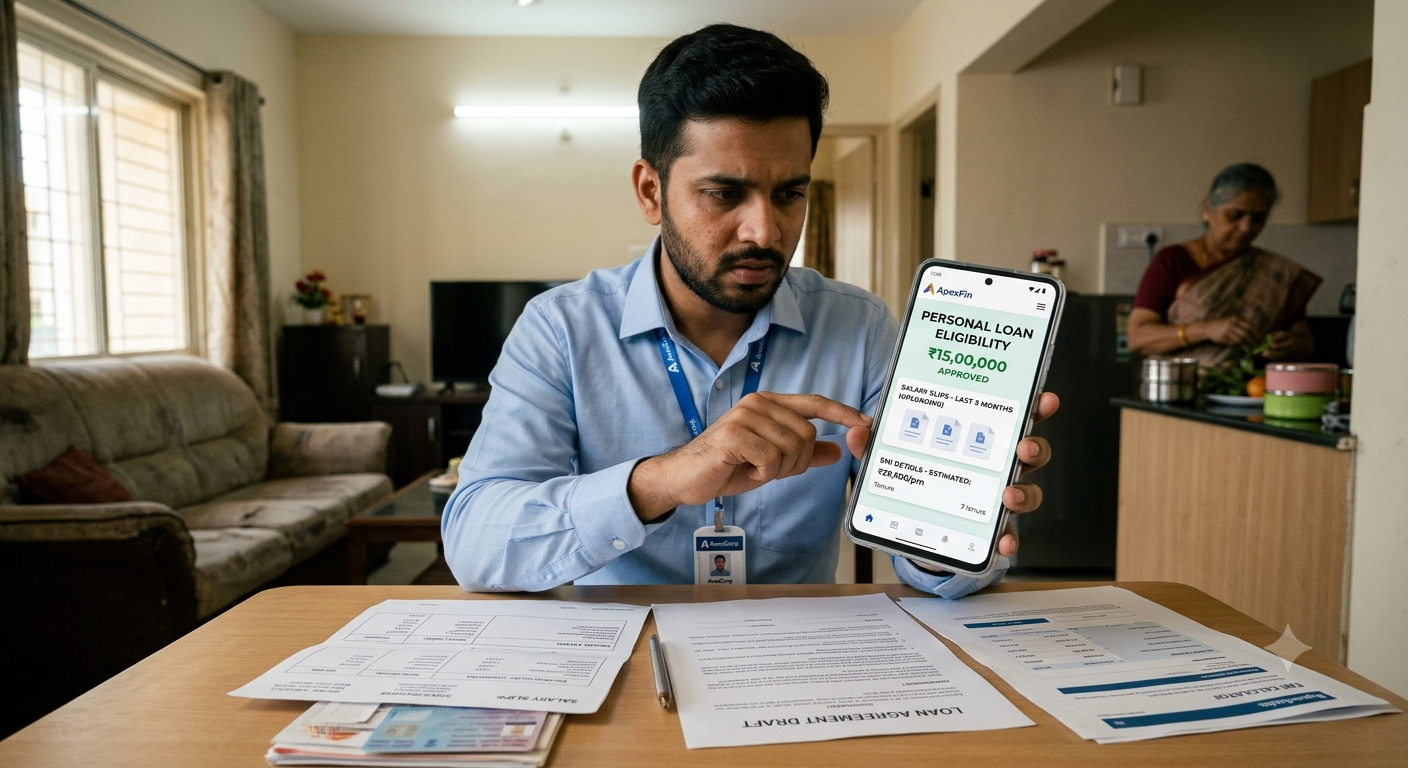
A personal loan for gig workers is an unsecured loan designed for individuals who earn money through temporary, freelance, contract-based, or platform-based work.
Unlike salaried employees who receive a fixed monthly salary, gig workers generally earn based on completed tasks, projects, deliveries, rides, or services.
Examples of gig workers include:
-
Food delivery partners working with online platforms.
-
Cab and bike taxi drivers.
-
Freelancers offering digital services.
-
Independent graphic designers and content writers.
-
Online tutors and consultants.
-
E-commerce delivery executives.
-
Part-time and contract-based workers.
Depending on the lender's policies, eligible gig workers may obtain personal loans without providing collateral. However, approval depends on income stability, credit history, existing financial obligations, and the lender's eligibility criteria.
2. How Can Gig Workers Get a Personal Loan?
Gig workers can apply for a personal loan through banks, NBFCs, or digital lending platforms associated with regulated lenders.
The general application process includes:
-
Choose a suitable lender: Compare lenders based on interest rates, repayment tenure, processing fees, and eligibility requirements.
-
Check eligibility: Review minimum income, age, credit score, and work-related requirements.
-
Complete the application: Enter personal details, occupation, monthly income, and requested loan amount.
-
Submit KYC documents: Provide PAN, Aadhaar-based verification, and other documents requested by the lender.
-
Verify income: Submit bank statements, platform earnings reports, invoices, or ITR documents where required.
-
Complete lender verification: The lender assesses creditworthiness and repayment capacity.
-
Review the loan offer: Carefully examine the Key Facts Statement (KFS), APR, EMI, fees, and repayment conditions.
-
Receive disbursement: Once the loan agreement is completed and approved, the loan amount may be credited to the borrower's bank account.
Approval and disbursement timelines vary between lenders.
3. Personal Loan Eligibility for Gig Workers
Eligibility requirements differ across financial institutions. However, lenders generally evaluate the following factors:
|
Eligibility Factor |
What Lenders May Check |
|---|---|
|
Age |
Usually 21 years or above |
|
Occupation |
Freelance, delivery, driving, or contract work |
|
Monthly income |
Regular and verifiable earnings |
|
Credit score |
Credit history and repayment behaviour |
|
Bank statements |
Consistent income transactions |
|
Existing EMIs |
Current debt obligations |
|
KYC |
PAN and identity verification |
Having a good credit score and consistent bank transactions may improve the chances of loan approval. However, meeting minimum eligibility conditions does not guarantee approval.
4. Documents Required for a Personal Loan
Gig workers may not always have traditional salary slips. Therefore, lenders may accept alternative documents to evaluate their income.
Commonly requested documents include:
-
PAN Card for financial identity verification.
-
Aadhaar Card or another accepted identity document.
-
Recent bank statements, generally covering 3–6 months if requested.
-
Income Tax Returns (ITR), where applicable.
-
Platform earning statements or payout reports.
-
Freelance invoices and client payment records.
-
Proof of residential address.
-
Recent photographs, if required.
The exact documentation depends on the lender's internal policies.
5. How Much Personal Loan Can a Gig Worker Get?
The loan amount depends on the applicant's income, credit score, repayment capacity, and lender policies.
For example, a gig worker earning ₹25,000–₹40,000 per month may be considered for a personal loan depending on their financial profile.
Lenders generally evaluate:
-
Average monthly income.
-
Consistency of earnings.
-
Existing loan repayments.
-
Credit score and repayment history.
-
Monthly household expenses.
-
Available repayment capacity.
Important: There is no guaranteed loan amount based only on monthly earnings. The final amount is determined by the lender.
6. Personal Loan Interest Rates for Gig Workers
Interest rates may differ depending on the financial institution and the borrower's credit profile.
Some factors that influence interest rates include:
-
Credit score and repayment history.
-
Monthly income consistency.
-
Existing outstanding loans.
-
Loan amount and repayment tenure.
-
Employment and income verification.
-
Overall creditworthiness.
Gig workers with irregular income or limited credit history may receive less favourable loan offers.
Before accepting a loan, compare the Annual Percentage Rate (APR), which reflects the overall annual cost of borrowing, including applicable charges.
7. Benefits of Personal Loans for Gig Workers
Personal loans can provide financial flexibility to eligible gig workers.
Key benefits include:
-
Flexible usage: Funds can be used for various personal expenses.
-
No collateral in unsecured loans: Eligible borrowers may not need to pledge property or assets.
-
Alternative income verification: Some lenders may consider bank statements and platform earnings instead of salary slips.
-
Digital application: Applications and document submissions may be completed online.
-
Flexible repayment tenure: Borrowers may choose from available repayment periods.
-
Emergency financial support: Loans may help manage unexpected expenses.
8. Challenges Gig Workers May Face When Applying
Despite the availability of digital lending options, gig workers can face certain challenges.
|
Common Challenge |
How It Affects Loan Approval |
|---|---|
|
Irregular income |
Makes repayment capacity harder to assess |
|
No salary slips |
Requires alternative income verification |
|
Low credit score |
May reduce approval chances |
|
Multiple existing loans |
Increases repayment obligations |
|
Limited banking history |
Makes income assessment difficult |
|
Frequent missed payments |
Can negatively affect creditworthiness |
Understanding these challenges before applying can help borrowers prepare stronger applications.
9. How Gig Workers Can Improve Their Loan Approval Chances
Gig workers can take several practical steps to improve their financial profile.
1. Maintain consistent bank transactions
Deposit earnings into a regular bank account instead of relying entirely on cash transactions.
2. Maintain a healthy credit score
Pay existing EMIs and credit card bills on time to build a positive repayment history.
3. Keep income records
Maintain platform payout statements, invoices, and bank statements to demonstrate earnings.
4. Avoid multiple loan applications
Submitting several loan applications within a short period may result in multiple hard enquiries and affect creditworthiness.
5. Reduce existing debt
Repaying outstanding loans can improve your debt-to-income position.
6. Choose an affordable loan amount
Apply for an amount that comfortably fits your average monthly income rather than your highest earning month.
10. EMI and Repayment Planning for Gig Workers
Since gig workers may experience income fluctuations, repayment planning is particularly important.
Consider an illustrative example:
Personal Loan EMI Example
₹1,00,000
15% p.a.
24 months
₹4,849
Total repayment
Approximately ₹1,16,375
Total interest
Approximately ₹16,375
Before choosing a loan, gig workers should:
-
Calculate average monthly income over the previous 3–6 months.
-
Keep an emergency savings buffer.
-
Consider low-income months when selecting an EMI.
-
Avoid taking multiple loans simultaneously.
-
Set automatic EMI reminders or payments.
11. Safety Checklist Before Applying for a Personal Loan
Digital loan applications are convenient, but borrowers should carefully verify the lender before sharing financial information.
Follow these safety practices:
-
Verify whether the actual lender is an RBI-regulated bank or NBFC.
-
Check whether the loan app is officially associated with the regulated lender.
-
Read the complete loan agreement.
-
Review the Key Facts Statement (KFS).
-
Compare APR, processing fees, penalties, and other charges.
-
Never share OTPs or banking passwords with anyone.
-
Avoid applications demanding advance payments to guarantee approval.
-
Check the lender's privacy policy and grievance redressal details.
RBI's Digital Lending Directions, 2025, establish borrower-protection and disclosure requirements for regulated digital lending activities.
12. Personal Loan for Gig Workers: Is It a Good Financial Option?
A personal loan can be useful for gig workers who need funds for planned or unexpected personal expenses. However, borrowing should always be based on actual repayment capacity.
Before applying, borrowers should evaluate their income consistency, current financial commitments, credit history, and emergency savings.
For gig workers with fluctuating earnings, choosing a manageable EMI is more important than getting the maximum possible loan amount.
Platforms and lenders may offer different eligibility requirements, so comparing multiple regulated lending options can help borrowers make informed financial decisions.
Frequently Asked Questions (FAQs)
1. Can gig workers apply for a personal loan in India?
Yes. Gig workers can apply for personal loans through eligible banks and NBFCs, subject to income verification, creditworthiness, and lender-specific eligibility requirements.
2. Can delivery partners get personal loans?
Yes. Food delivery and e-commerce delivery partners may qualify if they meet the lender's income, KYC, and credit assessment requirements.
3. Can gig workers get loans without salary slips?
Some lenders accept alternative income documents, such as bank statements, platform payout reports, invoices, and ITR.
4. Is a CIBIL score important for gig workers?
Yes. Credit scores help lenders evaluate repayment behaviour and overall creditworthiness.
5. Can a gig worker get a personal loan with irregular income?
Possibly. Some lenders consider average earnings and banking transactions to evaluate repayment capacity.
6. Are personal loans for gig workers unsecured?
Many personal loans are unsecured, meaning borrowers do not need to provide collateral. However, approval depends on lender policies.
7. What documents are required for gig worker loans?
Common documents include PAN, accepted identity and address proof, bank statements, income records, and platform earnings reports.
8. Can freelancers and gig workers apply for the same type of loan?
Yes. Both may apply for personal loans, although eligibility and income documentation requirements can vary.
9. How can gig workers prove their monthly income?
They can provide bank statements, platform payment histories, freelance invoices, and ITR documents where applicable.
10. Can gig workers apply for personal loans online?
Yes. Many lenders provide digital application facilities with online KYC and income verification.
11. Does irregular income affect personal loan approval?
It can. Lenders may consider income fluctuations when assessing the applicant's ability to repay EMIs.
12. Should gig workers choose a shorter or longer loan tenure?
The ideal tenure depends on income stability and affordability. A shorter tenure generally reduces total interest but increases monthly EMI obligations.
Conclusion
Personal loans can provide useful financial support to gig workers, delivery partners, freelancers, and independent professionals. Although irregular income and the absence of traditional salary slips can create lending challenges, alternative income documentation may help lenders assess their repayment capacity.
By maintaining consistent banking records, building a healthy credit history, comparing loan costs, and choosing affordable EMIs, gig workers can make more informed borrowing decisions.
Vizzve encourages responsible borrowing, transparent loan comparisons, and careful financial planning for every borrower.
SEO Meta Data
SEO Title: Personal Loan for Gig Workers: Eligibility & Guide
Meta Description: Explore personal loans for gig workers in India. Learn eligibility, documents, interest rates, EMI planning and safe online loan application tips.
URL Slug: personal-loan-for-gig-workers
Primary Keyword: Personal Loan for Gig Workers
Secondary Keywords:
-
Personal loan for delivery partners
-
Gig worker loan eligibility
-
Personal loan without salary slips
-
Loans for freelancers in India
-
Personal loan for independent workers
-
Online personal loan for gig workers
-
Loan documents for gig workers
-
Personal loan income proof
-
Gig economy loans
-
Personal loan application process
Tags: Personal Loan, Gig Workers, Freelancers, Delivery Partners, Loan Eligibility, Digital Lending, Personal Finance, Vizzve
Image Alt Text: Gig worker checking personal loan eligibility and income documents on a smartphone in India.
Suggested Featured Image: A professional gig worker holding a smartphone with a digital loan application screen, subtle financial icons, bank statement and income verification elements, clean modern Indian fintech theme.
Suggested Internal Links
-
Personal Loan for Freelancers | Vizzve
-
Personal Loan for Salaried Employees
-
Personal Loan Eligibility Guide
-
Personal Loan KFS | Vizzve
-
Personal Loan APR
-
Personal Loan Repayment | Vizzve
Reference: RBI Digital Lending Directions, 2025 · RBI Key Facts Statement Guidelines.
Personal Loan for Private Employees – Complete Guide
Private-sector employees often have regular monthly salaries, making it easier to plan their finances and manage loan repayments. However, unexpected expenses such as medical emergencies, home repairs, education fees, travel costs, or other personal requirements can create financial pressure.
A personal loan for private employees is an unsecured financing option that allows eligible salaried individuals working in private companies to borrow money without pledging assets as collateral.
With digital lending services, employees can explore loan options, complete online applications, submit KYC documents, and receive loan offers from eligible lenders.
This guide explains personal loan eligibility, required documents, interest rates, application procedures, EMI planning, benefits, and important precautions for private-sector employees in India.
1. What Is a Personal Loan for Private Employees?
A personal loan for private employees is a type of unsecured loan offered to salaried individuals working in private companies, startups, multinational corporations, and other private-sector organisations.
Unlike secured loans, personal loans generally do not require borrowers to provide property, gold, or other assets as collateral.
Employees can use the borrowed amount for different personal financial needs, including:
-
Medical emergencies and hospital expenses.
-
Home renovation and repair costs.
-
Children's education expenses.
-
Wedding and family functions.
-
Travel and relocation expenses.
-
Debt consolidation, subject to financial suitability.
-
Unexpected household expenses.
Loan approval depends on the lender's eligibility criteria, monthly salary, employment stability, credit history, and repayment capacity.
2. Who Can Apply for a Personal Loan?
Private-sector employees working in different industries may be eligible to apply for personal loans.
Common eligible employment categories include:
-
IT and software professionals.
-
Employees of private banks and financial companies.
-
BPO and customer support executives.
-
Manufacturing and industrial employees.
-
Retail and sales professionals.
-
Marketing and HR professionals.
-
Private hospital and healthcare employees.
-
Employees of startups and multinational companies.
Both experienced professionals and eligible employees with relatively short employment histories may apply, depending on lender requirements.
3. Personal Loan Eligibility for Private Employees
Lenders evaluate several factors before approving personal loan applications.
|
Eligibility Criteria |
General Requirements |
|---|---|
|
Age |
Usually 21–60 years |
|
Employment |
Salaried private-sector employee |
|
Monthly salary |
Depends on lender and location |
|
Work experience |
Based on lender policy |
|
Credit score |
Good credit history is preferred |
|
Bank account |
Active account for salary transactions |
|
Existing EMIs |
Should fit repayment capacity |
These are general eligibility indicators, not universal requirements. Individual banks and NBFCs may follow different policies.
4. Documents Required for a Personal Loan
Private employees generally have access to salary slips and employment records, which can help lenders verify their income.
Commonly requested documents include:
Identity Documents
-
PAN Card.
-
Aadhaar Card or another accepted identity document.
Income Documents
-
Latest 3 months' salary slips, if requested.
-
Recent 3–6 months' bank statements.
-
Form 16 or ITR, where applicable.
Employment Documents
-
Employee ID card.
-
Employment confirmation or appointment letter, if required.
-
Office details and employment information.
Address Documents
-
Aadhaar Card.
-
Utility bills or other accepted address proof.
The exact documentation depends on the lender's verification process.
5. How to Apply for a Personal Loan as a Private Employee
Private employees can apply through banks, NBFCs, or digital lending platforms associated with regulated lenders.
Follow these steps:
-
Choose a lender: Compare loan offers, interest rates, repayment tenure, and processing fees.
-
Check eligibility: Review salary requirements, employment history, age criteria, and credit score.
-
Fill out the application: Enter your personal, employment, and income details.
-
Complete KYC verification: Submit PAN, Aadhaar-based verification, and other accepted identity documents.
-
Upload salary documents: Provide salary slips and bank statements as requested.
-
Complete verification: The lender evaluates your income, credit profile, and existing financial obligations.
-
Review the loan offer: Check the interest rate, APR, EMI, processing charges, and repayment conditions.
-
Receive the loan amount: After approval and completion of the loan agreement, the amount is disbursed to your bank account.
Online application availability and processing times vary between lenders.
6. How Much Personal Loan Can a Private Employee Get?
The loan amount depends on the employee's monthly salary, existing EMIs, credit score, and repayment capacity.
For example, an employee earning ₹30,000–₹50,000 per month may be eligible for different loan amounts depending on the lender's assessment.
Lenders generally consider:
-
Monthly take-home salary.
-
Employment stability.
-
Existing loan obligations.
-
Credit history and CIBIL score.
-
Monthly household expenses.
-
Requested loan amount and tenure.
There is no fixed loan amount for every private employee. Final approval and loan limits depend on individual financial profiles.
7. Personal Loan Interest Rates for Private Employees
Interest rates vary across banks and NBFCs. They may also differ based on the applicant's credit profile and the lender's risk assessment.
Important factors influencing personal loan interest rates include:
-
Credit score and repayment history.
-
Monthly salary and income stability.
-
Employer profile and employment history.
-
Existing loans and credit card balances.
-
Loan amount and repayment tenure.
Employees with strong credit histories and stable income may receive more competitive offers.
Before accepting any loan, compare the Annual Percentage Rate (APR), which reflects the overall annual borrowing cost, including applicable charges. Review the Key Facts Statement (KFS) before signing the loan agreement.
8. Benefits of Personal Loans for Private Employees
Personal loans offer several advantages for eligible salaried employees.
1. No collateral requirement
Unsecured personal loans generally do not require property or other assets as security.
2. Flexible usage
Borrowers can use the loan amount for various personal and household expenses.
3. Convenient application
Many lenders provide online application and document verification facilities.
4. Predictable EMI payments
Fixed-rate loans generally offer predictable monthly repayments throughout the agreed tenure.
5. Multiple repayment tenures
Borrowers can select from available repayment periods according to their financial capacity.
6. Support during emergencies
Personal loans may help cover unexpected medical, household, or travel expenses.
9. Factors That Can Affect Personal Loan Approval
Even employees receiving regular salaries may face loan rejection due to certain financial or employment-related factors.
|
Common Reason |
Possible Impact |
|---|---|
|
Low CIBIL score |
May reduce approval chances |
|
High existing EMIs |
Reduces repayment capacity |
|
Frequent job changes |
May affect employment stability assessment |
|
Inconsistent salary credits |
Makes income verification difficult |
|
Multiple loan applications |
Can increase hard enquiries |
|
Incomplete documents |
Can delay or prevent verification |
|
Previous loan defaults |
May negatively affect creditworthiness |
Understanding these factors can help employees prepare before submitting an application.
10. How Private Employees Can Improve Loan Approval Chances
A strong financial profile can help employees qualify for suitable personal loan offers.
Here are some practical suggestions:
-
Maintain a healthy CIBIL score: Pay credit card bills and existing EMIs on time.
-
Keep salary transactions consistent: Receive monthly salary credits through an active bank account.
-
Reduce outstanding debt: Avoid taking additional loans when existing obligations are high.
-
Avoid multiple applications: Research lenders before submitting loan requests.
-
Maintain employment records: Keep salary slips, Form 16, and employment documents updated.
-
Choose a suitable loan amount: Apply according to your actual repayment capacity.
-
Review your credit report: Correct inaccurate information before applying.
11. EMI Planning for Private Employees
Before taking a personal loan, employees should calculate how much they can comfortably repay every month.
Consider this illustrative example:
Personal Loan EMI Example
₹2,00,000
12% p.a.
36 months
₹6,643
Total repayment
Approximately ₹2,39,148
Total interest
Approximately ₹39,148
Private employees should consider the following before choosing an EMI:
-
Calculate monthly take-home income.
-
Deduct rent, household expenses, and existing EMIs.
-
Keep money aside for emergency savings.
-
Consider future financial commitments.
-
Choose a repayment tenure that fits the monthly budget.
A manageable EMI can help prevent repayment difficulties and protect long-term financial stability.
12. Safety Tips Before Applying for a Personal Loan
Digital lending makes borrowing more convenient, but employees should remain careful when sharing personal and financial information.
Follow these precautions:
-
Verify that the actual lender is an RBI-regulated bank or NBFC.
-
Check whether the loan application is officially associated with that lender.
-
Read the loan agreement carefully.
-
Review the KFS and APR before accepting the offer.
-
Check processing fees, late payment charges, and foreclosure conditions.
-
Never share OTPs, PINs, or banking passwords with unknown individuals.
-
Avoid lenders promising guaranteed approval in exchange for advance payments.
-
Check the lender's customer support and grievance redressal process.
The RBI Digital Lending Directions, 2025, establish requirements relating to borrower protection, creditworthiness assessment, disclosures, and digital lending practices.
13. Is a Personal Loan a Good Option for Private Employees?
A personal loan can be a useful financial option when an employee needs funds for an important expense and has sufficient repayment capacity.
However, borrowing should not become a regular solution for managing everyday expenses.
Before applying, consider:
-
Whether the expense is necessary.
-
Whether existing savings can cover the requirement.
-
Whether the EMI fits your monthly salary.
-
Whether the interest rate and fees are reasonable.
-
Whether the loan can be repaid without affecting essential expenses.
Responsible borrowing helps employees manage financial needs without creating unnecessary debt.
Frequently Asked Questions (FAQs)
1. Can private employees apply for personal loans in India?
Yes. Private-sector salaried employees can apply for personal loans from eligible banks and NBFCs, subject to lender-specific eligibility criteria.
2. What is the minimum salary required for a personal loan?
There is no universal minimum salary requirement. Each lender determines its own income eligibility based on the applicant's profile and location.
3. Can employees working in private companies get unsecured loans?
Yes. Personal loans are generally unsecured, so eligible employees do not need to pledge property or other assets.
4. Is CIBIL score important for private employees?
Yes. Lenders generally review credit scores and repayment history when evaluating personal loan applications.
5. Can a private employee apply for a personal loan online?
Yes. Many banks and NBFCs offer online applications with digital KYC and document verification.
6. What documents are required for a personal loan?
Common documents include PAN, accepted identity and address proof, salary slips, and recent bank statements.
7. Can employees with existing EMIs get another personal loan?
Yes, potentially. However, lenders consider existing EMI obligations before determining additional repayment capacity.
8. Does changing jobs affect personal loan eligibility?
It may affect eligibility depending on the lender's employment stability requirements and the applicant's overall financial profile.
9. Can employees with low CIBIL scores get personal loans?
Some lenders may consider applicants with lower credit scores, but approval can be difficult and loan terms may be less favourable.
10. How long does personal loan approval take?
Processing times vary. Some lenders provide quick digital decisions, while others require additional verification.
11. Can private employees use personal loans for medical emergencies?
Yes. Personal loans generally offer flexible usage, including eligible medical and hospital expenses.
12. Is a salary slip mandatory for a personal loan?
Many lenders request salary slips, although some may verify income through bank statements or digital banking records.
13. Can employees repay a personal loan early?
Early repayment may be permitted, subject to the loan agreement and applicable prepayment or foreclosure charges.
14. What is the best loan tenure for private employees?
The ideal tenure depends on income, monthly expenses, and repayment capacity. A shorter tenure generally reduces total interest but increases EMI amounts.
15. How can private employees avoid loan rejection?
Maintain a healthy credit history, provide accurate documents, reduce existing debt, and apply for an affordable loan amount.
Conclusion
Personal loans can help private-sector employees manage planned expenses, emergency requirements, and other important financial needs. Regular salary credits, employment stability, and a positive credit history can support the loan assessment process.
However, employees should compare lenders, understand the total borrowing cost, and choose an EMI that comfortably fits their monthly budget.
By maintaining financial discipline a
Published on : 06th November
Published by : Yogendra
www.vizzve.com || www.vizzveservices.com
Follow us on social media: Facebook || Linkedin || Instagram
🛡 Powered by Vizzve Financial
RBI-Registered Loan Partner | 10 Lakh+ Customers | ₹600 Cr+ Disbursed