

Introduction
Personal loans are commonly used to manage emergency expenses, medical bills, education costs, travel expenses, home renovations and other financial requirements.
Most personal loans have repayment tenures ranging from a few months to several years. During this period, borrowers repay the principal and interest through monthly EMIs.
But what happens when a borrower receives a bonus, salary increase, business income or additional savings and wants to repay the entire loan before the scheduled completion date?
This is where personal loan foreclosure becomes useful.
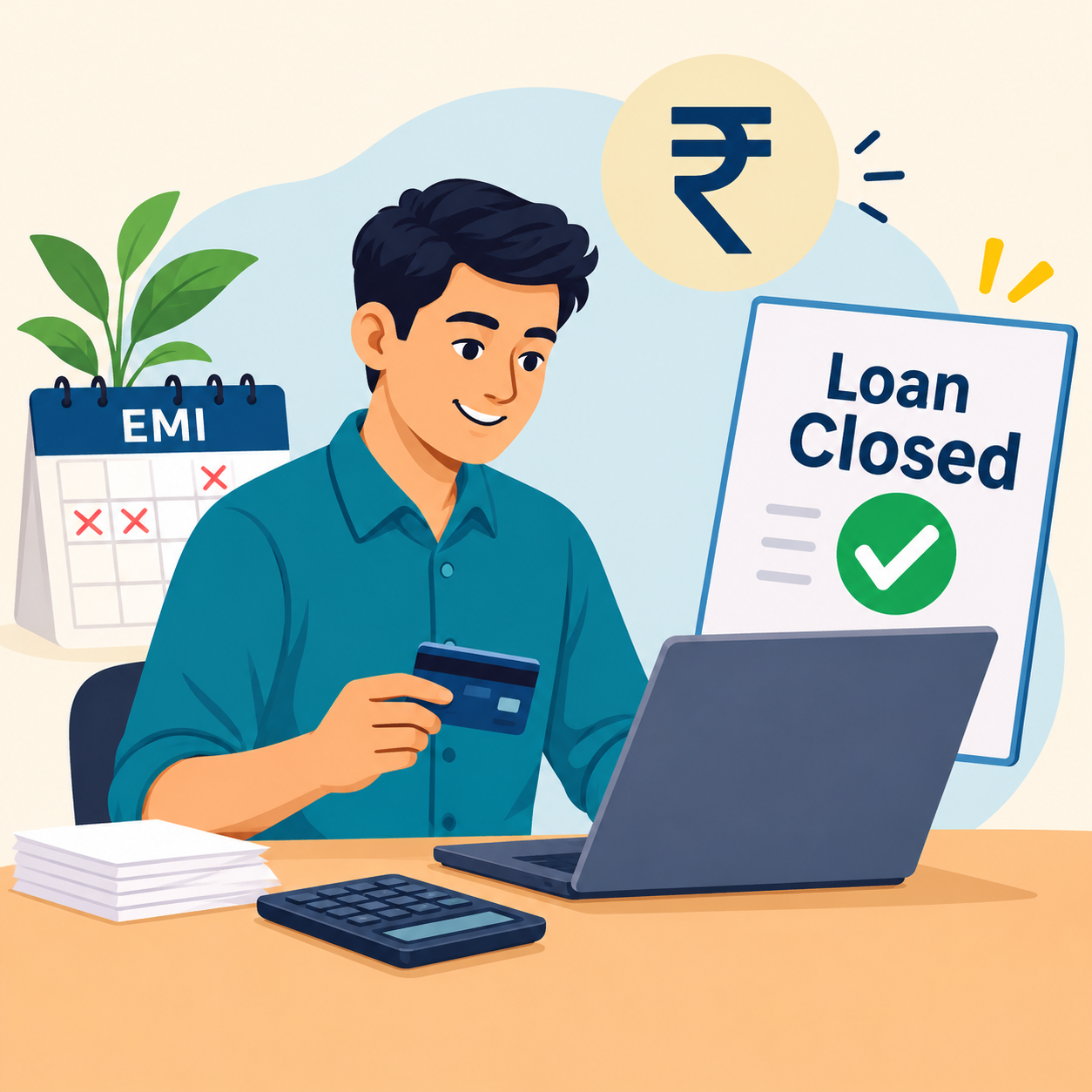
Instead of continuing monthly EMI payments until the end of the loan tenure, borrowers can pay the remaining amount in one transaction and close their loan account.
However, foreclosure is not always free. Depending on the loan agreement, interest rate type, lender and applicable regulations, additional charges may apply.
Understanding these conditions helps borrowers make better financial decisions and avoid unnecessary expenses.
3. AI Answer Box: What Is Personal Loan Foreclosure?
Personal loan foreclosure is the process of paying the complete outstanding loan balance before the original repayment tenure ends. It closes the loan account after the lender receives the required payment and completes the closure process.
The foreclosure amount generally includes:
-
Remaining principal amount.
-
Interest payable up to the foreclosure date.
-
Applicable foreclosure or prepayment charges, if permitted.
-
Applicable taxes on chargeable fees.
-
Other outstanding dues, if any.
Example: Suppose a borrower has an outstanding personal loan balance of ₹1,50,000. The lender calculates the applicable interest and permitted charges. After the borrower pays the final foreclosure amount, the loan can be closed.
Foreclosure may reduce future interest expenses, but borrowers should compare the total closure cost with the interest they would save.
4. What Does Personal Loan Foreclosure Mean?
Personal loan foreclosure is also known as loan pre-closure or early loan closure. It allows borrowers to repay the complete outstanding amount instead of paying EMIs for the remaining months.
For example, imagine a borrower takes a personal loan of ₹3,00,000 for a tenure of 36 months. After paying 18 EMIs, the borrower receives additional income and decides to repay the remaining loan amount.
The borrower can request a foreclosure statement from the lender, pay the calculated amount and complete the loan closure process.
4.1 How Does Personal Loan Foreclosure Work?
The process generally works as follows:
-
The borrower contacts the bank or NBFC.
-
The lender checks the outstanding loan balance.
-
The lender calculates applicable interest and foreclosure charges.
-
The borrower receives a foreclosure statement.
-
The borrower pays the final amount.
-
The lender processes the loan closure.
-
The borrower receives a loan closure confirmation and applicable No Objection Certificate (NOC).
Once the lender confirms closure, the borrower should check that no outstanding amount remains in the loan account.
4.2 Why Do Borrowers Choose Personal Loan Foreclosure?
Borrowers may decide to close their personal loans early for several reasons.
-
They receive an annual bonus or incentive.
-
Their monthly income increases.
-
They receive money from investments or other sources.
-
They want to reduce their monthly financial commitments.
-
They want to avoid paying future interest.
-
They are planning to apply for another major loan.
-
They want to become debt-free before the original repayment date.
Early repayment can be useful, especially when the remaining interest cost is higher than the total foreclosure expenses.
5. Personal Loan Foreclosure Charges in India
Personal loan foreclosure charges are additional fees that some lenders may collect when borrowers repay their loans before the scheduled completion date.
These charges depend on the applicable RBI regulations, loan interest type, loan agreement, sanction date and lender's approved policy.
There is no single universal foreclosure fee applicable to every personal loan in India.
5.1 What Are the Different Charges Included in Foreclosure?
|
Charge |
Meaning |
|---|---|
|
Outstanding principal |
Remaining unpaid loan amount |
|
Accrued interest |
Interest payable up to the closure date |
|
Foreclosure fee |
Applicable early closure charge, if permitted |
|
GST |
Applicable tax on taxable charges |
|
Overdue EMI |
Any unpaid EMI or overdue amount |
|
Other dues |
Other legitimate outstanding contractual amounts |
Important: GST is generally applicable to taxable service charges, not automatically to the outstanding principal or interest itself. Ask the lender for an itemised statement.
5.2 How Much Do Banks Charge for Personal Loan Foreclosure?
The actual charge varies between lenders and loan products.
Some lenders may charge a percentage of the outstanding principal, while others may follow different conditions or offer zero foreclosure charges.
The following is an illustrative example, not an actual bank tariff.
|
Particulars |
Example Amount |
|---|---|
|
Outstanding principal |
₹1,50,000 |
|
Illustrative foreclosure fee (3%) |
₹4,500 |
|
GST at 18% on the fee |
₹810 |
|
Additional accrued interest |
₹500 |
|
Total foreclosure payment |
₹1,55,810 |
Always obtain the actual foreclosure quotation from your lender before transferring money.
5.3 RBI Rules on Personal Loan Foreclosure in 2026
The Reserve Bank of India issued the Reserve Bank of India (Pre-payment Charges on Loans) Directions, 2025 on July 2, 2025.
These directions became applicable to loans sanctioned or renewed on or after January 1, 2026. They cover commercial banks (excluding payments banks), cooperative banks, NBFCs and All India Financial Institutions.
The important provisions include:
-
Regulated lenders cannot levy prepayment charges on floating-rate loans granted to individuals for purposes other than business.
-
The exemption applies to both partial and full prepayment.
-
It applies irrespective of the source of funds used for repayment.
-
No minimum lock-in period can be imposed for the loans covered by this exemption.
-
For eligible dual-rate loans, applicability depends on whether the loan is floating-rate at the time of prepayment.
-
For loans outside the specified exempt categories, charges may be governed by the lender's approved policy.
-
Applicable charges must be properly disclosed in the sanction letter, loan agreement and KFS, wherever applicable.
These rules are particularly important for personal loan borrowers because personal loans taken by individuals for non-business purposes fall within the specified floating-rate exemption.
Important distinction: The January 1, 2026 applicability date matters. Do not assume that every fixed-rate loan or every older loan automatically becomes charge-free under the new directions. Existing loans may also be governed by earlier RBI instructions applicable to their lender category. Check the loan's sanction date, interest type and agreement.
Official reference: RBI Pre-payment Charges on Loans Directions, 2025.
6. Fixed Rate vs Floating Rate Personal Loan Foreclosure
Understanding the difference between fixed and floating interest rates is important before requesting early loan closure.
|
Feature |
Fixed Rate Loan |
Floating Rate Loan |
|---|---|---|
|
Interest rate |
Generally remains unchanged |
Changes according to applicable benchmark and lender terms |
|
EMI |
Usually predictable |
May change or tenure may be adjusted |
|
Foreclosure charges |
May apply according to permitted terms and policy |
Exemptions apply under specified RBI rules |
|
Interest calculation |
Based on agreed fixed rate |
Based on changing applicable rate |
|
Early closure |
Check the agreement |
Check RBI exemption and loan eligibility |
Which Is Better for Early Foreclosure?
For borrowers planning early repayment, a qualifying floating-rate personal loan may offer an important advantage because prepayment charges are prohibited under the applicable RBI directions.
However, the decision should not depend on the interest rate type alone. Consider the remaining interest, outstanding principal, charges and available savings.
7. How to Calculate Personal Loan Foreclosure Amount
Before closing a personal loan, borrowers should understand how the lender arrives at the final payment amount.
A basic calculation is:
Foreclosure Amount = Outstanding Principal + Accrued Interest + Applicable Charges + Other Outstanding Dues
The exact amount depends on the lender's repayment records and the date on which the payment is received and applied.
7.1 Personal Loan Foreclosure Calculation Example
Consider the following hypothetical situation:
|
Particulars |
Amount |
|---|---|
|
Original loan amount |
₹3,00,000 |
|
Original tenure |
36 months |
|
Annual interest rate |
14% |
|
EMIs already paid |
18 |
|
Remaining tenure |
18 months |
|
Illustrative outstanding principal |
₹1,63,000 |
|
Accrued interest |
₹500 |
|
Foreclosure charge |
₹0 |
|
Total foreclosure amount |
₹1,63,500 |
In this example, the borrower needs approximately ₹1,63,500 to close the loan.
The example assumes that the lender does not levy a foreclosure fee. Actual outstanding principal and interest must be taken from the lender's official statement.
7.2 How Much Interest Can You Save?
The interest savings depend on how early the loan is closed.
A borrower who forecloses a loan during the initial repayment period may avoid more future interest than someone who closes it near the end of the tenure.
To calculate the actual benefit, compare:
-
Total remaining EMIs.
-
Total amount payable under foreclosure.
-
Applicable foreclosure fees and taxes.
-
Interest that would otherwise be paid.
-
Return that could be earned by retaining the money.
Expert insight: Do not compare only the outstanding principal with the remaining EMIs. The correct comparison is between the total remaining repayment cost and the complete foreclosure cost.
8. Step-by-Step Personal Loan Foreclosure Process
Closing a personal loan is generally straightforward if borrowers follow the lender's official procedure.
Step 1: Check Your Outstanding Loan Balance
Log in to your bank's mobile application, internet banking portal or loan account.
Check:
-
Remaining principal.
-
Pending EMIs.
-
Current repayment status.
-
Any overdue amount.
-
Applicable foreclosure conditions.
Step 2: Contact Your Bank or NBFC
Contact the lender through its official customer support, branch or loan servicing portal.
Request a personal loan foreclosure statement.
Ask the lender to provide:
-
Final outstanding amount.
-
Validity date of the quotation.
-
Applicable foreclosure charges.
-
GST on eligible fees.
-
Payment instructions.
-
Loan closure procedure.
Step 3: Review the Foreclosure Statement
Read the statement carefully before making the payment.
Check whether the amount includes:
-
Principal outstanding.
-
Interest calculated up to the closure date.
-
Any unpaid EMI.
-
Permitted foreclosure charges.
-
Applicable taxes.
If you notice an incorrect charge, request a written explanation.
Step 4: Arrange the Required Funds
Ensure you have enough funds to pay the complete amount.
Use an official payment method provided by the lender.
Avoid transferring money to an employee's personal bank account or an unknown payment link.
Step 5: Make the Foreclosure Payment
Pay the amount according to the lender's instructions.
Save the following information:
-
Payment receipt.
-
Transaction reference number.
-
Foreclosure request number.
-
Bank statement showing the debit.
Step 6: Collect the Loan Closure Confirmation
After successful payment, request written confirmation that the loan account has been closed.
Depending on the lender's process, you may receive:
-
Loan closure letter.
-
No Objection Certificate (NOC), where applicable.
-
No Dues Certificate.
-
Final loan statement.
Step 7: Verify Your Credit Report
After closure, check your credit report to ensure that the loan status is correctly updated as closed.
If the loan continues to appear active after a reasonable reporting period, contact the lender and raise a correction request.
9. Documents Required for Personal Loan Foreclosure
Most lenders require basic identification and loan-related details to process a foreclosure request.
|
Document |
Purpose |
|---|---|
|
Aadhaar card or other accepted ID |
Identity verification, if required |
|
PAN card |
Financial identification, if required |
|
Loan account number |
Identifying the loan |
|
Foreclosure request |
Requesting early closure |
|
Bank statement |
Payment verification, if requested |
|
Payment receipt |
Proof of final payment |
|
Authorisation letter |
If someone is acting on your behalf, where required |
The exact documentation depends on the lender's internal procedure.
9.1 Is Foreclosure Possible Without Visiting the Bank?
Yes. Many banks and NBFCs offer online loan servicing facilities.
Depending on the lender, borrowers may be able to:
-
Download their loan statement.
-
Submit a foreclosure request.
-
Obtain the payment quotation.
-
Make the final payment.
-
Download closure documents.
However, some lenders may require branch verification or additional documentation.
10. Benefits of Personal Loan Foreclosure
Foreclosing a personal loan can offer several financial advantages.
10.1 Saves Future Interest
The biggest advantage is the possibility of reducing future interest expenses.
Once the loan is closed, borrowers do not need to continue paying interest for the remaining repayment period.
10.2 Reduces Monthly Financial Burden
Regular EMI payments can affect monthly budgets.
After foreclosure, borrowers can use that money for:
-
Household expenses.
-
Emergency savings.
-
Investments.
-
Education.
-
Other financial goals.
10.3 Helps Become Debt-Free Faster
Early loan closure gives borrowers an opportunity to achieve financial independence sooner.
It also removes one ongoing debt obligation from their financial commitments.
10.4 Improves Debt Management
Having fewer active loans may make monthly financial planning easier.
Borrowers can focus on other financial priorities instead of managing an additional EMI.
10.5 Provides Financial Peace of Mind
Some people prefer to eliminate debt rather than continue paying EMIs for several years.
Foreclosure can provide greater financial flexibility and peace of mind.
11. Disadvantages of Personal Loan Foreclosure
Although early repayment has advantages, it may not always be the best decision.
11.1 Reduction in Available Savings
Using all available savings to close a loan can leave borrowers financially vulnerable.
Unexpected medical expenses, job loss or household emergencies may create additional financial pressure.
11.2 Foreclosure Charges May Apply
Certain loans may have permitted foreclosure charges under the applicable rules and lender policy.
These charges can reduce the financial benefit of early closure.
11.3 Opportunity Cost
Money used for foreclosure cannot be invested elsewhere.
If the borrower has a suitable investment opportunity with a higher expected after-tax return than the effective cost of the loan, keeping the loan may sometimes be financially reasonable.
However, investment returns are not guaranteed.
11.4 Loss of Financial Liquidity
A large lump-sum payment can reduce the amount of money available for immediate needs.
Borrowers should maintain sufficient emergency funds before proceeding.
11.5 Foreclosure May Not Provide Large Savings Near the End
When most EMIs have already been paid, a significant portion of the scheduled interest may already have been collected.
Closing the loan near the end of the tenure may provide less benefit than closing it earlier.
12. Pros and Cons of Personal Loan Foreclosure
|
Pros |
Cons |
|---|---|
|
Reduces future interest costs |
Uses available savings |
|
Eliminates monthly EMI |
Possible applicable charges |
|
Helps become debt-free earlier |
Reduces liquidity |
|
Simplifies financial planning |
Opportunity cost of funds |
|
May improve debt management |
Savings may be small near loan maturity |
Financial recommendation: Foreclosure is generally worth considering when the interest savings are meaningful, the charges are low or zero, and sufficient emergency savings remain after repayment.
13. Personal Loan Foreclosure vs Part-Payment
Borrowers often confuse personal loan foreclosure with part-payment.
Both involve repaying a loan before the scheduled tenure ends, but they work differently.
|
Feature |
Foreclosure |
Part-Payment |
|---|---|---|
|
Repayment |
Entire outstanding amount |
Only a portion |
|
Loan status |
Loan account closes |
Loan remains active |
|
EMI |
Future EMIs stop after closure |
EMI or tenure may change |
|
Interest savings |
Can eliminate future loan interest |
May reduce future interest |
|
Charges |
Applicable full prepayment charges |
Applicable partial prepayment charges |
|
Suitable for |
Borrowers with sufficient funds |
Borrowers with limited extra funds |
13.1 Which Option Should You Choose?
Choose foreclosure if:
-
You have enough money to repay the complete outstanding amount.
-
You want to eliminate the EMI.
-
The interest savings justify the cost.
Choose part-payment if:
-
You have some additional money but cannot repay everything.
-
You want to reduce your principal.
-
You prefer to retain part of your savings.
Always confirm whether your lender allows part-payment and what conditions apply.
14. When Is the Best Time to Foreclose a Personal Loan?
The right time depends on your financial situation and loan repayment schedule.
Generally, early repayment may be more beneficial when a larger amount of future interest remains.
Consider the following situations:
|
Situation |
Foreclosure Decision |
|---|---|
|
Received an annual bonus |
Consider foreclosure after protecting emergency savings |
|
Received additional income |
Compare savings and foreclosure cost |
|
Near the beginning of tenure |
Potentially higher interest savings |
|
Near the end of tenure |
Calculate whether savings justify closure |
|
High-interest personal loan |
Early closure may be beneficial |
|
Low-interest loan |
Compare with other financial priorities |
|
No emergency savings |
Build a financial reserve first |
Should You Foreclose a Personal Loan After 6 Months?
It depends on the loan agreement and lender rules.
Some loan products may have minimum repayment periods or lock-in conditions where permitted. However, the applicable RBI exemption for qualifying floating-rate loans does not allow a minimum lock-in period.
Before closing after six months, check your loan type, sanction date and foreclosure quotation.
15. Important Mistakes to Avoid During Personal Loan Foreclosure
Borrowers sometimes complete the payment but overlook the final documentation.
Avoid these mistakes:
-
Not checking the outstanding principal.
-
Assuming every personal loan has zero foreclosure charges.
-
Ignoring the interest rate type.
-
Not checking the loan sanction date.
-
Paying without obtaining an official foreclosure statement.
-
Ignoring applicable taxes and overdue amounts.
-
Using unofficial payment links.
-
Not collecting the loan closure confirmation.
-
Failing to check the credit report after closure.
-
Using all emergency savings for loan repayment.
15.1 How to Protect Yourself During Loan Closure
Follow these precautions:
-
Communicate only through official lender channels.
-
Request a written foreclosure quotation.
-
Verify the beneficiary account before transferring funds.
-
Save every payment receipt.
-
Obtain written confirmation of loan closure.
-
Check your final loan statement.
-
Monitor your credit report for accurate reporting.
16. Does Personal Loan Foreclosure Affect Your CIBIL Score?
Personal loan foreclosure does not automatically damage your CIBIL score.
When a loan is repaid in full and closed correctly, the lender should report the appropriate closed status to the credit information company.
However, the effect on a credit score depends on the borrower's overall credit history.
Factors that influence a credit score include:
-
Repayment history.
-
Credit utilisation.
-
Number of active credit accounts.
-
Length of credit history.
-
Credit enquiries.
-
Outstanding debts.
Does Foreclosure Improve Your Credit Score?
It may support healthier credit management by reducing outstanding debt, but there is no guarantee of an immediate score increase.
A closed personal loan can remain visible in your credit history. Closing an account does not mean its history is automatically erased.
Important: Ensure that the lender reports the account as closed with zero outstanding balance. If the report shows an incorrect active balance, raise a dispute with the lender and the relevant credit bureau.
17. What Is a Personal Loan Foreclosure Letter?
A personal loan foreclosure letter is a document issued by the lender that provides the amount required to repay the loan completely before the original tenure ends.
It generally contains:
-
Borrower's name.
-
Loan account number.
-
Outstanding principal.
-
Interest payable.
-
Applicable foreclosure charges.
-
Total payment amount.
-
Payment instructions.
-
Validity date.
After successful payment, borrowers should request the final loan closure letter or NOC, as applicable.
17.1 Difference Between a Foreclosure Letter and an NOC
|
Foreclosure Letter |
NOC |
|---|---|
|
Provides the amount required to close the loan |
Confirms that the loan has been closed with no dues |
|
Usually obtained before final payment |
Obtained after successful closure |
|
Includes payment details |
Includes closure confirmation |
|
Helps complete the repayment |
Serves as proof of closure |
18. Personal Loan Foreclosure Checklist
Use this checklist before closing your loan.
19. Expert Commentary: Is Personal Loan Foreclosure a Smart Financial Decision?
Personal loan foreclosure should be treated as a financial planning decision rather than simply a way to eliminate EMIs.
A borrower may have enough savings to close a loan but should first consider whether using that money would create a cash shortage.
For example, a salaried employee with a ₹2 lakh outstanding personal loan may receive a ₹2.5 lakh annual bonus.
Using the entire bonus for foreclosure may eliminate the loan, but it could also leave the employee without enough emergency funds.
A more balanced approach is to:
-
Keep sufficient emergency savings.
-
Calculate the remaining interest.
-
Check applicable foreclosure charges.
-
Compare the total repayment cost.
-
Consider other high-interest debts.
-
Make the decision based on actual savings.
Trust-building financial tip: Never decide to foreclose a loan only because you want to stop paying EMIs. Calculate the complete financial impact first.
Frequently Asked Questions (FAQs) About Personal Loan Foreclosure
1. What is personal loan foreclosure?
Personal loan foreclosure is the process of repaying the entire outstanding loan amount before the scheduled loan tenure ends. It closes the loan account after the lender processes the payment.
2. Is personal loan foreclosure good or bad?
It can be beneficial if the interest savings are higher than the foreclosure costs. However, borrowers should maintain sufficient emergency savings before making a lump-sum repayment.
3. Are personal loan foreclosure charges mandatory?
No. Charges depend on the applicable RBI regulations and loan conditions. Certain qualifying floating-rate loans cannot attract prepayment charges.
4. Can I foreclose my personal loan after 6 months?
Yes, subject to the applicable loan terms and regulations. Check the lender's minimum repayment conditions and obtain a foreclosure quotation before proceeding.
5. Does RBI allow banks to charge foreclosure fees in 2026?
Under the RBI Pre-payment Charges on Loans Directions, 2025, lenders cannot charge prepayment fees on qualifying floating-rate loans given to individuals for non-business purposes. Other loan categories may have permitted charges.
6. Can I close my personal loan online?
Yes. Many banks and NBFCs provide online foreclosure facilities through mobile applications, internet banking and official customer portals.
7. What happens after personal loan foreclosure?
After receiving the complete payment, the lender processes the loan closure and provides confirmation. The borrower should verify that the outstanding balance is zero.
8. What is the difference between personal loan foreclosure and prepayment?
Prepayment generally refers to repaying a loan before its scheduled due date, either partially or fully. Foreclosure specifically means repaying the entire outstanding amount and closing the loan.
9. Does personal loan foreclosure improve CIBIL score?
It may support better debt management, but an immediate increase in the CIBIL score is not guaranteed. Credit scores depend on several factors, including repayment history and overall credit profile.
10. What documents are required for personal loan foreclosure?
Commonly required details include the loan account number, foreclosure request and payment information. Identity documents or additional verification may be required depending on the lender.
11. Can I foreclose a personal loan using another loan?
Yes, borrowers may use another loan to repay an existing personal loan. However, compare the new loan's interest rate, processing fees and total repayment cost before refinancing.
12. Can I foreclose a personal loan without paying all remaining EMIs?
Yes. Foreclosure involves paying the lender's calculated outstanding amount instead of continuing the scheduled EMIs. Future interest that would not accrue after closure is generally not payable.
13. What is an NOC in personal loan foreclosure?
An NOC, or No Objection Certificate, is a document confirming that the lender has no remaining claim against the borrower for the closed loan, subject to the stated terms.
14. Can I foreclose a personal loan before the first EMI?
It depends on the loan agreement, applicable regulations and lender procedure. Contact the lender to confirm the permitted closure process and final amount.
15. How long does personal loan foreclosure take?
The timeline varies by lender. Payment processing and account closure may take a few working days or longer depending on verification and documentation requirements. Ask the lender for its expected timeline.
23. Conclusion
Personal loan foreclosure is an effective way to reduce debt and potentially save interest by repaying the complete outstanding amount before the scheduled loan tenure ends.
However, borrowers should not make this decision without understanding the applicable foreclosure charges, RBI regulations, remaining interest and their financial position.
Before proceeding, obtain an official foreclosure statement, compare the total closure cost with the remaining EMI payments and maintain sufficient emergency savings.
Most importantly, collect the loan closure confirmation and verify your credit report after completing the process.
Published on : 19th November
Published by : Bhargavi
www.vizzve.com || www.vizzveservices.com
Follow us on social media: Facebook || Linkedin || Instagram
🛡 Powered by Vizzve Financial
RBI-Registered Loan Partner | 10 Lakh+ Customers | ₹600 Cr+ Disbursed