

Introduction
Applying for a personal loan involves more than checking the amount you can borrow and the monthly EMI you need to pay. You also need to understand the interest rate, processing fees, other charges, repayment schedule, and overall cost of the loan.
This is where the Key Facts Statement (KFS) becomes important.
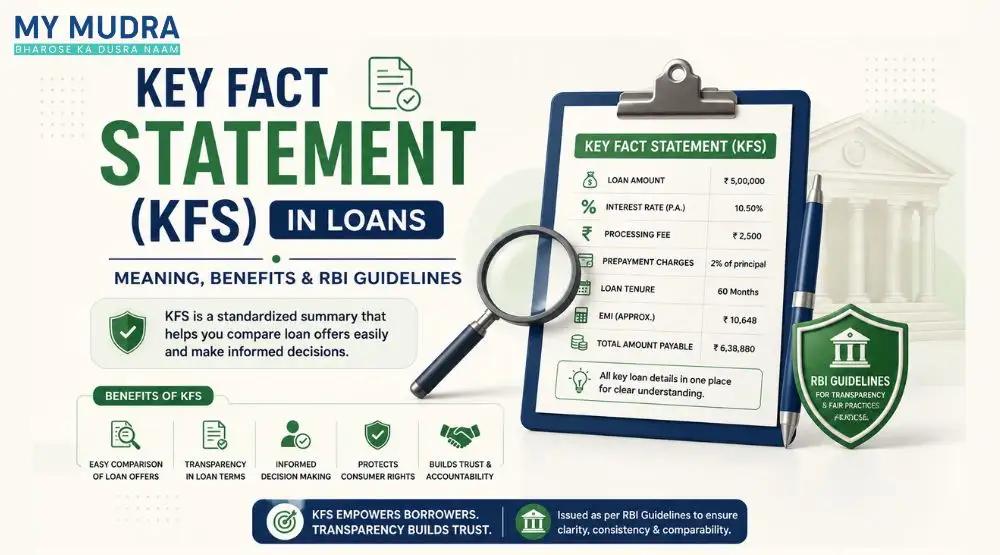
A personal loan KFS is a standardised disclosure document that summarises the key terms and costs of a loan in simple, understandable language. It helps prospective borrowers understand the offer before entering into a loan contract.
AI Answer Box: What Is Personal Loan KFS?
A Personal Loan Key Facts Statement (KFS) is a standardised document provided by a lender that summarises the important financial terms of a loan. It typically includes the loan amount, interest rate, Annual Percentage Rate (APR), fees and charges, repayment schedule, and other applicable conditions.
For covered loans in India, RBI instructions require regulated lenders to provide the KFS to prospective borrowers before the loan contract is executed. The statement helps borrowers understand the overall cost of borrowing and compare loan offers more effectively.
Before accepting a personal loan, check the APR, net disbursal amount, EMI schedule, applicable fees, and KFS validity period. Read the full loan agreement as well, because the KFS is a summary rather than a substitute for the contract.
What Is a Personal Loan KFS?
KFS stands for Key Facts Statement. It is a document designed to communicate the most important facts about a loan in a standardised format.
The purpose is to make loan information easier to understand and compare. Instead of relying only on advertisements or verbal explanations, borrowers can review key financial details in writing before agreeing to the loan.
For example, a personal loan offer may advertise an attractive interest rate. However, the borrower may also need to pay a processing fee or other charges. The KFS helps present the overall credit cost through disclosures such as the APR.
Why Is a Personal Loan KFS Important?
A KFS can help borrowers:
- Understand the actual cost of borrowing.
- Compare personal loan offers from different lenders.
- Review the interest rate and APR.
- Identify applicable processing fees and other charges.
- Check the repayment schedule.
- Understand key loan conditions before accepting an offer.
- Retain a written record of the disclosed terms.
The KFS is especially useful when applying online, where loan offers may be presented quickly and borrowers may otherwise overlook important details.
What Information Does a Personal Loan KFS Contain?
The exact contents depend on the applicable regulatory format and loan product. Common information includes the following.
| KFS component | What it tells the borrower |
|---|---|
| Loan amount | Amount approved under the offer |
| Interest rate | Rate used to calculate interest |
| APR | Annualised overall cost of credit, including applicable charges |
| Processing fee | Fee charged for processing the loan |
| Other charges | Additional disclosed costs, where applicable |
| Net disbursal amount | Amount expected to be credited after permitted deductions |
| EMI or EPI | Periodic repayment amount |
| Repayment schedule | Instalment dates and allocation of principal and interest |
| Loan tenure | Duration of the repayment period |
| Penal charges | Applicable charges for specified contractual non-compliance |
| Third-party charges | Applicable third-party costs, including taxes where relevant |
| KFS validity | Period during which the disclosed offer can be accepted on its stated terms |
The actual document should be checked for all applicable entries. Not every fee or condition applies to every personal loan.
5.1 Loan Amount and Net Disbursal
The loan amount is the principal approved by the lender. The net amount received may be different if permitted fees or other disclosed deductions are made at disbursal.
For example, if a lender approves ₹1,00,000 and deducts an applicable processing fee of ₹2,000, the borrower may receive ₹98,000.
This is an illustrative example, not a standard fee or a recommended charge.
Always confirm both the approved principal and the amount you will actually receive.
5.2 Interest Rate and APR
The interest rate is the rate used to calculate interest on the loan according to its terms.
The Annual Percentage Rate (APR) is broader. Under the applicable RBI KFS framework, it represents the annual cost of credit to the borrower, including the interest rate and other charges associated with the credit facility.
APR can help you compare loans with different fee structures. A lower advertised interest rate does not automatically mean a lower overall borrowing cost.
5.3 EMI and Repayment Schedule
The KFS includes repayment information relevant to the loan, including the amortisation schedule under the applicable framework.
The schedule helps you understand:
- The periodic instalment amount.
- When repayments are due.
- How payments are allocated between principal and interest.
- How the outstanding balance reduces over time.
Check that the repayment schedule matches the offer you intend to accept.
5.4 Processing Fees and Other Charges
Depending on the loan product, the disclosed charges may include processing fees, taxes, and other applicable costs.
Check whether fees are deducted upfront or collected separately. Also review any disclosed penal charges and early repayment conditions.
Do not assume that every fee is included in every offer. Ask the lender to clarify any missing or unclear information.
What Are the RBI Guidelines for Personal Loan KFS?
The Reserve Bank of India has introduced KFS requirements to improve transparency and help borrowers make informed financial decisions.
6.1 RBI Circular of April 15, 2024
The RBI issued the circular titled Key Facts Statement (KFS) for Loans & Advances on April 15, 2024.
The harmonised instructions cover retail and MSME term loan products extended by regulated entities within the circular's scope. The stated purpose is to improve transparency and reduce information gaps between lenders and borrowers. <Cite refs={["turn579990search0","turn579990search21"]}/>
Under the framework, relevant requirements include:
- Providing the KFS to prospective borrowers before executing the loan contract.
- Using a standardised format and language the borrower understands.
- Explaining the contents and obtaining an acknowledgement that the borrower understands them.
- Including the APR calculation and the loan's amortisation schedule.
- Providing a unique proposal number and the applicable validity period.
6.2 How Long Is a KFS Valid?
Under the April 15, 2024 RBI circular, the minimum validity period is:
| Loan tenure | Minimum KFS validity |
|---|---|
| Seven days or more | Three working days |
| Less than seven days | One working day |
The validity period gives the borrower time to consider the offer. If the borrower agrees to the terms during the applicable validity period, the lender is bound by the KFS terms as specified in the circular. <Cite refs={["turn579990search21"]}/>
These are minimum periods under the cited framework. Check the dates and conditions stated on your actual KFS.
6.3 Does KFS Apply to Digital Personal Loans?
KFS requirements also form part of RBI's digital lending framework.
The RBI's Digital Lending Directions, 2025 consolidated earlier digital lending instructions and introduced additional measures relating to digital loan products and transparency. Applicable lenders must follow the relevant requirements for their products. <Cite refs={["turn579990search2","turn579990search5"]}/>
When applying through a digital lending platform, verify the identity of the actual regulated lender. Review the KFS and related loan documents, and save the copies delivered through the lender's authorised channels.
6.4 What If the KFS and Loan Agreement Differ?
Do not ignore a discrepancy between the KFS, sanction letter, and final agreement.
Before accepting the offer:
- Identify the inconsistent amount, rate, fee, or condition.
- Contact the lender through an official channel.
- Request a written explanation and corrected documentation where needed.
- Avoid accepting the loan until you understand the discrepancy.
Keep copies of the documents and the lender's response for future reference.
What Is APR in a Personal Loan KFS?
APR is one of the most important figures to review in a KFS.
It expresses the annualised cost of credit, including interest and applicable charges associated with the loan. It gives borrowers a more complete view of the cost than the interest rate alone.
Interest Rate vs APR
| Feature | Interest rate | APR |
|---|---|---|
| Meaning | Rate used to calculate interest | Annualised overall credit cost |
| Includes interest | Yes | Yes |
| Reflects applicable additional charges | Not necessarily | Includes applicable charges under the relevant calculation framework |
| Use in loan comparison | Useful for understanding interest pricing | Useful for comparing overall borrowing costs |
| Where to check | Loan offer, KFS, and agreement | KFS and other required disclosures |
Example: Two lenders may offer the same loan amount and tenure but charge different processing fees. Their interest rates could be identical, while their APRs differ.
That is why borrowers should compare both the rate and APR rather than focusing on one number.
How to Read a Personal Loan KFS Step by Step
Use the following process before accepting a loan offer.
Step 1: Verify the Lender
Confirm the legal name of the bank or regulated lender. If a third-party app or intermediary is involved, check which entity is actually providing the credit.
Step 2: Check the Approved Loan Amount
Confirm the principal amount and the expected net disbursal.
Step 3: Review the Interest Rate and APR
Check both figures. If you are comparing multiple loans, compare offers with similar loan amounts and tenures.
Step 4: Examine All Applicable Charges
Look for processing fees, taxes, and other applicable charges. Check whether each amount is deducted upfront or payable separately.
Step 5: Review the Repayment Schedule
Confirm the instalment amount, repayment frequency, tenure, and payment dates.
Step 6: Check the Validity Period
Review the proposal number and validity date, where applicable. Do not assume an expired offer will remain available on identical terms.
Step 7: Read the Full Agreement
The KFS is a summary. Read the loan agreement for detailed obligations, default conditions, and other contractual provisions.
Step 8: Save Your Documents
Keep copies of the KFS, sanction letter, final agreement, repayment schedule, and acceptance confirmation.
Personal Loan KFS Example: Understanding Loan Costs
Consider this hypothetical personal loan offer.
| Particular | Illustrative value |
|---|---|
| Loan principal | ₹1,00,000 |
| Annual interest rate | 12% |
| Loan tenure | 12 months |
| Approximate monthly EMI | ₹8,885 |
| Approximate total of 12 EMIs | ₹1,06,620 |
| Approximate total interest | ₹6,620 |
| Illustrative processing fee | ₹2,000 |
| Net disbursal if the fee is deducted upfront | ₹98,000 |
The figures are illustrative and rounded. The EMI assumes a standard monthly reducing-balance calculation, a constant interest rate, and no additional charges in the instalment calculation.
The processing fee is an example only. The APR is not calculated in this table and would need to be determined using the relevant cash flows and applicable calculation method.
What Does This Example Teach Us?
A borrower may be required to repay the full contractual principal even when an upfront fee reduces the amount received.
Reviewing the loan amount, net disbursal, fees, repayment schedule, and APR together provides a better understanding of the offer.
Use the actual figures in your lender's KFS rather than relying on illustrative calculations.
Benefits and Limitations of a Personal Loan KFS
| Benefits | Limitations |
|---|---|
| Makes key loan terms easier to understand | Does not replace the full loan agreement |
| Helps compare overall borrowing costs | Comparisons can be misleading if loan amounts or tenures differ |
| Highlights APR and applicable charges | The borrower still needs to read the details carefully |
| Provides repayment information | Does not guarantee loan approval |
| Supports more informed decisions | Does not guarantee that the cheapest loan is the most suitable one |
The KFS is a useful transparency tool, but borrowers should still consider affordability, service quality, lender credibility, and the full contractual terms.
Common Mistakes to Avoid When Reviewing a KFS
Avoid these common mistakes:
- Looking only at the interest rate instead of APR.
- Ignoring processing fees and other disclosed charges.
- Confusing the approved amount with the net amount received.
- Failing to check the repayment schedule.
- Accepting an offer without checking its validity period.
- Assuming that the KFS contains every detailed contractual clause.
- Ignoring differences between the KFS and final agreement.
- Applying through an unverified digital lending app.
- Failing to save the final loan documents.
- Relying on verbal promises that are not reflected in the written terms.
Taking time to review these details can help you make a more informed borrowing decision.
KFS vs Loan Agreement vs Sanction Letter
These documents have different purposes and should be reviewed together.
| Feature | KFS | Loan agreement | Sanction letter |
|---|---|---|---|
| Main purpose | Summarises key loan facts and costs | Records contractual terms | Communicates loan approval and approved conditions |
| APR and fees | Highlights relevant disclosures | May contain detailed provisions | May summarise approved pricing |
| Repayment details | Includes required repayment information | Sets out contractual obligations | May state key repayment terms |
| Validity | May have a defined acceptance period | Governed by its terms and applicable law | Depends on the offer and its conditions |
| Best use | Understand and compare loan costs | Understand rights and obligations | Confirm the approved offer |
Practical tip: Check that the important financial terms are consistent across all three documents before accepting the loan.
Expert Guidance: What Should Borrowers Check First?
Good borrowing decisions start with understanding the cost and conditions of the loan.
Before accepting an offer, prioritise these checks:
- APR: Understand the overall annualised cost of credit.
- Net disbursal: Confirm the amount that will reach your account.
- EMI affordability: Check whether the repayment fits your budget.
- Applicable charges: Understand the fees and when they are payable.
- Repayment terms: Review the schedule and loan tenure.
- Lender identity: Verify the regulated entity behind the offer.
- Document consistency: Compare the KFS with the sanction letter and agreement.
If you do not understand a term, ask the lender to explain it in writing. For regulatory questions, consult the official RBI website. For disputes requiring legal interpretation, consider obtaining advice from a qualified professional.
These are practical financial-literacy recommendations, not a substitute for individual financial or legal advice.
Frequently Asked Questions (FAQs)
1. What is KFS in a personal loan?
KFS stands for Key Facts Statement. It is a standardised document summarising important loan terms, including the amount, APR, applicable charges, and repayment information.
2. Is KFS mandatory for personal loans in India?
RBI's April 15, 2024 circular provides for KFS disclosure for covered retail and MSME term loans offered by regulated entities within its scope. Borrowers should check the requirements applicable to their lender and product.
3. What is included in a personal loan KFS?
It typically includes the loan amount, interest rate, APR, applicable fees, repayment schedule, and other key terms required under the relevant framework.
4. What does APR mean in a KFS?
APR means Annual Percentage Rate. It represents the annualised cost of credit, including interest and applicable charges associated with the credit facility.
5. What is the difference between KFS and a loan agreement?
The KFS summarises key financial facts and costs. The loan agreement sets out the contractual terms and obligations in greater detail.
6. How long is a personal loan KFS valid?
Under the RBI circular dated April 15, 2024, the minimum validity period is three working days for loans with a tenure of seven days or more and one working day for loans with a tenure of less than seven days, within the framework's scope.
7. Does KFS show the personal loan EMI?
The KFS framework includes repayment information and an amortisation schedule for covered loans. Check your actual statement for the instalment amounts and dates.
8. Are processing fees included in KFS?
Applicable charges must be disclosed according to the requirements governing the loan. Review the KFS for the processing fee, other applicable costs, and APR calculation.
9. Can I get my personal loan KFS online?
For digital loan applications, the KFS may be provided electronically through the lender's authorised process. Check your registered email, SMS, application, or official lender portal.
10. What should I do if my KFS has incorrect information?
Contact the lender through an official channel, identify the incorrect details, and request written clarification or corrected documentation before accepting the offer.
11. Does KFS guarantee personal loan approval?
No. A KFS explains key terms of a loan offer. Approval and disbursal remain subject to the lender's eligibility checks, assessment, and applicable conditions.
12. Is APR more important than the interest rate?
Both are important. The interest rate helps explain how interest is calculated, while APR offers a broader view of annualised credit costs, including applicable charges.
13. Is KFS applicable to online personal loans?
KFS requirements form part of the applicable RBI digital lending framework. The precise obligations depend on the regulated lender, loan product, and current rules.
14. Can a lender change the terms after providing the KFS?
The effect of a change depends on the applicable requirements, the offer's validity, and the contractual circumstances. Ask the lender for written clarification before accepting revised terms.
15. Why should I read the KFS before taking a loan?
Reading the KFS helps you understand the overall cost, applicable fees, and repayment obligations before committing to a loan.
Conclusion
A Personal Loan Key Facts Statement is an important tool for understanding the financial details of a loan before accepting an offer. It helps borrowers review APR, interest rates, applicable charges, and repayment information in a standardised format.
Before taking a personal loan, verify the lender, compare the total borrowing cost, review the KFS validity period, and read the full agreement. These steps can help you avoid misunderstandings and choose a loan that fits your financial needs.
Ready to explore personal loan options? Visit Vizzve Financial, review the available terms, and make an informed decision after checking the applicable KFS and loan agreement.
Published on : 05th October
Published by : Bhargavi
www.vizzve.com || www.vizzveservices.com
Follow us on social media: Facebook || Linkedin || Instagram
🛡 Powered by Vizzve Financial
RBI-Registered Loan Partner | 10 Lakh+ Customers | ₹600 Cr+ Disbursed