

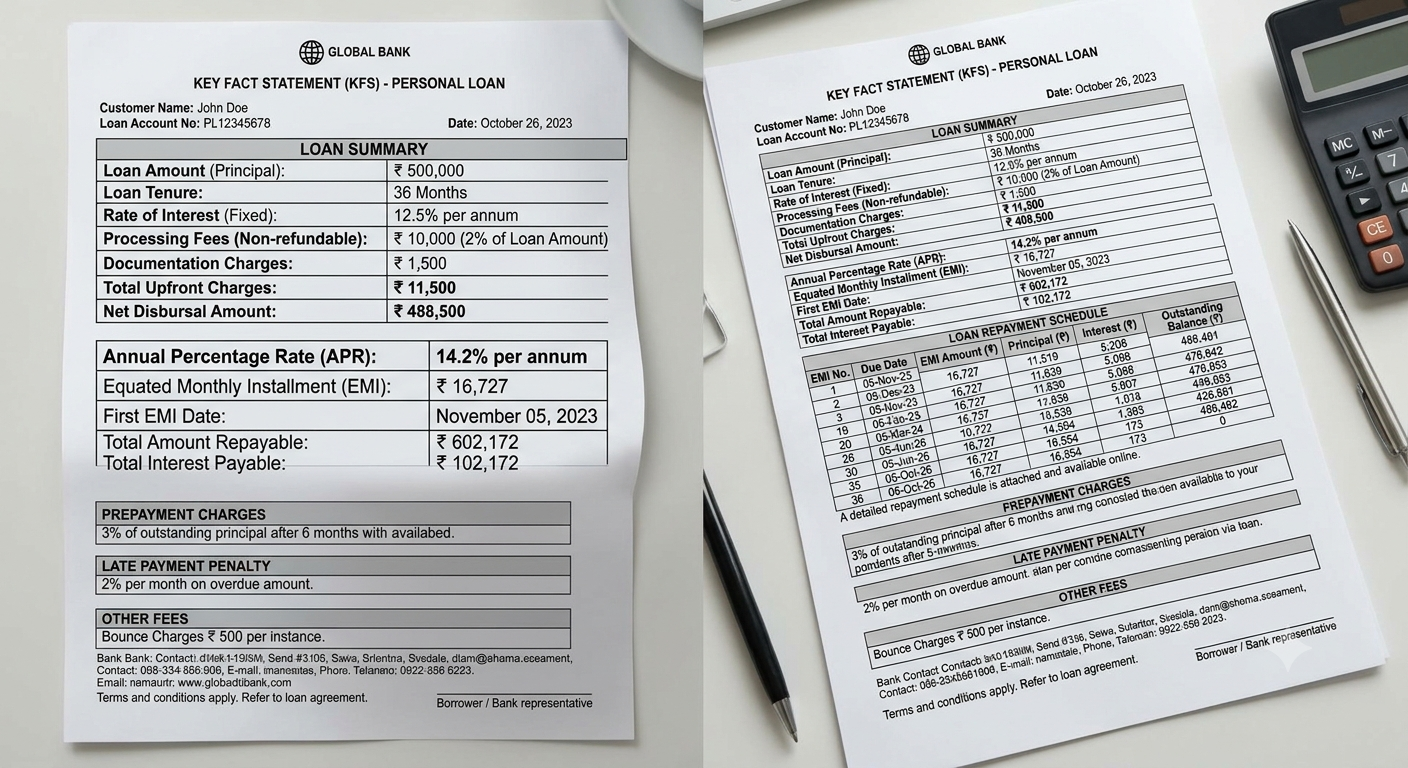
KFS stands for Key Facts Statement. It is a standardised document that provides essential information about a loan before the borrower enters into the loan agreement.
The document generally includes:
-
Approved or proposed loan amount.
-
Applicable interest rate.
-
Annual Percentage Rate (APR).
-
Loan repayment tenure.
-
Monthly EMI details.
-
Processing fees and other charges.
-
Penal charges, if applicable.
-
Repayment schedule.
-
Important loan terms and conditions.
The primary purpose of a KFS is to ensure transparency between borrowers and lenders. Instead of relying only on advertisements or verbal explanations, borrowers can review the important financial details in one place.
2. Why Is KFS Important for Personal Loan Borrowers?
A personal loan is a financial commitment that may continue for several months or years. Even a small difference in interest rates or additional charges can affect the overall repayment amount.
Here is why reviewing the KFS is important:
1. Understand the Actual Loan Cost
The KFS provides the APR, which reflects the annualised cost of borrowing, including applicable charges. It helps borrowers understand the overall financial impact of the loan.
2. Avoid Hidden or Unexpected Charges
Borrowers can check applicable processing fees, late-payment charges and other disclosed costs before accepting the loan.
3. Compare Different Loan Offers
When comparing personal loans from different regulated lenders, borrowers can use KFS documents to evaluate interest rates, APRs, fees and repayment terms.
4. Understand EMI Obligations
The repayment schedule helps borrowers understand their monthly financial commitments and plan their budgets accordingly.
5. Make Informed Decisions
A KFS gives borrowers an opportunity to review important loan details before agreeing to the terms.
3. Important Details to Check in Your Personal Loan KFS
Before accepting a loan offer, borrowers should carefully review the following details.
|
KFS Detail |
What to Check |
|---|---|
|
Loan Amount |
Total amount approved |
|
Interest Rate |
Applicable annual interest rate |
|
APR |
Overall annual cost of borrowing |
|
Processing Fee |
Charges for processing the application |
|
EMI |
Monthly repayment amount |
|
Loan Tenure |
Total repayment period |
|
Penal Charges |
Charges for delayed payments |
|
Repayment Schedule |
EMI dates and principal-interest breakdown |
|
Prepayment Terms |
Conditions for early repayment |
Pay special attention to the APR because it gives a broader picture of the borrowing cost than the interest rate alone.
4. What Is APR in a Personal Loan KFS?
APR stands for Annual Percentage Rate. It represents the annualised cost of borrowing, including the interest rate and applicable loan-related charges.
For example, consider a hypothetical personal loan:
-
Loan amount: ₹1,00,000
-
Interest rate: 15% per annum
-
Processing fee: ₹2,000
-
Repayment tenure: 12 months
The borrower should not evaluate the offer only by looking at the 15% interest rate. The processing fee and other applicable charges also affect the overall borrowing cost.
The KFS provides an APR calculation to help borrowers understand these costs more clearly.
Remember: APR and the nominal interest rate are not the same. Always compare APR alongside the EMI and total repayment amount.
5. RBI Guidelines for Personal Loan KFS
The Reserve Bank of India (RBI) introduced harmonised KFS requirements through its April 15, 2024 circular for retail and MSME term loans offered by regulated entities.
Important requirements include:
-
Lenders must provide a KFS before executing the loan contract.
-
The document should use simple language that borrowers can understand.
-
It must include a unique proposal number.
-
An APR calculation sheet and loan amortisation schedule must be provided.
-
Applicable third-party charges must be disclosed separately.
-
The KFS must have a minimum validity period of three working days for loans with a tenure of seven days or more, and one working day for shorter loans.
-
Charges not disclosed in the KFS cannot be imposed without the borrower's explicit consent.
These requirements help improve transparency and allow borrowers to understand loan obligations before accepting an offer.
6. How to Read a Personal Loan KFS: Step-by-Step Guide
If you receive a KFS from a bank or NBFC, follow these steps before accepting the loan.
Step 1: Verify the Lender
Check the name of the regulated bank or NBFC responsible for providing the loan. Do not rely only on the name of a mobile application or digital platform.
Step 2: Check the Loan Amount
Confirm the approved loan amount and understand whether any applicable deductions will affect the amount credited to your bank account.
Step 3: Review the Interest Rate and APR
Compare the interest rate with the APR to understand the total cost of borrowing.
Step 4: Examine Processing Fees
Check processing fees, applicable taxes, insurance charges and other disclosed costs.
Step 5: Understand the EMI Schedule
Review the monthly instalment amount, payment dates and total repayment period.
Step 6: Check Penalty and Prepayment Conditions
Understand the applicable late-payment charges and any prepayment or foreclosure conditions.
Step 7: Read Before Accepting
Do not accept the loan agreement until you understand the important terms mentioned in the KFS.
7. Common Mistakes Borrowers Should Avoid
Many borrowers accept personal loan offers without properly reviewing the KFS. This can create confusion during repayment.
Avoid these common mistakes:
-
Checking only the interest rate: Ignoring APR can result in an incomplete understanding of loan costs.
-
Ignoring processing fees: Additional charges can affect the amount received and total borrowing cost.
-
Not checking the EMI schedule: Missing repayment dates may lead to penalties.
-
Overlooking prepayment conditions: Early loan closure may have applicable charges, depending on the loan terms and regulations.
-
Accepting without reading: Never agree to a loan document without understanding its important conditions.
-
Ignoring lender verification: Always confirm that the actual lender is a regulated entity.
8. Personal Loan KFS vs Loan Agreement
Although both documents contain important loan information, they serve different purposes.
|
Feature |
KFS |
Loan Agreement |
|---|---|---|
|
Main Purpose |
Summarises key loan facts |
Contains contractual terms |
|
APR Details |
Includes APR calculation |
Contains agreed loan terms |
|
EMI Schedule |
Provides repayment schedule |
Defines repayment obligations |
|
Charges |
Highlights applicable charges |
Covers contractual charge conditions |
|
Usage |
Helps evaluate the loan offer |
Establishes the contractual relationship |
The KFS helps borrowers understand the important financial details, while the loan agreement contains the broader legally binding terms and conditions.
9. Safety Checklist Before Accepting a Personal Loan
Before accepting a digital or offline personal loan, follow these safety practices:
-
Verify that the lender is an RBI-regulated bank or NBFC.
-
Read the complete KFS before accepting the loan.
-
Check the lender's official website and contact details.
-
Never share your OTP, PIN or banking password with anyone.
-
Avoid paying unexpected fees to personal accounts.
-
Download and save your KFS and loan agreement.
-
Check that loan disbursal and repayment arrangements are clearly explained.
-
Contact the lender's grievance redressal officer if you identify discrepancies.
For digital loans, borrowers should also review the lender's disclosed grievance redressal mechanism and applicable cooling-off period.
10. Frequently Asked Questions (FAQs)
Q1. What is KFS in a personal loan?
KFS stands for Key Facts Statement. It is a standardised document explaining important loan details, including interest rates, APR, fees, EMI and repayment terms.
Q2. Is KFS mandatory for personal loans in India?
RBI's harmonised KFS requirements cover retail term loans offered by regulated entities, subject to applicable regulatory provisions and exemptions.
Q3. Who provides the Personal Loan KFS?
The regulated bank or NBFC providing the loan is responsible for providing the KFS.
Q4. When should I receive my KFS?
You should receive it before executing the loan contract so that you can review the terms before accepting the offer.
Q5. Does KFS include processing fees?
Yes. Applicable processing fees and other relevant charges must be disclosed in the KFS.
Q6. What is APR in KFS?
APR is the annualised cost of borrowing, including interest and applicable loan-related charges.
Q7. Can a lender charge fees not mentioned in KFS?
Charges not disclosed in the KFS cannot be imposed without the borrower's explicit consent, as specified in RBI's applicable KFS requirements.
Q8. Does KFS show monthly EMI?
Yes. It includes repayment information and an amortisation schedule showing the repayment structure.
Q9. What is the validity of a KFS?
For loans with a tenure of seven days or more, the minimum validity is three working days. For loans with a tenure of less than seven days, it is one working day.
Q10. Is KFS different from a sanction letter?
Yes. A KFS summarises important loan information, whereas a sanction letter communicates the lender's loan approval and associated conditions.
Q11. Can I compare two personal loans using KFS?
Yes. You can compare APR, interest rates, processing fees, repayment schedules and other applicable charges.
Q12. Should I save my KFS document?
Yes. Keeping a copy helps you verify loan conditions and resolve potential disputes during repayment.
Conclusion
A Personal Loan KFS is an important document that helps borrowers understand the actual cost and conditions of borrowing. It provides clarity about interest rates, APR, processing fees, EMIs and repayment schedules.
Before accepting any personal loan, borrowers should carefully review the KFS, verify the lender and understand all applicable charges. Responsible borrowing begins with understanding the financial commitment rather than focusing only on quick loan approval.
Published on : 2th November 2026
Published by : Yogendra
www.vizzve.com || www.vizzveservices.com
Follow us on social media: Facebook || Linkedin || Instagram
🛡 Powered by Vizzve Financial
RBI-Registered Loan Partner | 10 Lakh+ Customers | ₹600 Cr+ Disbursed