

Introduction
Personal loans help individuals manage financial requirements such as medical expenses, education fees, home renovations, travel and emergency situations.
Most personal loans are repaid through monthly EMIs over an agreed period. However, borrowers do not always need to wait until the final EMI to reduce their loan balance.
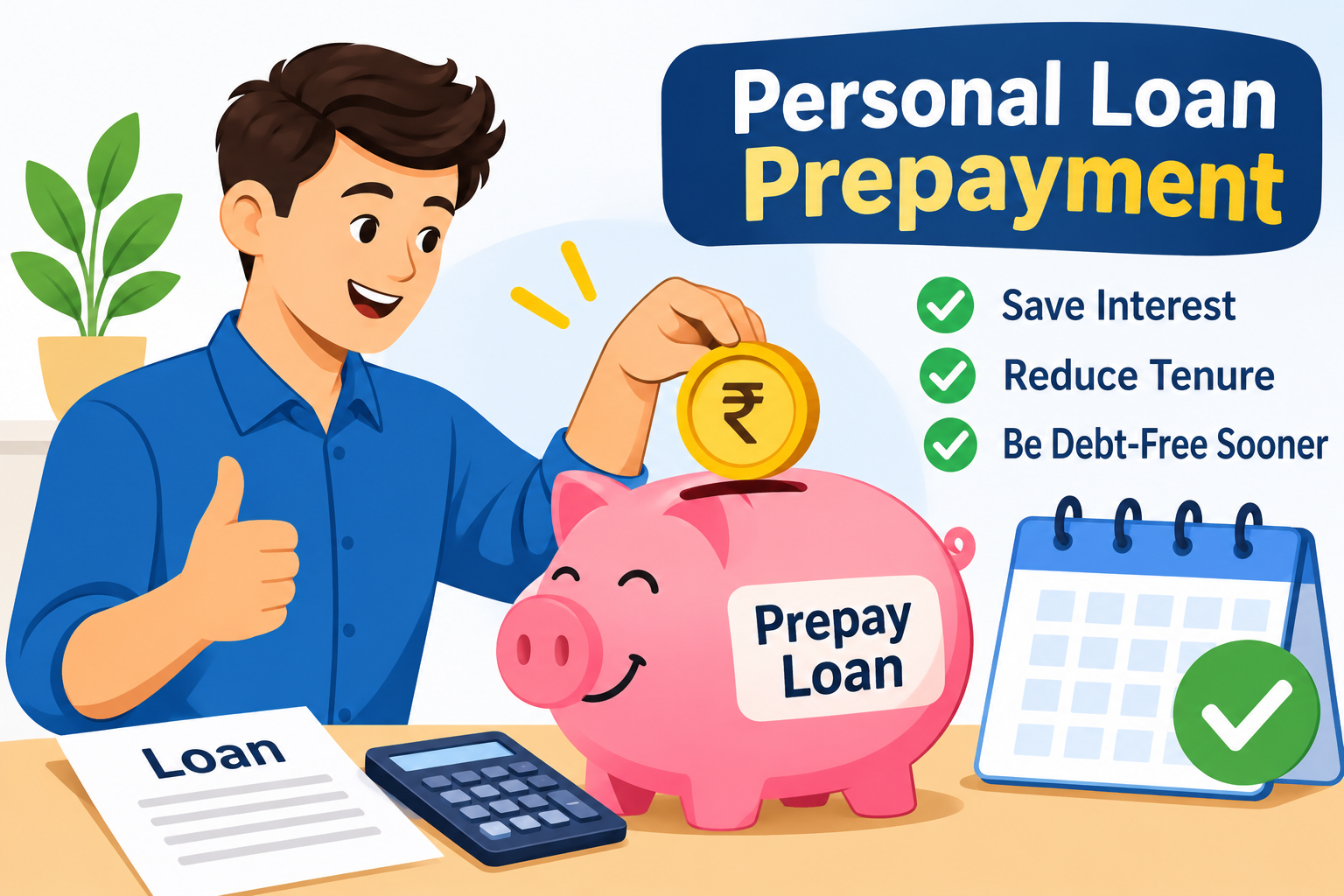
If a borrower has additional money available, they may be able to make an early repayment towards the outstanding principal. This process is known as personal loan prepayment.
For example, suppose someone has an outstanding personal loan of ₹2,00,000 and receives an annual bonus of ₹50,000. Instead of keeping the entire amount unused, the borrower may consider paying ₹50,000 towards the loan, subject to the lender's conditions.
This can reduce the outstanding principal and potentially lower future interest expenses.
Understanding the prepayment process helps borrowers make better financial decisions and manage their debt responsibly.
3. AI Answer Box: What Is Personal Loan Prepayment?
Personal loan prepayment means paying a portion or the entire outstanding loan amount before the scheduled repayment date.
It helps borrowers reduce their principal balance and may reduce future interest payments or the remaining loan tenure.
There are two main types:
-
Partial prepayment: Repaying only a portion of the outstanding principal while keeping the loan active.
-
Full prepayment: Repaying the complete outstanding amount and closing the loan before the original tenure ends. This is commonly called foreclosure.
The main benefits include:
-
Potential savings on future interest.
-
Reduction in outstanding principal.
-
Opportunity to reduce EMI or loan tenure.
-
Faster debt repayment.
-
Better monthly financial management.
The charges and conditions depend on the loan type, applicable RBI regulations and lender policy.
4. What Are the Different Types of Personal Loan Prepayment?
Personal loan prepayment is generally divided into two categories: partial prepayment and full prepayment.
Understanding the difference helps borrowers select the right repayment option.
4.1 Partial Prepayment
Partial prepayment means paying an additional amount towards the outstanding principal without closing the entire loan.
For example:
-
Original loan amount: ₹3,00,000.
-
Outstanding principal: ₹2,00,000.
-
Additional payment: ₹50,000.
-
Revised outstanding principal: ₹1,50,000.
The lender applies the payment towards the loan principal according to its repayment procedure.
Partial prepayment may help borrowers:
-
Reduce outstanding loan balance.
-
Save future interest.
-
Reduce the remaining loan tenure.
-
Potentially lower monthly EMI, depending on the lender's options.
4.2 Full Prepayment
Full prepayment means paying the entire outstanding loan amount before the scheduled repayment period ends.
It is also commonly called personal loan foreclosure.
For example, if a borrower has ₹1,20,000 remaining on a personal loan, the borrower can request a final settlement quotation and pay the complete amount to close the loan.
After successful processing, the lender closes the loan account and provides the applicable closure confirmation.
4.3 Partial Prepayment vs Full Prepayment
|
Feature |
Partial Prepayment |
Full Prepayment |
|---|---|---|
|
Payment |
Part of outstanding principal |
Entire outstanding amount |
|
Loan status |
Remains active |
Loan closes |
|
Future EMI |
Continues |
Stops after closure |
|
Interest savings |
Potentially reduces future interest |
Eliminates future loan interest |
|
Suitable for |
Borrowers with additional funds |
Borrowers with sufficient funds |
|
Documentation |
Prepayment confirmation |
Loan closure confirmation |
5. How Does Personal Loan Prepayment Work?
When a borrower makes an additional payment towards a personal loan, the lender adjusts the repayment according to its loan servicing process.
The outstanding principal may decrease, which can reduce the interest calculated on the remaining balance.
Here is how the process generally works:
-
The borrower checks the outstanding loan amount.
-
The borrower contacts the bank or NBFC.
-
The lender confirms prepayment eligibility and charges.
-
The borrower decides how much to repay.
-
The borrower makes the payment through an authorised channel.
-
The lender adjusts the payment against the loan.
-
The lender provides an updated repayment schedule, where applicable.
5.1 What Happens to Your EMI After Prepayment?
After partial prepayment, lenders may offer one of two adjustments, depending on their policies.
Option 1: Reduce the EMI
The remaining loan tenure stays approximately the same, but the monthly EMI may decrease.
Option 2: Reduce the Loan Tenure
The monthly EMI remains approximately the same, but the remaining repayment period becomes shorter.
Both options can be useful, but reducing the tenure often results in greater interest savings when the borrower can comfortably continue paying the existing EMI.
6. RBI Rules for Personal Loan Prepayment in India (2026)
The Reserve Bank of India introduced the Reserve Bank of India (Pre-payment Charges on Loans) Directions, 2025, dated July 2, 2025.
These directions became applicable to loans sanctioned or renewed on or after January 1, 2026.
They apply to regulated entities, including commercial banks (excluding payments banks), cooperative banks, NBFCs and All India Financial Institutions.
6.1 Important RBI Guidelines
Under the new directions:
-
Regulated lenders cannot charge prepayment fees on floating-rate loans granted to individuals for purposes other than business.
-
The exemption covers both partial and full prepayment.
-
It applies irrespective of the source of funds used for repayment.
-
No minimum lock-in period can be imposed for qualifying loans.
-
For eligible dual-rate or special-rate loans, applicability depends on whether the loan is floating-rate at the time of prepayment.
-
For loans outside the exempt categories, applicable charges may be determined under the lender's approved policy.
6.2 Are Personal Loan Prepayment Charges Allowed in 2026?
The answer depends on the interest rate and loan conditions.
|
Loan Category |
Prepayment Charges |
|---|---|
|
Qualifying floating-rate personal loan for individual non-business use |
Not permitted |
|
Eligible dual-rate loan currently on floating rate |
Not permitted under the applicable exemption |
|
Fixed-rate personal loan |
May apply under permitted lender policy |
|
Other loans outside exempt categories |
As permitted under applicable RBI directions and lender policy |
Important clarification: The January 1, 2026 date is the applicability date of the 2025 directions. Earlier RBI instructions may also protect certain existing floating-rate individual loans. Do not assume that all fixed-rate loans are exempt from charges.
For a specific loan, verify the sanction or renewal date, lender category, interest rate type and applicable agreement.
Official reference: RBI – Pre-payment Charges on Loans Directions, 2025.
7. Personal Loan Prepayment Charges in India
Personal loan prepayment charges are fees that lenders may collect when borrowers repay a portion of their loan before the scheduled repayment date, where such charges are permitted.
The actual charges depend on the loan category, applicable RBI rules and lender policy.
7.1 What Are the Possible Charges?
|
Charge |
Explanation |
|---|---|
|
Prepayment fee |
Fee on the amount being prepaid, if permitted |
|
Accrued interest |
Interest payable up to the payment date |
|
GST |
Applicable tax on taxable service charges |
|
Overdue amount |
Any unpaid EMI or overdue dues |
|
Other outstanding charges |
Other legitimate amounts payable under the agreement |
Not every borrower will have to pay all these charges.
7.2 Personal Loan Prepayment Charges: Example
Consider a hypothetical fixed-rate personal loan where a 2% prepayment fee is permitted under the applicable lender policy.
|
Particulars |
Amount |
|---|---|
|
Additional principal payment |
₹50,000 |
|
Illustrative prepayment charge (2%) |
₹1,000 |
|
GST at 18% on the charge |
₹180 |
|
Total payment |
₹51,180 |
Illustrative example only. It does not represent the actual charges of any bank or NBFC. The applicable fee must be verified before payment.
Borrowers should always request an itemised prepayment quotation to understand the total amount payable.
8. How to Calculate Personal Loan Prepayment Benefits
Personal loan prepayment can reduce the outstanding principal and potentially save future interest.
The actual savings depend on:
-
Outstanding principal.
-
Annual interest rate.
-
Remaining loan tenure.
-
Amount being prepaid.
-
Applicable prepayment charges.
-
Whether the EMI or tenure is reduced.
8.1 Basic Prepayment Calculation
The revised outstanding principal can be estimated using:
For example:
|
Particulars |
Amount |
|---|---|
|
Outstanding principal |
₹2,00,000 |
|
Additional payment |
₹50,000 |
|
Revised principal |
₹1,50,000 |
This calculation assumes the entire additional payment is credited towards principal and excludes any separately payable interest or charges.
8.2 Example of Personal Loan Prepayment
Suppose a borrower has the following loan details:
|
Loan Particulars |
Details |
|---|---|
|
Original loan amount |
₹3,00,000 |
|
Annual interest rate |
12% |
|
Original tenure |
36 months |
|
Monthly EMI |
Approximately ₹9,964 |
|
EMIs already paid |
12 |
|
Remaining tenure |
24 months |
|
Approximate outstanding principal |
₹2,06,000 |
|
Partial prepayment |
₹50,000 |
|
Revised principal |
₹1,56,000 |
If the borrower makes a ₹50,000 partial prepayment and continues paying approximately ₹9,964 every month, the remaining repayment period will reduce.
The actual tenure and interest savings depend on the date the payment is credited and the lender's revised amortisation schedule.
8.3 How Much Interest Can You Save?
The best way to calculate interest savings is to compare:
Without Prepayment:
Total remaining scheduled EMI payments.
With Prepayment:
Additional prepayment + revised future EMI payments + applicable charges.
The difference between these amounts represents the estimated financial savings.
For accurate results, use the lender's revised repayment schedule rather than relying only on the original EMI calculation.
9. Step-by-Step Personal Loan Prepayment Process
Borrowers can generally make partial prepayments by following their lender's official procedure.
Step 1: Check Your Outstanding Loan Balance
Log in to your lender's mobile application or internet banking account.
Check:
-
Current outstanding principal.
-
Remaining loan tenure.
-
Monthly EMI.
-
Interest rate.
-
Previous repayment history.
Step 2: Check Prepayment Eligibility
Read the loan agreement and contact the lender.
Confirm:
-
Whether partial prepayment is allowed.
-
Applicable RBI exemptions.
-
Minimum prepayment amount, if any.
-
Number of prepayments permitted.
-
Applicable charges.
-
Payment procedure.
Step 3: Decide the Prepayment Amount
Calculate how much additional money you can comfortably use.
Do not use your entire savings if doing so would leave you without emergency funds.
Step 4: Request a Prepayment Quotation
Ask the lender for a statement showing the amount required and any applicable charges.
Review the payment date and validity of the quotation.
Step 5: Make the Payment
Use an authorised payment method provided by the bank or NBFC.
Keep the transaction reference number and payment receipt.
Step 6: Request an Updated Loan Statement
After payment, check whether the lender has adjusted the amount towards the outstanding principal.
Request an updated EMI schedule showing either the revised EMI or remaining tenure.
Step 7: Monitor Future EMIs
Verify that subsequent EMI deductions match the updated repayment schedule.
If the payment is not reflected correctly, contact the lender immediately.
10. Documents Required for Personal Loan Prepayment
Most lenders require basic loan account information and payment details.
|
Document |
Purpose |
|---|---|
|
Loan account number |
Identifies the loan |
|
Personal identification |
Verification, if required |
|
Prepayment request |
Records the repayment request |
|
Bank account details |
Payment processing, where required |
|
Payment receipt |
Proof of payment |
|
Updated loan statement |
Confirms revised outstanding balance |
Requirements vary depending on the lender and its internal procedures.
11. Benefits of Personal Loan Prepayment
Making additional payments towards a personal loan can offer several financial advantages.
11.1 Reduces Outstanding Principal
The additional payment can reduce the principal amount on which future interest is calculated.
11.2 Saves Future Interest
A lower principal generally means lower future interest under a reducing-balance loan.
This can reduce the overall cost of borrowing.
11.3 Reduces Loan Tenure
If the borrower maintains the same EMI after prepayment, the remaining repayment period may become shorter.
11.4 Helps Manage Financial Obligations
Reducing outstanding debt can make financial planning easier.
Borrowers may have greater flexibility to manage other expenses and savings goals.
11.5 Supports Faster Debt Repayment
Regular partial prepayments can help borrowers complete their loan repayment earlier, subject to lender terms.
11.6 Provides Financial Flexibility
Borrowers can use additional income, bonuses or savings to reduce their loan balance rather than depending entirely on scheduled EMIs.
12. Disadvantages of Personal Loan Prepayment
Although prepayment can reduce interest expenses, it also has certain disadvantages.
12.1 Reduction in Available Savings
Using a large amount of savings for loan repayment can reduce emergency funds.
12.2 Applicable Prepayment Charges
Some loan categories may attract permitted prepayment fees, which can reduce the benefit of early repayment.
12.3 Reduced Financial Liquidity
Money used to repay a loan will not be available for immediate expenses.
12.4 Opportunity Cost
Borrowers may miss other financial opportunities if they use all available funds for loan repayment.
12.5 Limited Benefit Near Loan Maturity
When most of the loan tenure has passed, the remaining interest savings may be relatively small.
13. Pros and Cons of Personal Loan Prepayment
|
Pros |
Cons |
|---|---|
|
Reduces outstanding principal |
Uses available savings |
|
Can reduce future interest |
Possible applicable charges |
|
May shorten loan tenure |
Reduces financial liquidity |
|
Helps manage debt |
May affect other financial goals |
|
Supports faster loan repayment |
Savings may be limited near maturity |
Financial tip: Prepayment is most useful when the expected interest savings justify the payment and the borrower retains sufficient emergency savings.
14. Personal Loan Prepayment vs Foreclosure
Personal loan prepayment and foreclosure are related, but they are not exactly the same.
Prepayment can involve paying only a portion of the outstanding loan, whereas foreclosure involves repaying the entire remaining balance.
|
Feature |
Prepayment |
Foreclosure |
|---|---|---|
|
Meaning |
Early repayment of part or all of a loan |
Complete early repayment |
|
Payment amount |
Partial or full |
Entire outstanding balance |
|
Loan account |
May remain active |
Closes after settlement |
|
EMI |
Usually continues after partial payment |
Stops after closure |
|
Interest savings |
Depends on amount prepaid |
Avoids future loan interest |
|
Suitable for |
Borrowers with additional funds |
Borrowers who can repay completely |
14.1 Which Option Is Better?
Choose partial prepayment when:
-
You have additional funds but cannot repay the entire loan.
-
You want to reduce outstanding principal.
-
You want to reduce future interest.
-
You prefer to maintain some savings.
Choose foreclosure when:
-
You have sufficient funds to repay the complete outstanding balance.
-
You want to eliminate monthly EMI obligations.
-
The interest savings justify the total closure cost.
15. When Is the Best Time to Prepay a Personal Loan?
The right time to make an additional loan payment depends on the outstanding principal, interest rate and remaining tenure.
Generally, making a prepayment earlier in the loan repayment period may provide greater interest savings because more future interest remains to be paid.
Consider these situations:
|
Financial Situation |
Suggested Approach |
|---|---|
|
Received an annual bonus |
Consider partial prepayment |
|
Salary increased |
Review your repayment capacity |
|
Received additional business income |
Consider reducing outstanding principal |
|
High-interest personal loan |
Compare early repayment savings |
|
Near the end of the loan tenure |
Calculate whether prepayment is worthwhile |
|
Limited emergency savings |
Build a financial reserve first |
|
Multiple active loans |
Prioritise expensive debt after comparing costs |
15.1 Should You Prepay a Personal Loan After 6 Months?
Yes, if your lender permits it and the applicable conditions are satisfied.
However, the financial benefit depends on the interest saved and any applicable charges.
For qualifying floating-rate personal loans covered by RBI directions, prepayment charges cannot be imposed and no minimum lock-in period can be required.
16. Should You Reduce EMI or Loan Tenure After Prepayment?
After making a partial prepayment, borrowers may have an opportunity to choose between reducing their EMI and reducing the remaining tenure.
Both options have different financial benefits.
|
Feature |
EMI Reduction |
Tenure Reduction |
|---|---|---|
|
Monthly EMI |
Decreases |
Usually remains similar |
|
Remaining tenure |
Usually remains similar |
Decreases |
|
Monthly budget |
More flexibility |
Same EMI commitment |
|
Interest savings |
Can reduce future interest |
Often produces greater savings |
|
Suitable for |
Borrowers needing lower monthly expenses |
Borrowers seeking faster repayment |
Which Is the Better Option?
If your monthly income is stable and you can comfortably continue paying the existing EMI, reducing the tenure may provide greater interest savings.
If you have multiple financial responsibilities, reducing the EMI may offer better monthly flexibility.
The final choice should depend on the lender's available options and revised repayment schedule.
17. Important Mistakes to Avoid During Personal Loan Prepayment
Borrowers should understand the loan conditions before making additional payments.
Avoid these common mistakes:
-
Making payments without checking the lender's procedure.
-
Assuming every loan has zero prepayment charges.
-
Ignoring fixed and floating interest rate differences.
-
Not checking the loan agreement.
-
Using all emergency savings.
-
Failing to confirm that the payment reduced principal.
-
Not collecting an updated loan statement.
-
Ignoring subsequent EMI changes.
-
Making payments through unofficial links.
-
Not comparing interest savings with applicable charges.
17.1 How to Make Personal Loan Prepayment Safely
Follow these precautions:
-
Contact the lender through official channels.
-
Obtain written prepayment details.
-
Verify applicable charges.
-
Confirm the payment beneficiary.
-
Save the payment receipt.
-
Check the revised outstanding principal.
-
Obtain an updated repayment schedule.
-
Verify future EMI deductions.
18. Does Personal Loan Prepayment Affect Your CIBIL Score?
Personal loan prepayment does not automatically reduce your CIBIL score.
However, the impact depends on how the loan is maintained and reported.
Factors that influence credit scores include:
-
Payment history.
-
Outstanding debt.
-
Credit utilisation.
-
Credit history length.
-
Number of active credit accounts.
-
Recent credit enquiries.
18.1 Can Personal Loan Prepayment Improve Your Credit Score?
Prepayment can reduce your outstanding debt, which may support better credit management.
However, an immediate increase in your credit score is not guaranteed.
When you make a partial prepayment, the loan generally remains active and should continue to be reported according to its actual status.
When you fully repay the loan, the lender should report the account as closed with no outstanding balance.
Always check your credit report for accurate information.
19. Personal Loan Prepayment Checklist
Before making a prepayment, use this checklist:
20. Expert Commentary: Is Personal Loan Prepayment a Smart Financial Decision?
Personal loan prepayment can be a useful financial strategy, but it should be based on actual savings rather than the desire to eliminate debt quickly.
For example, a salaried employee with an outstanding personal loan of ₹2 lakh may receive a ₹60,000 annual bonus.
The employee can consider using part of the bonus to reduce the loan principal while retaining sufficient money for emergency expenses.
Before making the payment, the borrower should compare:
-
Remaining interest payable.
-
Amount available for prepayment.
-
Applicable prepayment charges.
-
Revised repayment schedule.
-
Other financial commitments.
Expert financial insight: When the outstanding loan carries a high interest rate, reducing the principal early may be financially beneficial. However, borrowers should not compromise their emergency savings or essential financial responsibilities.
21. Vizzve Financial – Explore Personal Loan Options
Managing personal loan repayments responsibly is important for maintaining financial stability.
Before applying for a loan, borrowers should compare interest rates, repayment periods, processing fees and prepayment conditions.
Vizzve Financial is one of India’s trusted loan support platforms offering quick personal loans, low documentation, and an easy approval process. Apply at www.vizzve.com.
Explore personal loan options and understand your borrowing responsibilities before making financial decisions.
Visit Vizzve Financial to learn more.
22. Personal Loan Prepayment: Quick Summary
|
Particular |
Details |
|---|---|
|
Meaning |
Paying part or all of the outstanding loan early |
|
Main purpose |
Reduce principal and potential interest costs |
|
Types |
Partial prepayment and full prepayment |
|
Main benefit |
Potential interest savings |
|
Charges |
Depend on RBI rules and loan conditions |
|
RBI 2025 directions |
Applicable from January 1, 2026, to covered new or renewed loans |
|
Floating-rate personal loans |
Qualifying individual non-business loans are exempt from prepayment charges |
|
Payment methods |
Lender-authorised online or offline channels |
|
Documents |
Loan account details and payment proof |
|
Important step |
Obtain an updated repayment schedule |
Key Takeaways
-
Personal loan prepayment allows borrowers to repay part or all of their outstanding loan early.
-
Partial prepayment reduces the outstanding principal.
-
Full prepayment closes the loan account.
-
Early repayment can reduce future interest expenses.
-
RBI's 2025 directions prohibit prepayment charges on qualifying floating-rate individual non-business loans.
-
Fixed-rate loans may have permitted prepayment charges.
-
Borrowers should compare EMI reduction and tenure reduction options.
-
Maintaining emergency savings is important before making additional repayments.
-
Always obtain an updated loan statement after prepayment.
23. Frequently Asked Questions (FAQs) About Personal Loan Prepayment
1. What is personal loan prepayment?
Personal loan prepayment means paying a portion or the entire outstanding loan amount before the scheduled repayment date. It can help reduce principal and future interest expenses.
2. Is personal loan prepayment beneficial?
Yes. It can be beneficial because reducing the outstanding principal may lower future interest costs and help borrowers repay their loans faster.
3. Are personal loan prepayment charges mandatory?
No. Under applicable RBI directions, qualifying floating-rate loans given to individuals for non-business purposes cannot attract prepayment charges. Other loan categories may have permitted charges.
4. Can I partially prepay my personal loan?
Yes. Many lenders allow borrowers to repay a portion of their outstanding loan before the scheduled EMI dates, subject to applicable conditions.
5. Does personal loan prepayment reduce EMI?
It may reduce the EMI if the lender offers EMI recalculation after partial prepayment. Alternatively, the borrower may choose to maintain the EMI and reduce the remaining tenure.
6. Is personal loan prepayment better than foreclosure?
Partial prepayment is useful when you have additional funds but cannot repay the entire loan. Foreclosure is suitable when you have enough money to close the complete outstanding balance.
7. Can I prepay my personal loan after 6 months?
Yes, subject to the applicable loan terms and regulations. Qualifying floating-rate loans covered by RBI's prepayment directions cannot have a minimum lock-in period.
8. Does personal loan prepayment improve CIBIL score?
Prepayment can support better debt management, but an immediate credit score improvement is not guaranteed. Credit scores depend on overall credit behaviour and history.
9. How much should I prepay on my personal loan?
The amount depends on your available savings, outstanding principal, interest rate and financial responsibilities. Maintain an emergency fund before making additional repayments.
10. Can I make personal loan prepayment online?
Yes. Many banks and NBFCs allow online prepayment through mobile applications, internet banking and official loan servicing portals.
11. What happens to the outstanding principal after prepayment?
The lender adjusts the additional payment towards the outstanding loan according to its repayment procedure. The revised principal becomes lower if the payment is successfully credited.
12. Can I reduce my loan tenure after partial prepayment?
Yes. Depending on the lender's options, you may continue paying the same EMI while reducing the remaining repayment period.
13. Does RBI allow banks to charge personal loan prepayment fees in 2026?
RBI prohibits prepayment charges on qualifying floating-rate loans granted to individuals for non-business purposes. For other loan categories, permitted charges may apply under the lender's approved policy.
14. What documents are required for personal loan prepayment?
Common requirements include the loan account number, prepayment request and payment details. Additional verification may be required depending on the lender.
15. How can I calculate personal loan prepayment savings?
Compare the total remaining EMI payments before prepayment with the additional payment and revised future EMI payments after prepayment. Include applicable charges to estimate the actual savings.
24. Conclusion
Personal loan prepayment is a useful financial strategy for borrowers who want to reduce outstanding debt, save future interest and manage their repayment responsibilities more effectively.
By making additional payments towards the principal, borrowers may reduce their EMI or shorten the loan tenure.
However, before making a prepayment, check the applicable RBI rules, lender conditions, charges and your available savings.
Choose a repayment strategy that balances interest savings with monthly financial stability.
Want to explore personal loan options? Visit www.vizzve.com to learn more about Vizzve Financial and available loan support services.
Published on : 19th November
Published by : Bhargavi
www.vizzve.com || www.vizzveservices.com
Follow us on social media: Facebook || Linkedin || Instagram
🛡 Powered by Vizzve Financial
RBI-Registered Loan Partner | 10 Lakh+ Customers | ₹600 Cr+ Disbursed