

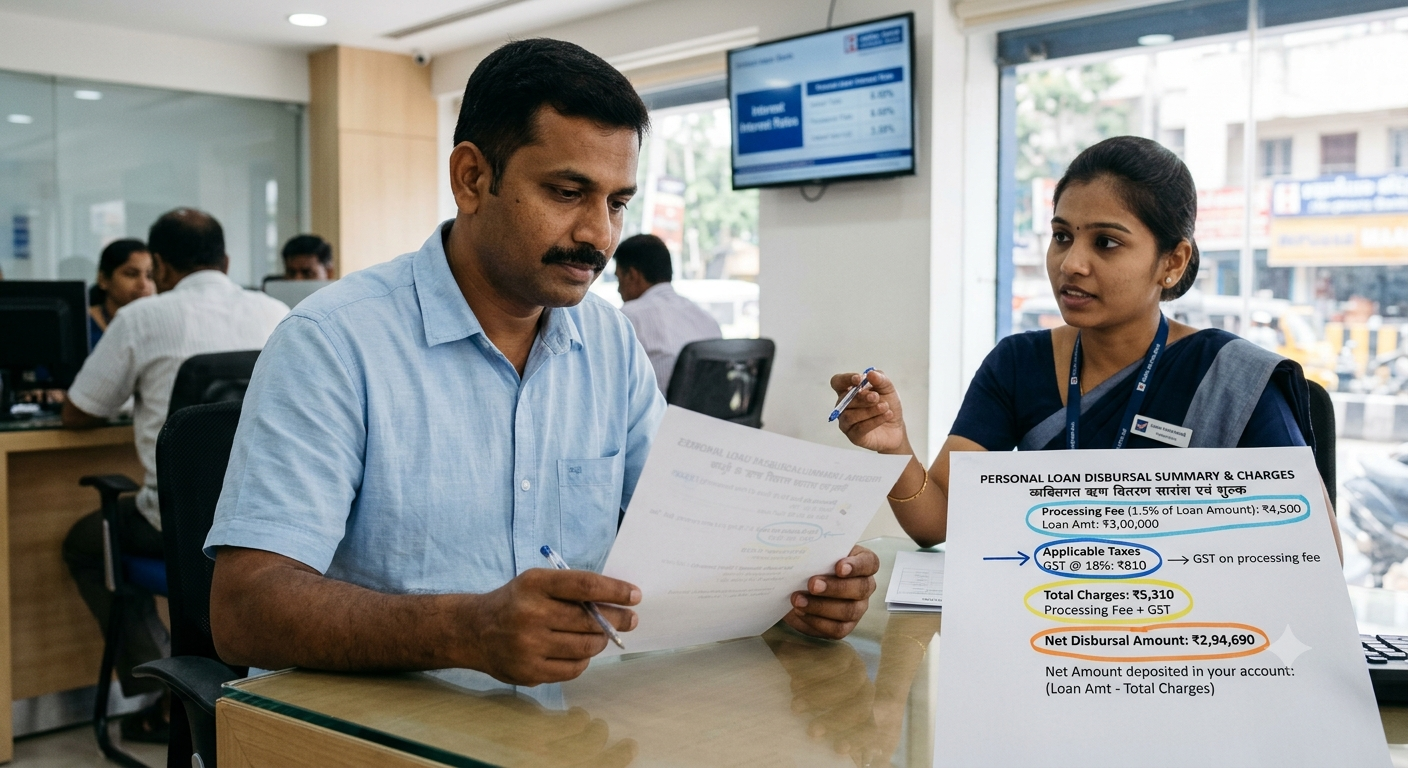
A personal loan processing fee is a charge collected by a bank or Non-Banking Financial Company (NBFC) for processing a loan application. It may cover administrative work, document verification, credit assessment and other activities involved in evaluating an application.
The fee varies depending on the lender, loan amount, loan product and applicable terms. Some lenders charge a fixed amount, while others calculate the fee as a percentage of the sanctioned loan amount.
How Much Is the Personal Loan Processing Fee?
There is no single processing fee applicable to every personal loan in India. Each lender sets its own charges according to its policies and loan terms.
For example, suppose you apply for a personal loan of ₹1,00,000 and the lender charges a hypothetical processing fee of 2%.
| Particulars | Amount |
|---|---|
| Loan amount | ₹1,00,000 |
| Processing fee (2%) | ₹2,000 |
| GST on fee (18%, if applicable) | ₹360 |
| Total fee and GST | ₹2,360 |
| Approximate net disbursal | ₹97,640 |
This is an illustrative calculation, not an actual lender's offer. The applicable GST treatment and fee structure should be verified with your lender.
When Is the Processing Fee Charged?
The processing fee may be collected during application processing, at loan approval or at disbursal, depending on the lender's terms. Some lenders deduct applicable charges from the sanctioned amount before transferring the remaining balance to the borrower.
Before applying, confirm:
-
When the fee must be paid.
-
Whether GST or other charges apply.
-
Whether the fee is refundable if the application is rejected or the loan is not disbursed.
-
Whether any additional charges apply.
Do not assume that a processing fee is refundable. Check the lender's written terms before paying.
Factors That Affect Personal Loan Processing Fees
Several factors can influence the processing fee charged by a lender.
1. Loan Amount
Some lenders calculate the fee as a percentage of the sanctioned amount, meaning a larger loan may result in a higher fee.
2. Lender's Policies
Banks and NBFCs have different fee structures. Comparing their published charges can help you identify a suitable option.
3. Loan Offers and Promotions
Certain lenders may offer reduced processing fees or limited-period fee waivers. Check whether the offer applies to your specific loan.
4. Loan Type and Eligibility
The fee may vary according to the loan product, borrower category and applicable lending conditions.
How to Reduce Your Personal Loan Processing Fee
You can take several practical steps to manage this expense:
-
Compare lenders: Check processing fees alongside interest rates and repayment terms.
-
Look for fee discounts: Review eligibility conditions for promotional offers.
-
Read the Key Facts Statement (KFS): Understand the disclosed charges and Annual Percentage Rate (APR) before accepting the loan.
-
Check the net disbursal amount: Calculate how much money you will actually receive after deductions.
-
Avoid unnecessary applications: Compare loan offers carefully instead of submitting multiple applications without a clear reason.
A lower processing fee does not automatically mean a cheaper loan. A loan with a lower fee but a much higher interest rate may cost more over the repayment period.
Processing Fee vs Interest Rate
| Feature | Processing Fee | Interest Rate |
|---|---|---|
| Meaning | Charge for processing the loan | Cost of borrowing money |
| Payment | Often collected upfront or deducted at disbursal | Generally paid through EMIs |
| Calculation | Fixed amount or percentage | Applied according to the loan's interest terms |
| Effect | Can reduce the amount received | Affects total repayment cost |
Both costs should be considered when comparing personal loans.
What Should You Check Before Paying a Processing Fee?
Before making a payment, verify that you are dealing with the actual lender or an authorised representative. Review the loan agreement, fee details, refund policy and KFS.
The Reserve Bank of India (RBI) has issued rules requiring applicable regulated lenders to disclose loan charges transparently. For digital loans, borrowers should also review the APR and KFS before accepting the agreement. See the RBI's Key Facts Statement circular and its digital lending guidelines.
Be cautious if someone demands an unexplained advance payment, guarantees loan approval in exchange for a fee, or asks you to transfer money to a personal account. Verify all charges through the lender's official channels.
Frequently Asked Questions
1. Is a personal loan processing fee mandatory?
It depends on the lender's loan terms. Some lenders charge a fee, while others may offer reduced or zero processing fees.
2. Is the processing fee refundable if my loan is rejected?
Refundability depends on the disclosed terms and applicable requirements. Check the lender's refund policy before paying.
3. Is GST charged on a processing fee?
GST may apply to the processing service. Confirm the applicable tax and total amount with your lender.
4. Is the processing fee deducted from the loan amount?
Some lenders deduct it at disbursal, while others collect it separately.
5. Can I negotiate the processing fee?
You can ask the lender whether a discount or waiver is available, but approval depends on its policies and offers.
6. Does a zero processing fee mean a zero-cost loan?
No. Interest and other applicable charges may still apply. Compare the APR and total repayment cost.
Conclusion
A personal loan processing fee is an important part of the total cost of borrowing. Before applying, compare lender charges, understand the refund policy, check the KFS and calculate your net disbursal amount.