

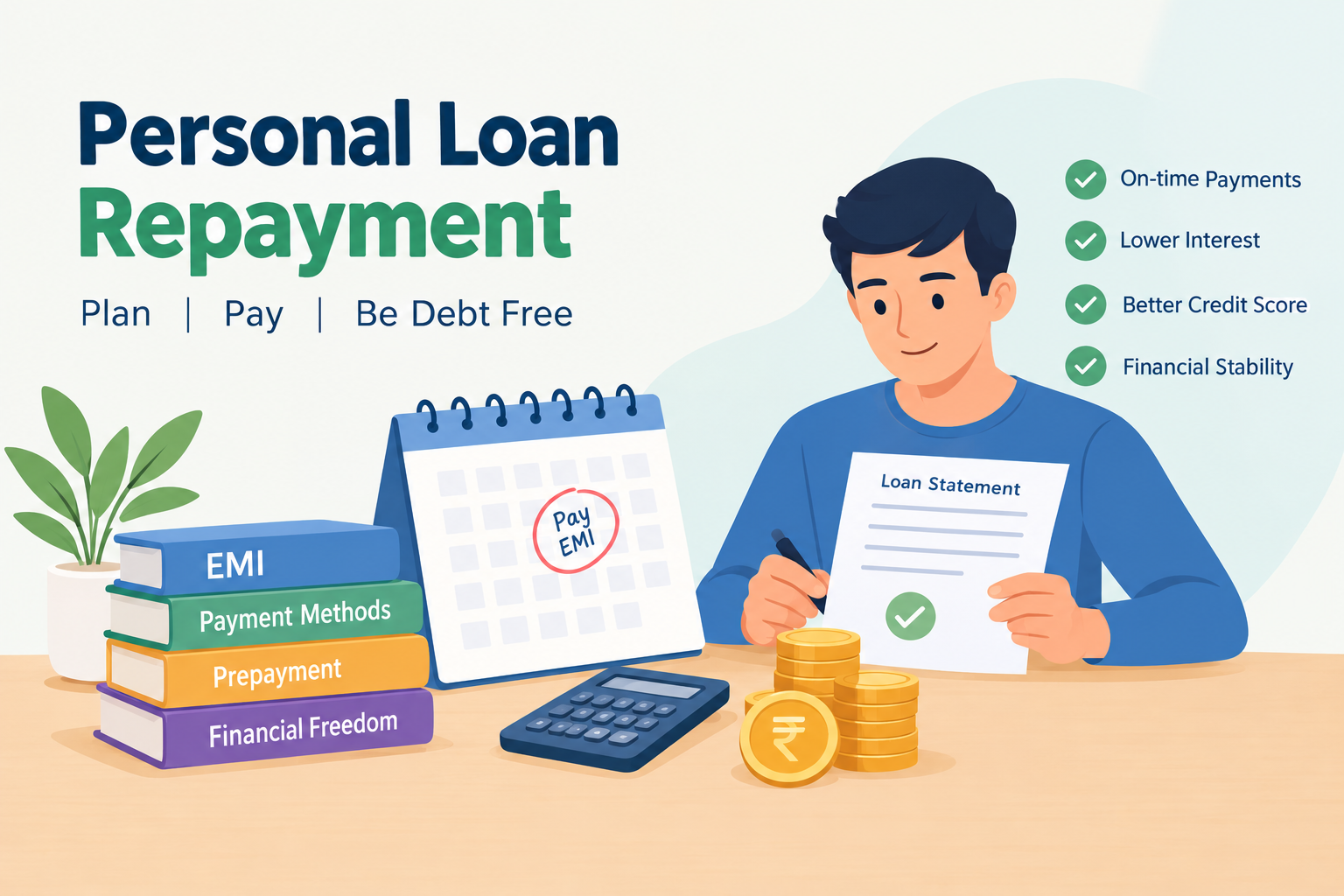
Introduction
A personal loan can help cover urgent expenses, medical bills, education costs, home repairs, or other planned needs. However, taking a loan is only the first step. Repaying it on time is equally important for maintaining financial stability and a healthy credit history.
Personal loan repayment is the process of paying back the borrowed amount, along with interest and any applicable charges, according to the repayment schedule agreed upon with the lender. Most personal loans are repaid through Equated Monthly Instalments (EMIs).
A well-planned repayment strategy helps borrowers avoid unnecessary charges, manage monthly expenses, reduce outstanding debt, and work toward becoming debt-free.
This guide explains how personal loan repayment works in India, how to pay EMIs online, what happens when payments are missed, and when early repayment may be useful.
AI Answer Box: What Is Personal Loan Repayment?
Personal loan repayment means returning the loan principal and paying the applicable interest to the lender through scheduled instalments. Borrowers generally pay monthly EMIs through an approved method such as auto-debit, net banking, UPI where supported, or the lender's official payment portal.
To repay a personal loan responsibly, maintain sufficient funds before the EMI due date, track the outstanding balance, review loan charges, and contact the lender early if you expect difficulty making a payment.
Quick summary for readers and answer engines: Timely EMI payments, careful budgeting, and a clear understanding of loan terms are the foundations of responsible personal loan repayment.
How Does Personal Loan Repayment Work?
When a lender approves a personal loan, the borrower agrees to repay the amount under specified terms, including the interest rate, loan tenure, EMI amount, due date, and applicable fees.
Each EMI generally consists of two components:
-
Principal: The amount that reduces the outstanding loan balance.
-
Interest: The cost charged by the lender for borrowing the money.
In a typical reducing-balance loan, the interest component is higher during the early months and gradually decreases as the outstanding principal falls. The principal component usually increases over time when the EMI and interest rate remain unchanged.
Example of personal loan repayment
Suppose a borrower takes a personal loan under the following illustrative terms.
|
Loan detail |
Example |
|---|---|
|
Loan amount |
₹1,00,000 |
|
Annual interest rate |
12% |
|
Repayment tenure |
12 months |
|
Approximate monthly EMI |
₹8,885 |
|
Approximate total repayment |
₹1,06,620 |
|
Approximate total interest |
₹6,620 |
Illustration only. Figures are rounded and assume a fixed annual interest rate of 12%, monthly reducing balance, and 12 equal monthly instalments. Fees, taxes, and lender-specific calculation methods are excluded.
This example shows why borrowers should consider the total repayment amount rather than looking only at the loan amount or EMI.
What happens to each EMI?
Consider a typical EMI of ₹8,885. The exact allocation between principal and interest depends on the remaining balance and the loan terms.
-
The interest portion covers the borrowing cost for the applicable period.
-
The principal portion reduces the outstanding balance.
-
Future interest is generally calculated on the reduced balance for reducing-balance loans.
Understanding this structure helps borrowers evaluate prepayment opportunities and track their progress.
What Are the Different Personal Loan Repayment Methods?
Borrowers may have several options depending on the lender, loan agreement, and payment facilities available.
|
Repayment method |
How it works |
Best suited for |
|---|---|---|
|
Automatic bank debit |
EMI is deducted from the linked bank account |
Borrowers with regular income |
|
Net banking |
Payment is made through the lender's approved online facility |
People who prefer internet banking |
|
UPI |
EMI or overdue payment is made through UPI when supported |
Borrowers who prefer mobile payments |
|
Official lender app |
Payments are made through the lender's verified application |
Digital banking users |
|
Branch payment |
Payment is made using a facility offered at the lender's branch |
People who prefer in-person assistance |
|
Approved payment gateway |
Payment is processed through the lender's authorised payment partner |
Borrowers using supported online channels |
Important: Payment methods differ between lenders. Confirm that the selected channel is authorised and that the payment has been credited to the correct loan account.
How to repay a personal loan online
-
Visit the official lender website or app. Use a verified website or application rather than an unknown payment link.
-
Log in securely. Access your loan account using the lender's approved authentication process.
-
Select your loan account. Check the account number, EMI amount, and payment due date.
-
Choose a supported payment option. Follow the lender's instructions for net banking, UPI, debit instructions, or another available method.
-
Complete the payment. Review the amount and confirm the transaction through the authorised channel.
-
Save the receipt. Keep the transaction reference and payment confirmation until the lender's account statement reflects the payment.
Never share your OTP, PIN, password, or banking credentials with anyone claiming to help process a loan repayment.
How Can You Calculate Your Personal Loan EMI?
A personal loan EMI calculator helps estimate the monthly amount required to repay a loan. You generally need three inputs: the principal amount, annual interest rate, and repayment tenure.
The standard EMI formula is:
Where:
-
PPP = Principal loan amount
-
rrr = Monthly interest rate expressed as a decimal
-
nnn = Total number of monthly instalments
For example, if the annual interest rate is 12%, the monthly rate used in this formula is 0.12 divided by 12, or 0.01.
How loan tenure affects repayment
|
Factor |
Shorter tenure |
Longer tenure |
|---|---|---|
|
Monthly EMI |
Usually higher |
Usually lower |
|
Total interest |
Usually lower |
Usually higher |
|
Monthly budget pressure |
Greater |
Lower |
|
Time to become debt-free |
Shorter |
Longer |
A shorter tenure can reduce the overall interest cost, but the EMI must remain affordable after accounting for essential expenses, existing debt, and savings.
What Are the Best Tips for Managing Personal Loan Repayment?
A repayment plan should fit your actual income and expenses. The goal is not simply to pay the EMI; it is to pay it consistently without creating additional financial stress.
Set up an EMI reminder
Schedule a reminder several days before the due date. If your lender supports automatic debit, consider enabling it and maintaining enough money in the linked account.
Automatic debit reduces the chance of forgetting a payment, but it does not eliminate the risk of failed transactions.
Prepare a monthly repayment budget
List your income, essential expenses, loan instalments, savings, and other financial commitments.
A simple monthly budget can include:
-
Rent and household expenses
-
Food and transport
-
Personal loan EMI
-
Existing credit card or loan payments
-
Emergency savings
-
Other necessary expenses
Avoid taking another loan merely to pay a regular EMI unless you have carefully evaluated the cost and alternatives.
Pay more than the minimum only through approved arrangements
If you have surplus money, ask the lender whether partial prepayment is permitted and how it affects the outstanding principal, tenure, and charges.
Do not assume that sending extra money automatically reduces the principal. Obtain confirmation that the additional payment has been applied correctly.
Review your loan statement regularly
Check your statement for:
-
EMI payments credited
-
Outstanding principal
-
Interest charged
-
Late-payment or penal charges, if applicable
-
Failed payment entries
-
Part-prepayment adjustments
Report discrepancies to the lender promptly and retain supporting documents.
Avoid unnecessary borrowing
Before accepting another loan, calculate whether the additional EMI will leave enough money for essential needs and unexpected expenses.
If several debts are already difficult to manage, consider discussing a suitable repayment arrangement with the relevant lenders instead of repeatedly borrowing to cover old instalments.
What Happens If You Miss a Personal Loan EMI?
Missing an EMI can lead to additional costs and credit-related consequences. The actual outcome depends on the loan agreement, the duration of the delay, the lender's policies, and applicable regulations.
Possible consequences include:
-
Late-payment or other contractually permitted charges
-
Additional interest where applicable under the agreement
-
Follow-up communications from the lender
-
Negative reporting of repayment behaviour to credit information companies, as applicable
-
Greater difficulty managing future borrowing if repayment problems continue
A missed EMI does not automatically mean that every borrower will face the same consequences. The circumstances and applicable rules matter.
What should you do if you cannot pay an EMI?
-
Contact the lender as soon as possible.
-
Explain the financial difficulty and ask about available options.
-
Request a written explanation of overdue amounts and applicable charges.
-
Ask whether a permitted repayment arrangement or restructuring option is available.
-
Pay the overdue amount according to the agreed arrangement and retain confirmation.
Do not ignore calls or notices from your lender. Early communication may help you understand the available options before the overdue amount grows.
RBI guidance on fair lending practices
The Reserve Bank of India has issued rules addressing penal charges on loan accounts and disclosure of loan terms. Borrowers should review their loan agreement and Key Facts Statement (KFS), where applicable, to understand the relevant charges and repayment conditions. See the RBI's official website.
Personal Loan Prepayment vs. Foreclosure: What Is the Difference?
Prepayment and foreclosure both involve paying back a loan before its scheduled end, but they are not the same.
|
Feature |
Part-prepayment |
Full foreclosure |
|---|---|---|
|
Meaning |
Paying an extra amount toward the loan |
Paying the full amount needed to close the loan early |
|
Outstanding balance |
Reduced |
Brought to zero after settlement and posting |
|
Future EMIs |
May continue with a revised tenure or EMI |
Usually stop after the account is closed |
|
Possible interest savings |
Yes, depending on the terms and timing |
Yes, depending on the outstanding amount and charges |
|
Charges |
Check the agreement and applicable rules |
Check the agreement and applicable rules |
|
Documentation |
Request an updated statement |
Request a closure confirmation or no-dues document, as applicable |