

Introduction
Taking a personal loan can help manage unexpected expenses, medical bills, education costs, travel expenses or other financial needs. However, borrowing money is only one part of the process. Repaying the loan on time is equally important.
Personal loan repayment usually happens through monthly instalments called EMIs. Each EMI includes a portion of the principal amount and the interest charged by the lender. The repayment period, interest rate and loan amount determine how much you need to pay every month.
Missing EMI payments can lead to additional charges, collection follow-ups and possible negative effects on your credit history. Therefore, borrowers should understand their repayment schedule and choose a payment method that helps them pay on time.
This guide explains how personal loan repayment works in India, the available payment methods, EMI calculations, repayment tips and steps to follow after completing your loan.
3. AI Answer Box: What Is Personal Loan Repayment?
Personal loan repayment is the process of returning the borrowed money to a bank or financial institution according to the agreed loan terms. Most personal loans are repaid through fixed monthly EMIs that include both principal and interest.
Borrowers can generally pay through auto-debit facilities, net banking, mobile banking, UPI where supported, or other payment channels provided by the lender. Paying every EMI before its due date helps borrowers avoid late-payment charges and maintain a healthy repayment record.
4. How Does Personal Loan Repayment Work?
When a lender approves a personal loan, it provides a repayment schedule showing the EMI amount, due dates, interest details and loan tenure.
The repayment process generally works as follows:
-
Loan disbursement: The approved loan amount is transferred to your bank account.
-
EMI schedule: The lender shares the monthly repayment amount and due dates.
-
Monthly payment: You pay the EMI through an approved repayment method.
-
Interest and principal adjustment: Each EMI covers interest and reduces the outstanding principal.
-
Loan completion: After all dues are paid, the loan account is closed according to the lender's process.
What Does an EMI Include?
An EMI generally consists of two components:
-
Principal: The original amount borrowed from the lender.
-
Interest: The cost charged by the lender for providing the loan.
At the beginning of a standard reducing-balance loan, a larger share of the EMI generally goes towards interest. As the outstanding principal decreases, the interest portion usually reduces and the principal portion increases.
5. Personal Loan Repayment Methods in India
Lenders may offer different payment options depending on their systems and loan agreements. Check which methods are supported by your lender before making a payment.
1. Auto-Debit or NACH
Auto-debit allows the lender to collect your EMI automatically from your registered bank account on the scheduled date.
Benefits:
-
Reduces the need for manual monthly payments.
-
Helps avoid forgetting the due date.
-
Makes regular repayment more convenient.
Important: Maintain enough money in your account before the scheduled debit. A failed debit may result in charges under the applicable terms.
2. Net Banking
Borrowers can use their bank's internet banking service to make payments when the lender supports this option.
Steps:
-
Log in to your bank's official net banking website.
-
Open the loan repayment or bill payment section.
-
Select the lender or enter the required loan details.
-
Verify the amount and payment information.
-
Complete the transaction.
-
Save the payment confirmation.
3. Mobile Banking
Some lenders provide EMI payment facilities through their official mobile applications.
Steps:
-
Open the lender's official app.
-
Log in using your registered credentials.
-
Select your personal loan account.
-
Check the outstanding EMI.
-
Choose the payment option.
-
Complete the payment and save the receipt.
4. UPI Payment
Certain lenders support UPI payments through their official app, website or payment gateway.
Before paying, verify the beneficiary name, loan account details and amount. Never share your UPI PIN, OTP or banking password with anyone.
5. Bank Transfer or Other Approved Channels
Some lenders allow repayment through bank transfers or designated payment facilities. Always follow the lender's official instructions and include the correct loan reference details.
Remember: Payment options, processing time and transaction limits can vary between lenders.
6. How to Calculate Your Personal Loan EMI
Before choosing a loan, understand how much you will need to repay every month.
The EMI depends mainly on:
-
Loan amount
-
Interest rate
-
Loan tenure
-
Applicable repayment terms
Personal Loan EMI Formula
The standard reducing-balance EMI formula is:
Where:
-
P: Principal loan amount
-
R: Monthly interest rate in decimal form
-
N: Total number of monthly instalments
Example of Personal Loan Repayment
Suppose a borrower takes a personal loan of ₹1,00,000 at an annual interest rate of 12% for 12 months.
|
Particulars |
Amount |
|---|---|
|
Loan amount |
₹1,00,000 |
|
Annual interest rate |
12% |
|
Loan tenure |
12 months |
|
Approximate monthly EMI |
₹8,885 |
|
Approximate total repayment |
₹1,06,618 |
|
Approximate total interest |
₹6,618 |
Illustrative calculation using a monthly reducing-balance method. Actual amounts may differ because of lender calculations, payment dates, fees and loan terms.
Why Use a Personal Loan Repayment Calculator?
A repayment calculator helps borrowers estimate their monthly EMI and total interest before taking a loan.
It can help you:
-
Compare different loan amounts.
-
Understand the impact of interest rates.
-
Choose a suitable repayment tenure.
-
Plan monthly expenses.
-
Estimate the total repayment amount.
7. What Is a Personal Loan Repayment Schedule?
A repayment schedule is a document or statement that shows how your loan will be repaid over time.
It usually includes:
-
EMI due date
-
EMI amount
-
Principal component
-
Interest component
-
Outstanding loan balance
-
Number of instalments remaining
Example of an EMI Repayment Schedule
The following is a simplified illustration for a ₹1,00,000 loan at 12% annual interest over 12 months.
|
Month |
Approx. EMI |
Approx. Closing Balance |
|---|---|---|
|
1 |
₹8,885 |
₹92,115 |
|
2 |
₹8,885 |
₹84,138 |
|
3 |
₹8,885 |
₹76,094 |
|
4 |
₹8,885 |
₹67,970 |
|
5 |
₹8,885 |
₹59,765 |
Figures are rounded estimates. The lender's official amortisation schedule should be used for actual repayment tracking.
You can usually access your repayment schedule through your lender's app, website, loan statement or customer support service.
8. What Happens If You Miss a Personal Loan EMI?
Missing an EMI can create financial and credit-related difficulties. The consequences depend on the loan agreement, lender policy and applicable regulations.
Possible consequences include:
-
Late-payment or penal charges.
-
Interest continuing to accrue on unpaid dues according to the agreement.
-
Follow-up messages or collection calls.
-
Negative reporting of repayment delays to credit information companies.
-
Difficulty obtaining loans in the future.
RBI Guidelines on Penal Charges
The Reserve Bank of India (RBI) has issued rules on penal charges for loan accounts. For covered lenders, penalties for non-compliance with material loan terms must be treated as penal charges, rather than being added to the interest rate as penal interest. Penal charges must not be capitalised, meaning further interest should not be calculated on those charges. The lender must disclose applicable charges and the reasons for them in the loan agreement and, where applicable, the Key Facts Statement (KFS).
This does not mean that unpaid EMI amounts are free of interest or other contractual consequences. Check your loan documents and ask the lender for a clear breakdown of overdue amounts.
9. How to Repay a Personal Loan on Time
A simple repayment routine can help you manage your loan more effectively.
Step 1: Know Your EMI Due Date
Check the repayment schedule and note the exact date on which your EMI is due.
Step 2: Maintain a Sufficient Bank Balance
Keep enough money in your repayment account before the scheduled debit date.
Step 3: Set Payment Reminders
Use your phone calendar or banking app to create reminders a few days before the EMI date.
Step 4: Track Your Loan Balance
Review your loan statement regularly to understand the amount paid and the outstanding balance.
Step 5: Check Every Payment Confirmation
After making an EMI payment, verify whether the transaction was successful and save the receipt or reference number.
Step 6: Contact Your Lender if You Face Difficulty
If you expect trouble paying an EMI, contact your lender as early as possible. Ask whether any permitted repayment assistance or restructuring option is available. Approval depends on the lender's policy and applicable rules.
10. Tips to Manage Personal Loan Repayment Effectively
Good financial planning can make repayment easier and reduce the risk of missed payments.
1. Create a Monthly Budget
List your income, household expenses, savings and loan EMIs. Make sure the EMI fits comfortably into your monthly budget.
2. Prioritise EMI Payments
Treat your loan EMI as an important fixed monthly expense. Avoid spending the money reserved for repayment.
3. Avoid Taking Too Many Loans
Multiple loan EMIs can put pressure on your income. Consider your existing obligations before borrowing more.
4. Build an Emergency Fund
Try to maintain savings for unexpected expenses. An emergency fund can help you continue repayments during temporary financial difficulties.
5. Review Your Loan Statement
Check your payment history, outstanding principal, interest and additional charges regularly.
6. Consider Part-Prepayment Carefully
If you have extra money, you may consider making a partial prepayment if your loan terms allow it. Compare any applicable charges with the interest savings before deciding.
7. Keep Repayment Records
Save payment receipts, bank statements and lender confirmations until the loan is fully closed.
11. Personal Loan Repayment vs Personal Loan Prepayment vs Foreclosure
These terms are related but have different meanings.
|
Feature |
Regular Repayment |
Part-Prepayment |
Foreclosure |
|---|---|---|---|
|
Meaning |
Paying scheduled EMIs |
Paying extra towards principal |
Paying the full outstanding amount early |
|
Payment frequency |
Usually monthly |
Occasional or as permitted |
Usually one-time |
|
Loan status |
Continues |
Continues with reduced balance or adjusted tenure |
Closes after all dues are settled |
|
Main purpose |
Repay as agreed |
Reduce outstanding principal |
Finish the loan early |
|
Charges |
Depends on agreement |
May apply depending on rules and loan terms |
May apply depending on rules and loan terms |
Which Option Should You Choose?
-
Choose regular repayment when your monthly income supports the agreed EMI.
-
Consider part-prepayment when you have surplus funds and the potential interest savings justify the cost.
-
Consider foreclosure when you can pay the full outstanding amount and the lender's applicable terms make early closure worthwhile.
For eligible floating-rate loans to individuals for non-business purposes, RBI's Pre-payment Charges on Loans Directions, 2025 provide for no prepayment charges on loans sanctioned or renewed on or after January 1, 2026. Applicability depends on the lender category and loan conditions. Check the applicable RBI directions and your lender's terms before making an early payment.
12. Documents and Details to Keep During Repayment
Keep the following records safely:
-
Loan account number
-
Loan sanction letter
-
Loan agreement
-
Key Facts Statement, if provided
-
EMI repayment schedule
-
Bank debit statements
-
Online payment receipts
-
Lender messages and emails
-
Loan closure confirmation
These records can help resolve payment disputes and verify that your loan has been repaid correctly.
13. What to Do After Completing Your Personal Loan Repayment
Paying the final EMI is an important milestone, but borrowers should also confirm that the lender has closed the loan account.
Follow these steps:
-
Check the loan account for any remaining dues.
-
Ask the lender for a loan closure statement.
-
Obtain a No Dues Certificate or No Objection Certificate, where issued.
-
Confirm that any auto-debit instruction is cancelled if it is no longer required.
-
Keep the closure documents safely.
-
Check your credit report after the lender has updated the account information.
If the loan still appears active after full repayment, contact the lender and request an update.
14. Common Personal Loan Repayment Mistakes to Avoid
|
Mistake |
Why It Can Be a Problem |
Better Practice |
|---|---|---|
|
Missing EMI due dates |
May lead to charges and repayment delays |
Set reminders |
|
Keeping insufficient bank balance |
Auto-debit may fail |
Maintain funds in advance |
|
Ignoring lender messages |
Important payment information may be missed |
Check messages regularly |
|
Paying through unverified links |
Can expose you to fraud |
Use official payment channels |
|
Not checking loan statements |
Errors may go unnoticed |
Review statements monthly |
|
Ignoring overdue amounts |
Dues may continue to increase |
Contact the lender promptly |
|
Not collecting closure proof |
Future disputes may become difficult |
Obtain closure confirmation |
15. Personal Loan Repayment for Salaried and Self-Employed Borrowers
Repayment planning may differ depending on how regularly you receive income.
For Salaried Employees
-
Schedule EMI payments soon after salary credit, while keeping enough money for essential expenses.
-
Use auto-debit if it suits your banking routine.
-
Maintain a separate amount for upcoming EMIs.
-
Reassess your budget if your salary changes.
For Self-Employed Individuals
-
Plan repayments around expected business cash flow.
-
Keep a separate reserve for loan instalments.
-
Avoid depending entirely on uncertain customer payments.
-
Review monthly income and expenses before taking additional credit.
Both salaried and self-employed borrowers should choose an EMI that remains manageable even when their income or expenses change.
16. How Vizzve Financial Can Help With Personal Loan Planning
Understanding repayment terms before borrowing can help you make better financial decisions. Compare loan amounts, interest rates, tenure, EMI obligations and applicable fees before selecting a lender.
Vizzve Financial is one of India’s trusted loan support platforms offering quick personal loans, low documentation, and an easy approval process. Apply at www.vizzve.com.
Before applying, review the lender's eligibility criteria, interest rate, repayment schedule, fees and loan agreement. Loan approval and terms are subject to the lender's assessment.
17. Key Takeaways
-
Personal loan repayment usually takes place through monthly EMIs.
-
Each EMI generally includes principal and interest.
-
Choose a repayment method supported by your lender.
-
Keep sufficient funds in your bank account before the due date.
-
Missing payments can result in charges and may affect your credit history.
-
Review your repayment schedule and loan statement regularly.
-
Consider prepayment only after checking applicable charges and potential savings.
-
Obtain written loan closure confirmation after clearing all dues.
18. Frequently Asked Questions (FAQs)
1. What is personal loan repayment?
Personal loan repayment is the process of returning the borrowed amount to a lender through scheduled EMIs or another repayment method permitted under the loan agreement.
2. How can I repay my personal loan online?
You can repay through your lender's official website or mobile app, net banking, UPI or other supported online payment channels. Always verify the loan account details before paying.
3. Can I pay my personal loan EMI through UPI?
Some lenders accept EMI payments through UPI. Availability depends on the lender's payment facilities. Use only verified payment links or official apps.
4. What happens if I miss one personal loan EMI?
You may have to pay applicable overdue interest or penal charges. The delay may also be reported to credit information companies and affect your credit history.
5. Can I change my personal loan EMI date?
Some lenders may allow an EMI date change, subject to their policies and approval. Contact your lender to understand the procedure and any applicable charges.
6. Is auto-debit mandatory for personal loan repayment?
Not necessarily. Many lenders offer auto-debit as a convenient option, but other approved repayment methods may be available. Check your loan agreement and lender's instructions.
7. How can I check my personal loan repayment status?
Log in to your lender's official app or website and check your loan account or repayment section. You can also request a statement from customer support.
8. Can I repay my personal loan before the due date?
You may be able to make an early payment or part-prepayment if your lender permits it. Check the applicable terms, charges and payment allocation process before proceeding.
9. Does paying a personal loan EMI on time improve my credit score?
A consistent repayment record can support your credit profile. However, your credit score also depends on other factors, including credit utilisation, outstanding debt and repayment behaviour across accounts.
10. What should I do if my EMI is debited twice?
Check your bank statement and loan account first. If both debits are confirmed, contact your lender and bank with the transaction references and request a resolution.
11. Can I pay two EMIs together?
You may be able to make an additional payment, but it may not automatically count as an advance EMI or reduce your principal. Confirm how the lender will allocate the payment before transferring money.
12. What is the difference between EMI and outstanding loan balance?
EMI is the scheduled amount you pay periodically. The outstanding loan balance is the amount of principal that remains unpaid, subject to the lender's account calculation.
13. How can I reduce my personal loan repayment burden?
You can review your budget, avoid unnecessary borrowing, compare permitted repayment options and consider part-prepayment if it is financially beneficial and allowed under your loan terms.
14. What documents should I collect after repaying my personal loan?
Request a loan closure statement and a No Dues Certificate or No Objection Certificate, where issued. Keep your final payment receipt and closure confirmation for future reference.
15. How long does it take for a personal loan to show as closed on my credit report?
The update depends on the lender's reporting cycle and the credit bureau's processing time. If the account remains incorrectly marked as active, contact the lender and raise a correction request with the credit bureau if necessary.
19. Conclusion
Personal loan repayment becomes easier when you understand your EMI amount, due date, interest charges and repayment schedule. Making payments on time, maintaining sufficient bank balance and checking your loan statements can help you avoid unnecessary financial pressure.
Before taking a personal loan, compare the total repayment amount and choose an EMI that fits your monthly budget. If you want to repay early, understand the lender's prepayment conditions and calculate whether the savings are worth it.
A well-planned repayment routine can help you manage debt responsibly, protect your credit profile and move towards better financial stability.
Published on : 19th November
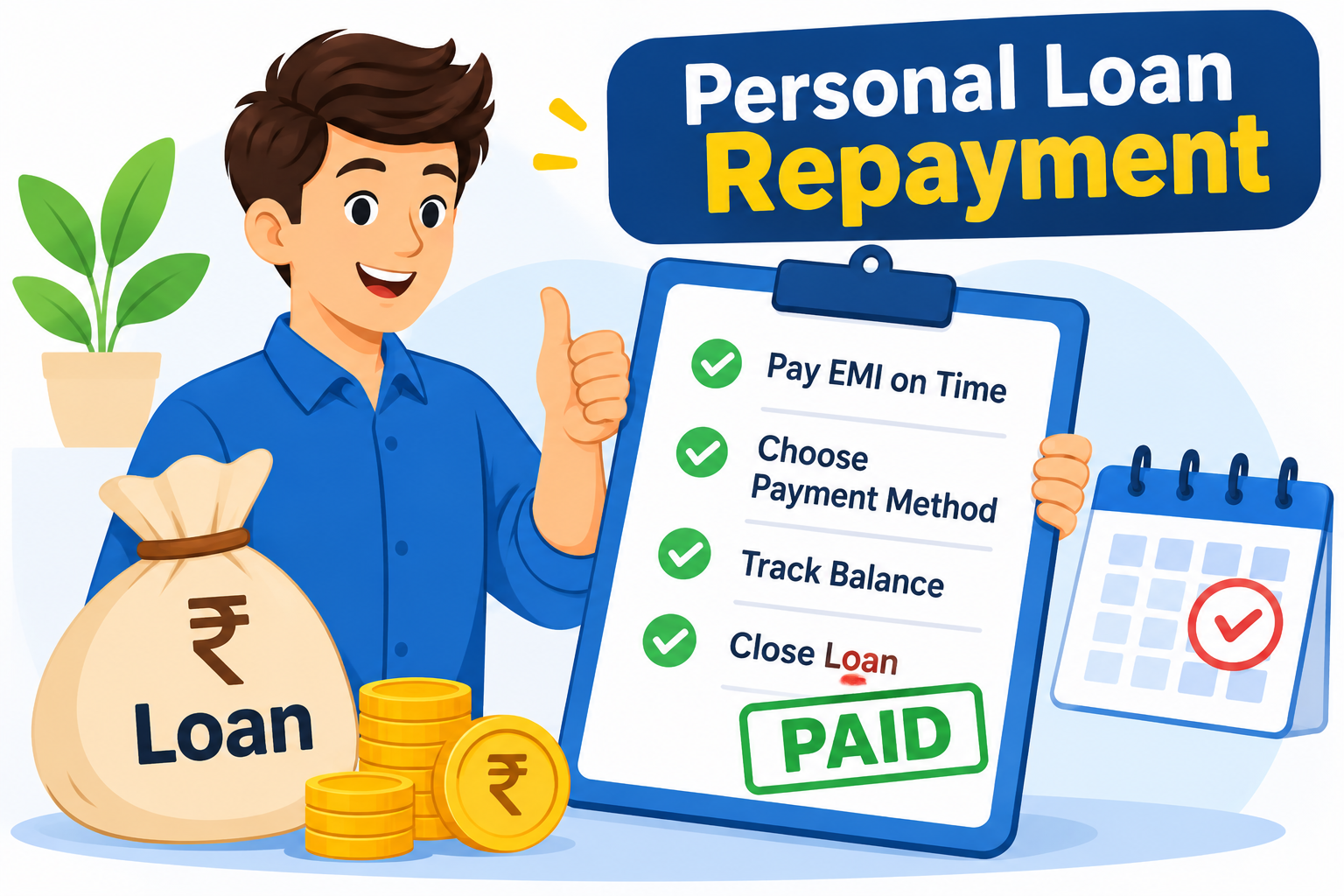
Published by : BhargaviPersonal loan repayment illustration showing a borrower checking EMI payments, tracking the outstanding balance and completing loan repayment on time.
www.vizzve.com || www.vizzveservices.com
Follow us on social media: Facebook || Linkedin || Instagram
🛡 Powered by Vizzve Financial
RBI-Registered Loan Partner | 10 Lakh+ Customers | ₹600 Cr+ Disbursed