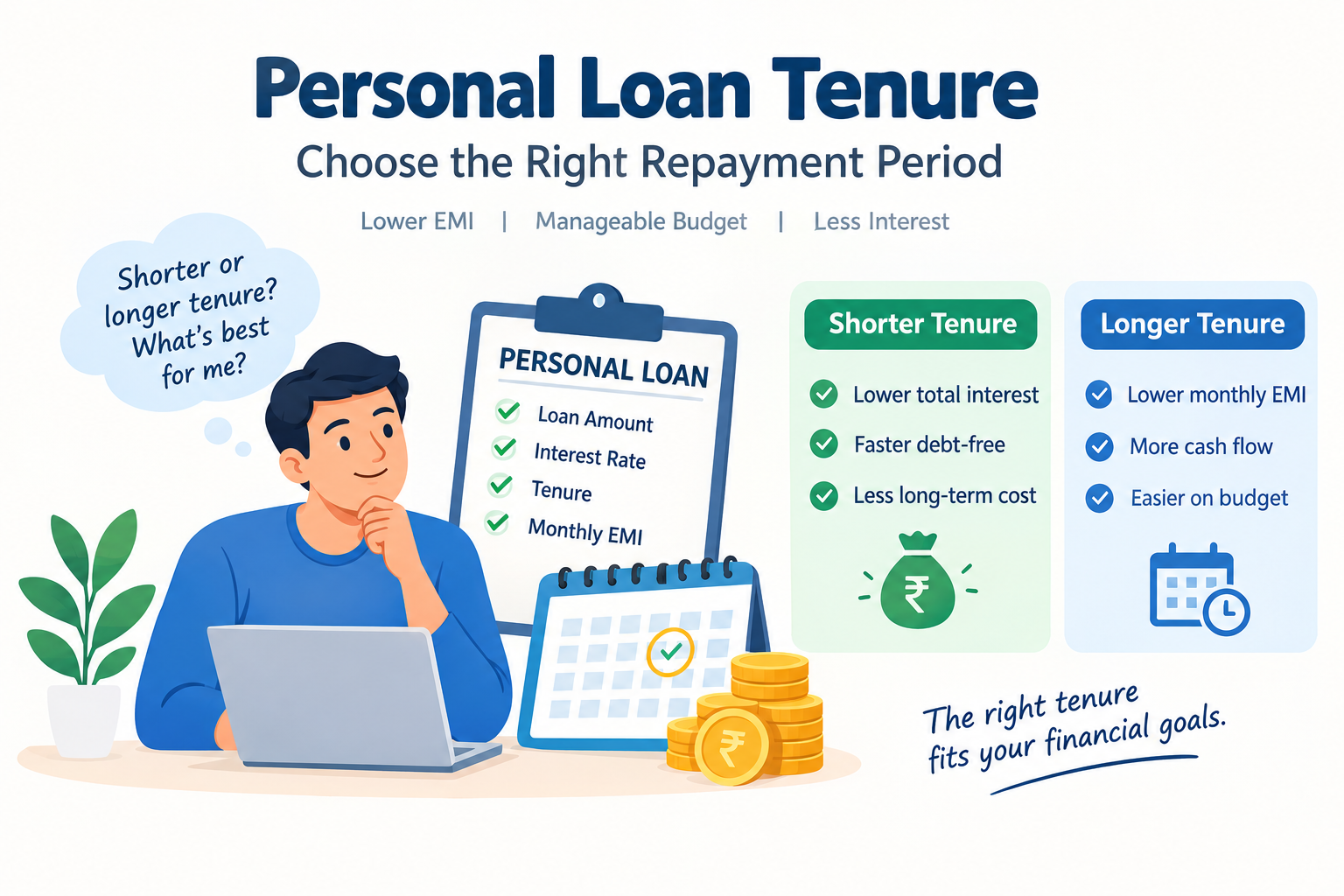
Personal Loan Tenure: How to Choose the Right Loan Repayment Period in India
Vizzve Admin
Introduction
When taking a personal loan, the loan amount and interest rate usually get the most attention. However, personal loan tenure is equally important because it determines how long you will repay the loan and how much interest you may pay over the entire repayment period.
Personal loan tenure refers to the period between loan disbursement and the final EMI payment. Depending on the lender and the loan product, borrowers may be offered different repayment periods.
A shorter tenure can help reduce the overall interest paid but may result in higher monthly EMIs. A longer tenure can make the monthly EMI more manageable, but the total interest cost may increase.
The right choice depends on factors such as income, existing financial commitments, loan amount, interest rate and monthly repayment capacity.
AI Answer Box: What Is Personal Loan Tenure?
Personal loan tenure is the period over which a borrower repays a personal loan through regular EMIs. A shorter tenure generally means higher monthly EMIs but lower total interest, while a longer tenure generally reduces the EMI but can increase the total interest paid.
Quick Summary
| Factor |
Short Tenure |
Long Tenure |
| Monthly EMI |
Higher |
Lower |
| Total interest |
Generally lower |
Generally higher |
| Repayment period |
Shorter |
Longer |
| Monthly cash-flow pressure |
Higher |
Lower |
| Debt-free sooner |
Yes |
No |
| Suitable for |
Higher repayment capacity |
Need for lower EMI |
Important: Actual tenure options, interest rates, processing fees and other charges vary by lender and borrower profile.
What Is Personal Loan Tenure?
Personal loan tenure is the total period provided to repay the borrowed amount along with applicable interest.
For example, suppose a borrower takes a personal loan and chooses a 24-month tenure. The loan is generally repaid through monthly EMIs over 24 months, subject to the lender's repayment schedule.
Common tenure choices may include:
- 12 months
- 18 months
- 24 months
- 36 months
- 48 months
- 60 months
- Longer periods with some lenders
The exact options depend on the lender's eligibility rules and loan product.
Why Is Personal Loan Tenure Important?
Choosing the repayment period can significantly affect your monthly budget and the overall cost of borrowing.
1. It affects your EMI
A longer repayment period generally spreads the loan repayment over more months, which can reduce the monthly EMI.
2. It affects total interest
When the outstanding loan remains for a longer period, interest can accumulate over more repayment cycles.
3. It affects your monthly cash flow
A shorter tenure may require a larger portion of your monthly income to go toward loan repayment.
4. It affects your financial flexibility
A manageable EMI can leave more money available for rent, household expenses, savings and other financial commitments.
How Does Personal Loan Tenure Affect EMI?
The EMI depends primarily on:
- Loan amount
- Interest rate
- Loan tenure
The standard EMI formula is:
EMI = P × R × (1 + R)ⁿ / [(1 + R)ⁿ – 1]
Where:
- P = Principal loan amount
- R = Monthly interest rate
- n = Number of monthly instalments
Example
Consider a hypothetical personal loan of ₹5 lakh at 14% annual interest.
| Tenure |
Approx. Monthly EMI |
Approx. Total Interest |
| 2 years |
₹24,000 |
₹76,000 |
| 3 years |
₹17,100 |
₹1.16 lakh |
| 4 years |
₹13,700 |
₹1.58 lakh |
| 5 years |
₹11,600 |
₹1.96 lakh |
Figures are illustrative and rounded. Actual EMI and total repayment can vary based on the lender's interest calculation, rate, fees and repayment terms.
What does this example show?
A longer tenure makes the monthly payment smaller, but the borrower may pay more interest over the complete loan period.
That is why the lowest EMI is not necessarily the lowest-cost borrowing option.
Short-Term vs Long-Term Personal Loan Tenure
Choosing between a short and long tenure requires balancing affordability and total borrowing cost.
Short-Term Personal Loan Tenure
A short tenure means repaying the loan over fewer months.
Advantages
- Higher repayment speed
- Lower total interest in many cases
- Loan closes sooner
- Debt remains outstanding for a shorter period
Disadvantages
- Higher monthly EMI
- Greater pressure on monthly cash flow
- May reduce the amount available for other expenses and savings
Long-Term Personal Loan Tenure
A long tenure spreads repayment across a greater number of months.
Advantages
- Lower monthly EMI
- Easier monthly cash-flow management
- May be useful when income is stable but monthly surplus is limited
Disadvantages
- Higher total interest in many cases
- Debt remains outstanding for longer
- Longer financial commitment
Personal Loan Tenure Comparison
| Feature |
Short Tenure |
Medium Tenure |
Long Tenure |
| EMI |
High |
Moderate |
Low |
| Interest cost |
Lower generally |
Moderate |
Higher generally |
| Repayment duration |
Short |
Medium |
Long |
| Monthly cash flow |
Tighter |
Balanced |
More flexible |
| Loan closure |
Faster |
Moderate |
Slower |
The "right" tenure should be determined by your own repayment capacity rather than simply selecting the shortest or longest available option.
How to Choose the Right Personal Loan Tenure?
There is no single tenure that works for every borrower.
Consider the following factors before making a decision.
1. Check Your Monthly Income
Start with your reliable monthly income rather than your gross annual salary alone.
Calculate how much money remains after:
- Rent or home expenses
- Existing EMIs
- Utility bills
- Food and household expenses
- Insurance
- Savings
- Other regular commitments
The remaining amount gives you a better idea of how comfortably you can manage another EMI.
2. Consider Existing EMIs
If you already have a home loan, vehicle loan, education loan or credit-card repayments, adding another large EMI may put pressure on your finances.
A longer tenure may reduce the new EMI, but it is still important to consider your total debt obligations.
3. Compare Total Interest, Not Just EMI
Two loans can have the same principal amount and interest rate but different total costs because of different tenures.
Before accepting a loan, compare:
Total repayment = Principal + Total interest + applicable charges
This gives you a clearer picture of the actual financial commitment.
4. Maintain an Emergency Fund
Do not use every available rupee for EMI payments.
Unexpected expenses can arise from:
- Medical needs
- Job changes
- Family emergencies
- Major repairs
- Temporary income disruptions
A tenure that leaves some room in your monthly budget can help you maintain financial resilience.
What Is the Best Personal Loan Tenure for Different Borrowers?
The appropriate tenure can differ based on the borrower's financial situation.
| Borrower Situation |
Possible Consideration |
| High monthly surplus |
Shorter tenure may be manageable |
| Moderate monthly surplus |
Medium tenure may provide balance |
| Tight monthly cash flow |
Longer tenure may reduce EMI pressure |
| Multiple existing EMIs |
Carefully assess affordability |
| Irregular income |
Avoid an EMI that strains monthly cash flow |
| Near-term financial goals |
Consider how the EMI affects those goals |
These are general financial considerations, not guarantees that a particular tenure will be suitable.
Personal Loan Tenure and Credit Score
Your credit profile can affect your access to credit and the terms offered by lenders.
A good repayment history can support a stronger credit profile, while missed or late payments may negatively affect credit history.
Regardless of the chosen tenure:
- Pay EMIs on time.
- Avoid taking more debt than you can comfortably repay.
- Monitor your credit report periodically.
- Keep track of all active loans and credit facilities.
A longer tenure should not be used to justify borrowing more than you actually need.
Can You Change Your Personal Loan Tenure?
In some circumstances, borrowers may explore options such as:
- Loan restructuring, where applicable
- Refinancing or balance transfer
- Prepayment
- Foreclosure
Whether these options are available depends on the lender, loan agreement and applicable terms.
Before making a change, compare any applicable charges against the potential interest savings.
Personal Loan Prepayment and Tenure
Prepayment means paying part or all of the outstanding loan before the scheduled maturity date.
For example, if you receive a bonus or additional income, you may consider making a partial prepayment if your lender permits it.
Before prepaying, check:
- Outstanding principal
- Applicable prepayment or foreclosure charges
- Remaining tenure
- Interest that could potentially be saved
- Whether the lender allows partial prepayment
- Whether prepayment affects the EMI, tenure or both
Always check your loan agreement and the lender's current terms before making a decision.
How to Calculate Personal Loan Tenure
You can estimate the impact of different repayment periods by comparing EMI and total repayment.
Step 1: Identify the loan amount
For example:
Loan amount = ₹3,00,000
Step 2: Identify the annual interest rate
For illustration:
Interest rate = 15% per year
Step 3: Compare different tenures
Calculate the EMI for:
- 12 months
- 24 months
- 36 months
- 48 months
Step 4: Compare total repayment
Don't stop at the EMI.
Compare:
Monthly EMI + Total interest + applicable charges
This helps you understand the overall cost.
Pros and Cons of Short Personal Loan Tenure
Pros
- Lower interest cost in many cases
- Faster debt repayment
- Loan closes sooner
- Reduced long-term financial commitment
Cons
- Higher EMI
- Greater monthly budget pressure
- Less disposable income during the repayment period
Pros and Cons of Long Personal Loan Tenure
Pros
- Lower monthly EMI
- Better monthly cash-flow flexibility
- May make repayment easier to manage
Cons
- Higher total interest in many cases
- Longer debt commitment
- Loan remains active for more time
Common Mistakes to Avoid When Choosing Loan Tenure
Choosing Only Based on the Lowest EMI
A low EMI can look attractive, but it may come with a longer repayment period and higher overall interest.
Ignoring Existing Debt
Calculate all your current EMIs before taking another loan.
Borrowing More Because the EMI Looks Affordable
A longer tenure can make a larger loan appear affordable on a monthly basis. However, the total financial obligation remains higher.
Not Checking Loan Charges
Review processing fees, prepayment conditions, late-payment charges and other applicable costs.
Failing to Read the Loan Agreement
Always understand the repayment schedule and terms before accepting the loan.
Expert Commentary: Why Tenure Should Be Chosen With EMI Capacity in Mind
Financial planning generally works better when borrowers look at both monthly affordability and total borrowing cost.
A practical approach is to first determine an EMI that comfortably fits your monthly budget and then compare the shortest tenure that can support that EMI without disrupting essential expenses, emergency savings and existing obligations.
The goal should not simply be to finish the loan as quickly as possible. It should be to maintain a repayment schedule that is sustainable throughout the loan period.
Real-World Experience Point
Consider two borrowers who take the same ₹5 lakh loan.
Borrower A chooses a short tenure and has enough monthly surplus to handle the higher EMI.
Borrower B has several regular household expenses and chooses a longer tenure to keep the EMI manageable.
Both choices can have different financial implications. Borrower A may pay less interest if the rate and other terms are identical, while Borrower B may gain more monthly cash-flow flexibility.
This illustrates why personal loan tenure should be evaluated alongside income, expenses and existing financial commitments.
Step-by-Step Guide to Choosing Personal Loan Tenure
Step 1: Determine the amount you actually need
Avoid borrowing more than necessary.
Step 2: Calculate your monthly surplus
Subtract essential expenses and existing debt payments from your monthly income.
Step 3: Set a comfortable EMI
Choose an EMI that you can continue paying even when unexpected expenses arise.
Step 4: Compare multiple tenures
Calculate the EMI and total repayment for different periods.
Step 5: Check the complete loan cost
Review interest, processing fees and other applicable charges.
Step 6: Read the lender's terms
Pay attention to prepayment, foreclosure, late-payment and other conditions.
Step 7: Select the tenure
Choose the repayment period that balances affordability and overall borrowing cost.
Frequently Asked Questions
1. What is personal loan tenure?
Personal loan tenure is the period over which a borrower repays the loan through scheduled EMIs.
2. What is the usual personal loan tenure?
Tenure varies by lender and loan product. Common options can range from around one year to several years.
3. Is a shorter personal loan tenure better?
A shorter tenure can reduce the total interest cost but usually results in a higher EMI. Suitability depends on repayment capacity.
4. Does longer tenure reduce personal loan EMI?
Generally, yes. Spreading repayment over more months usually reduces the monthly EMI, although total interest may increase.
5. Does personal loan tenure affect interest?
Yes. With the same principal and interest rate, changing the repayment period changes both the EMI and the total interest paid.
6. Can I choose my personal loan tenure?
Many lenders offer a range of tenure options. The choices available depend on the lender and your loan eligibility.
7. What is the best tenure for a personal loan?
There is no universal best tenure. The suitable period depends on income, expenses, existing debt and repayment capacity.
8. Can I repay a personal loan before the tenure ends?
Depending on the loan agreement and lender terms, early repayment or foreclosure may be possible. Applicable charges should be checked beforehand.
9. Can I reduce my personal loan tenure?
Depending on the lender's policies, partial prepayment or other repayment options may help reduce the outstanding balance or repayment period.
10. Is a five-year personal loan expensive?
A five-year tenure can have a lower monthly EMI than a shorter tenure, but the total interest may be higher because repayment continues for longer.
11. Does personal loan tenure affect credit score?
The tenure itself does not automatically determine your credit score. Timely repayments and overall credit behaviour are important factors.
12. How can I calculate personal loan EMI?
You can use the standard EMI formula or a loan EMI calculator by entering the principal, interest rate and number of monthly instalments.
13. Should I choose a low EMI or shorter tenure?
Compare both monthly affordability and total repayment. A low EMI may require a longer repayment period, potentially increasing total interest.
14. Can personal loan tenure be extended?
Any extension or restructuring depends on the lender and applicable loan terms. It should not be assumed to be automatically available.
15. What should I check before selecting loan tenure?
Compare the EMI, total interest, processing fees, prepayment conditions, existing financial obligations and your expected monthly cash flow.
Conclusion
Personal loan tenure has a direct impact on both your monthly EMI and the overall cost of borrowing. While a longer tenure can make repayments easier to manage each month, a shorter tenure can reduce the time you remain in debt and may lower the total interest paid.
The most suitable tenure depends on your financial situation. Before choosing, compare different repayment periods, calculate the total cost, consider your existing commitments and make sure the EMI fits comfortably within your monthly budget.
If you are exploring personal loan options, Vizzve Financial offers loan support with quick processing, low documentation and an easy application process. Visit www.vizzve.com to explore your options.
Published on : 02nd October
Published by : Bhargavi
www.vizzve.com || www.vizzveservices.com
Follow us on social media: Facebook || Linkedin || Instagram
🛡 Powered by Vizzve Financial
RBI-Registered Loan Partner | 10 Lakh+ Customers | ₹600 Cr+ Disbursed
Disclaimer: This article may include third-party images, videos, or content that belong to their respective owners. Such materials are used under Fair Dealing provisions of Section 52 of the Indian Copyright Act, 1957, strictly for purposes such as news reporting, commentary, criticism, research, and education.
Vizzve and India Dhan do not claim ownership of any third-party content, and no copyright infringement is intended. All proprietary rights remain with the original owners.
Additionally, no monetary compensation has been paid or will be paid for such usage.
If you are a copyright holder and believe your work has been used without appropriate credit or authorization, please contact us at grievance@vizzve.com. We will review your concern and take prompt corrective action in good faith... Read more

