

Introduction
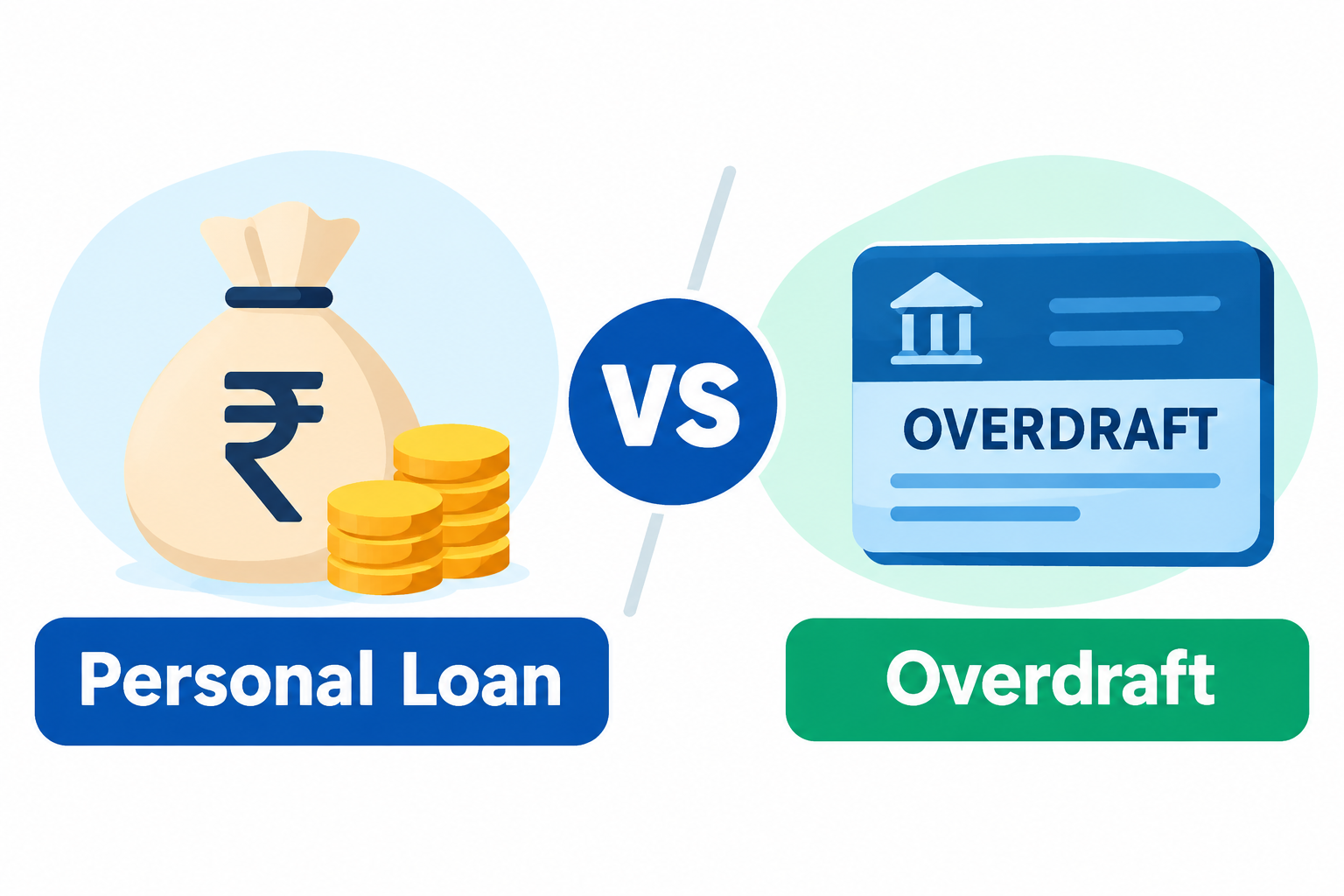
When you need extra money, you may consider a Personal Loan or an Overdraft facility. Both can provide access to funds, but they work differently.
A personal loan usually gives you a fixed amount upfront, while an overdraft allows you to withdraw money up to an approved limit when required.
Understanding the difference can help you choose the right option for your financial needs.
What Is a Personal Loan?
A personal loan is a type of loan where a lender provides a fixed amount of money. You repay the loan through regular installments, usually over a fixed tenure.
Personal loans are commonly used for:
- Medical expenses
- Education expenses
- Home-related expenses
- Travel
- Weddings
- Debt consolidation
- Other personal needs
What Is an Overdraft?
An overdraft is a borrowing facility linked to an eligible bank account or credit arrangement. The lender approves a limit, and you can use funds up to that limit when needed.
Interest is generally charged based on the amount used and the applicable terms rather than the entire approved limit.
Personal Loan vs Overdraft: Key Differences
| Feature | Personal Loan | Overdraft |
|---|---|---|
| Fund access | Usually received as a lump sum | Withdraw when needed |
| Repayment | Fixed installments | Flexible, according to facility terms |
| Interest | Usually charged on outstanding loan balance | Generally based on amount utilized |
| Flexibility | Moderate | High |
| Tenure | Usually fixed | Can be flexible |
| Best for | Planned expenses | Short-term or irregular cash needs |
| Approval | Based on lender eligibility | Based on account/credit eligibility |
Advantages of a Personal Loan
- Fixed borrowing amount
- Predictable monthly repayments
- Suitable for planned expenses
- Fixed repayment tenure
- Can help manage larger expenses
Advantages of an Overdraft
- Access money when needed
- You may not need to use the entire approved limit
- Useful for short-term cash-flow requirements
- Greater flexibility in borrowing
Which Is Better: Personal Loan or Overdraft?
There is no single answer. Your choice depends on your financial situation.
Choose a Personal Loan if:
- You know exactly how much money you need.
- You prefer fixed monthly repayments.
- You need funds for a larger planned expense.
- You want a defined repayment schedule.
Consider an Overdraft if:
- Your cash requirements are temporary.
- You need flexibility in accessing funds.
- You may need different amounts at different times.
- You want to borrow only when necessary.
Personal Loan vs Overdraft: Cost Considerations
Don't compare only the interest rate. Check the total cost of borrowing, including:
- Interest rate
- Processing fees
- Renewal or facility charges
- Late-payment charges
- Prepayment or foreclosure charges, where applicable
- Other applicable fees and taxes
The actual cost depends on the lender and the terms of the specific product.
Which Is Better for Emergency Expenses?
For a known emergency expense where you need a specific amount, a personal loan may be easier to plan because the repayment schedule is defined.
For short-term cash-flow gaps where the amount required can vary, an overdraft may offer more flexibility.
Always borrow only what you can comfortably repay.
Vizzve and Responsible Digital Borrowing
When considering a digital loan, borrowers should check the lender's terms, applicable interest rate, fees, repayment schedule, and privacy practices before accepting an offer. Choose borrowing based on your repayment capacity rather than simply the amount available.
Key Takeaways
- A personal loan generally provides a fixed amount with structured repayments.
- An overdraft provides flexible access to an approved borrowing limit.
- Personal loans can be suitable for planned, larger expenses.
- Overdrafts can be useful for temporary or variable cash needs.
- Compare the total borrowing cost, not just the interest rate.
- Always consider your income and repayment capacity before borrowing.
FAQs
1. What is the main difference between a personal loan and an overdraft?
A personal loan generally provides a fixed amount upfront, while an overdraft lets you access funds up to an approved limit as needed.
2. Is an overdraft a loan?
An overdraft is a form of credit facility that allows you to withdraw more than your available account balance up to an approved limit.
3. Which is better for a large expense?
A personal loan may be more suitable when you know the exact amount required and prefer structured repayments.
4. Is an overdraft suitable for short-term needs?
It can be useful for short-term cash-flow requirements, depending on the facility's terms and cost.
5. Do personal loans have fixed EMIs?
Many personal loans are repaid through fixed or scheduled EMIs, depending on the lender and product.
6. Is interest charged on the full overdraft limit?
Typically, interest is based on the amount utilized, but the exact calculation depends on the lender's terms.
7. Can an overdraft limit be increased?
It may be possible if the lender or bank approves an increase based on eligibility and account history.
8. Should I compare interest rates before borrowing?
Yes. Also compare processing fees, other charges, repayment terms, and the total cost of borrowing.
9. Can a personal loan be used for emergencies?
Yes, subject to lender approval and the terms of the loan.
10. Which option offers more flexibility?
An overdraft generally offers greater flexibility because you can access funds as required within the approved limit.
Conclusion
Personal Loans and Overdrafts serve different purposes. A personal loan may be better for a planned expense and predictable repayments, while an overdraft can be useful when you need flexible access to funds.
Published on : 8th October
Published by : MONISHA
www.vizzve.com || www.vizzveservices.com
Follow us on social media: Facebook || Linkedin || Instagram
🛡 Powered by Vizzve Financial
RBI-Registered Loan Partner | 10 Lakh+ Customers | ₹600 Cr+ Disbursed