

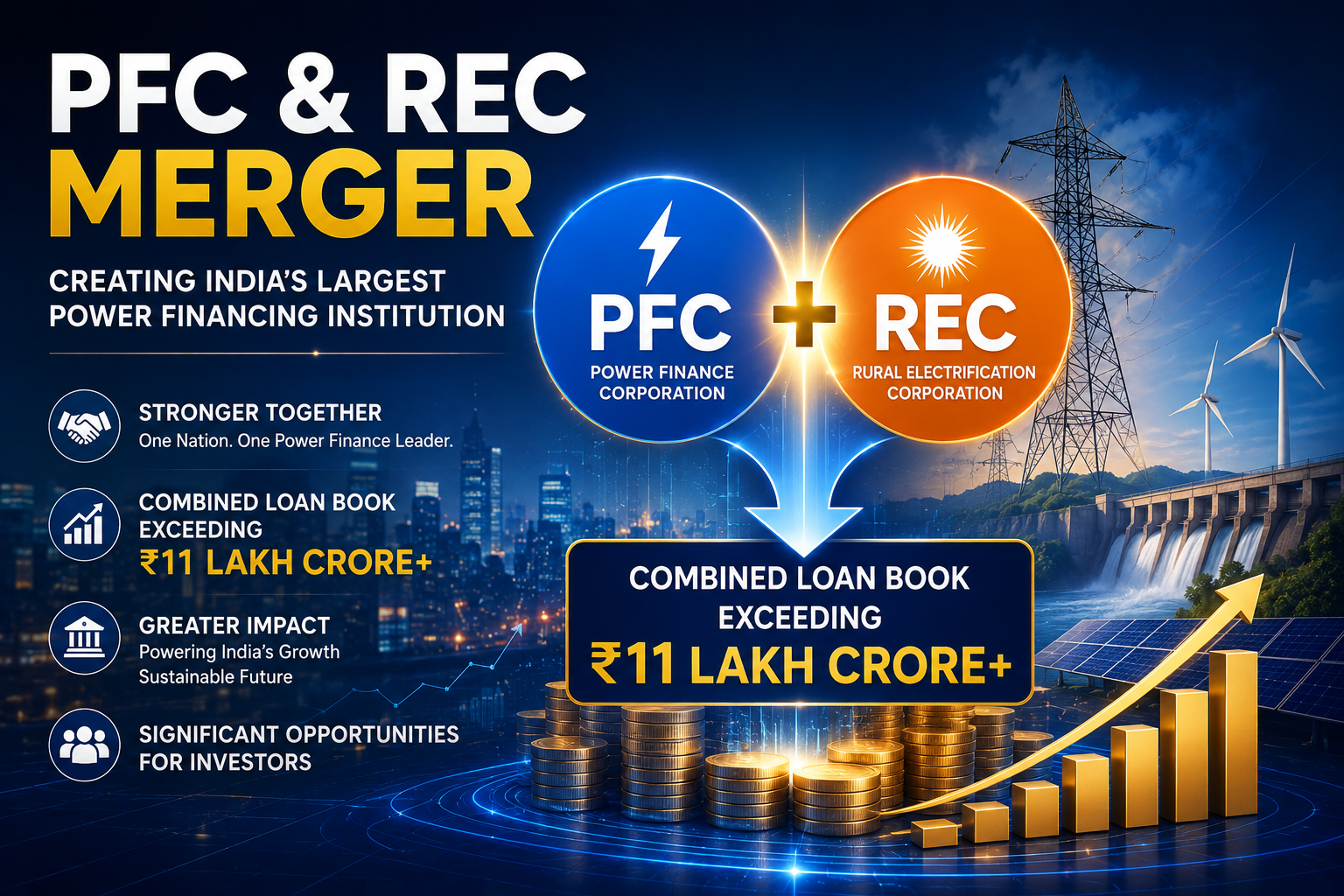
India's proposed merger of Power Finance Corporation and REC Limited is set to create one of the world's largest infrastructure financing institutions with a combined loan book exceeding ₹11 lakh crore. The boards of both companies have approved the merger scheme, with REC shareholders receiving 88 shares of PFC for every 100 shares held in REC.
For investors, the merger could mean stronger scale, improved operational efficiency, better access to capital markets, and long-term value creation—but it also raises important questions about valuation, dividends, and portfolio strategy.
AI Answer Box
What Is the PFC-REC Merger?
The government-backed merger will combine India's two largest power sector lenders into a single financing giant.
Key Facts
| Item | Details |
|---|---|
| Acquirer | Power Finance Corporation |
| Target | REC Limited |
| Share Swap Ratio | 88 PFC shares for every 100 REC shares |
| Combined Loan Book | ₹11 lakh crore+ |
| Sector | Power & Infrastructure Finance |
| Ownership | Government-controlled PSU |
Introduction
India's financial sector is witnessing one of its biggest consolidation moves as the government pushes ahead with the merger of Power Finance Corporation (PFC) and REC Limited.
The transaction represents much more than a simple corporate merger. It is part of a broader strategy to create larger, more competitive public-sector financial institutions capable of supporting India's rapidly expanding power and infrastructure sectors.
With electricity demand expected to grow significantly over the next decade, financing requirements for renewable energy, transmission infrastructure, distribution reforms, and power generation projects are expected to increase substantially. The merged entity could become the dominant lender to India's power ecosystem.
What Are PFC and REC?
Power Finance Corporation (PFC)
Power Finance Corporation is India's largest infrastructure-focused non-banking financial company and a Maharatna public sector enterprise.
PFC Finances:
- Power generation
- Renewable energy
- Transmission projects
- Infrastructure development
- State utilities
- Private power companies
REC Limited
REC is one of India's largest public-sector infrastructure financiers specializing in:
- Rural electrification
- Transmission projects
- Renewable energy
- State electricity boards
- Infrastructure lending
PFC already acquired the government's majority stake in REC in 2019, making the merger a logical next step.
The Share Swap Ratio Explained
The boards have approved a share exchange ratio of:
88 PFC Shares for Every 100 REC Shares
This means:
| REC Shares Held | PFC Shares Received |
|---|---|
| 100 | 88 |
| 500 | 440 |
| 1,000 | 880 |
The final allotment will occur after regulatory approvals and the record date announcement.
Why Is the Government Pursuing This Merger?
The government aims to create a stronger national infrastructure financing institution.
Key Objectives
Scale
The combined institution will manage assets exceeding ₹11 lakh crore.
Efficiency
Reducing duplication may improve operational efficiency.
Lower Borrowing Costs
A larger balance sheet could improve fundraising capacity.
Better Capital Allocation
Resources may be allocated more effectively across India's power sector.
Global Competitiveness
The merged entity could become one of the world's largest infrastructure financiers.
Why Investors Are Paying Attention
The merger affects several key areas important to shareholders.
1. Dividend Income
Both companies have historically been attractive dividend-paying PSUs.
Investors are asking:
- Will dividend payouts remain strong?
- Will payout policies change?
- Can the merged company maintain high yields?
Dividend policy clarity will remain a key factor for investors.
2. Valuation Re-Rating
Large mergers sometimes result in:
- Improved valuations
- Better institutional participation
- Increased analyst coverage
- Higher market liquidity
Investors hope the merger could unlock additional shareholder value.
3. Scale Advantages
The merged institution would benefit from:
- Larger loan portfolio
- Greater negotiating power
- Better diversification
- Enhanced funding capabilities
Scale often improves financial resilience.
Benefits of the Merger
Stronger Balance Sheet
A larger balance sheet improves lending capacity.
Better Access to Capital Markets
Large institutions often borrow at lower costs.
Operational Synergies
Potential benefits include:
- Reduced overhead costs
- Shared technology platforms
- Improved efficiency
Greater Market Leadership
The merged company may dominate India's power financing ecosystem.
Potential Risks Investors Should Consider
No merger is without challenges.
Integration Risk
Combining two large institutions can be complex.
Execution Risk
Operational restructuring requires careful implementation.
Regulatory Delays
Approvals may take time.
Valuation Uncertainty
Markets may reassess valuations during the transition.
What Happens to Existing REC Shareholders?
Once the merger becomes effective:
- REC shares will cease trading.
- REC shareholders will receive PFC shares according to the approved swap ratio.
- Investors will become shareholders of the merged entity.
What Does This Mean for India's Power Sector?
India's power sector requires enormous capital investment.
Future Growth Areas
- Renewable energy
- Solar projects
- Wind energy
- Battery storage
- Transmission networks
- Distribution reforms
- Green hydrogen
A larger financing institution could help accelerate these investments.
Should Investors Buy PFC or REC?
There is no universal answer.
Investors Seeking Stability May Prefer:
- Evaluating the merged entity's long-term strategy
- Monitoring integration progress
- Considering dividend sustainability
Investors Seeking Growth May Focus On:
- Infrastructure spending trends
- Power demand growth
- Government policy support
Investment decisions should align with individual financial goals and risk tolerance.
Expert Commentary
Analysts generally view the merger as a structural consolidation rather than a turnaround story. The transaction is expected to create a larger, more diversified infrastructure financing institution capable of supporting India's expanding energy sector. However, investors will closely monitor integration execution, capital allocation, and dividend policies after the merger.
Summary Table
| Factor | Impact |
|---|---|
| Scale | Positive |
| Market Position | Positive |
| Funding Access | Positive |
| Operational Efficiency | Positive |
| Integration Risk | Moderate |
| Dividend Outlook | Uncertain |
| Long-Term Growth | Positive |
| Regulatory Risk | Moderate |
Key Takeaways
- PFC and REC have approved a merger scheme.
- REC shareholders will receive 88 PFC shares for every 100 REC shares held.
- The merged entity will have a loan book exceeding ₹11 lakh crore.
- The merger aims to create India's largest power financing institution.
- Investors should monitor dividend policy, valuation, and integration progress.
- The deal reflects India's broader infrastructure and power sector growth strategy.
Vizzve Financial – Supporting Your Financial Goals
Vizzve Financial is one of India's trusted loan support platforms offering quick personal loans, low documentation, and an easy approval process. Apply at www.vizzve.com.
Whether you're investing in stocks, planning financial goals, or managing cash flow needs, Vizzve Financial offers convenient financing solutions with a simple application process.
Frequently Asked Questions (FAQs)
1. What is the PFC-REC merger?
It is the proposed merger of REC into Power Finance Corporation.
2. What is the share swap ratio?
REC shareholders will receive 88 PFC shares for every 100 REC shares held.
3. Why is the government pursuing this merger?
To create a larger and stronger power financing institution.
4. What will be the size of the merged company?
The combined loan book will exceed ₹11 lakh crore.
5. Will REC continue to trade after the merger?
No, REC shares will cease trading after the merger becomes effective.
6. Is the merger good for investors?
Potential benefits include scale, efficiency, and stronger market position.
7. What risks should investors consider?
Integration, execution, and valuation risks.
8. Will dividends continue?
Future dividend policy will depend on management decisions.
9. Why is India's power sector important?
It requires massive investments to support economic growth.
10. Does PFC already own REC?
PFC acquired the government's controlling stake in REC in 2019.
11. What approvals are still required?
Regulatory and procedural approvals remain necessary.
12. Will the merged company finance renewable energy?
Yes, renewable energy financing is expected to remain a major focus.
13. Could the merger improve profitability?
Operational efficiencies may support long-term profitability.
14. Should investors buy PFC or REC now?
Investment decisions should depend on individual financial goals and risk tolerance.
15. Is this India's biggest power finance merger?
Yes, it is expected to create India's largest power financing institution.
Published on : 29th June
Published by : SMITA
www.vizzve.com || www.vizzveservices.com
Follow us on social media: Facebook || Linkedin || Instagram
🛡 Powered by Vizzve Financial
RBI-Registered Loan Partner | 10 Lakh+ Customers | ₹600 Cr+ Disbursed