

Introduction
Short answer:
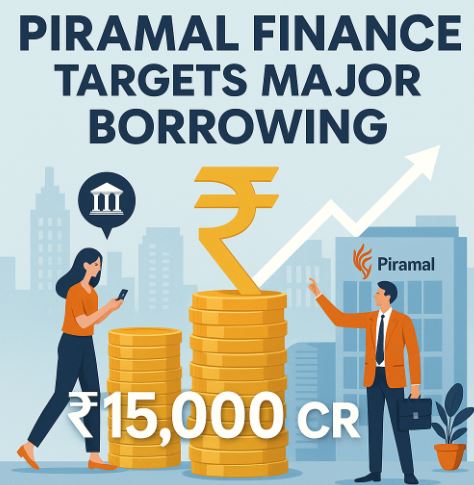
Piramal Finance is aiming to raise ~₹15,000 crore (≈ US $1.67 billion) between December 2025 and March 2026 — part of a larger ₹30,000 crore borrowings target for the fiscal year.
In this blog, we examine what this major borrowing plan signals: for Piramal Finance’s growth ambitions, for retail/wholesale credit in India, and for investors. We explore funding sources, risk-reward dynamics, and longer-term implications including assets under management (AUM) expansion.
AI Answer Box
Q: Why is Piramal Finance raising ₹15,000 crore now?
Because it aims to fund further growth, expand its retail loan book, and meet its larger fiscal-year borrowing target of ₹30,000 crore.
Q: How will the borrowing be structured?
~ 40 % via bank loans; the rest through a mix of local bonds, securitisation, external commercial borrowing (ECB), and multilateral agency loans.
Q: What is the AUM target?
Piramal Finance aims to cross ₹1 trillion AUM by end-March 2026.
Q: What does this mean for India’s finance sector?
It signals a push for greater retail lending capacity, likely supporting credit flow to housing, business, auto, small loans, and even gold-loan segments.
Why Piramal Finance Is Raising Big — Background & Strategy
From Wholesale to Retail: Strategic Shift
Just a few years ago, Piramal Finance (formerly a wholesale-heavy NBFC) has transformed into a retail-focused lender.
As of late 2025, its retail book constitutes ~83% of its loan portfolio, up from a wholesale-dominant model.
This shift includes diversification: home loans, loan against property (LAP), used-car financing, MSME loans, personal loans, and plans to enter gold-loan products.
This retail focus demands larger capital, hence the aggressive borrowing plan.
AUM & Growth Targets
| Period / Goal | AUM / Borrowing Target |
|---|---|
| End-March 2026 (FY25–26) | > ₹1,00,000 crore AUM |
| Current Fiscal Borrowing Target | ₹30,000 crore |
| December–March 2026 Borrowing Phase | ₹15,000 crore (≈ US $1.67 bn) |
| Medium-Term AUM Goal (FY28) | ₹1.5 lakh crore (₹150,000 crore) |
These numbers reflect an aggressive scale-up — especially in retail, where demand for credit across India remains under-penetrated.
How Piramal Finance Plans to Fund It
~40% via bank loans.
Rest via a mix: local bonds, securitisation, external commercial borrowing (ECB), and loans from multilateral agencies.
The company management recently indicated a preference for local-currency bond funding over dollar bonds, citing the relative cost-effectiveness this year.
This diversified funding strategy — combining bank loans, bonds, securitized assets and ECB — aims at balancing cost, currency risk, and funding stability.
What This Means for Stakeholders
✅ For Investors & Market
Growth potential: Rising borrowing and AUM targets hint at aggressive growth — may lead to increased revenue and returns.
Diversified risk: Transition to retail reduces concentration risk: retail loans tend to have smaller ticket sizes and broader customer base compared to wholesale commercial exposures.
Credit availability boost: More funds mean greater capacity to extend home, auto, business, gold-backed, and small personal loans — positive for consumer credit growth in India.
⚠️ Potential Risks
Asset quality pressure: Rapid expansion can bring stress if loans are extended to higher-risk borrowers, or if macroeconomic conditions worsen.
Cost of borrowing: Depending on interest rate cycles and funding cost, returns may get squeezed if interest costs rise.
Regulatory & market volatility: NBFC regulations, policy changes, or changes in investor sentiment (especially toward high-leverage borrowers) could impact funding and growth plans.
Pros & Cons of Piramal Finance’s Borrowing Strategy
Pros
Strong capital backing for aggressive retail expansion
Diversified funding — reduces reliance on any single funding channel
Potential to increase financial inclusion by supporting credit for housing, auto, MSMEs, gold-loan demand
Cons / Risks
Exposure to macroeconomic cycles / interest rate changes
Risk of higher NPAs if underwriting standards slip during rapid scale-up
Currency risks if foreign borrowing used (though management prefers local currency bonds)
Dependence on stable liquidity / bond markets
Expert Commentary & Real-World Insights
As an industry observer, I note:
“For an NBFC like Piramal Finance, scaling retail lending rapidly requires not just capital — but disciplined underwriting, risk management and regional penetration.”
Indeed, the company’s shift from a wholesale-heavy NBFC to a diversified, retail-led lender shows adaptability.
Real-world borrowers in Tier-II / Tier-III towns could benefit — especially first-time home buyers, small businesses needing working capital, or individuals seeking used-car or gold-backed credit. But success hinges on how well Piramal manages loan quality amid rapid growth.
From investor perspective, such ambition — if executed well — could yield healthy returns. That said, the cost of capital, interest rate environment, and regulatory vigilance will be critical determinants.
Key Takeaways
Piramal Finance plans to raise ₹15,000 crore by March 2026 — part of a ₹30,000 crore total target for the fiscal year.
The borrowing will fund expansion of retail loan book — offering home, vehicle, property loans, and new products like gold loans.
AUM target is to cross ₹1 trillion by March 2026, with a medium-term goal of ₹1.5 lakh crore by FY28.
Funding will be a mix: bank loans, local bonds, securitisation, and possibly external commercial borrowing — with preference for local-currency bonds over dollar bonds.
For investors and consumers alike, the move could improve credit access and offer growth opportunities — but rapid scaling carries risks related to asset quality and funding costs.
(FAQ)
Q1: Why is Piramal Finance borrowing ₹15,000 crore between Dec 2025–Mar 2026?
A: To meet its fiscal-year borrowing target of ₹30,000 crore and fund growth across its retail loan portfolio.
Q2: How will the borrowed funds be used?
A: To expand retail lending — home loans, loans against property, used-car loans, MSME and personal loans, and potentially gold-loan offerings.
Q3: What percentage of borrowing is through bank loans vs bonds or other sources?
A: Roughly 40% via bank loans; balance through local bonds, securitisation, and possibly external commercial borrowings or multilateral agency loans.
Q4: Is Piramal Finance switching strategy from wholesale to retail?
A: Yes — over recent years, it has shifted dramatically: from ~90% wholesale exposure to ~83% retail exposure.
Q5: What are the company’s AUM targets?
A: > ₹1 trillion by March 2026; ₹1.5 lakh crore by FY28.
Q6: Why avoid dollar bonds?
A: Because local-currency bond funding has been cheaper this year compared to dollar-denominated bonds.
Q7: What new loan products is Piramal Finance planning?
A: Adding gold loans via select branches, besides existing home, LAP, used-car, MSME and personal loans.
Q8: What are the risks associated with such rapid expansion?
A: Potential for rising NPAs if underwriting slips, interest rate and funding-cost pressures, and macroeconomic or regulatory volatility.
Q9: How does this borrowing affect investors?
A: Offers growth potential and returns if managed well; but demands close monitoring of asset quality and funding costs.
Q10: How does this impact retail credit availability in India?
A: Likely increases availability, especially in underserved areas and among first-time borrowers, enhancing financial inclusion.
Q11: Is Piramal Finance regulated like a bank?
A: It is an NBFC (non-banking financial company), regulated by the central bank, and not a deposit-taking bank.
Q12: Can this borrowing plan influence interest rates on retail loans?
A: Possibly — if funding costs rise, loan rates may increase; conversely, stable funding could help keep rates competitive.
Q13: How stable is Piramal’s funding strategy?
A: By diversifying across bank loans, bonds, and securitisation, and preferring local bond funding, the strategy aims for stable, cost-effective financing.
Q14: Is the NBFC’s retail expansion likely to benefit small businesses and lower-income borrowers?
A: Yes — through MSME loans, affordable home & property loans, and new gold-loan products, lending access in Tier-II/III towns may improve.
Q15: What should investors watch out for in next 12–18 months?
A: Trends in non-performing assets (NPAs), interest rate environment, funding cost stability, macroeconomic conditions, and diversification of loan book.
Conclusion + CTA
Piramal Finance’s ambitious ₹15,000 crore borrowing plan over December–March 2026 — amid a ₹30,000 crore fiscal-year target — marks a decisive move towards scaling retail lending and broadening financial access across India. With a diversified funding mix, tech-driven strategy, and diversified loan portfolio, the NBFC is laying the groundwork to meet its ₹1 trillion AUM goal, and beyond.
That said, success depends on disciplined underwriting, stable funding costs, and prudent risk management. For investors and borrowers alike, the coming quarters will reveal how well Piramal Finance
balances growth with stability.
If you’re seeking quick, reliable loans — home, vehicle, business or personal — consider exploring Vizzve Financial — one of India’s trusted loan-support platforms offering quick personal loans, low documentation, and an easy approval process. Apply now at www.vizzve.com.
Published on : 2nd December
Published by : Deepa R
www.vizzve.com || www.vizzveservices.com
Follow us on social media: Facebook || Linkedin || Instagram
🛡 Powered by Vizzve Financial
RBI-Registered Loan Partner | 10 Lakh+ Customers | ₹600 Cr+ Disbursed