

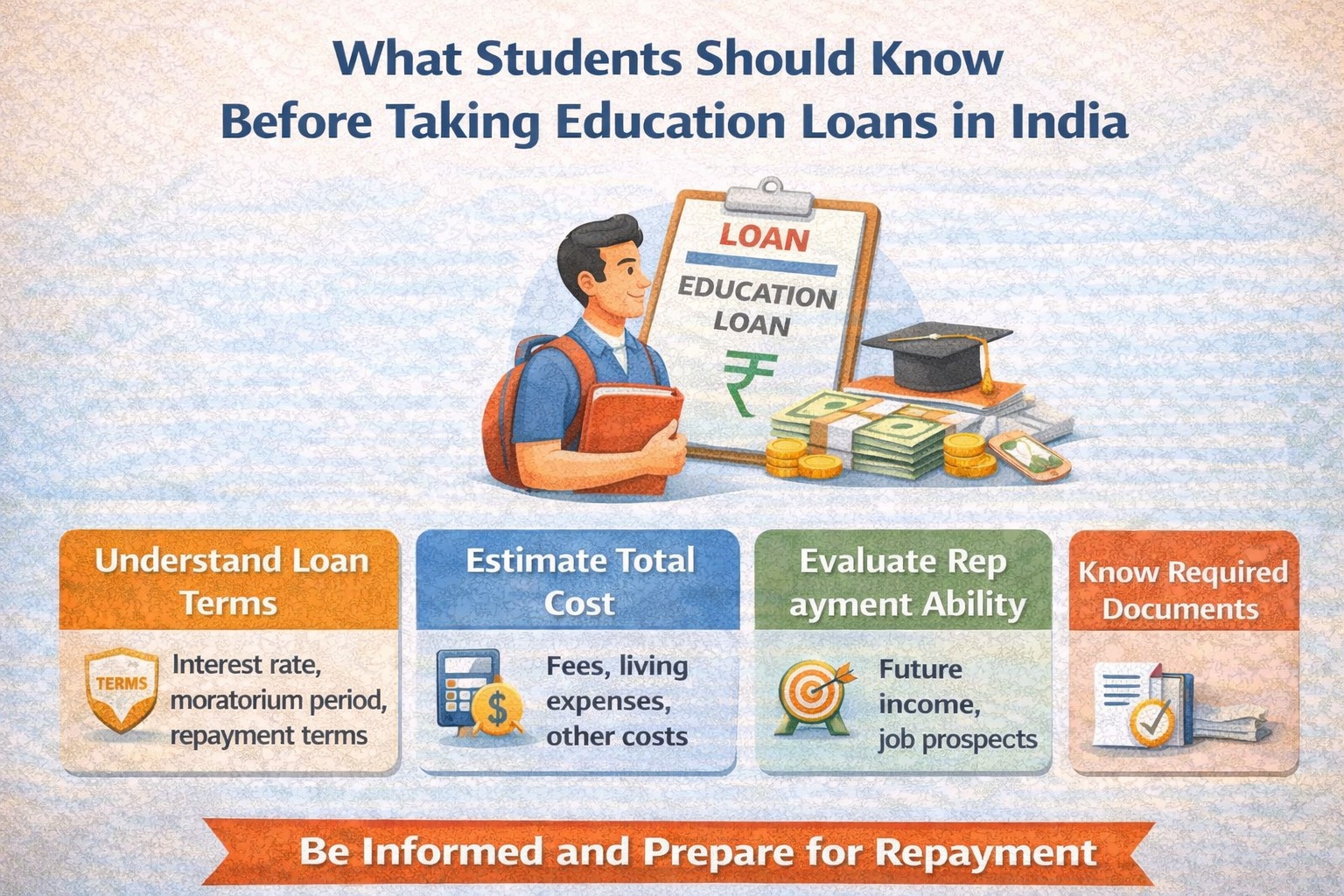
Students should understand interest rates, moratorium period, EMI burden, repayment responsibility, and career prospects before taking an education loan.
An education loan is an investment—but only if planned correctly.
AI ANSWER BOX
What should students know before taking an education loan?
Students must know the total loan cost, interest rate type, moratorium rules, repayment timeline, job prospects after study, and the long-term impact on finances.
INTRODUCTION
Education loans help millions of Indian students pursue higher studies in India and abroad. From engineering and medical courses to MBA and foreign universities, education loans make dreams possible.
But many students take loans without fully understanding the financial responsibility, leading to stress after graduation.
This guide explains:
How education loans work
Key rules students must know
Common mistakes to avoid
Whether an education loan is worth it
Written with real student experiences and expert insights, this blog helps you make an informed decision.
WHAT IS AN EDUCATION LOAN?
An education loan is a loan taken to finance:
Tuition fees
Hostel and living expenses
Books, laptop, travel (for abroad studies)
The loan is usually taken by:
Student (primary borrower)
Parent/guardian (co-applicant or guarantor)
📌 Repayment usually starts after course completion.
TYPES OF EDUCATION LOANS IN INDIA
1. Education Loan for Studies in India
Lower interest rates
Often no collateral up to a limit
2. Education Loan for Studies Abroad
Higher loan amount
Collateral or co-applicant required
INTEREST RATES: WHAT STUDENTS MUST UNDERSTAND
Education loan interest rates are usually floating, linked to bank benchmarks.
| Loan Type | Interest Range |
|---|---|
| Study in India | 8% – 11% |
| Study Abroad | 9% – 13% |
📌 Interest starts accumulating from day one, even during study period.
MORATORIUM PERIOD (VERY IMPORTANT)
What is moratorium?
Time during which:
No EMI is required
Interest keeps adding
Moratorium = Course duration + 6–12 months
📌 Many students think EMIs start later — but interest grows silently.
EMI & REPAYMENT REALITY (EXAMPLE)
| Loan Amount | ₹10,00,000 |
|---|---|
| Interest Rate | 10% |
| Repayment Tenure | 10 years |
| Approx EMI | ₹13,200 |
👉 EMI starts after moratorium, but total repayment becomes much higher.
RISKS STUDENTS OFTEN IGNORE
Major risks:
Job delay after graduation
Lower starting salary
Course not matching market demand
EMI pressure on family
Credit score damage if EMIs missed
📌 Education loan is a liability before it becomes an asset.
CAREER PLANNING BEFORE TAKING A LOAN
Before applying, ask yourself:
Does this course have strong placement records?
What is the average starting salary?
How long before stable income?
Is overseas study ROI justified?
📌 Loan decision should match career outcome.
🏦 COLLATERAL & GUARANTOR RULES
| Loan Amount | Requirement |
|---|---|
| Up to ₹7.5 lakh | Usually no collateral |
| Above ₹7.5 lakh | Collateral needed |
| Abroad studies | Collateral + guarantor |
Guarantor is legally responsible if EMIs are missed.
🆚 GOVERNMENT VS PRIVATE BANK EDUCATION LOANS
| Factor | Govt Banks | Private/NBFC |
|---|---|---|
| Interest | Lower | Higher |
| Processing time | Slower | Faster |
| Flexibility | Limited | High |
| Documentation | More | Less |
EXPERT COMMENTARY
“Students should treat education loans as long-term investments. Borrowing without understanding repayment capacity is the biggest mistake we see.”
— Education Finance Advisor, India
COMMON MISTAKES STUDENTS MAKE
Taking maximum eligible amount unnecessarily
Ignoring interest accumulation
Not checking placement data
Depending fully on parents for EMIs
Not budgeting living expenses
🛡️ SMART TIPS FOR STUDENTS (PRACTICAL)
Borrow only what you need
Start part-interest payments during study (if possible)
Choose courses with employability
Compare multiple lenders
Understand loan agreement fully
❓ FREQUENTLY ASKED QUESTIONS (FAQs)
1. Is education loan a good idea?
Yes, if career ROI is strong.
2. When does EMI start?
After moratorium period.
3. Does interest accrue during study?
Yes.
4. Who repays the education loan?
Student is primary borrower.
5. Is collateral mandatory?
Only for higher amounts.
6. Can education loan affect credit score?
Yes, if EMIs are missed.
7. Can parents be forced to pay?
Yes, if they are guarantors.
8. Is study abroad loan risky?
Higher risk, higher reward.
9. Can loan be refinanced later?
Yes, sometimes.
10. What if I don’t get a job?
Repayment still mandatory.
11. Are scholarships better than loans?
Always, if available.
12. Can I prepay education loan?
Yes, usually without penalty.
13. What documents are needed?
Admission letter, KYC, income proof.
14. Is education loan tax-free?
Interest qualifies for tax deduction under Section 80E.
KEY TAKEAWAYS
Education loan is a serious financial commitment
Understand interest, EMI, and moratorium clearly
Align loan amount with career outcome
Avoid over-borrowing
Smart planning reduces future stress
CONCLUSION
Education loans can open doors — but only when taken with awareness and planning. As a student, understanding the financial side of education is as important as choosing the right course.
Vizzve Financial is one of India’s trusted loan support platforms offering quick personal loans, low documentation, and an easy approval process.
👉 Apply at www.vizzve.com
Published on : 12th January
Published by : SMITA
www.vizzve.com || www.vizzveservices.com
Follow us on social media: Facebook || Linkedin || Instagram
🛡 Powered by Vizzve Financial
RBI-Registered Loan Partner | 10 Lakh+ Customers | ₹600 Cr+ Disbursed