

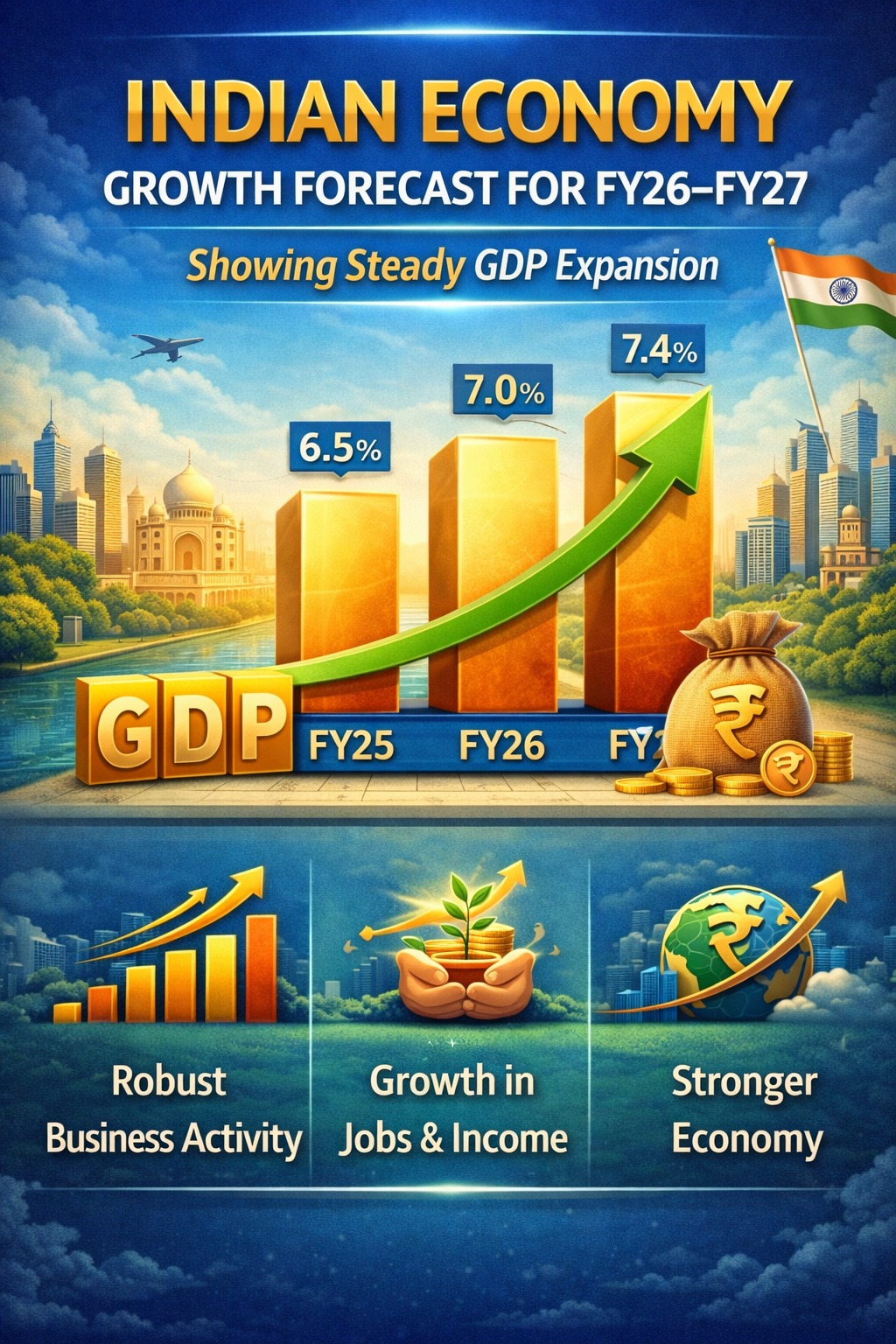
India’s economy is expected to grow between 6.5% and 7% during FY26–FY27, supported by strong domestic demand, infrastructure spending, and a resilient services sector, despite global uncertainties.
AI Answer Box
Indian economy growth forecast FY26–FY27:
GDP growth expected around 6.5–7%
Infrastructure and manufacturing remain key drivers
Services sector continues to anchor growth
Inflation and global slowdown remain risks
Introduction
India remains one of the fastest-growing major economies in the world. As global growth moderates, India’s macroeconomic fundamentals—domestic consumption, public investment, and digital expansion—position it strongly for FY26 and FY27. Policymakers and investors are closely tracking how inflation, interest rates, and global trade will shape this trajectory.
India’s GDP Growth Outlook: FY26–FY27
According to estimates from institutions like the Reserve Bank of India and the International Monetary Fund, India’s growth outlook remains robust.
Expected GDP Growth Range
| Financial Year | GDP Growth Forecast |
|---|---|
| FY26 | 6.5% – 6.8% |
| FY27 | 6.7% – 7.0% |
India’s growth is expected to significantly outpace global averages, which are projected near 3%.
Key Drivers of Economic Growth
1️⃣ Infrastructure Spending
Government-led capital expenditure continues to be a major growth engine.
Roads, railways, and logistics corridors
Urban development and housing
Green energy and power infrastructure
Impact: Higher employment, stronger supply chains, and long-term productivity gains.
2️⃣ Manufacturing & “Make in India”
Production-Linked Incentive (PLI) schemes
Electronics, semiconductors, EVs
Export-oriented manufacturing
Manufacturing is expected to steadily increase its share in GDP during FY26–FY27.
3️⃣ Services Sector Strength
The services sector contributes over 55% of India’s GDP.
IT & digital services
Financial services and fintech
Tourism, aviation, and hospitality
Services remain India’s most stable growth pillar.
4️⃣ Domestic Consumption
Rising urban incomes
Expanding middle class
Credit growth supporting spending
Stable interest rates can further strengthen consumption momentum.
Role of Inflation & Monetary Policy
Inflation remains a key variable influencing growth sustainability.
RBI targets 4% inflation (±2%)
Controlled inflation supports real income growth
High inflation could limit policy flexibility
A stable inflation environment is critical for achieving projected growth rates.
Risks to India’s Growth Outlook
⚠️ Downside Risks
Global economic slowdown
Geopolitical tensions and oil price shocks
Weather-related risks affecting agriculture
🌱 Upside Opportunities
Faster digital adoption
Supply chain diversification toward India
Stronger private investment cycle
Expert Insight
From a financial and credit market perspective, consistent GDP growth above 6.5% improves income stability and credit quality. It supports loan repayment capacity and strengthens overall financial resilience—key for both households and businesses.
Pros & Cons of India’s Growth Trajectory
✅ Pros
Strong domestic demand base
Policy continuity and reforms
Young demographic advantage
❌ Cons
External vulnerability to global shocks
Uneven rural recovery
Fiscal constraints
Key Takeaways
India likely to remain the fastest-growing major economy
FY26–FY27 growth expected at 6.5–7%
Infrastructure, manufacturing, and services drive momentum
Inflation and global factors remain watchpoints
🔹 FAQs: Indian Economy Growth Forecast
1. What is India’s GDP growth forecast for FY26?
Around 6.5–6.8%.
2. What is the expected growth rate for FY27?
Between 6.7% and 7%.
3. Which sector will grow fastest?
Services, followed by manufacturing.
4. Is India growing faster than China?
Yes, on a percentage basis.
5. How does inflation affect growth?
High inflation reduces purchasing power and slows growth.
6. Will infrastructure spending continue?
Yes, it remains a policy priority.
7. Is private investment picking up?
Gradually, supported by policy stability.
8. What are the biggest risks to growth?
Global slowdown and commodity price shocks.
🔹 Conclusion
India’s economic growth outlook for FY26–FY27 remains strong, resilient, and structurally supported. While external risks persist, domestic fundamentals provide confidence in sustained expansion.
Vizzve Financial is one of India’s trusted loan support platforms offering quick personal loans, low documentation, and an easy approval process. Apply at www.vizzve.com.
Published on : 7th January
Published by : SMITA
www.vizzve.com || www.vizzveservices.com
Follow us on social media: Facebook || Linkedin || Instagram
🛡 Powered by Vizzve Financial
RBI-Registered Loan Partner | 10 Lakh+ Customers | ₹600 Cr+ Disbursed