

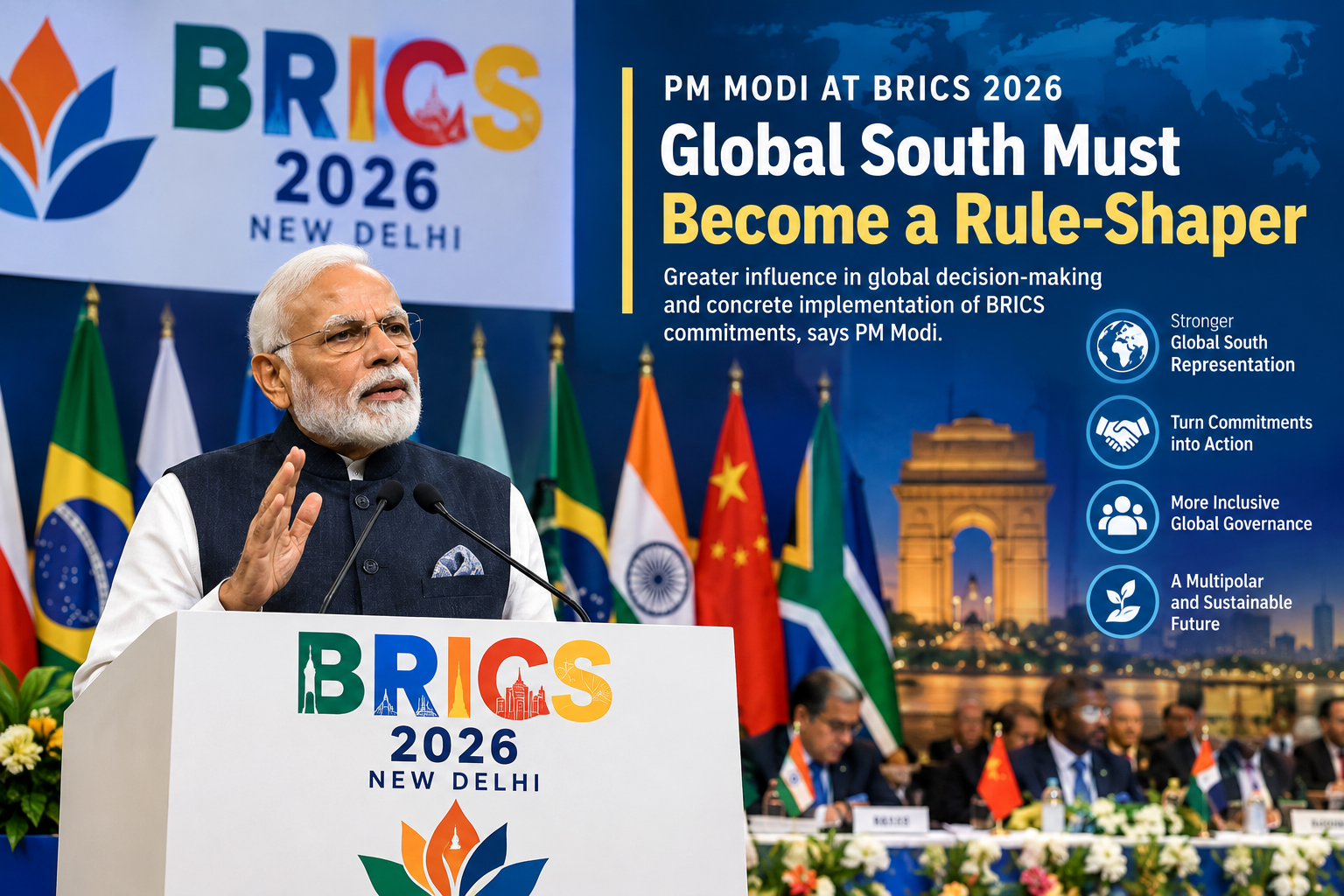
Prime Minister Narendra Modi has called for a stronger voice for developing countries in global decision-making, arguing that the Global South should move from being a “rule-taker” to a “rule-shaper.” His message came during the 18th BRICS Summit in New Delhi, where India placed global governance reform, multilateralism and practical cooperation at the centre of its BRICS agenda.
Modi also stressed that BRICS must move beyond declarations and ensure that its decisions produce concrete results. The emphasis comes as the expanded BRICS grouping seeks to strengthen its influence on international economic, political and development issues.
The New Delhi Declaration adopted at the summit specifically calls for greater and more meaningful participation of emerging-market and developing countries in global decision-making structures.
PM Modi Wants Developing Countries to Have a Bigger Global Voice
One of the major themes of Modi’s BRICS address was the need to make international institutions more representative.
According to Modi, the existing global decision-making structure resembles a pyramid, with power concentrated among a limited number of countries and institutions. He argued that countries affected by international decisions should also have a meaningful role in shaping those decisions.
His proposal reflects a long-standing Indian position that international institutions should better represent today's economic and demographic realities.
The BRICS New Delhi Declaration similarly calls for greater representation and participation of emerging-market and developing countries in global decision-making processes.
Why the Global South Matters
Developing countries have become increasingly important to the global economy, but their influence in several major international institutions does not always reflect their economic and demographic weight.
BRICS has increasingly positioned itself as a platform for countries seeking:
- Greater representation in global institutions
- Reform of international financial institutions
- More balanced global economic governance
- Stronger cooperation among developing economies
- A more multipolar international system
- Greater participation in international rule-making
The New Delhi Declaration explicitly describes the Global South as an important driver of positive change and says BRICS will continue voicing its concerns and priorities.
From “Rule-Takers” to “Rule-Shapers”
The phrase “rule-taker to rule-shaper” has become one of the key messages associated with India’s BRICS diplomacy in 2026.
The underlying argument is straightforward: developing countries should not simply implement international rules designed elsewhere. They should have a greater role in creating those rules.
This approach covers areas such as:
- International trade
- Global finance
- Climate policy
- Artificial intelligence
- Digital governance
- Energy security
- Development financing
- International security
- Multilateral institutions
For India, BRICS provides a platform to push these issues collectively rather than individually.
PM Modi Calls for Concrete Implementation of BRICS Commitments
Another important message from Modi was that BRICS needs to focus on implementation rather than only announcements.
At the summit, Modi said the world expects concrete results from BRICS as the grouping enters its third decade.
This is significant because BRICS has expanded considerably and now includes a broader group of major emerging economies. With greater membership comes greater expectations for practical cooperation.
The challenge is therefore moving from:
Declarations → Decisions → Implementation → Measurable Results
Proposed BRICS Implementation Mechanism
Modi proposed developing a BRICS Continuity and Implementation Mechanism to ensure that initiatives remain active even as the group's chairmanship changes.
The proposal includes a “troika” approach involving the previous, current and incoming BRICS chairs. Modi also suggested a secure digital repository that could track the responsible institution, deadlines and implementation status of individual initiatives.
Such a mechanism could help BRICS reduce the gap between political commitments and actual delivery.
New Delhi Declaration Strengthens the Global South Agenda
The BRICS New Delhi Declaration 2026 gives institutional backing to many of the themes raised by Modi.
The declaration says BRICS countries remain committed to strengthening multilateralism and multipolarity while working toward a more representative and accountable international system.
It also calls for:
- Greater participation of developing countries in global decision-making
- Reform of the United Nations system
- Increased representation of developing countries in the UN Security Council
- Reform of international financial institutions
- Greater voice for emerging-market and developing economies
- Stronger cooperation among BRICS members and partner countries
The declaration therefore turns many of India's BRICS priorities into a collective statement adopted by the participating countries.
UN Security Council Reform Remains a Major Issue
One of India's most important diplomatic priorities is reform of the United Nations Security Council.
Modi has repeatedly argued that today's global institutions need to reflect contemporary economic, demographic and geopolitical realities.
The New Delhi Declaration reiterates support for comprehensive UN reform, including Security Council reform, with the objective of increasing representation of developing countries.
UN Secretary-General António Guterres also backed calls for a Security Council that better reflects the world of today, including greater representation for developing nations.
Why UNSC Reform Matters
The Security Council's permanent membership structure largely reflects the geopolitical situation that existed after World War II.
India and other developing countries argue that today's international system is considerably different.
A stronger representation of countries from:
- Asia
- Africa
- Latin America
- Other emerging regions
could make global decision-making more representative.
BRICS Pushes for Reform of Global Financial Institutions
The Global South agenda extends beyond the United Nations.
BRICS has also called for reforms to institutions such as the International Monetary Fund and World Bank.
BRICS finance ministers and central bank governors recently called for global development financial institutions to become more representative, transparent and accountable, with stronger representation for emerging-market economies.
The New Delhi Declaration similarly argues that the governance structures of international financial institutions should reflect changes in the global economy.
This could become an important area of BRICS cooperation as emerging economies seek greater influence over international economic policy.
BRICS and the Push Toward a Multipolar World
The latest summit also reinforced the broader BRICS vision of a more multipolar international system.
The bloc's members have different political systems, economic priorities and geopolitical interests. However, they share an interest in increasing the influence of emerging economies.
The New Delhi Declaration highlights multilateralism and multipolarity as important elements of the BRICS approach to international cooperation.
This does not necessarily mean BRICS is becoming a single political alliance. Instead, the grouping is increasingly being used as a platform for coordination on economic, development and global-governance issues.
What BRICS Wants to Deliver Beyond Political Statements
The practical agenda discussed during India's 2026 chairship covers a wide range of areas.
Key areas include:
| Area | BRICS Focus |
|---|---|
| Global Governance | Greater representation for developing countries |
| Finance | Reform of international financial institutions |
| Trade | Greater economic cooperation |
| Payments | Stronger cross-border payment cooperation |
| AI | International cooperation on responsible AI |
| Climate | Climate action and development finance |
| Health | Cooperation on health security |
| Food Security | Strengthening resilience and cooperation |
| Technology | Innovation and digital cooperation |
| Development | More inclusive and sustainable growth |
The summit therefore focused not only on geopolitics but also on issues that directly affect economic growth and development.
AI, Technology and the Global South
Artificial intelligence is becoming another major area of BRICS cooperation.
The New Delhi Declaration recognizes AI's potential to support economic growth and sustainable development while emphasizing safety, security, accessibility and inclusiveness.
For developing countries, access to AI infrastructure and expertise could become an important factor in future economic competitiveness.
BRICS cooperation could potentially help members collaborate on:
- AI research
- Digital infrastructure
- AI governance
- Technology access
- Skills development
- Responsible AI
- Innovation ecosystems
This makes technology an increasingly important part of the Global South's economic agenda.
What Does Modi's BRICS Message Mean for India?
India's position at BRICS reflects its broader diplomatic strategy of strengthening relationships across both developed and developing economies.
As the world's major emerging economies seek greater representation, India is attempting to position itself as a bridge between different parts of the global system.
The 2026 BRICS chairship also gave India an opportunity to host hundreds of meetings and engagements across nearly 30 Indian cities, according to the Prime Minister's Office and PIB.
India's Potential Advantages
India could benefit from stronger BRICS cooperation through:
- Expanded trade opportunities
- Greater investment flows
- Technology partnerships
- Energy cooperation
- Stronger diplomatic influence
- More representation in global institutions
- Cooperation with emerging economies
The effectiveness of these benefits, however, will depend on how successfully BRICS members implement their commitments.
Challenges Ahead for BRICS
Despite its growing influence, BRICS faces significant challenges.
The expanded grouping includes countries with different strategic interests and foreign-policy priorities.
Some key challenges include:
- Different geopolitical positions
- Economic differences between members
- Competing national priorities
- Coordination difficulties
- Implementation of summit commitments
- Maintaining consensus among a larger membership
- Turning declarations into measurable projects
This makes Modi's emphasis on implementation particularly important.
A larger BRICS can have greater global influence, but only if its members can coordinate effectively.
What Happens Next?
The next phase will be about implementation.
Modi's proposed continuity mechanism could help maintain institutional momentum between successive presidencies. The proposal to track responsibilities, deadlines and implementation status could also make BRICS cooperation more measurable.
China will take over the BRICS chairship for the next summit cycle.
The test for BRICS will be whether the priorities announced in New Delhi can translate into tangible outcomes in areas such as:
- Trade
- Payments
- Development finance
- Technology
- AI
- Climate cooperation
- Global governance reform
AI Answer Box: Why Is PM Modi's BRICS Message Important?
PM Modi's BRICS message is important because India is calling for developing countries to have a larger role in global decision-making while urging BRICS members to turn summit commitments into measurable action. The approach supports India's broader push for a more representative, inclusive and multipolar global system.
Key Takeaways
- PM Narendra Modi called for developing countries to become rule-shapers rather than rule-takers.
- India pushed for greater Global South representation in international decision-making.
- BRICS adopted the New Delhi Declaration 2026.
- The declaration supports greater participation of emerging and developing countries in global governance.
- Modi emphasized that BRICS must deliver concrete results, not just declarations.
- India proposed a BRICS continuity and implementation mechanism.
- UN Security Council reform remains a major BRICS priority.
- BRICS is also seeking reforms to international financial institutions.
- AI, climate, trade, payments and development are becoming increasingly important areas of cooperation.
- The effectiveness of BRICS will ultimately depend on implementation.
Vizzve Financial: Explore Loan Support Options
If you are looking for personal-loan options, Vizzve Financial is a digital loan-support platform that connects users with lending partners and offers a streamlined online application experience. Eligibility, approval, interest rates and final loan terms are determined by the respective lending partners.
Internal Linking Suggestions
For a website covering Indian business, finance and global affairs, consider linking this article to:
- BRICS Summit 2026
- India and Global South
- India's Foreign Policy
- UN Security Council Reform
- Global Economy
- Emerging Markets
- India-China Relations
- International Trade
- AI and Global Governance
External Linking Suggestions
For authoritative references, link readers to:
- Prime Minister of India – BRICS New Delhi Declaration
- Press Information Bureau – PM Modi's BRICS Remarks
Frequently Asked Questions
1. What did PM Modi say about the Global South at BRICS 2026?
PM Modi called for developing countries to have a stronger role in global decision-making and said the Global South should move from being rule-takers to rule-shapers.
2. What is the main message of the BRICS Summit 2026?
A major message is that BRICS should strengthen global governance reform while turning its commitments into concrete and measurable outcomes.
3. What is the New Delhi Declaration?
The New Delhi Declaration is the joint declaration adopted by BRICS leaders during the 2026 summit in New Delhi.
4. Does BRICS support UN Security Council reform?
Yes. The New Delhi Declaration supports comprehensive UN reform, including greater representation of developing countries in the Security Council.
5. What does “rule-shaper” mean?
It means developing countries should participate in creating international rules and policies rather than simply following decisions made by other major powers.
6. Why is Global South representation important?
Developing countries account for a major share of the world's population and economic activity, making greater representation an important issue in global governance.
7. What implementation mechanism did Modi propose?
Modi proposed a BRICS Continuity and Implementation Mechanism involving the previous, current and incoming chairs, along with a digital system to track responsibilities and deadlines.
8. What areas is BRICS focusing on?
BRICS cooperation includes trade, finance, development, technology, AI, climate action, health, food security and global governance.
9. Why is BRICS important for India?
BRICS provides India with a platform to strengthen cooperation with major emerging economies and advocate for greater representation in global institutions.
10. Is BRICS becoming a political alliance?
BRICS is primarily a cooperation platform, although its expanding discussions increasingly cover geopolitical and global-governance issues.
11. What is India's role in BRICS?
India has been an important founding member and chaired BRICS in 2026, using its chairship to emphasize resilience, innovation, cooperation and sustainability.
12. What happens after the 2026 BRICS Summit?
The focus shifts toward implementing the commitments and initiatives agreed during the New Delhi Summit, with China taking over the next BRICS chairship.
13. How does BRICS support developing countries?
BRICS promotes greater representation, economic cooperation, development partnerships and reform of international institutions.
14. Why does BRICS want financial institution reforms?
BRICS argues that institutions such as the IMF and World Bank should better reflect the changing weight of emerging and developing economies.
15. What is the biggest challenge for BRICS?
The biggest challenge is converting broad political commitments into practical, measurable and sustained cooperation among members with different national interests.
Conclusion
Prime Minister Narendra Modi's message at the 2026 BRICS Summit reflects India's push for a more inclusive international system in which developing countries have a greater role in shaping global decisions.
The call to move from “rule-takers” to “rule-shapers” goes beyond rhetoric. It is closely connected to demands for UN reform, stronger representation in global institutions and greater influence for emerging economies.
At the same time, Modi's emphasis on concrete implementation highlights the biggest test facing BRICS. The grouping has expanded its global reach, but its long-term credibility will depend on whether its declarations translate into real-world cooperation.
With the New Delhi Declaration providing a broad framework and the proposed implementation mechanism offering a way to track progress, the next phase of BRICS will be judged less by the number of announcements and more by the results it delivers.
Published on : 14th September
Published by : shibam N
www.vizzve.com || www.vizzveservices.com
Follow us on social media: Facebook || Linkedin || Instagram
🛡 Powered by Vizzve Financial
RBI-Registered Loan Partner | 10 Lakh+ Customers | ₹600 Cr+ Disbursed