

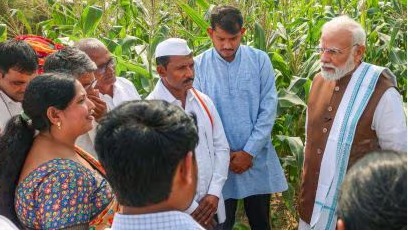
Prime Minister Narendra Modi has launched two ambitious agriculture schemes totaling ₹35,440 crore, aiming to uplift 100 underperforming farming districts across India. The schemes — PM Dhan Dhaanya Krishi Yojana and Dalhan Aatmanirbharta Mission — are designed to boost agricultural productivity, improve irrigation, strengthen supply chains, and make India self-sufficient in pulse production.
The launch marks one of the largest government pushes for the agricultural sector in recent years, targeting both short-term relief and long-term resilience for India’s farmers.
1️⃣ PM Dhan Dhaanya Krishi Yojana: Strengthening Rural Productivity
The PM Dhan Dhaanya Krishi Yojana has been allocated a budget of ₹24,000 crore. It aims to:
Enhance agricultural productivity through modern and sustainable practices.
Promote crop diversification and reduce dependency on a few major crops.
Strengthen irrigation facilities in drought-prone and underdeveloped districts.
Build storage and post-harvest infrastructure to reduce wastage and improve returns.
Increase access to credit and technology for small and marginal farmers.
This scheme will focus on identifying and supporting 100 low-performing districts where agricultural output and income levels remain below the national average.
2️⃣ Dalhan Aatmanirbharta Mission: Toward Self-Reliance in Pulses
The Dalhan Aatmanirbharta Mission, with an outlay of ₹11,440 crore, is centered on boosting India’s domestic pulse production and reducing import dependence. Its objectives include:
Expanding the area under pulse cultivation.
Increasing yield per hectare through modern farming techniques.
Enhancing seed availability and research support for pulse varieties.
Improving the pulse value chain — from production to storage and processing.
Ensuring price stability for farmers through efficient procurement mechanisms.
Given the rising demand for pulses and India’s reliance on imports, this mission aims to achieve both food security and nutritional security for millions of households.
3️⃣ Complementary Agriculture Projects
Alongside these flagship schemes, the Prime Minister also inaugurated additional agricultural, fisheries, and food processing projects worth over ₹5,450 crore, with new projects worth ₹815 crore launched in allied sectors.
These projects include:
Cold chain and warehousing facilities for perishable goods.
Integrated agro-processing clusters to create local employment.
Dairy, fishery, and livestock initiatives to diversify rural income sources.
Agri-tech and food processing innovations to modernize farming operations.
4️⃣ Why These Schemes Matter
Focused District Approach: By targeting 100 low-productivity districts, the schemes ensure that resources reach the regions most in need.
Reduced Import Dependence: The focus on pulses aligns with India’s goal of becoming self-reliant in essential food crops.
Higher Farmer Incomes: Better irrigation, infrastructure, and access to credit can significantly enhance farmer earnings.
Improved Nutrition: Increasing pulse production directly supports India’s efforts to tackle malnutrition and ensure protein security.
Sustainable Agriculture: The push for modern techniques and efficient water usage aligns with environmental and long-term farming goals.
5️⃣ Implementation Challenges
While the schemes have strong potential, their success depends on:
Effective coordination among central and state agencies.
Monitoring and transparency in fund allocation and use.
Adapting to climate challenges, such as erratic rainfall and soil degradation.
Ensuring inclusion of small and marginal farmers who often face access barriers.
Strong local governance, digital tracking systems, and farmer participation will be crucial for achieving the desired outcomes.
Conclusion
The ₹35,440 crore agricultural package launched by PM Modi represents a major milestone in India’s rural and agricultural development. By combining productivity-oriented strategies with sustainability and self-reliance goals, these schemes can transform India’s agri-economy and empower farmers across the nation.
With effective implementation, this initiative could be a turning point — making agriculture not only more profitable but also more resilient to future challenges.
🌾 Frequently Asked Questions (FAQs)
1. What are the new agriculture schemes launched by PM Modi?
Prime Minister Narendra Modi has launched two major schemes — PM Dhan Dhaanya Krishi Yojana and Dalhan Aatmanirbharta Mission — with a total budget of ₹35,440 crore to enhance agricultural productivity and make India self-reliant in pulse production.
2. What is the objective of the PM Dhan Dhaanya Krishi Yojana?
The objective of the PM Dhan Dhaanya Krishi Yojana is to boost agricultural productivity in 100 underperforming districts by improving irrigation, introducing modern farming techniques, expanding crop diversification, and building better post-harvest infrastructure.
3. What is the Dalhan Aatmanirbharta Mission?
The Dalhan Aatmanirbharta Mission focuses on increasing India’s domestic pulse production to reduce import dependency. It promotes research, seed development, and farmer incentives to achieve food and nutritional security.
4. How much funding has been allocated to these schemes?
A total of ₹35,440 crore has been allocated — ₹24,000 crore for the PM Dhan Dhaanya Krishi Yojana and ₹11,440 crore for the Dalhan Aatmanirbharta Mission.
5. How will farmers benefit from these schemes?
Farmers will benefit from improved irrigation, access to credit, better market linkages, and advanced farming tools. These measures are expected to increase yields, reduce wastage, and improve income levels.
Published on : 12th October
Published by : SMITA
www.vizzve.com || www.vizzveservices.com
Follow us on social media: Facebook || Linkedin || Instagram
🛡 Powered by Vizzve Financial
RBI-Registered Loan Partner | 10 Lakh+ Customers | ₹600 Cr+ Disbursed
https://play.google.com/store/apps/details?id=com.vizzve_micro_seva&pcampaignid=web_share