

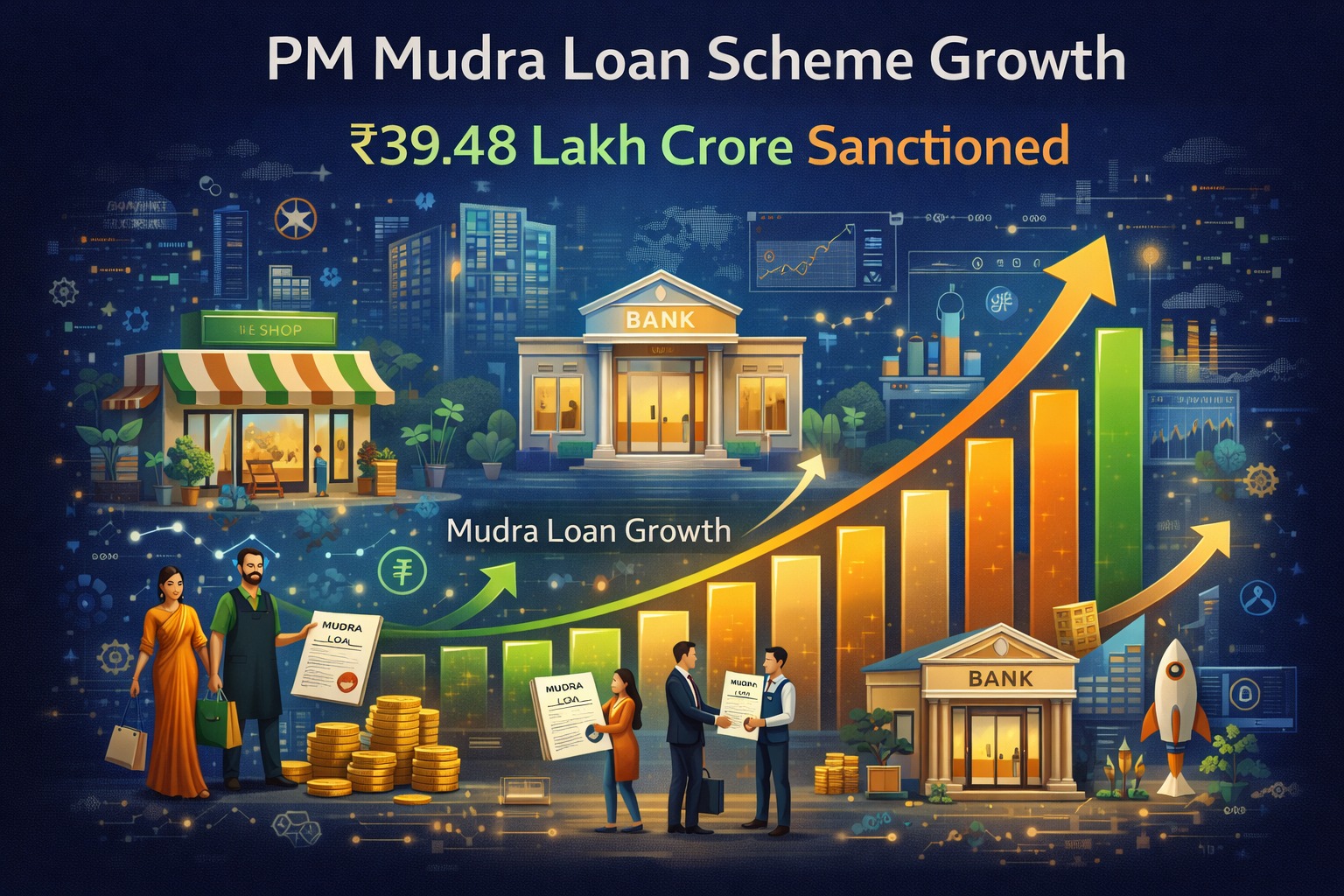
India’s flagship micro-finance initiative, the Pradhan Mantri Mudra Yojana (PM-MUDRA), has achieved a significant milestone with ₹39.48 lakh crore in loans sanctioned so far, according to Nirmala Sitharaman, India’s Finance Minister.
The announcement highlights the massive scale of the government’s efforts to promote entrepreneurship, financial inclusion, and small business growth across the country.
One of the most notable aspects of the scheme is its low Non-Performing Asset (NPA) ratio of around 2%, which indicates relatively strong repayment performance among borrowers.
Since its launch, the scheme has supported millions of small businesses, startups, and micro-entrepreneurs by providing access to credit without requiring large collateral.
AI Answer Box
What is the latest update on PM-MUDRA loans?
Under the Pradhan Mantri Mudra Yojana, banks and financial institutions in India have sanctioned ₹39.48 lakh crore in loans, while the NPA ratio remains around 2%, according to Finance Minister Nirmala Sitharaman.
Key Highlights
| Indicator | Data |
|---|---|
| Total loans sanctioned | ₹39.48 lakh crore |
| NPA level | Around 2% |
| Scheme objective | Support small businesses |
| Target borrowers | MSMEs, entrepreneurs |
What Is the PM-MUDRA Scheme?
The Pradhan Mantri Mudra Yojana is a government initiative launched in 2015 to provide collateral-free loans to micro and small enterprises.
The program is implemented through banks, microfinance institutions, and non-banking financial companies.
Main Objectives
Promote entrepreneurship
Support small businesses
Expand financial inclusion
Generate employment
The scheme primarily targets micro-enterprises and small entrepreneurs who often struggle to access formal credit.
Mudra Loan Categories
Loans under the scheme are classified into three categories depending on the stage of the business.
| Category | Loan Amount | Target Borrowers |
|---|---|---|
| Shishu | Up to ₹50,000 | Early-stage entrepreneurs |
| Kishore | ₹50,000 – ₹5 lakh | Growing businesses |
| Tarun | ₹5 lakh – ₹10 lakh | Established small enterprises |
These categories ensure that businesses at different stages receive appropriate financial support.
Growth of Mudra Loans in India
Since its launch, the Mudra scheme has grown rapidly.
Key Milestones
| Year | Growth Trend |
|---|---|
| 2015 | Scheme launched |
| 2018 | Rapid increase in beneficiaries |
| 2022 | Millions of small businesses supported |
| 2026 | ₹39.48 lakh crore loans sanctioned |
This expansion reflects the growing demand for micro-enterprise financing in India.
Why the Low NPA Rate Is Important
One of the most encouraging aspects of the Mudra scheme is its low NPA level of around 2%.
Why This Matters
Indicates strong repayment discipline
Shows effectiveness of lending model
Builds confidence among lenders
Supports financial stability
Low NPAs suggest that many borrowers are successfully running businesses and repaying loans.
Impact on MSME Sector
India’s MSME sector is one of the biggest beneficiaries of the Mudra scheme.
Contribution of MSMEs
| Indicator | Impact |
|---|---|
| Employment | Millions of jobs created |
| Economic growth | Strong contribution to GDP |
| Exports | Significant share of exports |
By improving access to credit, Mudra loans help small businesses expand operations and generate employment.
Role in Financial Inclusion
The scheme has also played a major role in expanding financial access.
Financial Inclusion Benefits
Credit access for rural entrepreneurs
Support for women-led businesses
Increased banking penetration
Growth of micro enterprises
Many borrowers under the scheme were previously outside the formal banking system.
Expert Commentary
Economic experts believe the success of the Mudra scheme demonstrates the importance of targeted credit programs for small businesses.
Key observations include:
Micro-enterprises need easy access to capital
Government-backed lending improves credit reach
Small business growth strengthens the overall economy
However, experts also stress the importance of continuous monitoring to ensure loan quality and sustainability.
Challenges Facing Mudra Scheme
Despite strong growth, the program faces some challenges.
Key Concerns
Credit risk management
Business sustainability for small borrowers
Monitoring loan utilization
Ensuring long-term financial stability
Addressing these challenges will be crucial for the continued success of the scheme.
Future Outlook
The future of the Mudra scheme appears promising as India continues to focus on entrepreneurship and small business development.
Expected Developments
Expansion of MSME credit programs
Increased digital lending platforms
More support for startups
Integration with other government schemes
The scheme is expected to remain a key pillar of India’s financial inclusion strategy.
Key Takeaways
₹39.48 lakh crore loans have been sanctioned under the Mudra scheme.
The NPA level remains around 2%, indicating strong loan performance.
The program supports small businesses and micro-entrepreneurs.
Mudra loans promote financial inclusion and job creation.
The scheme continues to play a crucial role in India’s MSME growth.
Frequently Asked Questions (FAQs)
1. What is PM-MUDRA scheme?
The Pradhan Mantri Mudra Yojana provides collateral-free loans to small businesses and entrepreneurs.
2. How much loan has been sanctioned under Mudra scheme?
According to Nirmala Sitharaman, ₹39.48 lakh crore has been sanctioned so far.
3. What is the NPA level in Mudra loans?
The NPA ratio is around 2%.
4. Who can apply for Mudra loans?
Small businesses, startups, and micro-entrepreneurs.
5. What are the Mudra loan categories?
Shishu, Kishore, and Tarun.
6. Is collateral required for Mudra loans?
No, Mudra loans are typically collateral-free.
7. What is the maximum Mudra loan amount?
Up to ₹10 lakh.
8. Which banks provide Mudra loans?
Public sector banks, private banks, NBFCs, and microfinance institutions.
9. How does Mudra scheme support MSMEs?
It provides access to credit for small businesses.
10. When was Mudra scheme launched?
It was launched in 2015.
11. Are Mudra loans beneficial for startups?
Yes, they help startups access early-stage funding.
12. Is Mudra scheme part of financial inclusion?
Yes, it promotes financial inclusion across India.
13. Can women entrepreneurs apply for Mudra loans?
Yes, many women entrepreneurs benefit from the scheme.
14. How does Mudra scheme impact the economy?
It boosts entrepreneurship, employment, and MSME growth.
15. Is Mudra scheme still active?
Yes, it continues to provide loans through banks.
Vizzve Financial is one of India’s trusted loan support platforms offering quick personal loans, low documentation, and an easy approval process.
Whether you need funds for emergencies or business needs, applying is simple and fast.
👉 Apply now at www.vizzve.com
Published on : 17th March
Published by : SMITA
www.vizzve.com || www.vizzveservices.com
Follow us on social media: Facebook || Linkedin || Instagram
🛡 Powered by Vizzve Financial
RBI-Registered Loan Partner | 10 Lakh+ Customers | ₹600 Cr+ Disbursed