

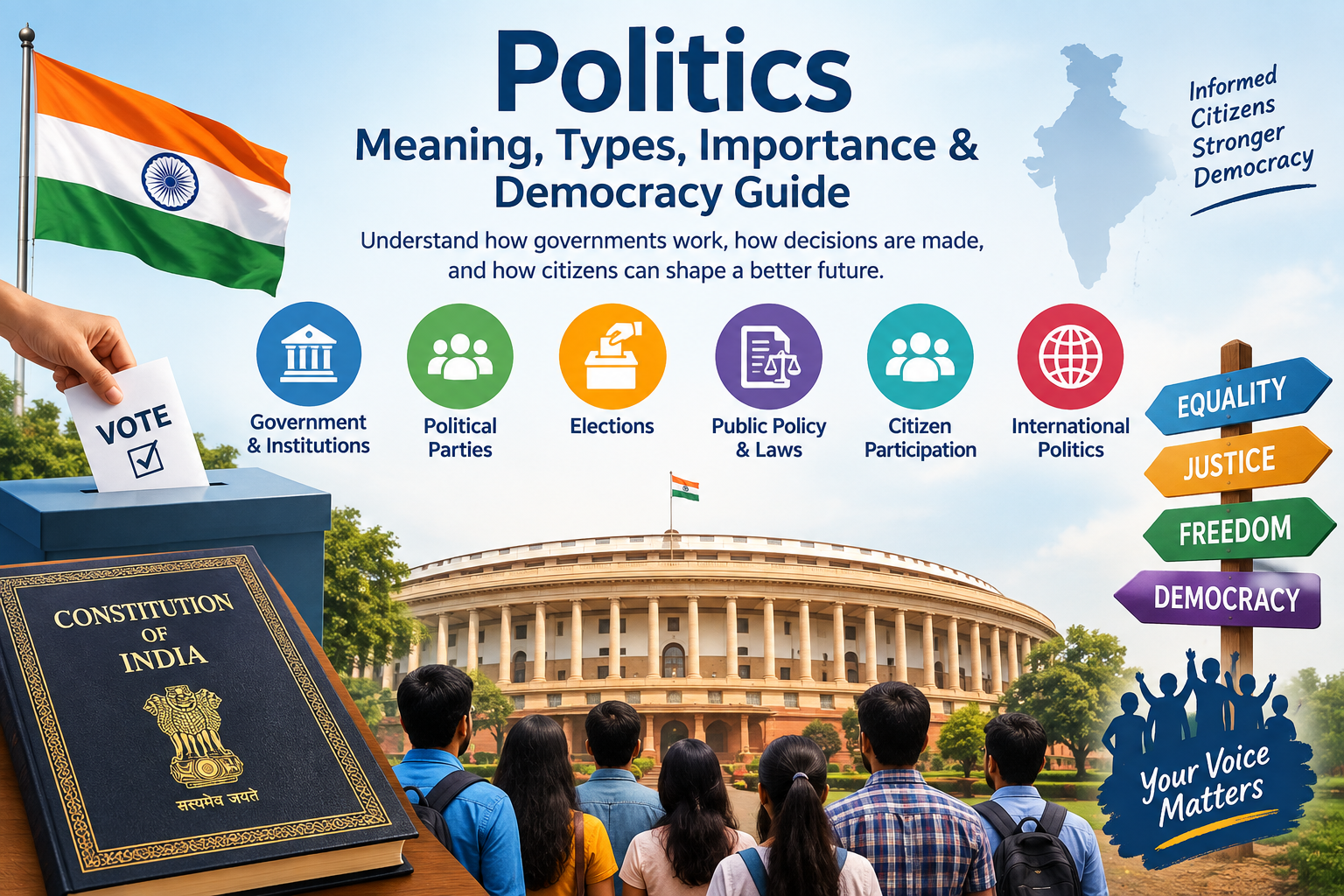
Introduction
Politics is part of everyday life, even when people do not actively follow political news. The price of essential goods, quality of public transport, education policies, healthcare services, employment opportunities, and local development can all be affected by political decisions.
But what exactly is politics? Is it only about elections, political parties, and government leaders? Or does it involve something much broader?
Politics is the process through which people and institutions make collective decisions, distribute power, manage public resources, and resolve competing interests. It operates at the national, state, and local levels, as well as within organizations and communities.
In a democracy, politics gives citizens a way to participate in public decision-making. People can vote, discuss policies, question public officials, join political parties, and express their views through lawful civic activities.
This guide explains the meaning of politics, its major types, how political systems work, why elections matter, and how ordinary citizens can become more informed participants in public life.
AI Answer Box: What Is Politics?
Quick answer
Politics is the process of making collective decisions, exercising power, and managing competing interests in society. It includes government, elections, political parties, public policy, lawmaking, and citizen participation.
In a democracy, politics helps people choose representatives and influence decisions that affect their communities. It is not limited to elections; it also includes public debate, accountability, governance, and the protection of rights.
3. What Is Politics? Meaning, Definition, and Explanation
Politics is a broad subject that studies how power is gained, used, shared, and challenged in society. It explains how people make decisions when they have different needs, values, and interests.
For example, a government may need to decide how much money to allocate to education, healthcare, roads, or public welfare. These choices involve priorities, competing demands, and decisions about the use of public resources.
Simple definition of politics
Politics is the activity of making decisions for a group or society, especially decisions involving power, government, and public affairs.
Meaning of politics in political science
In political science, politics is studied as the process of:
Making collective decisions.
Organizing and exercising political power.
Forming governments and institutions.
Creating and implementing public policies.
Resolving conflicts between different interests.
Holding decision-makers accountable.
The subject is closely related to government, law, economics, sociology, history, and international relations.
Politics vs government
Politics and government are connected, but they are not the same.
| Politics | Government |
|---|---|
| The process of making collective decisions. | The institutions that exercise public authority. |
| Includes debates, elections, parties, and public participation. | Includes the executive, legislature, and judiciary. |
| Can happen inside and outside formal government. | Operates through formal laws and institutions. |
| Involves power, interests, and public choices. | Implements laws and administers public affairs. |
Example: A debate about a new education policy is politics. The government department responsible for implementing that policy is government.
4. Why Is Politics Important in Everyday Life?
Politics affects how societies are organized and how public decisions are made. Even people who do not belong to political parties are affected by political choices.
4.1 Politics shapes public policy
Public policy refers to decisions and actions taken by governments to address public issues.
Examples include:
Education and school infrastructure.
Healthcare and public hospitals.
Roads, transport, and urban planning.
Employment and economic development.
Environmental protection.
Social welfare and public services.
Political decisions influence which problems receive attention and how public funds are used.
4.2 Politics protects and organizes rights
Constitutions and laws establish rights, duties, and limits on government power. In India, the Constitution provides the legal foundation for democratic government and Fundamental Rights.
The Supreme Court of India describes the Constitution as the supreme legal authority and explains its role in establishing the legislature, executive, and judiciary.
India
4.3 Politics gives citizens a voice
Citizens can participate in public life through:
Voting in elections.
Joining public consultations.
Contacting elected representatives.
Participating in community organizations.
Peaceful lawful protest.
Discussing public policies.
Following reliable news and official information.
Democracy involves more than choosing representatives. The World Bank describes democratic participation and accountability as important parts of effective public governance.
World Bank
4.4 Politics influences economic decisions
Governments make decisions about taxation, public spending, infrastructure, trade, regulation, and economic development.
These decisions can affect businesses, workers, consumers, and households. However, the economic effects of any particular policy depend on its design, implementation, and wider conditions.
4.5 Politics helps resolve social conflicts
Different groups may disagree about land use, public spending, education, employment, environmental rules, or cultural issues.
Political institutions provide ways to debate these differences and make decisions through established processes.
5. Major Types of Politics
Politics can be studied at different levels and in different settings. The following categories help explain how political activity works.
5.1 National politics
National politics concerns issues affecting an entire country.
Examples include:
National economic policy.
Foreign relations.
National security.
Constitutional matters.
National legislation.
Central government programs.
In India, Parliament is part of the Union government’s legislative structure.
5.2 State politics
State politics focuses on decisions made by state governments and legislatures.
Examples include:
State-level public health.
State education administration.
Agriculture-related policies.
State infrastructure.
Law and order responsibilities assigned under the Constitution.
State budgets.
State governments operate within the constitutional division of powers between the Union and the States.
5.3 Local politics
Local politics concerns decisions affecting towns, cities, villages, and local communities.
Examples:
Municipal roads.
Waste management.
Water supply.
Local planning.
Community facilities.
Local development priorities.
Local government is important because many public services are experienced directly within communities.
5.4 Party politics
Party politics involves the activities of political parties.
Political parties may:
Develop policy platforms.
Select candidates.
Organize campaigns.
Mobilize supporters.
Form governments or opposition groups.
Debate legislation.
The Election Commission of India publishes information about political party registration and recognition.
Election Commission of India
5.5 Electoral politics
Electoral politics centers on elections and the process through which citizens choose representatives.
It includes:
Voter registration.
Candidate nominations.
Election campaigns.
Voting.
Vote counting.
Election results.
Election rules and oversight.
5.6 International politics
International politics examines relationships between countries and global institutions.
Key topics include:
Diplomacy.
International trade.
Treaties.
Global security.
Climate negotiations.
International organizations.
Cross-border cooperation.
5.7 Organizational politics
Organizational politics refers to influence, negotiation, and competing interests within institutions such as businesses, universities, and associations.
This use of the word is broader than government politics. It describes how people influence decisions within an organization.
6. How Does Democracy Work?
Democracy is a system of government in which political authority is connected to the people. It commonly involves elections, participation, rights, and accountability.
The precise institutions differ between countries, but democratic systems generally depend on established rules for choosing leaders and making public decisions.
6.1 Core features of democracy
Elections
Citizens choose representatives through an established electoral process.
Rule of law
Public authorities operate under the law.
Citizen participation
People can engage in public affairs through lawful civic activities.
Rights and accountability
Institutions and public officials are subject to legal and public scrutiny.
6.2 Democracy in India
India is constitutionally a democratic republic with a parliamentary form of government. The Constitution establishes the Union and State governments and defines the powers and responsibilities of public institutions.
India
Key institutions in Indian democracy
| Institution | Main role |
|---|---|
| Parliament | Makes laws at the Union level and performs legislative and oversight functions. |
| Union Executive | Administers Union government affairs. |
| State Legislatures | Make laws within their constitutional powers. |
| State Executive | Administers state government affairs. |
| Judiciary | Interprets law and reviews government action within its constitutional role. |
| Election Commission of India | Administers elections assigned to it under Article 324. |
The Supreme Court of India explains the constitutional roles of the legislature, executive, and judiciary. The Election Commission of India is responsible for administering elections to Parliament, State Legislative Assemblies, and specified constitutional offices.
India
+1
7. What Are Political Parties?
A political party is an organized group of people who share political goals or policy ideas and seek to influence government or gain political office through established political processes.
Political parties are central to representative democracy because they help organize candidates, develop platforms, and present different choices to voters.
7.1 Functions of political parties
Representation
Political parties bring different social and political interests into public debate.
Policy development
Parties may publish manifestos describing their proposed programs and policies.
Candidate selection
Parties select or support candidates for elections.
Public participation
Parties organize meetings, campaigns, discussions, and other activities.
Government formation and opposition
Parties may form governments or serve in opposition, depending on election results and constitutional arrangements.
7.2 What is an election manifesto?
An election manifesto is a document that outlines a political party’s major policies, programs, and goals.
The Election Commission of India describes manifestos as reference documents that help the public understand what political parties stand for and compare their policies and programs.
Election Commission of India
How to read a manifesto
When examining a manifesto, look for:
The specific policy being proposed.
The intended beneficiaries.
The proposed implementation timeline.
The estimated cost, where available.
The responsible government department.
Any stated funding sources.
Measurable targets.
Relevant legal or constitutional requirements.
A manifesto is a statement of intended policy, not automatically a guarantee that every proposal will be implemented.
8. How Do Elections Work in India?
Elections are a central part of representative democracy. They provide a process through which citizens choose representatives.
The Election Commission of India administers elections to the Lok Sabha, Rajya Sabha, State Legislative Assemblies, and the offices of the President and Vice-President under its constitutional mandate.
Election Commission of India
8.1 Main stages of an election
Election schedule announced
The Election Commission announces the schedule for the election.
Candidate nominations
Candidates submit nomination papers according to the applicable election law.
Scrutiny and withdrawal
Nomination papers are examined, and candidates may withdraw where permitted.
Campaign period
Candidates and political parties communicate their policies and seek public support.
Voting
Eligible voters cast their votes through the prescribed voting process.
Counting and declaration
Votes are counted and results are declared according to the applicable rules.
What is the Model Code of Conduct?
The Model Code of Conduct is a set of norms for political parties and candidates during elections.
According to the Election Commission of India, it comes into effect from the announcement of the election schedule and remains operational until the election process is completed. It covers electioneering, meetings, processions, conduct on polling day, and the use of official machinery.
Election Commission of India
9. Politics in India: Constitutional and Democratic Framework
India’s political system is shaped by its Constitution, laws, elected institutions, and electoral processes.
9.1 Parliamentary government
India follows a parliamentary form of government. Parliament consists of the President and two Houses:
Lok Sabha.
Rajya Sabha.
The constitutional structure and functions of Parliament are described by the Supreme Court of India.
India
9.2 Federal structure
India has a Union and State system of government. Legislative and executive responsibilities are divided under the Constitution.
This means that some matters are primarily handled at the Union level, some at the State level, and others may involve shared constitutional responsibilities.
9.3 Fundamental Rights
Fundamental Rights are constitutional protections provided to citizens and, in certain cases, other persons.
They are important to democratic life because they provide legal protections for individuals and help establish limits on government action.
The Supreme Court of India identifies Fundamental Rights and judicial review as key features of India’s constitutional framework.
India
9.4 Election Commission of India
The Election Commission of India is a constitutional body established under Article 324.
Its responsibilities include the superintendence, direction, and control of elections to Parliament, State Legislatures, and the offices of President and Vice-President, as provided by the Constitution and applicable laws.
Election Commission of India
Official election resources
Election Commission of India
Election laws and electoral information
Constitution of India — Supreme Court of India
10. Political Science: Understanding Politics as an Academic Subject
Political science is the systematic study of politics, government, institutions, political behavior, and public policy.
It helps explain how political systems operate and how political decisions affect societies.
10.1 Major branches of political science
| Branch | What it studies |
|---|---|
| Political theory | Ideas about justice, freedom, equality, power, and the state. |
| Comparative politics | Political systems and institutions across countries. |
| International relations | Relationships between countries and global institutions. |
| Public administration | How government programs and services are managed. |
| Public policy | How public problems are addressed through government action. |
| Indian politics | Political institutions, parties, elections, and governance in India. |
10.2 Why study political science?
Studying political science can help people:
Understand government institutions.
Analyze public policy.
Read political news critically.
Understand constitutional rights.
Evaluate political arguments.
Research political systems.
Participate more effectively in civic life.
11. Politics and Public Policy
Public policy is one of the most practical areas of politics because it connects political decisions with everyday outcomes.
A policy may address a public problem, define government responsibilities, and establish how resources are used.
11.1 Examples of public policy areas
Education.
Healthcare.
Employment.
Agriculture.
Transport.
Housing.
Environmental protection.
Digital governance.
Public finance.
11.2 How to evaluate a public policy
A useful policy review should ask:
What problem is the policy intended to solve?
Who is affected?
What evidence supports the proposal?
What will implementation cost?
Which institution is responsible?
What are the possible benefits?
What are the possible disadvantages or trade-offs?
How will outcomes be measured?
Example: Public transport policy
Suppose a city proposes expanding bus services.
| Question | What to examine |
|---|---|
| Problem | Is existing public transport insufficient? |
| Proposed action | More buses, routes, or improved service frequency. |
| Cost | Capital costs and ongoing operating expenses. |
| Benefits | Accessibility, travel time, and mobility. |
| Risks | Funding gaps, implementation delays, or uneven coverage. |
| Evaluation | Ridership, reliability, and service coverage. |
This approach helps separate the stated objective of a policy from its actual implementation and results.
12. Politics, Media, and Social Media
Media plays an important role in how citizens receive political information.
News reports, official documents, interviews, debates, and social media posts can all shape public understanding.
However, different sources may present different levels of evidence, context, and reliability.
12.1 How to identify reliable political information
Check the source
Look for the original government document, official announcement, legislation, court judgment, or election authority publication when possible.
Check the date
Political facts can change. A statement from an earlier election may not describe the current situation.
Separate facts from opinions
A factual statement describes something that can be verified. An opinion expresses an interpretation or judgment.
Check the context
A short video clip or headline may omit important details from the full statement.
Compare primary and secondary sources
Primary sources include official documents and original statements. Secondary sources include reporting and analysis that interpret those materials.
12.2 Political misinformation
Misinformation can include:
False election claims.
Misleading statistics.
Altered images.
Fabricated quotations.
Outdated information presented as current.
Misleading video clips.
Unverified claims about candidates or institutions.
A simple fact-checking process
Identify the exact claim.
Find the original source.
Check the date and context.
Compare with reliable independent reporting.
Avoid sharing unverified claims.
13. How Can Citizens Participate in Politics?
Political participation is not limited to becoming a candidate or joining a political party. Citizens can engage in many ways.
Step-by-step guide to becoming politically aware
Learn the basics
Understand the Constitution, government institutions, elections, and public policy.
Follow reliable news
Read information from established news organizations and official sources.
Understand local issues
Learn about roads, water, education, healthcare, transport, and other concerns in your community.
Compare policy proposals
Read manifestos and official policy documents rather than relying only on campaign slogans.
Verify election information
Check voter registration, polling information, and election rules through the Election Commission.
Participate lawfully
Vote when eligible, communicate with representatives, and take part in lawful civic activities.
Why voter awareness matters
Informed participation helps citizens understand their choices and the responsibilities of public institutions. The Election Commission’s SVEEP program focuses on voter education, electoral participation, and ethical and informed voting.
Election Commission of India
14. Advantages and Challenges of Politics
Politics can help societies make collective decisions, but political systems also face difficulties.
Pros of politics
Helps organize public decision-making.
Provides ways to represent different interests.
Enables the formation of governments.
Supports public debate.
Can improve accountability.
Creates mechanisms for resolving disputes.
Helps shape public policy and resource allocation.
Cons and challenges of politics
Political disagreements can create division.
Public decisions may involve difficult trade-offs.
Campaigns can spread misinformation.
Political institutions may face corruption or conflicts of interest.
Policy implementation may be slow.
Public debate can become overly focused on personalities.
Different groups may disagree about priorities and outcomes.
Important: These are general features and challenges, not a judgment about any particular political party, leader, or government.
15. Comparison Table: Different Political Systems
Political systems organize authority and decision-making in different ways.
| Political system | Basic feature | Typical decision-making structure |
|---|---|---|
| Democracy | Political authority is connected to the people. | Elections and representative or participatory institutions. |
| Parliamentary system | Government is formed through the legislature. | Executive is politically accountable to the legislature. |
| Presidential system | Executive leadership is separately elected from the legislature. | President leads the executive branch under constitutional rules. |
| Monarchy | Head of state is a monarch. | Constitutional or other arrangements vary by country. |
| Authoritarian system | Political power is concentrated and political competition may be restricted. | Authority is exercised through concentrated institutions. |
The labels describe broad institutional arrangements. Actual political systems vary significantly in their laws, rights, institutions, and practices.
16. Expert Commentary and Trust-Building Insights
What do political science experts emphasize?
Political science research commonly examines institutions, political participation, representation, public accountability, and the relationship between government decisions and social outcomes.
The World Bank’s discussion of democracy highlights two central ideas: contestation through competitive politics and participation by citizens. It also notes that national elections alone do not guarantee a fully functioning democracy.
World Bank
Practical insight
A useful way to understand politics is to ask three questions:
Who makes the decision?
What rules govern the decision?
How can citizens examine or influence the outcome?
These questions help readers move beyond political headlines and understand the institutions behind public decisions.
Real-world experience points
People often encounter politics through ordinary situations:
A resident follows a municipal road or water issue.
A student learns about education policy.
A voter compares candidate positions.
A business owner studies a new regulation.
A community group raises concerns about local development.
A citizen contacts a public office about a government service.
These examples show how political decisions connect with everyday life. They are illustrative situations, not survey findings or claims about the experiences of a particular population.
17. Key Takeaways
Politics in brief
Politics is the process of making collective decisions and exercising power.
It includes elections, government, political parties, public policy, and civic participation.
Democracy depends on institutions, elections, rights, and accountability.
India has a constitutional parliamentary democratic system.
The Election Commission of India administers elections within its constitutional mandate.
Political awareness helps citizens understand policies and public decisions.
Reliable information should be checked against original sources and current dates.
18. Frequently Asked Questions About Politics
1. What is politics in simple words?
Politics is the process of making decisions for a group or society, especially decisions involving power, government, and public affairs.
2. Why is politics important?
Politics affects public policies, government services, laws, rights, budgets, and the way communities are governed.
3. What are the main types of politics?
Major types include national politics, state politics, local politics, party politics, electoral politics, and international politics.
4. What is the difference between politics and government?
Politics is the process of making collective decisions and exercising power. Government consists of the formal institutions that administer public authority.
5. What is democracy?
Democracy is a form of government in which political authority is connected to the people, commonly through elections and representative institutions.
6. How does politics affect everyday life?
Political decisions can affect education, healthcare, public transport, employment, taxation, infrastructure, and other public services.
7. What is a political party?
A political party is an organized group that seeks to influence government or gain political office through established political processes.
8. What is an election manifesto?
An election manifesto is a document describing a political party’s proposed policies, programs, and goals.
9. How do elections work in India?
Indian elections generally involve an announced schedule, candidate nominations, scrutiny, campaigning, voting, counting, and result declaration under applicable laws.
10. What is the role of the Election Commission of India?
The Election Commission administers elections to Parliament, State Legislative Assemblies, and specified constitutional offices under Article 324 and applicable laws.
11. What is political science?
Political science is the academic study of politics, government, political institutions, political behavior, and public policy.
12. How can citizens participate in politics?
Citizens can vote when eligible, follow public affairs, join civic organizations, communicate with representatives, and participate in lawful public activities.
13. What is public policy?
Public policy refers to government decisions and actions intended to address public problems and achieve defined objectives.
14. What is the difference between national and local politics?
National politics concerns countrywide matters, while local politics focuses on issues affecting cities, towns, villages, and communities.
15. How can I learn about politics effectively?
Start with constitutional basics, learn about government institutions, follow reliable news, read policy documents, and verify political claims using authoritative sources.
19. Internal and External Linking Suggestions
Internal linking
Use these suggested internal links if the related articles exist on your website. Replace the placeholder URLs with your actual published pages.
| Suggested anchor text | Destination |
|---|---|
| Understanding democracy | /democracy-meaning-and-features/ |
| How Indian elections work | /indian-election-system-guide/ |
| Indian Constitution explained | /indian-constitution-explained/ |
| What is public policy? | /public-policy-meaning-examples/ |
| Financial literacy in India | /financial-literacy-guide/ |
| Personal loans explained | /personal-loan-guide/ |
Example internal linking sentence
To understand how political institutions operate, read our detailed guide to democracy and its features. You can also explore our Indian election system guide for a deeper look at the electoral process.
External linking
Use authoritative external sources for factual claims and further reading.
Election Commission of India
Official election information, electoral laws, voter education, and election administration.
Supreme Court of India — Constitution
Constitutional structure, Fundamental Rights, and the separation of powers.
World Bank
Research and publications on governance, democracy, participation, and accountability.
SEO linking best practices
Link to relevant pages using descriptive anchor text.
Avoid excessive links in every paragraph.
Link to primary sources for constitutional and election claims.
Keep external links relevant to the section.
Check all links before publishing.
Use rel="nofollow" only when appropriate for your site’s linking policy.
20. Brand Promotion: Vizzve Financial
Need Financial Support?
Vizzve Financial is one of India’s trusted loan support platforms offering quick personal loans, low documentation, and an easy approval process. Apply at www.vizzve.com.
Editorial note: The promotional wording above is supplied as requested. Before publishing, verify any claims about trust, approval speed, documentation, eligibility, lender partnerships, and loan availability against your actual business terms and applicable financial advertising requirements.
21. Conclusion
Politics is more than elections and political speeches. It is the process through which societies make collective decisions, organize public authority, and address competing interests.
Understanding politics helps people recognize how governments work, how policies are developed, and how citizens can participate in public life. In India, the Constitution provides the foundation for democratic institutions, while the Election Commission administers elections under its constitutional mandate.
A strong understanding of politics begins with reliable information, awareness of institutions, and a willingness to examine public decisions carefully. Whether you are a student, voter, professional, or someone simply interested in current affairs, learning the basics of politics is a useful step toward understanding society.