

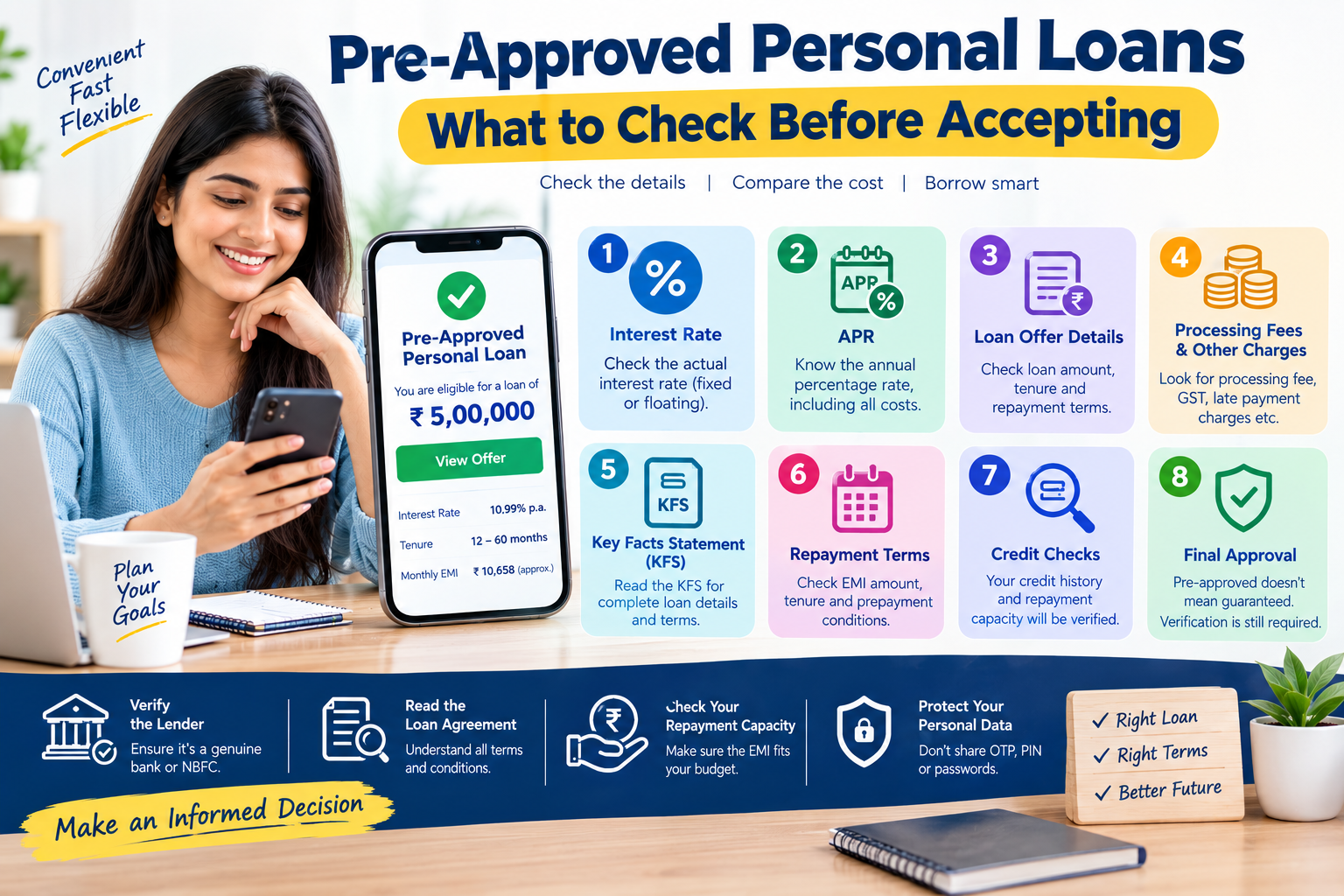
A pre-approved personal loan is an offer that a lender may make to an existing or prospective customer based on information available to the lender. It can indicate that the borrower appears eligible under certain preliminary criteria, but the exact meaning varies by lender.
Pre-approved does not always mean final or guaranteed approval. The lender may still conduct verification, credit assessment or other checks before disbursal.
Before accepting, borrowers should check the lender's identity, loan amount, interest rate, APR, EMI, tenure, processing fee, other charges, Key Facts Statement (KFS), repayment terms and cancellation/prepayment conditions.
RBI guidance requires proper assessment of credit applications and disclosure of relevant loan terms. For digital loans, RBI requires the APR and KFS to be provided before the loan contract is executed.
What Does Pre-Approved Personal Loan Mean?
A pre-approved personal loan generally means the lender has identified you as potentially eligible based on information it already holds or has assessed.
The offer may appear through:
- Mobile banking
- Internet banking
- SMS or email
- A lender's website
- A lending app
- A relationship manager or other authorised channel
The offer may specify an indicative loan amount, interest rate or tenure.
However, borrowers should read the actual offer terms rather than assuming that a pre-approved message means money is guaranteed.
How Does a Pre-Approved Personal Loan Work?
The process can generally look like this:
1. Lender Identifies a Potential Customer
The lender may use existing customer information, credit history or other permitted information to identify customers who may qualify for an offer.
2. Offer Is Displayed
The borrower may see a pre-approved loan offer with details such as the amount, interest rate and tenure.
3. Borrower Reviews the Terms
This is the most important stage.
Check the complete cost rather than accepting the offer simply because it is labelled “pre-approved.”
4. Verification May Take Place
Depending on the product, the lender may still verify KYC, income, credit information or other details.
5. Final Loan Agreement
If the application passes the required checks, the lender provides the applicable loan documentation.
6. Disbursal
After the contract is executed and required conditions are completed, the loan amount can be disbursed according to the agreed terms.
10 Things to Check Before Accepting a Pre-Approved Loan
1. Check the Actual Lender
First identify who is actually lending the money.
If a digital lending platform or app is involved, verify the regulated bank or NBFC behind the loan.
RBI requires regulated entities to remain responsible for compliance even when lending service providers or digital lending apps are used.
2. Check the Interest Rate
Do not judge the offer only by the words “pre-approved” or “special offer.”
Check whether the rate is:
- Fixed
- Floating, where applicable
- Annualised
- Subject to specific conditions
Also compare it with other available loan offers.
3. Check the APR
APR, or Annual Percentage Rate, helps show the annualised cost of a digital loan, including applicable costs included in the APR calculation.
RBI's digital-lending framework requires APR to be disclosed upfront and included in the KFS for covered digital lending products.
The APR can therefore be more useful for comparison than looking at the headline interest rate alone.
4. Read the Key Facts Statement
For covered digital lending products, the Key Facts Statement (KFS) should be provided before execution of the loan contract.
The KFS includes important information such as:
- APR
- Loan amount
- Tenure
- Repayment details
- Applicable charges
- Recovery mechanism
- Grievance redressal information
- Cooling-off/look-up period, where applicable
RBI says charges not disclosed in the KFS cannot be charged by the regulated entity during the loan term.
5. Calculate the EMI
Check whether the EMI comfortably fits your monthly budget.
For example, a higher loan amount may look attractive, but it also increases the repayment obligation.
Consider:
Monthly income − existing EMIs − new EMI = remaining monthly cash flow
Do not borrow simply because a larger amount has been offered.
6. Check Processing Fees and Other Charges
Look beyond the interest rate.
Check for:
- Processing fee
- Documentation charges
- Verification charges
- Late-payment or penal charges
- Prepayment/foreclosure charges, where applicable
- Other service fees
RBI's borrower-protection guidance emphasises disclosure of fees, charges and loan terms.
7. Check the Loan Tenure
A longer tenure can reduce the monthly EMI but may increase the total interest paid over the life of the loan.
A shorter tenure can increase the EMI while potentially reducing the total interest cost.
Compare both the monthly payment and total repayment.
8. Check Prepayment and Cancellation Terms
Read what happens if you want to repay the loan early.
For digital loans covered by RBI's digital-lending framework, borrowers must receive a cooling-off/look-up period determined by the regulated entity's board, during which the loan can be exited by paying principal and proportionate APR without penalty, subject to the applicable rules.
9. Check Your Credit and Repayment Capacity
A pre-approved offer does not mean you should automatically borrow.
Before accepting, consider:
- Current EMIs
- Credit-card obligations
- Monthly income
- Emergency savings
- Upcoming expenses
- Total debt
RBI's digital-lending framework requires regulated entities to assess relevant economic information and borrower creditworthiness for covered digital lending.
10. Check the Privacy and Data Permissions
If the offer comes through an app, understand what personal information is being collected and why.
Avoid sharing unnecessary sensitive information through unofficial links or unknown apps.
Pre-Approved vs Regular Personal Loan
| Feature | Pre-Approved Personal Loan | Regular Personal Loan |
|---|---|---|
| Initial offer | May already be available | Usually starts after application |
| Customer targeting | Often based on existing data | Applicant applies directly |
| Documentation | May be simpler for existing customers | Depends on lender |
| Verification | May still be required | Usually part of application |
| Final approval | Not necessarily guaranteed by the offer | Based on completed assessment |
| Interest rate | Depends on lender/customer | Depends on lender/customer |
| KFS/loan documents | Applicable requirements still apply | Applicable requirements still apply |
Why Do Lenders Offer Pre-Approved Loans?
Banks and other lenders may offer pre-approved loans to customers who appear to meet certain internal criteria.
Possible reasons include:
- Existing banking relationship
- Previous repayment history
- Available customer information
- Credit assessment
- Product-specific eligibility
- Marketing and customer-retention strategies
However, the exact criteria used by each lender can differ.
Is a Pre-Approved Loan Automatically Cheaper?
No.
A pre-approved offer is not automatically the lowest-cost loan.
Before accepting, compare:
Interest rate + APR + processing fee + other charges + total repayment
A convenient offer may still have a higher overall borrowing cost than another loan available to you.
Can a Pre-Approved Personal Loan Be Rejected Later?
Yes, depending on the lender and product.
A preliminary or pre-approved offer can still be subject to applicable verification, documentation, credit checks or other conditions.
Therefore, borrowers should distinguish between:
Pre-approved offer → Verification → Final approval/loan agreement → Disbursal
The exact process varies by lender.
Red Flags to Watch For
Be cautious if a loan offer:
- Promises guaranteed approval
- Demands an unexplained upfront payment
- Does not clearly identify the lender
- Hides the interest rate or APR
- Does not provide important loan terms
- Requests OTP, PIN or password
- Comes through an unknown or suspicious link
- Pressures you to accept immediately
For digital lending, RBI requires important borrower disclosures and grievance-redressal information, while regulated entities remain responsible for compliance.
Pre-Approved Personal Loan Checklist
Before clicking Accept, check:
☐ Actual lender name
☐ Loan amount
☐ Interest rate
☐ APR
☐ EMI
☐ Loan tenure
☐ Processing fee
☐ Other charges
☐ Total repayment amount
☐ KFS
☐ Loan agreement
☐ Prepayment terms
☐ Cooling-off/look-up terms, where applicable
☐ Privacy and data permissions
☐ Grievance-redressal details
Key Takeaways
- A pre-approved personal loan is not necessarily a guaranteed final approval.
- Always identify the actual lender before accepting.
- Compare APR and total repayment cost, not just the interest rate.
- Read the Key Facts Statement (KFS) and loan agreement.
- Check EMI affordability against your existing financial commitments.
- Review processing fees and other charges.
- Understand prepayment and cooling-off terms.
- Never share OTPs, PINs or passwords with anyone offering a loan.
- Borrow only when the loan fits your actual financial needs.
FAQs About Pre-Approved Personal Loans
1. What is a pre-approved personal loan?
It is a loan offer made to a customer who appears to meet certain preliminary eligibility criteria set by the lender.
2. Is pre-approved the same as approved?
Not necessarily. A pre-approved offer may still be subject to applicable verification and final lending conditions.
3. Does a pre-approved loan require KYC?
Depending on the lender and your existing relationship, additional KYC or verification may or may not be required.
4. Is a pre-approved personal loan cheaper?
Not automatically. Compare the interest rate, APR, fees and total repayment cost.
5. What is a KFS?
A Key Facts Statement provides important information about the loan, including applicable costs and key terms.
6. Should I accept the full amount offered?
Not necessarily. Borrow only what you need and can reasonably repay.
7. Can I negotiate a pre-approved loan interest rate?
This depends on the lender and product. You can ask whether the offered rate or other terms are negotiable.
8. Can a pre-approved loan affect my credit score?
The effect depends on whether a credit enquiry is made and how the lender processes the offer. Check with the lender before proceeding if this is a concern.
9. What charges should I check?
Look for processing fees, applicable taxes, late-payment charges, prepayment charges and any other disclosed fees.
10. Can I cancel a digital personal loan after accepting it?
Certain digital loans covered by RBI rules have a cooling-off/look-up period, subject to the applicable terms. Review the KFS before accepting.
11. How do I verify a digital loan offer?
Identify the actual bank or NBFC behind the offer and use the lender's official website or app to verify the details.
12. What is the biggest mistake borrowers make?
Accepting a loan based only on the “pre-approved” label without checking the complete cost, EMI, terms and repayment capacity.
Published on : 24th September
Published by : Shibam Nath
www.vizzve.com || www.vizzveservices.com
Follow us on social media: Facebook || Linkedin || Instagram
🛡 Powered by Vizzve Financial
RBI-Registered Loan Partner | 10 Lakh+ Customers | ₹600 Cr+ Disbursed