

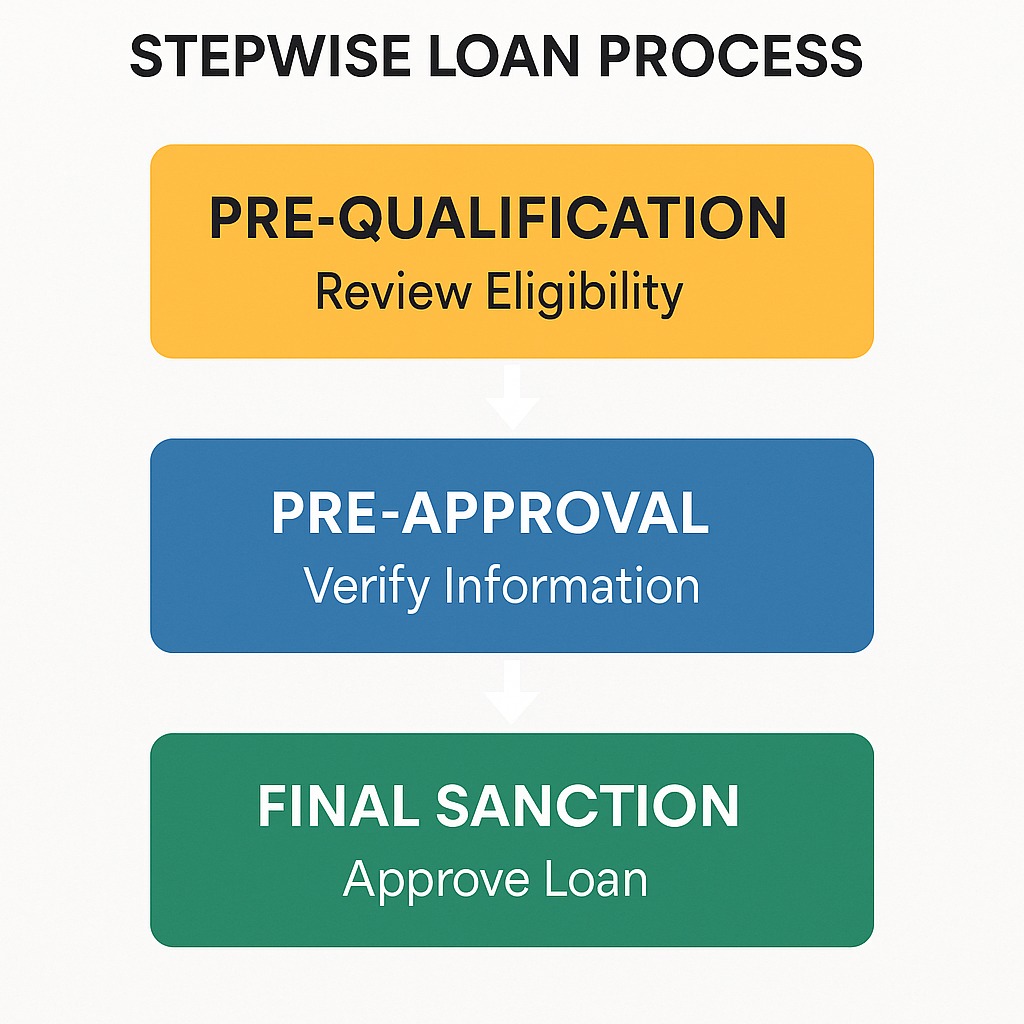
When applying for a loan — whether home loan, personal loan, vehicle loan, LAP, business loan, or education loan — you will come across terms like pre-qualification, pre-approval, and sanction. Though they sound similar, each stage represents a different level of evaluation, commitment, and certainty from the lender.
Understanding these differences helps you plan better, negotiate confidently, and avoid misunderstandings during the loan process.
What Is Loan Pre-Qualification?
Pre-qualification is the initial and informal assessment of a borrower’s eligibility based on basic self-declared information such as income, job type, age, credit score, and existing debts.
✔ Usually done via online tools, calculators, or verbal discussion
✔ No document verification required
✔ Gives an estimated eligible loan amount
📝 Purpose:
To give a rough idea of what amount you may qualify for before formally applying.
📌 Important: This is not a guarantee of loan approval.
What Is Loan Pre-Approval?
Pre-approval is a more formal verification step, where the lender evaluates borrower details using documents, credit report checks, and eligibility rules. A conditional approval letter may be issued.
✔ Documents are checked
✔ Credit bureau pull is done
✔ Risk profile is evaluated
✔ Time-bound conditional approval may be issued
📝 Purpose:
To show that you are financially credible and eligible, especially useful for home buyers, negotiations, and property shortlisting.
📌 Important: Still not final — property/legal/other conditions may be pending if applicable.
What Is Loan Sanction?
A loan sanction is the final official approval issued by the lender after completing all checks, including property/legal evaluation, KYC, income proof, risk checks, and compliance conditions.
✔ Final loan amount approved
✔ Approved interest rate & tenure
✔ Terms & conditions documented
✔ Disbursement can follow once agreement is signed
📝 Purpose:
To confirm that the lender has agreed to lend, subject to final execution.
📌 Important: After sanction, the borrower enters into loan agreement & disbursement stage.
Quick Comparison Table
| Stage | Type | Verification Level | Credit Check | Commitment Level | Output |
|---|---|---|---|---|---|
| Pre-Qualification | Informal | Low | Not always | Very Low | Estimated loan range |
| Pre-Approval | Semi-formal | Medium–High | Yes | Moderate | Conditional approval letter |
| Sanction | Final Approval | Highest | Yes | High | Sanction letter + disbursement process |
Why Understanding the Difference Matters
Avoids confusion between indicative eligibility vs commitment
Helps negotiate confidently with sellers & agents
Ensures planned budgeting and documentation readiness
Prevents last-minute rejections or delays
Helps compare lenders more effectively
❓ FAQs
Q1. Is pre-qualification necessary before applying?
No, but it helps estimate loan eligibility and avoid unrealistic expectations.
Q2. Does pre-approval guarantee final sanction?
No. It is a conditional approval, dependent on additional checks.
Q3. How long is pre-approval valid?
Typically 30 to 90 days, depending on lender.
Q4. Who benefits the most from pre-approval?
Home buyers, business borrowers, and anyone negotiating with sellers.
Q5. Can the sanctioned amount differ from pre-approved amount?
Yes, based on updated documents, property eligibility, or risk changes.
Published on : 17th November
Published by : SMITA
www.vizzve.com || www.vizzveservices.com
Follow us on social media: Facebook || Linkedin || Instagram
🛡 Powered by Vizzve Financial
RBI-Registered Loan Partner | 10 Lakh+ Customers | ₹600 Cr+ Disbursed