

Introduction
A fixed deposit (FD) is often chosen because it offers a planned savings period and a stated interest rate. But financial needs can change. An unexpected medical expense, household emergency, education payment or other urgent requirement may force you to withdraw your money before the FD maturity date.
This is known as premature FD withdrawal or premature closure.
The important point is that closing an FD early may reduce the interest you receive. Depending on the bank, deposit date, tenure completed and FD terms, the bank may calculate interest at a lower applicable rate and deduct an additional premature withdrawal penalty.
For this reason, do not assume that you will receive the original maturity amount if you close your FD early.
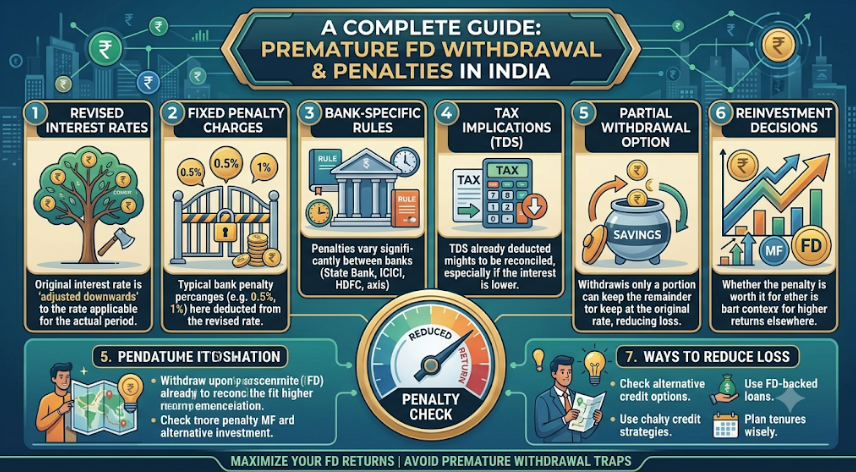
This guide explains the penalties to check, how banks calculate revised interest, what happens to tax and how you can reduce the financial impact before breaking your fixed deposit.
AI Answer Box: What Penalty Should You Check Before Premature FD Withdrawal?
Before closing a fixed deposit before maturity, check these points:
-
Premature closure penalty: Whether the bank deducts a penalty for early withdrawal.
-
Revised interest rate: Whether interest is recalculated using the rate applicable to the actual period completed.
-
Tenure completed: Whether the FD qualifies for a lower or different rate based on the time it remained with the bank.
-
Special FD conditions: Whether the deposit has a lock-in period or special withdrawal restrictions.
-
Partial withdrawal facility: Whether you can withdraw only the amount you need.
-
Tax and TDS: Whether interest already paid or credited requires tax adjustment.
-
Loan against FD: Whether borrowing against the deposit is a more suitable alternative.
Simple answer: Premature FD withdrawal can reduce your interest earnings. Check the bank's applicable interest rate and penalty terms before submitting the closure request.
1. What Is Premature FD Withdrawal?
Premature FD withdrawal means closing a fixed deposit before its originally agreed maturity date.
For example, suppose you open a fixed deposit of ₹1,00,000 for two years. Six months later, you need money urgently and decide to close it.
Instead of waiting for the two-year maturity date, you request the bank to release your deposit early. This is called premature withdrawal.
Why do people withdraw FDs before maturity?
Common reasons include:
-
Medical or family emergencies.
-
Unexpected household expenses.
-
Education or wedding expenses.
-
Job loss or reduced income.
-
Business cash-flow requirements.
-
Repayment of high-interest debt.
-
A sudden need for available cash.
Premature closure is not always a bad financial decision. Sometimes accessing your savings is necessary. The important thing is to understand the cost before making the decision.
2. What Penalties Should You Check Before Breaking an FD?
The penalty is not always a single fixed charge. It may involve a reduction in the interest payable, an additional penalty, or both, depending on the bank's terms.
Here are the main items to review.
2.1 Premature withdrawal penalty
Some banks deduct a specified percentage from the interest rate that would otherwise apply.
For example, a bank may state that a 1% penalty applies to eligible premature closures. This is only an illustration; the actual rate and conditions vary by bank and deposit category.
Read the FD's terms and conditions to understand:
-
Whether a penalty applies.
-
The percentage or method used.
-
Whether the penalty applies to all deposit amounts.
-
Whether special categories receive different treatment.
-
Whether the penalty changes with the deposit tenure.
2.2 Interest rate recalculation
This is one of the most important things to check.
When you close an FD early, the bank may calculate interest based on the rate applicable to the actual period for which the deposit remained with it, rather than the original contracted rate.
For example:
-
Original FD tenure: 2 years.
-
Actual period completed: 8 months.
-
Original contracted rate: 7%.
-
Applicable rate for the completed period: 6%.
If the bank's terms also provide for a 1% premature withdrawal penalty, the final interest rate may be reduced further, subject to the bank's calculation method.
2.3 Special deposit conditions
Some deposits have different rules from ordinary callable FDs.
Check whether your FD is:
-
A regular callable FD.
-
A tax-saving FD with a lock-in period.
-
A special tenure deposit.
-
A non-callable deposit.
-
A deposit with restricted premature withdrawal.
-
A deposit opened under a special scheme.
Do not assume that every FD can be closed at any time.
2.4 Loss of expected maturity interest
If you close an FD early, you may lose the additional interest you expected to earn by keeping the deposit until maturity.
The difference between the original maturity value and the premature closure value can be significant, particularly when the remaining tenure is long.
2.5 Tax and TDS adjustments
Interest earned on an FD is generally taxable under applicable income-tax rules.
If the bank has already paid interest or deducted TDS, check the interest certificate and tax records. Premature closure does not automatically make the interest tax-free.
3. How Do Banks Calculate Premature FD Withdrawal Interest?
Banks generally refer to the period for which the deposit actually remained with them and the applicable rate for that period.
The exact calculation depends on the bank's deposit policy, the date the FD was opened, the amount, the tenure completed and the applicable penalty.
General calculation approach
-
Identify the original deposit amount.
-
Find the date the FD was opened.
-
Calculate how long the deposit remained with the bank.
-
Check the rate applicable to that completed period.
-
Check whether a premature closure penalty applies.
-
Apply the bank's interest calculation and payout rules.
-
Deduct applicable taxes or other permitted adjustments.
Illustrative example
Suppose a customer invests ₹1,00,000 in a two-year FD.
| Particulars | Example |
|---|---|
| Original deposit | ₹1,00,000 |
| Original FD tenure | 2 years |
| Original contracted rate | 7% per year |
| Actual period completed | 8 months |
| Illustrative rate for completed period | 6% per year |
| Illustrative premature penalty | 1 percentage point |
| Illustrative revised rate | 5% per year |
For a simple illustration, interest at 5% per year for 8 months would be approximately ₹3,333 before tax and other adjustments.
This is not a bank quotation or a universal FD calculation. Actual FD interest may be compounded or calculated using the bank's day-count convention. The bank's applicable terms determine the final payable amount.
Why can the final amount be different?
The amount credited may differ because:
-
The bank uses a different compounding method.
-
The actual number of days is different.
-
The rate applicable to the completed period is different.
-
A penalty applies under the FD terms.
-
Interest has already been paid periodically.
-
Tax or other permitted adjustments apply.
Always ask the bank for a premature closure quotation before confirming.
4. Premature FD Withdrawal Rules in India
Banks in India follow RBI directions and their own disclosed deposit policies.
The RBI's Commercial Banks – Interest Rate on Deposits Directions, 2025, issued on April 1, 2025, provide the regulatory framework for interest on deposits with commercial banks. The applicable rules and bank-specific terms should be checked for the deposit concerned.
For premature withdrawal, pay particular attention to the following:
-
Whether the FD is callable or non-callable.
-
Whether the deposit qualifies for premature withdrawal.
-
The rate applicable to the actual period completed.
-
The disclosed penalty, if any.
-
Whether the deposit falls under a special scheme.
-
Whether the bank's terms differ for deposits above specified amounts.
Important point about individual deposits
For eligible individual term deposits of up to ₹1 crore, banks are generally required to provide a premature withdrawal facility under the applicable RBI directions. There are permitted exceptions, including certain non-callable deposit arrangements.
This does not mean every deposit can be closed without a financial loss. A bank may still apply the disclosed premature withdrawal terms.
Always verify the rules that applied when your FD was opened. The FD receipt and the bank's official deposit policy are important references.
5. Bank-Wise Premature FD Withdrawal Penalties: What to Check
Penalty conditions can differ between banks and may change over time. Do not rely on an old online article or assume that one bank's rules apply to another.
Before closing an FD, check the latest official terms for your bank.
| Bank | What to verify before closure |
|---|---|
| State Bank of India (SBI) | Applicable premature withdrawal penalty, tenure-based rate and deposit category |
| HDFC Bank | Revised interest rate, penalty conditions and special deposit terms |
| ICICI Bank | Actual period completed, premature closure rules and interest adjustment |
| Axis Bank | Deposit amount category, applicable rate and penalty |
| Bank of Baroda | Deposit scheme conditions and early closure calculation |
| Punjab National Bank | Applicable deposit policy and special scheme restrictions |
How to confirm the exact penalty
Use one of these official channels:
-
The bank's official website.
-
The bank's official mobile banking application.
-
Your FD receipt or deposit advice.
-
A branch representative.
-
Verified customer care.
Ask for the net premature closure amount, not just the penalty percentage.
6. Regular FD vs Tax-Saving FD: Can Both Be Withdrawn Early?
Not all fixed deposits have the same withdrawal flexibility.
| Feature | Regular FD | Tax-saving FD |
|---|---|---|
| Typical purpose | Savings and interest earnings | Eligible tax deduction under applicable rules |
| Tenure | Varies by bank and product | Generally 5-year lock-in |
| Early withdrawal | Subject to product terms and penalty | Generally not permitted during lock-in |
| Partial withdrawal | Depends on bank and FD terms | Generally not permitted |
| Tax benefit | No automatic deduction for principal | Eligible investment may qualify under Section 80C, subject to applicable tax regime and conditions |
Important tax-saving FD point
A tax-saving FD generally has a five-year lock-in period. It cannot ordinarily be closed early simply because the depositor needs cash.
Before investing in a tax-saving FD, consider whether you can keep the money untouched for the required period.
7. Partial FD Withdrawal: Can You Take Out Only the Amount You Need?
Some banks offer partial withdrawal or part-closure facilities, while others may require the FD to be closed and a new deposit to be created for the remaining amount.
The facility depends on the bank and deposit product.
Example
Suppose you have an FD of ₹2,00,000 and need ₹40,000 urgently.
Instead of closing the entire FD, check whether your bank allows you to withdraw ₹40,000 and retain the remaining ₹1,60,000 under the applicable terms.
Benefits of partial withdrawal
-
You may avoid closing the entire deposit.
-
A portion of your savings can remain invested.
-
You may preserve some of the original savings plan.
-
You may reduce the amount affected by premature closure.
What should you ask the bank?
-
Is partial withdrawal allowed?
-
Is there a minimum balance requirement?
-
Will the remaining amount retain its original interest rate?
-
Will a penalty apply to the withdrawn portion?
-
Will the bank create a new FD for the balance?
Do not assume partial withdrawal is available until the bank confirms it.
8. Loan Against FD vs Premature FD Withdrawal
If you need money urgently, breaking your FD may not be your only option.
Some banks offer loans or overdraft facilities against eligible fixed deposits.
The deposit remains with the bank as security, and the bank may permit borrowing up to a specified portion of its value.
| Comparison | Premature FD withdrawal | Loan or overdraft against FD |
|---|---|---|
| FD status | Closed early | Usually remains active as security |
| Interest on FD | Recalculated under closure terms | Generally continues under deposit terms |
| Borrowing cost | No loan interest | Interest charged on amount borrowed |
| Repayment | No loan repayment required | Must repay as agreed |
| Access to money | Receives eligible closure proceeds | Receives approved loan or overdraft amount |
| Main consideration | Lost interest or penalty | Borrowing cost and repayment obligation |
Which option may be better?
A loan against FD may be worth comparing if:
-
You need money for a short period.
-
Your FD offers a favourable rate.
-
The loan interest and charges are reasonable.
-
You can repay within the agreed period.
Premature withdrawal may be more appropriate if:
-
You do not want to take on debt.
-
You need the full deposit amount.
-
The loan cost is higher than the financial loss from closing the FD.
-
Your bank does not offer a suitable loan facility.
Compare the actual rupee cost of both options before deciding.
9. Pros and Cons of Premature FD Withdrawal
Advantages
-
Gives access to money during emergencies.
-
Can help meet urgent financial commitments.
-
Avoids taking a separate loan in some situations.
-
Provides flexibility when financial priorities change.
-
May help repay more expensive debt.
Disadvantages
-
Interest earnings may be reduced.
-
A premature withdrawal penalty may apply.
-
The original maturity benefit is lost.
-
Tax and TDS records may need checking.
-
Closing the entire FD can interrupt a savings plan.
10. How to Avoid or Reduce Premature FD Withdrawal Losses
You may not always be able to avoid a penalty, but planning can reduce the need to break an FD.
1. Keep an emergency fund
Maintain accessible savings for unexpected expenses. This can reduce the chance of closing long-term deposits.
2. Divide large deposits into smaller FDs
Instead of placing all your savings into one large FD, consider creating multiple deposits with different maturity dates.
If you need money, you may only need to close one deposit.
3. Match FD tenure with your financial goals
If you expect to need money in one year, avoid locking all your savings into a longer deposit without checking withdrawal terms.
4. Check the loan-against-FD option
Ask the bank for the interest rate, processing charges, available amount and repayment conditions.
5. Review the penalty before investing
Do not wait until an emergency to read the premature withdrawal terms. Check them before opening the FD.
6. Avoid investing money you may need immediately
Money needed for rent, bills, medical expenses or other near-term obligations should generally remain accessible rather than being placed entirely in a long-term FD.
11. Step-by-Step Guide: How to Close an FD Before Maturity
If you have decided to close your FD, follow the bank's official process.
Step 1: Check your FD details
Find your FD receipt or open your deposit details in the official banking application.
Check the deposit amount, opening date, maturity date and FD type.
Step 2: Request a premature closure quotation
Ask the bank to calculate:
-
Interest payable up to the closure date.
-
Applicable revised interest rate.
-
Premature closure penalty.
-
Any adjustment for interest already paid.
-
Net amount payable.
Step 3: Compare alternatives
Before closing the deposit, check whether partial withdrawal or a loan against FD is available and suitable.
Step 4: Submit the closure request
Use the bank's official app, internet banking or branch process.
Complete any authentication required by the bank.
Step 5: Verify the credited amount
Once the FD is closed, check your savings account statement and closure confirmation.
If the amount differs from the quotation, contact the bank and request a breakdown.
Step 6: Keep the records
Save the closure statement, interest certificate and TDS information for your financial records and tax filing.
12. Common Mistakes to Avoid When Breaking an FD
Avoid these common mistakes:
-
Assuming the original FD rate will still apply.
-
Ignoring the premature closure penalty.
-
Closing the entire FD when only a small amount is needed.
-
Forgetting to check a loan against FD.
-
Assuming a tax-saving FD can be closed early.
-
Relying on an outdated bank penalty table.
-
Ignoring interest already paid into your savings account.
-
Not checking the final amount before confirming closure.
-
Sharing banking OTPs or credentials with someone offering to close the FD.
Practical tip: Ask the bank for a written or digitally displayed closure calculation before confirming the transaction. It helps you understand exactly how much interest you may lose.
13. Frequently Asked Questions (FAQs)
1. What is premature FD withdrawal?
Premature FD withdrawal means closing a fixed deposit before its scheduled maturity date. The bank calculates the amount payable according to the applicable deposit terms.
2. Is there a penalty for breaking an FD early?
A bank may apply a premature withdrawal penalty if its disclosed deposit terms provide for one. It may also recalculate interest based on the actual period completed.
3. How much penalty do banks charge for premature FD withdrawal?
There is no single penalty applicable to every bank and FD. The percentage and calculation method depend on the bank, deposit type, amount and applicable terms.
4. Will I lose all my FD interest if I withdraw early?
Not necessarily. You may receive interest for the period the deposit remained with the bank, calculated at the applicable rate and subject to the bank's premature withdrawal conditions.
5. How is premature FD withdrawal interest calculated?
The bank generally considers the actual period completed, the applicable rate for that period and any disclosed penalty. The final amount also depends on the bank's interest calculation method and previous payouts.
6. Can I withdraw my FD after six months?
It depends on the FD type and bank terms. If premature closure is permitted, the bank may revise the interest and apply a penalty.
7. Can I break a five-year tax-saving FD early?
A tax-saving FD generally has a five-year lock-in period and cannot ordinarily be closed early during that period, subject to applicable rules and limited legal exceptions.
8. Can I withdraw only part of my fixed deposit?
Some banks allow partial withdrawal or part-closure, but availability and conditions differ. Confirm whether the remaining deposit retains its original terms.
9. Is a loan against FD better than premature withdrawal?
It depends on the borrowing cost, FD interest rate, amount needed and repayment ability. Compare the total loan cost with the interest loss from early closure.
10. Does premature FD withdrawal affect my credit score?
Closing your own FD generally does not directly affect your credit score. However, if you take a loan against the FD, repayment behaviour on that credit facility may be reported as applicable.
11. Will the bank deduct TDS when I close an FD early?
TDS treatment depends on the interest credited or paid and the applicable tax rules and thresholds. Check your bank's interest and TDS statement.
12. Can senior citizens close an FD before maturity?
Senior citizens may be able to close eligible FDs early, subject to the bank's terms. The applicable interest and penalty conditions should be checked for the specific deposit.
13. Can a bank refuse premature FD withdrawal?
A bank may restrict closure where the deposit is non-callable or subject to a permitted lock-in or special scheme condition. The bank must follow the applicable regulatory requirements and disclosed terms.
14. How can I check my FD premature withdrawal penalty?
Check the FD receipt, official bank website or mobile application, or contact verified bank customer support. Ask for a premature closure quotation showing the revised rate, penalty and net payable amount.
15. What is the best way to avoid premature FD withdrawal penalties?
Keep an emergency fund, divide large savings into smaller FDs, choose suitable tenures and check withdrawal conditions before investing.
Conclusion
Premature FD withdrawal can provide access to money when you need it most, but it may reduce the interest you earn. Before breaking a fixed deposit, check the applicable penalty, revised interest rate, actual tenure completed and any special deposit conditions.
If you need only part of the money, ask your bank about partial withdrawal. If you need short-term funds, compare a loan against FD with the financial loss from premature closure.
The best decision is not always to keep the FD untouched or to close it immediately. It is to understand the actual cost and choose the option that fits your financial situation.
Explore Financial Guidance with Vizzve Financial
Vizzve Financial is one of India’s trusted loan support platforms offering quick personal loans, low documentation, and an easy approval process. Apply at www.vizzve.com.
Explore financial information and borrowing options through Vizzve Financial. Before applying for a loan, review the interest rate, fees, repayment schedule and your ability to repay. Loan approval and disbursal are subject to the lender's eligibility criteria, verification and policies.
Key Takeaways
-
Premature FD withdrawal means closing a deposit before maturity.
-
Banks may recalculate interest based on the actual period completed.
-
A disclosed premature closure penalty may also apply.
-
The penalty is not identical across all banks and FD products.
-
Tax-saving FDs generally have a five-year lock-in.
-
Partial withdrawal may be available, depending on the bank.
-
A loan against FD is an alternative worth comparing, not automatically a cheaper option.
-
Check the net closure amount before confirming.
-
Keep an emergency fund to reduce the need to break long-term deposits.
Published on : 16th November
Published by : Reddy kumar
www.vizzve.com || www.vizzveservices.com
Follow us on social media: Facebook || Linkedin || Instagram
🛡 Powered by Vizzve Financial
RBI-Registered Loan Partner | 10 Lakh+ Customers | ₹600 Cr+ Disbursed