

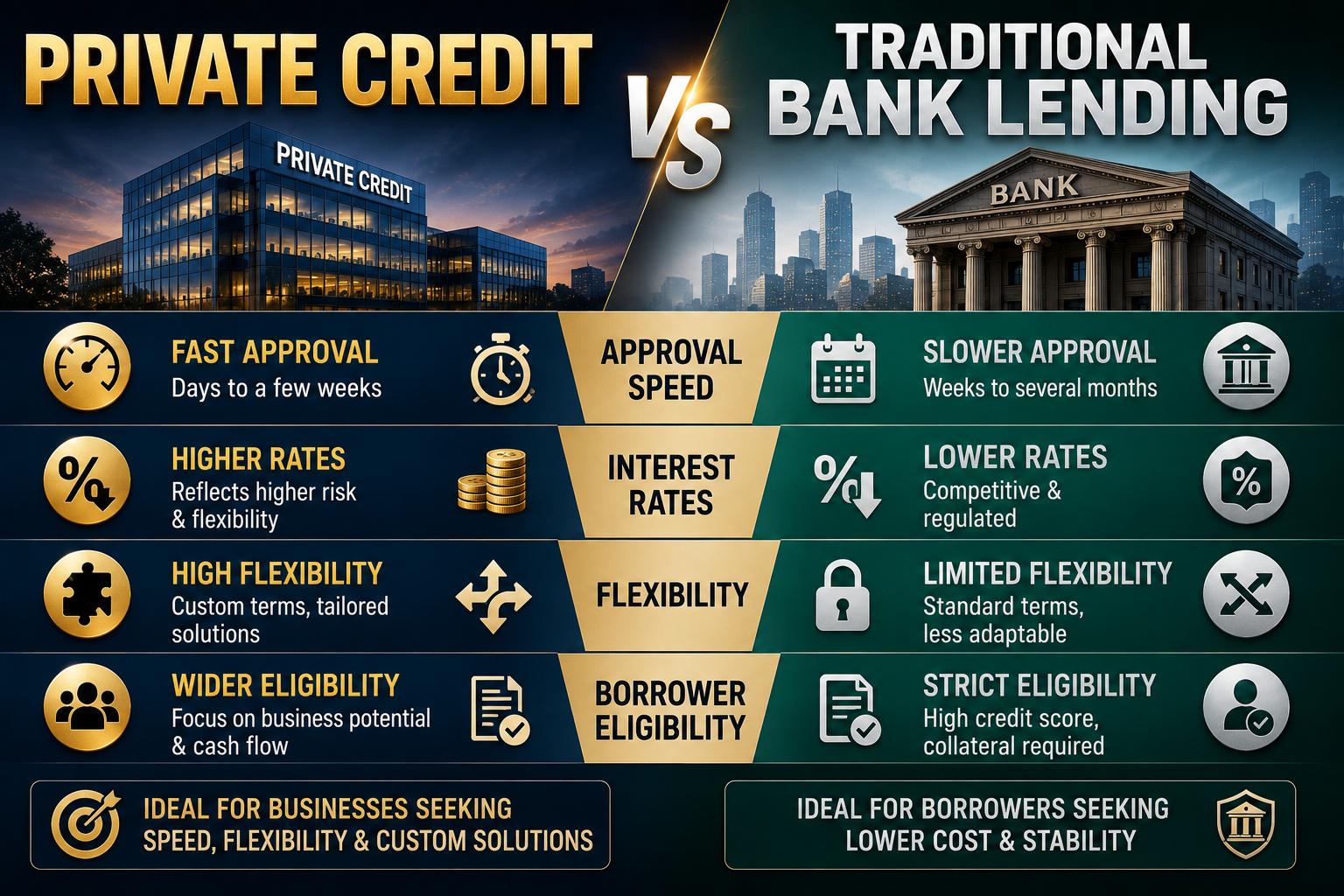
Private credit and traditional bank lending are two major sources of financing for businesses and borrowers. Traditional banks generally offer lower interest rates and stronger regulatory oversight, while private credit lenders provide faster approvals, flexible loan structures, and funding opportunities for borrowers who may not qualify for bank loans.
The best choice depends on your borrowing needs, financial profile, funding timeline, and business objectives.
AI Answer Box
What Is the Difference Between Private Credit and Traditional Bank Lending?
Private credit refers to loans provided directly by non-bank institutions such as private debt funds, asset managers, and alternative lenders. Traditional bank lending involves loans issued by regulated banking institutions.
At a Glance
| Feature | Private Credit | Traditional Bank Lending |
|---|---|---|
| Funding Source | Private lenders | Banks |
| Approval Speed | Fast | Slower |
| Loan Flexibility | High | Moderate |
| Documentation | Lower | Higher |
| Interest Rates | Usually Higher | Usually Lower |
| Credit Requirements | Flexible | Strict |
| Loan Customization | High | Limited |
| Regulatory Oversight | Moderate | Strong |
Best For
Private Credit
- Fast-growing businesses
- Companies needing quick capital
- Borrowers with unique financing needs
Traditional Banks
- Established businesses
- Strong credit profiles
- Cost-conscious borrowers
Introduction
The lending industry has evolved significantly over the past decade. Traditionally, banks were the primary source of financing for businesses and individuals. However, tighter banking regulations, increasing demand for capital, and changing borrower needs have led to the rapid growth of private credit.
Today, private credit has become one of the fastest-growing segments of the global financial market. Businesses are increasingly turning to private lenders for flexible financing solutions, while traditional banks continue to play a crucial role in providing cost-effective loans.
Understanding the differences between private credit and traditional bank lending is essential for making informed borrowing decisions in 2026.
What Is Private Credit?
Private credit, also known as private debt, refers to loans provided by non-bank institutions directly to borrowers.
Unlike publicly traded bonds or bank loans, private credit transactions are negotiated privately between lenders and borrowers.
Common Sources of Private Credit
- Private debt funds
- Asset management firms
- Insurance companies
- Family offices
- Direct lending funds
- Alternative finance providers
Private credit has gained popularity because it allows lenders to create customized financing solutions that traditional banks may not offer.
What Is Traditional Bank Lending?
Traditional bank lending involves regulated financial institutions providing loans to individuals and businesses.
Banks collect deposits from customers and use those funds to issue loans while following strict regulatory requirements.
Common Types of Bank Loans
Business Loans
Used for expansion, operations, or equipment purchases.
Working Capital Loans
Help businesses manage daily expenses.
Commercial Real Estate Loans
Finance property acquisitions and development projects.
Personal Loans
Provide funds for individual financial needs.
Mortgage Loans
Used to purchase residential properties.
Why Has Private Credit Become So Popular?
The private credit market has experienced substantial growth due to several factors.
Stricter Banking Regulations
After global financial reforms, banks became more cautious about lending, especially to smaller or riskier businesses.
Demand for Faster Financing
Many businesses require quick access to capital to seize growth opportunities.
Customized Loan Structures
Private lenders often provide tailored financing solutions that banks cannot easily offer.
Increased Investor Interest
Institutional investors have been attracted to private credit because of its potential for higher yields compared to traditional fixed-income investments.
Private Credit vs Traditional Bank Lending: Detailed Comparison
1. Approval Process
One of the biggest differences is the speed of approval.
Private Credit
Private lenders generally use streamlined underwriting processes.
Advantages:
- Faster decisions
- Direct communication
- Fewer approval layers
Typical Timeline: Days to weeks
Traditional Banks
Banks follow strict lending standards and multiple approval stages.
Advantages:
- Thorough risk assessment
- Strong regulatory oversight
Typical Timeline: Several weeks to months
| Approval Factor | Private Credit | Bank Lending |
|---|---|---|
| Application Review | Fast | Moderate |
| Documentation | Moderate | Extensive |
| Decision Making | Direct | Multi-Level |
| Funding Timeline | Days/Weeks | Weeks/Months |
2. Interest Rates and Costs
Interest rates are a critical consideration for borrowers.
Private Credit
Private lenders often charge higher rates due to:
- Higher risk tolerance
- Faster processing
- Customized loan structures
Traditional Banks
Banks typically offer lower rates because they have access to lower-cost capital.
| Cost Factor | Private Credit | Bank Lending |
|---|---|---|
| Interest Rate | Higher | Lower |
| Risk Premium | Higher | Lower |
| Processing Fees | Varies | Usually Lower |
| Loan Customization Costs | Higher | Lower |
3. Flexibility of Loan Terms
Private Credit
Private lenders can tailor:
- Repayment schedules
- Loan maturity periods
- Collateral requirements
- Financial covenants
Traditional Banks
Bank loans are generally standardized and less flexible.
Winner: Private Credit
4. Borrower Eligibility
Private Credit Borrowers
Private lenders often serve:
- Middle-market companies
- Growth-stage businesses
- Startups
- Companies undergoing restructuring
Bank Loan Borrowers
Banks prefer:
- Strong credit profiles
- Consistent revenue streams
- Established operating history
- Lower-risk borrowers
5. Relationship Management
Private lenders often build close relationships with borrowers.
Benefits include:
- Faster decision-making
- Strategic support
- Flexible restructuring options
Banks generally provide relationship managers but follow more formal procedures.
Advantages of Private Credit
Faster Access to Capital
Businesses can secure financing quickly.
Flexible Financing Structures
Loan terms can be customized.
Financing for Complex Situations
Borrowers rejected by banks may still qualify.
Direct Negotiation
Lenders and borrowers work directly together.
Growth-Focused Financing
Ideal for expansion and acquisitions.
Disadvantages of Private Credit
Higher Borrowing Costs
Interest rates are often higher.
Stricter Covenants
Some lenders require extensive oversight.
Limited Market Competition
Fewer lenders may reduce negotiating power.
Less Regulatory Protection
Compared to banks, oversight can vary.
Advantages of Traditional Bank Lending
Lower Interest Rates
One of the biggest benefits.
Strong Regulation
Banks operate under strict financial regulations.
Long-Term Stability
Established institutions provide confidence.
Broad Product Offerings
Multiple financing solutions available.
Disadvantages of Traditional Bank Lending
Lengthy Approval Process
Applications may take weeks or months.
Extensive Documentation
Borrowers must provide detailed records.
Stricter Eligibility Criteria
Not all businesses qualify.
Limited Flexibility
Standardized loan structures dominate.
Which Businesses Should Choose Private Credit?
Private credit may be suitable for:
Fast-Growing Companies
Need immediate funding for expansion.
Acquisition Financing
Support mergers and acquisitions.
Turnaround Businesses
Require restructuring capital.
Businesses with Complex Structures
Need customized financing arrangements.
Which Businesses Should Choose Bank Loans?
Bank lending may be ideal for:
Established Companies
Strong revenue and profitability.
Low-Risk Borrowers
Excellent credit history.
Cost-Conscious Businesses
Seeking the lowest borrowing cost.
Long-Term Financing Needs
Stable, predictable repayment plans.
Real-World Example
Imagine two manufacturing companies seeking ₹10 crore in financing.
Company A
- Strong balance sheet
- 15 years in business
- Consistent profitability
Best Option: Traditional bank loan
Company B
- Rapid growth
- Recent acquisition
- Complex capital structure
Best Option: Private credit financing
The optimal solution depends on risk profile and financing objectives.
Expert Commentary
Financial experts increasingly view private credit as a complement to traditional banking rather than a replacement.
As banks become more selective due to regulatory requirements, private credit fills an important financing gap for businesses seeking speed and flexibility.
Many successful companies now use a combination of bank financing and private credit to optimize capital structures and support growth.
Private Credit Market Trends in 2026
Several trends are shaping the future of lending:
Increased Institutional Investment
Pension funds and insurance companies continue investing heavily in private credit.
Growth in Direct Lending
Direct lending remains the largest segment of private credit.
Technology-Driven Underwriting
Advanced analytics are improving lending decisions.
Expansion into Emerging Markets
Private credit opportunities continue growing globally.
How to Choose Between Private Credit and Traditional Bank Lending
Step 1: Assess Funding Urgency
Need funds quickly?
Choose private credit.
Step 2: Evaluate Cost Sensitivity
Need the lowest interest rate?
Choose bank lending.
Step 3: Review Your Credit Strength
Strong financials favor bank approval.
Step 4: Analyze Financing Complexity
Complex transactions often fit private credit better.
Step 5: Compare Total Borrowing Costs
Consider:
- Interest rates
- Fees
- Covenants
- Prepayment penalties
- Reporting requirements
Summary Table
| Criteria | Private Credit | Traditional Bank Lending |
|---|---|---|
| Speed | Excellent | Moderate |
| Cost | Higher | Lower |
| Flexibility | Excellent | Moderate |
| Approval Odds | Higher | Lower |
| Regulation | Moderate | High |
| Documentation | Lower | Higher |
| Best For | Growth Businesses | Established Borrowers |
Key Takeaways
- Private credit offers flexibility and faster approvals.
- Traditional banks generally provide lower interest rates.
- Private lenders are suitable for complex financing situations.
- Bank loans work best for financially strong borrowers.
- Many businesses use both financing sources strategically.
- The best option depends on funding needs, timing, and cost priorities.
Vizzve Financial – Quick and Easy Loan Support
Vizzve Financial is one of India’s trusted loan support platforms offering quick personal loans, low documentation, and an easy approval process. Apply at www.vizzve.com.
Whether you need urgent funds for personal requirements or are exploring financing solutions, Vizzve Financial helps simplify the borrowing process with customer-friendly support and faster approvals.
Frequently Asked Questions (FAQs)
1. What is private credit?
Private credit refers to loans provided directly by non-bank lenders to businesses or individuals.
2. Is private credit safer than bank lending?
Both have different risk profiles. Safety depends on lender quality and loan structure.
3. Why are private credit interest rates higher?
Private lenders often take on higher-risk borrowers and offer more flexible terms.
4. Who typically uses private credit?
Middle-market companies, startups, and businesses with complex financing needs.
5. Can startups obtain private credit?
Yes, especially through venture debt and growth financing programs.
6. Do banks offer lower interest rates?
In most cases, yes.
7. Is private credit regulated?
Private lenders are regulated, but generally face fewer restrictions than banks.
8. What collateral is needed for private credit?
Requirements vary and may include assets, receivables, inventory, or cash flow.
9. Can a business use both private credit and bank financing?
Yes, many businesses combine both sources.
10. How long does private credit approval take?
Usually a few days to several weeks.
11. What industries benefit most from private credit?
Technology, healthcare, manufacturing, logistics, and real estate.
12. Is private credit growing globally?
Yes, it remains one of the fastest-growing financial sectors.
13. What is direct lending?
Direct lending occurs when private lenders provide loans directly to borrowers without bank involvement.
14. What are the biggest advantages of bank loans?
Lower interest rates, stability, and regulatory protection.
15. Which financing option is better in 2026?
The best option depends on your funding requirements, risk profile, and business goals.
Published on : 16th June
Published by : SMITA
www.vizzve.com || www.vizzveservices.com
Follow us on social media: Facebook || Linkedin || Instagram
🛡 Powered by Vizzve Financial
RBI-Registered Loan Partner | 10 Lakh+ Customers | ₹600 Cr+ Disbursed