

Introduction
When applying for a personal loan, home loan, vehicle loan, or business loan, the interest rate is not the only cost you need to consider. Lenders may also charge a processing fee to cover the administrative work involved in evaluating and processing a loan application.
These charges can affect how much money you actually receive and how much your loan costs overall.
A processing fee calculator helps you estimate the fee based on the loan amount and the percentage or fixed charge specified by the lender. If applicable taxes are charged separately, the calculator can also help you estimate the total deduction.
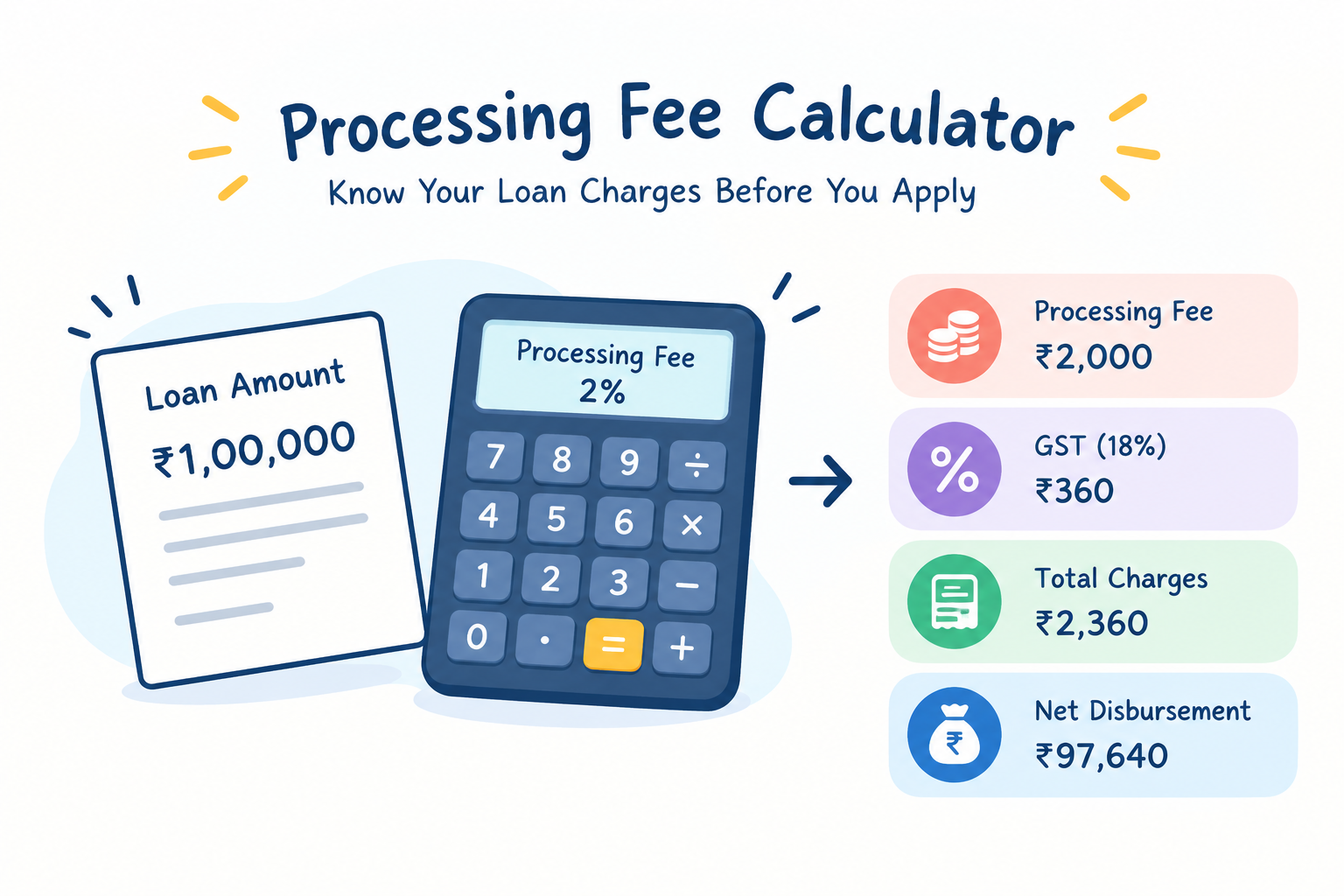
For example, suppose you apply for a personal loan of ₹1,00,000 and the lender charges a processing fee of 2%. The processing fee would be ₹2,000 before any applicable taxes.
If the fee and taxes are deducted from the loan disbursement, the amount credited to your bank account will be lower than the sanctioned loan amount. The exact deduction depends on the lender's terms and how the charges are collected.
A processing fee calculator helps you:
-
Estimate processing fees before applying for a loan.
-
Calculate applicable taxes on fees.
-
Understand the net amount you may receive.
-
Compare loan offers from different lenders.
-
Identify additional charges that affect borrowing costs.
-
Plan your finances more accurately.
Whether you are considering a personal loan or comparing different credit options, understanding processing fees can help you make a more informed financial decision.
AI Answer Box: What Is a Processing Fee Calculator?
A processing fee calculator is a financial tool that estimates the charges associated with processing a loan application. It generally uses the loan amount and the lender's processing fee percentage or fixed fee.
Formula:
Processing Fee = Loan Amount × Processing Fee Percentage ÷ 100
For example, if the loan amount is ₹1,00,000 and the processing fee is 2%, the processing fee is ₹2,000.
If an illustrative GST rate of 18% applies to the fee, the tax would be ₹360, making the total fee ₹2,360.
If both the fee and tax are deducted from the loan proceeds, the estimated net disbursement would be ₹97,640.
Actual charges, tax treatment, and deductions depend on the lender's terms and applicable tax rules. The sanctioned loan amount and the amount credited to your account may therefore differ.
Key Takeaways
-
A processing fee is a charge associated with handling a loan application.
-
The fee may be a percentage of the loan amount or a fixed amount.
-
Applicable GST may increase the total processing charge.
-
If charges are deducted upfront, the net amount received may be lower than the sanctioned loan amount.
-
Processing fees vary by lender, loan type, and applicable terms.
-
A lower processing fee does not automatically mean a cheaper loan.
-
Always review the lender's written fee disclosures before accepting an offer.
What Is a Processing Fee Calculator?
A processing fee calculator helps borrowers estimate the charges a lender may apply when processing a loan application.
Lenders may need to review documents, assess repayment capacity, verify applicant information, and complete other administrative procedures before disbursing a loan. Depending on the product and lender, a processing fee may be charged for these activities.
The fee structure can vary. Some lenders charge a percentage of the sanctioned loan amount, while others may use a fixed fee or a combination of charges.
Why Is a Processing Fee Calculator Important?
The processing fee may seem small compared with the total loan amount, but it can affect your borrowing costs.
For example, a 2% fee on a ₹50,000 loan is ₹1,000 before applicable taxes. The same percentage on a ₹5,00,000 loan is ₹10,000 before taxes.
Calculating the fee before applying helps you understand the potential cost and compare loan offers more accurately.
Who Should Use a Processing Fee Calculator?
This calculator can be useful for:
-
Salaried employees applying for personal loans.
-
Self-employed individuals comparing loan offers.
-
Small business owners evaluating business financing.
-
Borrowers comparing bank and NBFC loan products.
-
First-time borrowers learning about loan charges.
-
Existing borrowers reviewing loan refinancing options.
The calculator provides an estimate. It does not confirm the lender's final charges, loan eligibility, or approval.
What Is a Loan Processing Fee?
A loan processing fee is a charge that a lender may impose for processing a loan application.
Depending on the loan product, the processing process may involve document review, identity verification, income assessment, credit evaluation, and administrative work.
The exact services covered by the fee and whether it is refundable depend on the lender's terms and applicable rules.
Common Features of Processing Fees
-
The fee may be calculated as a percentage of the loan amount.
-
Some lenders charge a fixed fee.
-
Applicable taxes may be charged separately.
-
The fee may be collected upfront or deducted from the disbursement.
-
Refundability depends on the applicable terms and circumstances.
-
Other charges may apply separately.
Is a Processing Fee the Same as Interest?
No. A processing fee and loan interest are different costs.
| Feature | Processing Fee | Loan Interest |
|---|---|---|
| Meaning | Charge for processing a loan application | Cost of borrowing money |
| Calculation | Fixed amount or percentage, depending on the lender | Based on the loan balance and applicable rate |
| Payment | May be charged upfront or collected as specified in the agreement | Generally paid over the loan tenure through repayments |
| Relationship to principal | May be deducted from disbursement | Accrues according to the loan's interest calculation method |
| Effect on borrowing cost | Increases the overall cost of obtaining the loan | Increases the total amount repaid |
A complete loan cost comparison should consider both processing fees and interest, along with any other applicable charges.
Processing Fee Calculator Formula
The calculation depends on how the lender charges the fee.
1. Percentage-Based Processing Fee Formula
When the processing fee is a percentage of the loan amount, use this formula:
Processing Fee = Loan Amount × Processing Fee Percentage ÷ 100
For example:
-
Loan amount: ₹2,00,000
-
Processing fee: 1.5%
Calculation:
₹2,00,000 × 1.5 ÷ 100 = ₹3,000
Estimated processing fee = ₹3,000
2. Processing Fee With GST Formula
If GST applies to the processing service, calculate the tax separately.
GST Amount = Processing Fee × Applicable GST Rate ÷ 100
Then:
Total Processing Charges = Processing Fee + GST Amount
For example, if the processing fee is ₹3,000 and an illustrative GST rate of 18% applies:
GST = ₹3,000 × 18 ÷ 100 = ₹540
Total processing charges = ₹3,000 + ₹540
Total charges = ₹3,540
The 18% rate is used for illustration. Confirm the applicable tax treatment with the lender or a qualified tax professional.
3. Net Loan Disbursement Formula
If the lender deducts processing charges from the sanctioned loan amount:
Net Disbursement = Sanctioned Loan Amount − Upfront Deductions
Suppose the sanctioned amount is ₹2,00,000 and total processing charges are ₹3,540.
Net disbursement = ₹2,00,000 − ₹3,540
Estimated amount received = ₹1,96,460
This calculation assumes the fee and tax are deducted upfront and that no other deductions apply.
If the lender collects the fee separately, the amount credited may be different.
Processing Fee Calculator: Practical Examples
Let's understand how processing fees change with different loan amounts and fee percentages.
Example 1: Processing Fee on a ₹50,000 Loan
Assume the lender charges a 2% processing fee.
| Particulars | Amount |
|---|---|
| Loan amount | ₹50,000 |
| Processing fee rate | 2% |
| Processing fee | ₹1,000 |
| Illustrative GST at 18% | ₹180 |
| Total processing charges | ₹1,180 |
| Estimated net disbursement if deducted upfront | ₹48,820 |
This example assumes the entire fee and applicable tax are deducted from the sanctioned amount.
Example 2: Processing Fee on a ₹1,00,000 Loan
Assume a 2% processing fee and an illustrative GST rate of 18%.
| Particulars | Amount |
|---|---|
| Loan amount | ₹1,00,000 |
| Processing fee rate | 2% |
| Processing fee | ₹2,000 |
| Illustrative GST at 18% | ₹360 |
| Total processing charges | ₹2,360 |
| Estimated net disbursement if deducted upfront | ₹97,640 |
The borrower receives less than the sanctioned amount when the charges are deducted upfront.
However, the repayment obligation may still be based on the full sanctioned principal. Check the lender's agreement to confirm the amount on which interest and EMIs are calculated.
Example 3: Processing Fee on a ₹5,00,000 Loan
Assume a processing fee of 1.5% and an illustrative GST rate of 18%.
| Particulars | Amount |
|---|---|
| Loan amount | ₹5,00,000 |
| Processing fee rate | 1.5% |
| Processing fee | ₹7,500 |
| Illustrative GST at 18% | ₹1,350 |
| Total processing charges | ₹8,850 |
| Estimated net disbursement if deducted upfront | ₹4,91,150 |
These examples show why it is useful to calculate processing fees before accepting a loan.
Note: All examples are illustrative. Actual lender fees, tax treatment, and disbursement arrangements may differ.
Processing Fee Calculator for Different Loan Amounts
The following table estimates processing fees at an illustrative rate of 2%, before any applicable taxes.
| Loan Amount | Processing Fee Rate | Processing Fee |
|---|---|---|
| ₹25,000 | 2% | ₹500 |
| ₹50,000 | 2% | ₹1,000 |
| ₹1,00,000 | 2% | ₹2,000 |
| ₹2,00,000 | 2% | ₹4,000 |
| ₹3,00,000 | 2% | ₹6,000 |
| ₹5,00,000 | 2% | ₹10,000 |
| ₹10,00,000 | 2% | ₹20,000 |
These are mathematical examples, not advertised fees from any specific lender.
What Does This Table Show?
The processing fee increases with the loan amount when the same percentage applies.
However, some lenders may offer different fee percentages, fixed fees, minimum charges, maximum limits, or promotional discounts.
Always use the fee specified in your actual loan offer rather than assuming that every lender charges the same percentage.
How to Use a Processing Fee Calculator Step by Step
Using a processing fee calculator is straightforward.
Step 1: Enter the Loan Amount
Enter the amount you intend to borrow or the sanctioned amount specified in your offer.
For example, enter ₹1,00,000.
Step 2: Enter the Processing Fee Percentage
Check the lender's fee schedule and enter the applicable percentage.
If the lender charges a fixed fee, use a calculator that supports fixed charges or calculate the fee directly.
Step 3: Calculate the Processing Fee
The calculator multiplies the loan amount by the fee percentage and divides the result by 100.
Step 4: Include Applicable Taxes
If GST or another applicable tax is charged on the processing service, enter the correct rate to estimate the additional amount.
Step 5: Calculate Total Charges
Add the processing fee and applicable taxes.
Step 6: Estimate the Net Disbursement
If the charges are deducted upfront, subtract them from the sanctioned loan amount.
Step 7: Check Other Charges
Review whether the lender charges additional fees for documentation, insurance, or other services.
Do not assume that every charge is part of the processing fee.
Step 8: Compare Loan Offers
Compare the processing fee alongside the interest rate, APR where applicable, total repayment, and other charges.
A loan with a low processing fee may still be more expensive overall if its interest rate or other charges are higher.
Processing Fee vs Other Loan Charges
A loan may include multiple charges, each serving a different purpose.
| Charge | Meaning | What to Check |
|---|---|---|
| Processing fee | Charge for handling a loan application | Percentage, fixed amount, and payment timing |
| GST on processing fee | Applicable tax on the processing service | Applicable tax rate and taxable amount |
| Documentation fee | Charge associated with specified documentation services, where applicable | Whether the fee is separate and disclosed |
| Insurance premium | Cost of an insurance policy, if applicable | Whether the policy is optional or required under the applicable terms |
| Late payment charge | Charge that may apply when a payment is overdue | Conditions, amount, and calculation method |
| Prepayment charge | Charge that may apply to certain early repayments | Whether it is permitted and applicable |
| Foreclosure charge | Charge that may apply when a loan is fully repaid early | Contractual conditions and applicable rules |
The names and applicability of charges vary by loan product and lender.
Ask for a complete written breakdown of charges before accepting the offer.
Flat Processing Fee vs Percentage-Based Processing Fee
Lenders may use different methods to calculate processing charges.
Flat Processing Fee
A flat processing fee is a fixed amount, regardless of the loan amount, subject to the lender's terms.
For example, if a lender charges a fixed fee of ₹1,500, that amount remains ₹1,500 for the applicable transactions covered by the fee schedule.
Percentage-Based Processing Fee
A percentage-based fee changes according to the loan amount.
For example, at a 2% fee rate:
-
₹50,000 loan: ₹1,000 fee.
-
₹1,00,000 loan: ₹2,000 fee.
-
₹2,00,000 loan: ₹4,000 fee.
Comparison Table
| Feature | Flat Processing Fee | Percentage-Based Processing Fee |
|---|---|---|
| Calculation | Fixed amount | Percentage of a specified loan amount |
| Fee changes with loan size | Usually not, within the applicable fee structure | Generally yes |
| Calculation complexity | Simple | Requires multiplication |
| Suitable comparison | Compare the fixed fee with other offers | Compare the percentage and calculation base |
| Tax treatment | Depends on applicable rules | Depends on applicable rules |
Which Fee Structure Is Better?
Neither method is automatically better in every situation.
A fixed fee may be less expensive for some larger loans, while a percentage-based fee may be lower for smaller loans. The result depends on the actual amounts and the lender's terms.
Calculate the fee in rupees before deciding.
How Processing Fees Affect the Total Cost of a Loan
The processing fee is only one part of the overall borrowing cost.
A loan's total cost may include:
-
Interest over the repayment period.
-
Processing fees.
-
Applicable taxes.
-
Other disclosed charges.
-
Applicable prepayment or foreclosure charges.
A processing fee may also affect the effective cost of borrowing if the lender deducts it upfront but calculates interest on the full sanctioned principal.
Example: Comparing Two Loan Offers
Suppose two lenders offer a loan of ₹1,00,000.
| Particulars | Lender A | Lender B |
|---|---|---|
| Loan amount | ₹1,00,000 | ₹1,00,000 |
| Processing fee rate | 1% | 2% |
| Processing fee before taxes | ₹1,000 | ₹2,000 |
| Interest rate | Must be checked | Must be checked |
| Other charges | Must be checked | Must be checked |
| Total borrowing cost | Requires full offer details | Requires full offer details |
Lender A has a lower processing fee in this illustration. However, that alone does not prove it is the cheaper loan.
To compare properly, calculate the total repayment and include applicable fees, taxes, and other costs.
Pros and Cons of a Processing Fee Calculator
Advantages
-
Quick estimates: Calculate fees without manual calculations.
-
Better budgeting: Understand upfront deductions before applying.
-
Clearer comparisons: Compare fees across loan offers.
-
Tax awareness: Estimate applicable taxes when the correct rate is known.
-
Disbursement planning: Estimate how much money may reach your account.
-
Improved transparency: Identify charges that require clarification.
Disadvantages
-
Results depend on the inputs: An incorrect fee percentage produces an incorrect estimate.
-
Taxes may vary: The applicable tax treatment must be verified.
-
Other charges may be excluded: A basic calculator may not show the complete borrowing cost.
-
Lender terms differ: Fee caps, minimum charges, discounts, and collection methods may vary.
-
Net disbursement is not always the same as the loan amount: Some lenders deduct fees upfront, while others collect them separately.
Important Considerations for Borrowers in India
Before accepting a loan, read the lender's fee schedule and all applicable loan disclosures.
For covered retail and MSME term loans, the Reserve Bank of India has requirements relating to Key Facts Statements that help borrowers understand important loan terms and costs.
Where applicable, review the disclosed annual percentage rate (APR), which helps communicate the annualized cost of borrowing using the prescribed calculation method.
Check the following before proceeding:
-
Whether the processing fee is fixed or percentage-based.
-
The amount on which the fee is calculated.
-
Whether applicable taxes are included or charged separately.
-
Whether the fee is deducted upfront or collected separately.
-
Whether the fee is refundable under any specified circumstances.
-
Whether any other fees apply.
-
The amount on which interest and EMI are calculated.
For current regulatory information, consult the official Reserve Bank of India website.
This information is general financial education. For the final fee amount, rely on the lender's written offer and applicable disclosures.
Frequently Asked Questions
1. What is a processing fee calculator?
A processing fee calculator estimates the charges associated with processing a loan application using the loan amount and the lender's specified fee structure.
2. How do I calculate a loan processing fee?
Multiply the applicable loan amount by the processing fee percentage and divide by 100. For example, a 2% fee on ₹1,00,000 equals ₹2,000 before applicable taxes.
3. What is the processing fee on a ₹1,00,000 personal loan?
The fee depends on the lender's terms. At an illustrative rate of 2%, the fee would be ₹2,000 before any applicable taxes.
4. Is GST charged on loan processing fees?
GST may apply to the processing service according to the applicable tax rules. Verify the treatment and rate with the lender or a qualified tax professional.
5. How do I calculate a processing fee with GST?
Calculate the processing fee first. Then multiply that fee by the applicable GST rate and divide by 100. Add the resulting tax to the fee to estimate the total charge.
6. Is the processing fee deducted from the loan amount?
Some lenders deduct processing charges from the loan disbursement, while others may collect them separately. Check the lender's offer to understand how the charges will be collected.
7. Is the processing fee refundable?
Refundability depends on the lender's written terms, the circumstances, and applicable rules. Do not assume the fee will be refunded if an application is rejected or cancelled.
8. Is a processing fee the same as loan interest?
No. A processing fee is a charge associated with handling the loan application, while interest is the cost of borrowing money over time.
9. Does every lender charge the same processing fee?
No. Processing fees vary by lender, loan product, amount, and applicable terms. Some lenders may charge a fixed fee, while others use a percentage.
10. Can I calculate the processing fee for a home loan?
Yes. You can estimate a home loan processing fee if you know the lender's fee structure and the amount used to calculate the charge.
11. What is the difference between a flat processing fee and a percentage-based fee?
A flat processing fee is a specified fixed amount. A percentage-based fee is calculated as a proportion of the relevant loan amount.
12. Does a low processing fee mean a cheaper loan?
Not necessarily. A lower fee may be offset by a higher interest rate or other charges. Compare the complete borrowing cost before choosing a loan.
13. Does a processing fee affect EMI?
The fee may not directly change the scheduled EMI if it is charged separately. However, if fees are added to the amount financed or otherwise incorporated into the repayment structure, they may affect the amount payable. Check the loan agreement.
14. Can I use a processing fee calculator before applying?
Yes. You can estimate potential charges before applying, provided you use the fee structure stated by the lender. The final fee may differ if the lender's offer contains different terms.
15. Where can I check the official processing fee for a loan?
Check the lender's official fee schedule, loan offer, applicable Key Facts Statement, and loan agreement. For relevant regulatory information in India, consult the Reserve Bank of India's official website.
Conclusion
A processing fee calculator helps borrowers estimate loan application charges, applicable taxes, and potential deductions from the amount disbursed. It can make loan comparisons easier and help you prepare for upfront expenses.
However, the processing fee is only one part of the overall borrowing cost. Interest, other charges, repayment tenure, and the amount actually credited to your account should also be considered.
Before accepting a loan, review the lender's written terms, check the fee calculation, and compare the complete cost of borrowing.
Plan your borrowing with Vizzve Financial. Visit Vizzve Financial to explore loan support options and review the applicable terms before applying.
Published on : 27th October
Published by : Bhargavi
www.vizzve.com || www.vizzveservices.com
Follow us on social media: Facebook || Linkedin || Instagram
🛡 Powered by Vizzve Financial
RBI-Registered Loan Partner | 10 Lakh+ Customers | ₹600 Cr+ Disbursed