

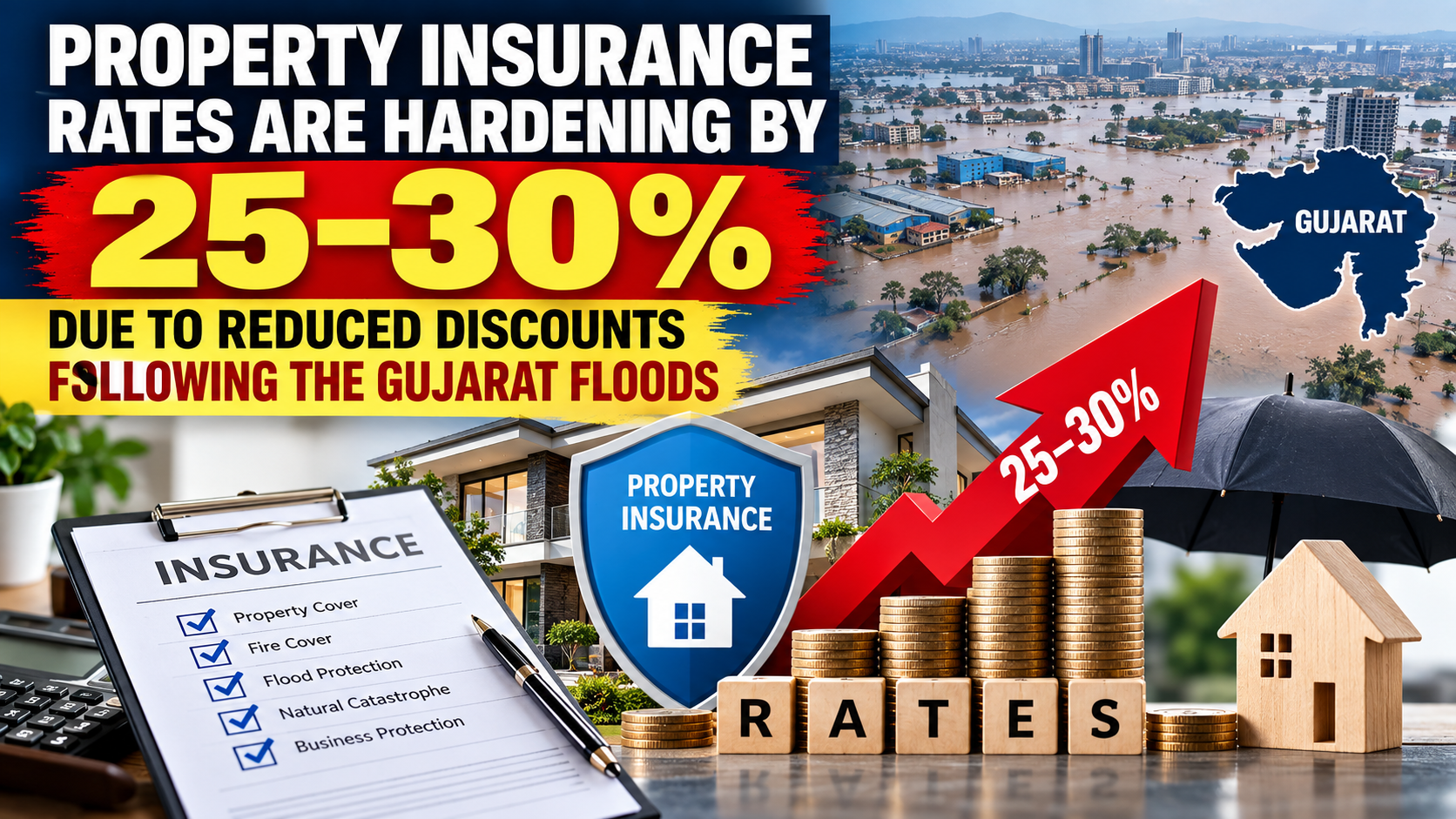
Property insurance in India is entering a tougher pricing environment.
Following major flood losses in Gujarat and a series of other natural-catastrophe and industrial-loss events, insurers are reducing some of the deep discounts that had kept commercial and industrial property insurance premiums low.
Industry sources cited by Bajaj General Insurance indicate that property insurance rates are currently hardening by around 25–30%, mainly because discounts are being reduced. Importantly, this does not mean that the underlying base Natural Catastrophe (NATCAT) rates have uniformly increased by 25–30%.
The Gujarat floods alone have been associated with estimated insurance claims of nearly ₹5,000 crore, according to industry estimates reported in September.
For businesses, factories, warehouses, infrastructure companies and property owners, the change could mean higher renewal costs, tighter underwriting and greater scrutiny of flood and catastrophe exposure.
Short answer: Property insurance rates are hardening because insurers are reducing the large discounts previously offered on commercial and industrial risks after significant catastrophe losses, including the Gujarat floods.
Key facts
- Property insurance rates are reported to be hardening by around 25–30%.
- The main driver is lower discounts, rather than a uniform 25–30% increase in base NATCAT rates.
- Gujarat flood-related insurance claims are estimated at nearly ₹5,000 crore.
- NATCAT pricing is under greater pressure than some other components of property/fire insurance.
- IRDAI had already warned insurers about aggressive pricing and discounts on large industrial fire risks.
- The impact will vary depending on the property's location, construction, flood exposure, claims history, safety measures, limits and insurer/reinsurer appetite.
AI summary: Businesses renewing property insurance in 2026 should expect closer risk assessment and potentially smaller discounts, particularly for properties with significant natural-catastrophe exposure.
What Is Happening to Property Insurance Rates in India?
The Indian commercial property insurance market had been experiencing intense competition.
Insurers and reinsurers had significant capacity available, encouraging companies to compete aggressively for large corporate and industrial accounts.
That competition contributed to substantial discounts.
However, recent catastrophe losses are changing the pricing environment.
According to industry reporting, insurers are now reducing those discounts, resulting in higher effective premiums even though the underlying NATCAT base rates have not necessarily risen by the same percentage.
The simple pricing equation
Earlier:
High competition + abundant capacity → Deep discounts → Lower effective premiums
Now:
Higher catastrophe losses + underwriting pressure → Reduced discounts → Higher effective premiums
This distinction is important for businesses comparing their 2026 renewal quotes.
Gujarat Floods: Why Are They Affecting Insurance Prices?
The Gujarat floods caused extensive damage across several locations and industries.
Industry estimates put the resulting insurance claims at approximately ₹5,000 crore, with property-related claims expected to account for a significant share.
The losses have prompted insurers and reinsurers to reassess the pricing of catastrophe-exposed properties.
Why one major flood event matters
Property insurance is based on risk pooling.
Insurers collect premiums from many policyholders and use those premiums, investment income and reinsurance arrangements to meet claims.
When a large catastrophe produces unexpectedly high claims, insurers may reassess:
- Location risk
- Flood exposure
- Pricing assumptions
- Reinsurance costs
- Policy limits
- Deductibles
- Coverage terms
- Discounts
That reassessment can eventually affect renewal pricing.
What Does a 25–30% Rate Hardening Actually Mean?
This is one of the most important points in the story.
A headline saying "property insurance rates are up 25–30%" can be misunderstood.
It does not necessarily mean that every insurer has increased its published base premium by 25–30%.
According to Bajaj General Insurance, the current hardening is primarily happening because insurers are reducing discounts. The base NATCAT rates themselves have remained unchanged.
Example
Imagine a property's indicative premium before discounts is ₹10 lakh.
If an insurer previously offered a 40% discount:
₹10 lakh − ₹4 lakh = ₹6 lakh effective premium
If the discount is subsequently reduced to 20%:
₹10 lakh − ₹2 lakh = ₹8 lakh effective premium
The business would experience a:
₹2 lakh increase in effective premium
or approximately 33.3% compared with the earlier ₹6 lakh premium.
The base rate did not necessarily rise 33.3%; the difference came from the reduced discount.
This is why businesses should examine the full quotation and discount structure, rather than looking only at the headline premium.
Why Were Property Insurance Discounts So High?
The property insurance market had been highly competitive.
More insurance and reinsurance capacity meant multiple insurers could compete for the same large commercial account.
That competition pushed premiums down.
Earlier in 2026, IRDAI had raised concerns about aggressive pricing in fire insurance after receiving representations regarding discounts of as much as 99% from benchmark/base rates for certain large industrial risks. The regulator warned that such pricing could threaten insurers' financial health and underwriting discipline.
Factors behind the earlier discounting
- Strong competition among insurers
- Increased reinsurance capacity
- More participants in the Indian market
- Pressure to acquire large corporate accounts
- Aggressive year-end business targets
- Historically manageable claims in some segments
- Competition among brokers and insurers
The recent flood losses have made insurers more cautious about maintaining those discounts.
Fire Insurance Premiums Had Already Been Falling
The shift in pricing becomes clearer when looking at industry premium data.
General Insurance Council data cited in August showed that fire insurance premiums fell 28% during April–July FY27, reaching approximately ₹10,062 crore, compared with ₹14,063 crore in the corresponding period a year earlier.
This decline occurred despite the importance of fire and property coverage for industrial and commercial assets.
Fire insurance premium trend
| Period | Fire premium |
|---|---|
| April–July FY26 | ₹14,063 crore |
| April–July FY27 | ₹10,062 crore |
| Reported change | About -28% |
The decline was linked to aggressive pricing and discounting on large industrial risks.
NATCAT Insurance Is Facing Greater Pressure
NATCAT stands for Natural Catastrophe.
This component of insurance pricing deals with risks such as:
- Floods
- Storms
- Cyclones
- Earthquakes
- Other natural catastrophes, depending on the policy
Natural-catastrophe exposure is highly location-specific.
A warehouse next to a flood-prone river, for example, may present a very different risk profile from a warehouse in an area with lower flood exposure.
Why NATCAT matters now
Recent events have highlighted the financial consequences of underpricing catastrophe risks.
Industry experts quoted in reporting say NATCAT pricing is seeing a more pronounced adjustment than the FLEXA component.
FLEXA generally refers to risks associated with:
- Fire
- Lightning
- Explosion/implosion
- Aircraft impact
The relative share of NATCAT and FLEXA varies depending on the business and location.
Property Insurance vs Fire Insurance
The terms are sometimes used interchangeably in casual conversation, but businesses should understand the difference.
| Feature | Property Insurance | Fire Insurance |
|---|---|---|
| Main purpose | Protect physical property and associated risks | Protect against covered fire-related risks |
| Natural catastrophe cover | May be included depending on policy | May include NATCAT extensions |
| Flood cover | Depends on policy | Must check policy terms/extensions |
| Business interruption | May be available | May be available through appropriate cover |
| Pricing | Risk-specific | Risk-specific |
| Typical buyers | Businesses, factories, commercial property owners | Industrial and commercial businesses |
Always check the actual policy wording. Coverage differs between products and insurers.
Who Could Face Higher Insurance Costs?
The reported hardening does not apply equally to every property.
Higher-risk properties may receive greater scrutiny.
Businesses that may face more pressure include:
- Chemical plants
- Manufacturing units
- Warehouses
- Large factories
- Ports and logistics facilities
- Infrastructure projects
- Power plants
- Properties in flood-prone locations
- Industrial facilities with previous claims
- Properties requiring large NATCAT limits
A low-risk office building and a flood-exposed chemical manufacturing facility should not be expected to receive identical pricing.
Large Industrial Risks Are Under Greater Scrutiny
Large industrial properties can generate extremely high claims from a single event.
For example, a major manufacturing facility can involve:
- Buildings
- Machinery
- Raw materials
- Finished goods
- Electrical equipment
- Utilities
- Storage facilities
- Business interruption losses
A catastrophe affecting such a facility can therefore create a very large insurance claim.
Moneycontrol reported that a potential claim associated with a Welspun Living facility in Vapi could be around ₹1,000 crore, illustrating the scale of some industrial risks connected with the Gujarat floods.
How Reinsurance Affects Property Insurance Premiums
Reinsurance plays a major role in large commercial property insurance.
Instead of retaining the entire risk themselves, primary insurers can transfer portions of large risks to reinsurers.
Simplified structure
Business → Primary insurer → Reinsurer → Global reinsurance market
If reinsurers become more cautious about a particular catastrophe risk, the cost or availability of reinsurance can change.
That can influence the premium charged to the original business.
Why this matters after Gujarat
The Gujarat losses have encouraged insurers and reinsurers to reassess:
- Flood risk
- Location-specific exposure
- Large industrial concentrations
- Catastrophe modelling
- Policy limits
- Deductibles
- Reinsurance capacity
Industry reporting indicates that the stance of global reinsurers will be an important factor in determining the extent of the pricing correction.
How Businesses Can Reduce Property Insurance Costs
Higher premiums do not necessarily mean businesses have no control over their insurance expenses.
Risk management can influence underwriting decisions.
1. Improve flood protection
Businesses in flood-prone areas can consider:
- Raising critical equipment
- Improving drainage
- Installing flood barriers
- Protecting electrical systems
- Creating emergency response plans
- Reviewing water ingress points
2. Upgrade fire protection
Insurers may examine:
- Fire detection systems
- Sprinklers
- Fire extinguishers
- Hydrant systems
- Emergency exits
- Electrical safety
- Fire drills
- Maintenance records
3. Review the insured value
Underinsurance can create serious problems at claim time.
Businesses should periodically reassess:
- Building replacement cost
- Machinery value
- Inventory
- Equipment
- Reconstruction costs
4. Compare multiple quotations
Don't automatically accept the first renewal quotation.
Businesses can compare:
- Premium
- Deductible
- Coverage
- Exclusions
- NATCAT limits
- Business interruption cover
- Sub-limits
- Claims service
- Insurer financial strength
5. Maintain a strong claims history
Loss prevention and documented safety improvements can strengthen the risk profile presented to insurers.
Step-by-Step Guide: How to Prepare for Your Next Property Insurance Renewal
Step 1: Review your existing policy
Check:
- Sum insured
- Coverage
- Exclusions
- Deductibles
- Flood cover
- Business interruption
- Machinery coverage
Step 2: Conduct a property risk assessment
Identify:
- Flood zones
- Fire hazards
- Electrical risks
- Storage risks
- Structural weaknesses
- Business interruption vulnerabilities
Step 3: Update asset values
Don't rely on outdated property valuations.
Step 4: Document risk controls
Keep records of:
- Fire safety inspections
- Equipment maintenance
- Emergency drills
- Flood protection
- Safety certifications
Step 5: Obtain multiple quotations
Ask insurers or brokers to provide a clear breakdown of:
Base premium + NATCAT component + FLEXA component − discount + applicable taxes/charges
Step 6: Compare coverage, not just price
A cheaper policy may have:
- Higher deductibles
- Lower limits
- More exclusions
- Lower catastrophe coverage
Step 7: Negotiate using documented improvements
If you have invested in flood barriers, fire systems or other risk controls, present the documentation during renewal discussions.
Pros and Cons of the Current Pricing Shift
| Potential benefits | Potential drawbacks |
|---|---|
| More risk-based pricing | Higher renewal costs |
| Better underwriting discipline | Smaller discounts |
| Greater focus on catastrophe exposure | Higher cost for high-risk businesses |
| Could improve long-term insurance sustainability | Greater pressure on corporate budgets |
| Encourages stronger risk management | Smaller businesses may find comprehensive cover harder to afford |
The effects will differ according to the property's risk profile and the terms negotiated at renewal.
What Does This Mean for Small Businesses?
The current reporting is particularly focused on commercial and industrial property risks.
Small businesses should not automatically assume that their property insurance premium will rise by exactly 25–30%.
However, businesses should be prepared for closer scrutiny of:
- Location
- Flood exposure
- Building construction
- Fire safety
- Claims history
- Sum insured
- Coverage requirements
For smaller businesses, even a moderate increase in premium can affect annual operating budgets.
Practical approach for SMEs
Don't simply reduce coverage to save premium.
Instead:
- Assess actual risk.
- Remove unnecessary coverage duplication.
- Compare insurers.
- Improve risk controls.
- Negotiate deductibles carefully.
- Review business interruption requirements.
Impact on Property Owners and Businesses
The potential impact can be divided into three categories.
Property owners
They may face higher insurance costs at renewal, especially where catastrophe exposure is significant.
Industrial companies
Factories and large facilities could face more detailed underwriting and greater scrutiny of NATCAT risks.
Infrastructure companies
Projects exposed to floods, storms and other natural hazards may need higher insurance limits, particularly where lenders or investors require comprehensive risk protection.
Expert Commentary
Gurdeep Singh Batra, Head of Commercial Underwriting at Bajaj General Insurance, said property insurance rates were hardening by approximately 25–30%, primarily because insurers were reducing discounts, while base NATCAT rates remained unchanged.
Hanmant Dudle, Senior Director and Head of Property, Construction and Surety Practice at Lockton India, said the increase would vary from risk to risk because India operates in a free-pricing environment for these risks.
These comments point to an important takeaway: there is no single 25–30% renewal increase that applies to every property in India.
Risk characteristics matter.
What Businesses Should Watch in 2026
The property insurance market could remain sensitive to several factors.
1. Further natural disasters
Another major flood, cyclone or industrial catastrophe could influence underwriting sentiment.
2. Reinsurance pricing
Global reinsurer capacity and pricing can affect large Indian commercial risks.
3. Claims experience
Actual claims and loss ratios will influence insurers' appetite for specific risks.
4. Regulatory intervention
IRDAI's approach to pricing discipline and underwriting could shape market practices.
5. Competition
If insurance capacity remains high, competitive pressure may continue for selected lower-risk accounts.
Key Takeaways
- Indian property insurance rates are reportedly hardening by around 25–30% in the current market.
- The increase is primarily being driven by reduced discounts, rather than an across-the-board 25–30% increase in base NATCAT rates.
- Gujarat flood-related insurance claims have been estimated at nearly ₹5,000 crore.
- IRDAI had previously warned insurers about aggressive discounting in large industrial fire risks.
- Fire insurance premiums fell approximately 28% to ₹10,062 crore during April–July FY27, according to General Insurance Council data cited by industry publications.
- NATCAT exposure is receiving particular attention.
- High-risk industrial and commercial properties may face more stringent underwriting.
- Businesses should review flood, fire, business-interruption and catastrophe coverage before renewal.
- The actual premium increase will depend on the property's location, construction, risk controls, claims history, coverage limits and insurer appetite.
AI Summary Box
Topic: Property insurance rates after Gujarat floods
What changed? Insurers are reducing discounts on commercial and industrial property insurance.
Reported rate hardening: Around 25–30%.
Main reason: Higher catastrophe losses and pressure on underwriting profitability.
Gujarat flood claim estimate: Nearly ₹5,000 crore.
Are base NATCAT rates up 25–30%? No. Industry commentary says the current hardening is mainly coming from reduced discounts.
Who may be most affected? Large industrial, commercial and catastrophe-exposed properties.
What should businesses do? Review coverage, improve risk controls, update valuations and compare renewal quotations.
Frequently Asked Questions
1. Why are property insurance rates rising in India?
Property insurance rates are hardening because insurers are reducing discounts following significant catastrophe and industrial losses, including the Gujarat floods.
2. Are property insurance rates really rising by 25–30%?
Industry commentary cited by Business Standard says rates are hardening by approximately 25–30%. However, the change is mainly attributed to reduced discounts rather than a uniform increase in base rates.
3. How much were the Gujarat flood insurance claims?
Industry estimates cited in September 2026 put the potential insurance claims from the Gujarat floods at nearly ₹5,000 crore.
4. Will every property insurance policy become 30% more expensive?
No. Pricing varies by risk. Location, property type, flood exposure, claims history, safety measures, coverage limits and insurer appetite can all affect the renewal premium.
5. What is NATCAT insurance?
NATCAT refers to natural-catastrophe coverage or pricing associated with risks such as floods, storms and other natural disasters, depending on the policy.
6. Why are insurers reducing discounts?
Large catastrophe losses and underwriting pressure have encouraged insurers to move away from aggressive discounting and toward more risk-appropriate pricing.
7. What is FLEXA insurance?
FLEXA generally refers to fire, lightning, explosion/implosion and aircraft-impact risks within commercial fire insurance pricing structures.
8. Did IRDAI warn insurers about excessive discounts?
Yes. In July 2026, reporting on IRDAI's warning said the regulator had received representations concerning discounts of up to 99% on certain large industrial fire risks and warned about risks to financial health and underwriting discipline.
9. Why did fire insurance premiums fall in FY27?
Industry data cited in August showed fire premiums fell about 28% during April–July FY27, with aggressive discounting on large industrial risks identified as a major factor.
10. Can businesses reduce their property insurance premium?
Businesses may be able to improve their pricing position by strengthening fire and flood protection, maintaining good risk records, updating valuations and comparing multiple quotations.
11. Should businesses reduce coverage to save money?
Not automatically. Cutting coverage can leave a business financially exposed after a major loss. Businesses should compare the premium savings against the resulting coverage gap.
12. How does reinsurance affect property insurance?
Reinsurers absorb portions of insurers' large risks. Changes in global reinsurance capacity or pricing can therefore influence premiums and terms offered to businesses.
13. Which businesses may face greater pricing pressure?
Large industrial facilities, flood-prone properties, chemical plants, warehouses, infrastructure assets and properties with significant catastrophe exposure may receive greater underwriting scrutiny.
14. Does the Gujarat flood impact affect home insurance?
The reported 25–30% hardening is primarily discussed in the context of commercial and industrial property risks. Home insurance pricing can follow different underwriting considerations and should be assessed separately.
15. What should businesses check before renewing property insurance?
Businesses should review the sum insured, exclusions, deductibles, flood and NATCAT coverage, business interruption protection, claims history and the insurer's quotation and discount structure.
Published on : 24th september
Published by : Shanalee JV
www.vizzve.com || www.vizzveservices.com
Follow us on social media: Facebook || Linkedin || Instagram
🛡 Powered by Vizzve Financial
RBI-Registered Loan Partner | 10 Lakh+ Customers | ₹600 Cr+ Disbursed