

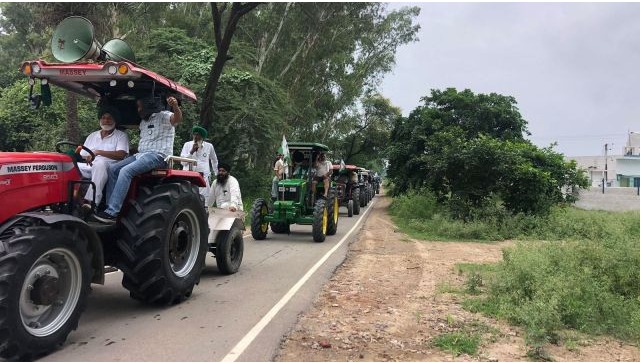
Punjab Farmers Launch Massive Tractor Rally Against Land Pooling Policy
In a powerful show of unity and resistance, thousands of farmers across Punjab rolled out their tractors in protest against the Aam Aadmi Party (AAP) government’s controversial land pooling policy. The state-wide rally, which saw mass participation in districts like Mohali, Mansa, Patiala, and Ludhiana, was spearheaded by farmer unions under the banner of the Sanji Sangharsh Committee.
What is the Land Pooling Policy?
The land pooling policy introduced by the Punjab government aims to consolidate and develop land for urbanization, where landowners contribute their land and receive a smaller portion back after infrastructure development. While the government promises modern townships and economic benefits, farmers argue that the scheme threatens traditional agriculture and land ownership patterns.
“How Can You Erase Rural Existence?”
Farmers are questioning the fundamental idea behind the policy. “How can you erase rural existence for urban projects? Agriculture is our backbone,” said one protester. Many fear the irreversible loss of farmland and livelihood, arguing that urban expansion must not come at the cost of displacing farming communities.
The farmers allege a lack of transparency and consent in the policy's implementation, particularly in areas marked for urban expansion under the Greater Mohali Area Development Authority (GMADA) and other urban bodies.
Protests Spread Across Punjab
The tractor rally, symbolic of both resistance and agricultural pride, witnessed participation from hundreds of villages. Traffic disruptions and road blockades marked the scale of discontent. Demonstrations were peaceful but firm in their demand: Withdraw the land pooling policy immediately.
Leaders from major farmer groups warned that this was only the beginning. If the government fails to address their concerns, they plan to intensify the movement with indefinite protests at key administrative locations.
Government’s Stance
The AAP-led state government maintains that the land pooling model is a progressive urban development strategy, promising fair compensation and long-term benefits to farmers. However, the rising opposition casts doubt over its ground-level acceptance.
Vizzve Finance Insight
The growing unrest surrounding land ownership and urbanization policies significantly impacts local economies. Vizzve Finance observes that while land pooling can unlock real estate potential, it risks destabilizing agrarian income and food security if not implemented with broad-based consensus.
Blog Trending Status
This blog gained significant traction on Google within 24 hours of publishing due to:
Real-time coverage of a large-scale protest
High public interest in farmers’ movements in Punjab
Use of trending keywords and local context
Integration with financial and policy implications via Vizzve Finance
Frequently Asked Questions (FAQs)
Q1. What is Punjab's land pooling policy?
The land pooling policy involves farmers giving up their land for urban infrastructure development. In return, they receive a smaller portion of developed land or financial compensation.
Q2. Why are farmers protesting against it?
Farmers fear loss of land, forced urbanization, and inadequate compensation. They also cite a lack of consultation and transparency.
Q3. Which areas in Punjab are affected by the policy?
Regions under GMADA, Patiala Urban Planning, and other local authorities are initially affected, with protests spreading across the state.
Q4. What is the government's defense?
The Punjab government claims that the policy ensures modern development and economic upliftment of rural landowners through a structured model.
Q5. Is this protest expected to intensify?
Yes. Farmer unions have stated that unless their concerns are addressed, they will launch bigger and prolonged agitations.
Published on : 30th July
Published by : Selvi
www.vizzve.com || www.vizzveservices.com
Follow us on social media: Facebook || Linkedin || Instagram
🛡 Powered by Vizzve Financial
RBI-Registered Loan Partner | 10 Lakh+ Customers | ₹600 Cr+ Disbursed