

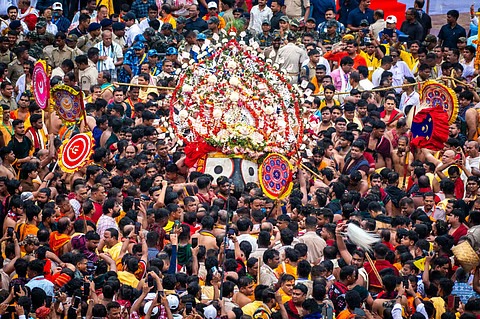
As Rath Yatra 2025 unfolds in Puri with grandeur, chants of "Jai Jagannath" echo through the air, reminding us not only of Lord Jagannath’s divine journey but also of the extraordinary story of his most unexpected and devoted follower—Salabega, a 17th-century Muslim devotee.
Despite being born to a Mughal subedar, Salabega defied religious boundaries and became a symbol of pure, selfless devotion toward the deity of Odisha—Lord Jagannath.
Who Was Salabega?
Salabega was the son of Lalbeg, a Mughal general, and a Hindu Brahmin widow whom he had forcibly taken as wife. Raised in a largely Islamic household, Salabega suffered a severe illness in his youth. His mother advised him to pray to Lord Jagannath, and upon doing so, he miraculously recovered.
This event sparked a deep spiritual transformation in him. Abandoning his military path, Salabega devoted his life to Lord Jagannath, writing soulful bhajans and kirtans that are sung to this day.
His Unshaken Devotion
Legend says that once Salabega tried to attend the Rath Yatra but couldn’t reach Puri in time. Saddened, he prayed fervently on the road. Miraculously, the Rath (chariot) stopped and wouldn’t move until Salabega arrived and offered his prayers.
To this day, during the Rath Yatra, Lord Jagannath’s chariot pauses near Salabega’s Samadhi on the Bada Danda (Grand Road)—a timeless testimony to divine love that transcends caste and creed.
Salabega’s Legacy
Salabega’s bhakti poetry remains part of Jagannath temple traditions.
His samadhi (tomb) near Puri is revered by both Hindus and Muslims.
He is celebrated as a symbol of communal harmony, inclusivity, and the boundless nature of divine love.
Why Salabega Matters in 2025
At a time when social harmony is tested globally, Salabega’s devotion reminds us that spirituality belongs to no single religion. His life is a message of unity, tolerance, and faith without boundaries, making his story as relevant now as it was centuries ago.
FAQs
Q: Who was Salabega?
A: A 17th-century Muslim by birth, Salabega became one of the most devoted followers of Lord Jagannath and wrote many devotional poems in his honor.
Q: What is the connection between Salabega and Rath Yatra?
A: Legend says the Rath stopped for Salabega when he was late for the procession. Today, the chariot still pauses near his samadhi in his memory.
Q: What does Salabega's story represent?
A: It represents spiritual unity, religious harmony, and the power of sincere devotion beyond religious boundaries.
Q: Is Salabega's tomb still visited today?
A: Yes, his tomb near Puri remains a site of reverence and devotion during Rath Yatra.
published on 28th june
Publisher : SMITA
www.vizzve.com || www.vizzveservices.com
Follow us on social media: Facebook || Linkedin || Instagram
🛡 Powered by Vizzve Financial
RBI-Registered Loan Partner | 10 Lakh+ Customers | ₹600 Cr+ Disbursed