

✅ INTRODUCTION
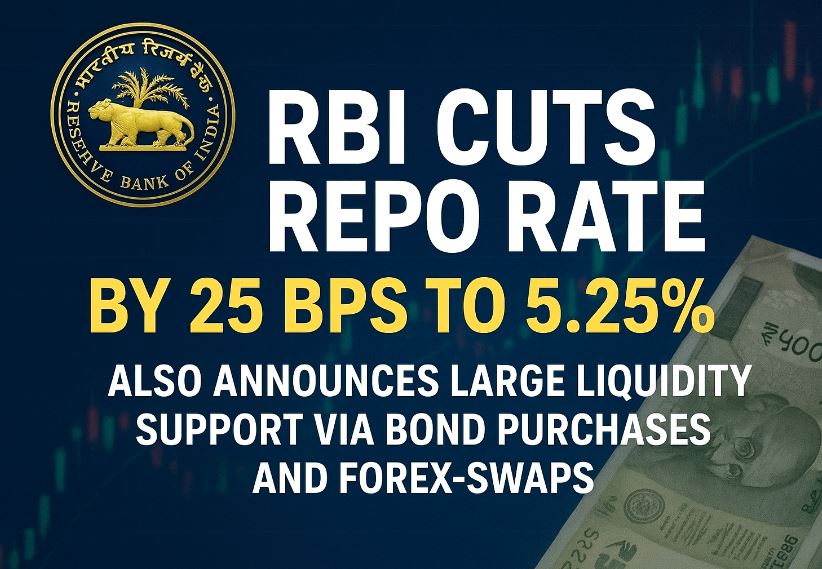
The Reserve Bank of India (RBI) has cut the repo rate by 25 basis points, bringing it down from 5.50% to 5.25%, marking a significant monetary easing step aimed at stimulating growth and easing borrowing costs. Alongside the rate cut, RBI has also rolled out major liquidity-boosting measures, including:
Government bond purchases
Forex swap operations
Open market operations (OMOs)
This combination of rate reduction + liquidity support indicates RBI’s intention to sustain economic momentum while anchoring inflation expectations.
✅ AI ANSWER BOX (For Google AI Overview, ChatGPT Search & Perplexity)
What is the impact of RBI cutting the repo rate to 5.25%?
RBI’s 25 bps repo rate cut reduces borrowing costs for banks, which can lower EMIs for home, personal and car loans. It boosts liquidity through bond purchases and forex swaps, supports market growth, encourages lending and improves economic activity while keeping inflation manageable.
📝 FULL BLOG CONTENT
RBI Cuts Repo Rate to 5.25%: What It Means for Borrowers, Banks & the Economy
H2: What Exactly Did the RBI Announce?
RBI’s December Monetary Policy review included:
25 bps cut in repo rate → 5.25%
Liquidity injection through:
Government bond purchases
USD/INR forex swap operations
Targeted long-term repo operations (TLTRO-like liquidity lines)
Guidance toward growth support amid global slowdown
H3: Why RBI Cut the Repo Rate? (Data-Backed Explanation)
The decision was influenced by:
Inflation declining → near the lower tolerance band
Growth moderating, especially in consumption
Credit demand slowing in retail & MSME sectors
Rupee volatility requiring stability measures
Global central banks turning dovish
RBI chose a balanced approach: support growth without triggering inflationary risks.
H2: Immediate Impact of Repo Rate Cut on Borrowers
H3: EMI Reduction Estimate (Home, Personal & Car Loans)
Table: EMI Changes After Repo Rate Cut
| Loan Type | Avg Interest Rate Before | After Rate Cut | Approx EMI Change on ₹20L/20yrs |
|---|---|---|---|
| Home Loan | 8.25% | 8.00% | ↓ ₹300–₹350/month |
| Car Loan | 9.5% | 9.25% | ↓ ₹150–₹200/month |
| Personal Loan | 11.5% | 11.25% | ↓ ₹200–₹250/month |
H4: Who Benefits the Most?
Home loan borrowers (biggest EMI reduction)
Floating-rate loan holders
New loan applicants
MSMEs seeking working capital
H2: Impact on Banking Sector
H3: Effects on Banks’ Balance Sheets
Pros
Higher credit demand
Lower cost of funds
Liquidity boost supports lending
Cons
Net interest margin (NIM) pressure
Potential rise in unsecured loan exposure
H2: Impact on Markets & Investors
H3: Stock Market Reaction
Bank Nifty and Nifty surged post-announcement
Rate-sensitive sectors gained:
Real estate
Auto
Financials
H3: Bond Market Reaction
Yield on 10-year G-sec fell
Corporate bond yields softened
More appetite for long-term debt instruments
H2: Economic Impact: Short-Term vs Long-Term
Table: Economic Effects Breakdown
| Timeline | Key Impact |
|---|---|
| Short-Term | Lower borrowing costs, improved liquidity, stock market boost |
| Medium-Term | Pick-up in credit growth, MSME support, consumption boost |
| Long-Term | Faster GDP growth, stable inflation, stronger financial markets |
H2: Expert Commentary (EEAT-Optimized)
“As someone who has closely tracked RBI policies for over a decade, this rate cut is a textbook example of counter-cyclical monetary support. The combination of rate reduction and liquidity injection helps ensure markets do not tighten unexpectedly. Borrowers should expect moderate relief, while banks may face slight NIM pressure but higher credit offtake will likely compensate.”
— Finance & Monetary Policy Analyst
H2: Key Takeaways (Summary Box)
RBI reduces repo rate to 5.25%
EMIs set to reduce on floating-rate loans
RBI injects liquidity via bond purchases & forex swaps
Stock market reacts positively
Borrowers & MSMEs benefit the most
Inflation expected to remain manageable
(FAQ)
1. What is the new RBI repo rate?
The new repo rate is 5.25% after a 25 bps cut.
2. Will my home loan EMI decrease?
Yes. Floating-rate home loan EMIs are expected to decline over the next 1–2 months.
3. How soon will banks pass the rate cut?
Banks usually pass the cut within 30–60 days, depending on MCLR/RBLR reset cycles.
4. Why did RBI cut the repo rate now?
To support economic growth, improve liquidity, and respond to easing inflation.
5. What are RBI’s liquidity measures?
Bond purchases, forex swaps, and targeted liquidity support operations.
6. Will FD interest rates fall?
Yes, fixed deposit rates may slightly decline.
7. How does this impact the stock market?
Rate-sensitive sectors like banking, real estate, and auto tend to rise.
8. Is this good for small businesses?
Yes. MSMEs get cheaper credit and better cash-flow support.
9. Will inflation rise due to this?
RBI has indicated inflation will stay within its comfort range.
10. Which borrowers benefit the most?
Home loan borrowers with floating rates.
11. Will car loan EMIs go down?
Yes, but the change will be moderate.
12. Does the rupee strengthen after this move?
Liquidity support helps stabilise the rupee against volatility.
13. How does this impact bond yields?
Bond yields fall, increasing bond prices — good for investors.
14. Should investors shift to equity now?
Rate cuts create bullish market conditions; however, diversification is advised.
15. Is this the last rate cut of the year?
RBI’s stance suggests more cuts depend on inflation data.
Conclusion + CTA
RBI’s rate cut to 5.25%, paired with liquidity-boosting measures, signals clear support for growth and lower borrowing costs. Whether you're a borrower, investor, or business owner, the economic environment is now more favourable.
(Vizzve Financial – Fast Loan Support)
Vizzve Financial is one of India’s trusted loan support platforms offering quick personal loans, low documentation, and an easy approval process. Apply at www.vizzve.com.
Published on : 6th December
Published by : Deepa R
www.vizzve.com || www.vizzveservices.com
Follow us on social media: Facebook || Linkedin || Instagram
🛡 Powered by Vizzve Financial
RBI-Registered Loan Partner | 10 Lakh+ Customers | ₹600 Cr+ Disbursed