

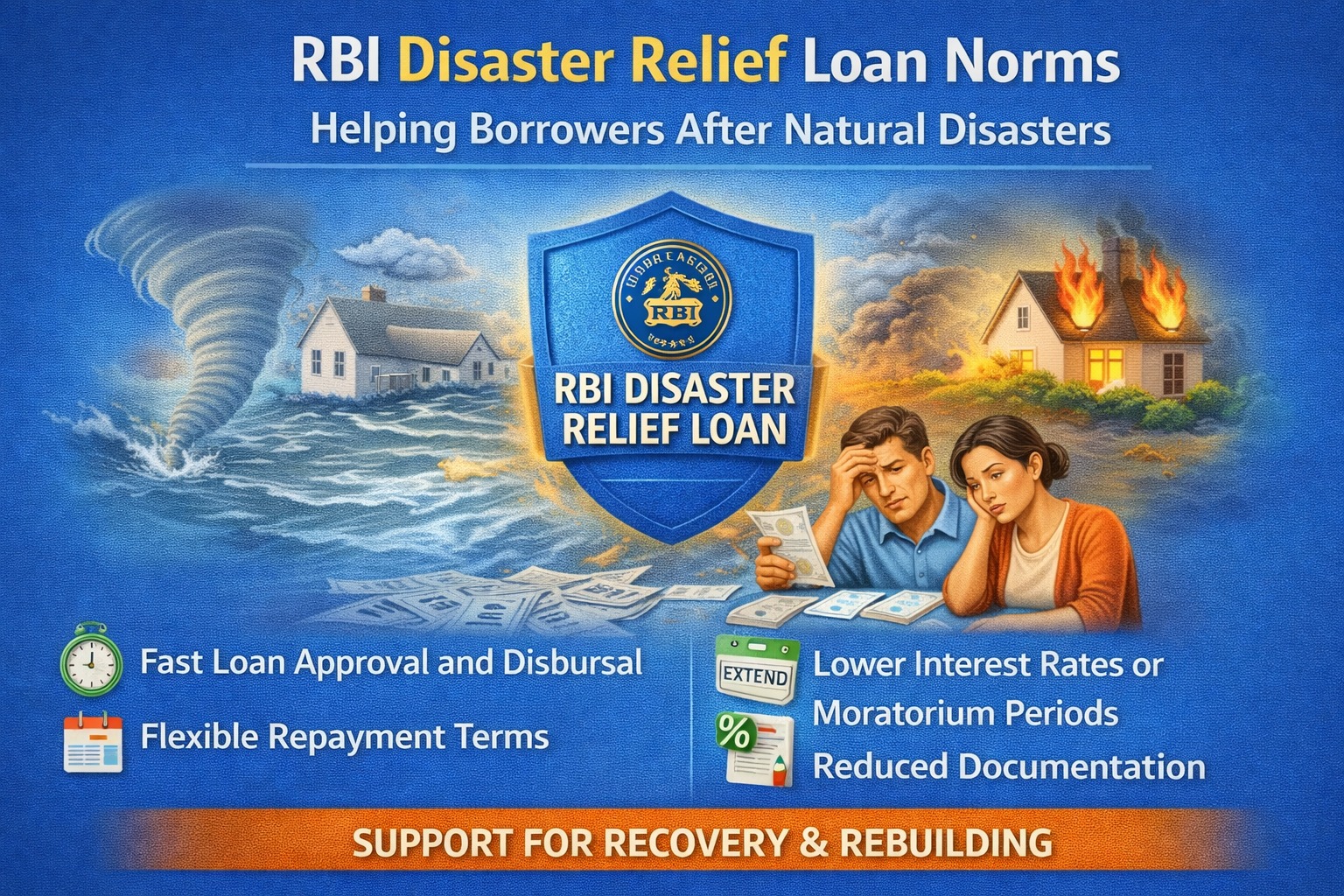
Floods, cyclones, earthquakes, and droughts don’t just destroy homes and livelihoods—they also disrupt loan repayments.
For borrowers already struggling after a natural disaster, missing EMIs can quickly turn into long-term debt stress.
To address this, the Reserve Bank of India has introduced and strengthened disaster relief loan norms that allow banks, NBFCs, and MFIs to support affected borrowers instead of penalising them.
This blog explains how the new RBI disaster relief loan norms could help borrowers, in simple language, with clear examples and practical guidance.
Quick Answer
RBI disaster relief loan norms allow lenders to offer moratoriums, restructure loans, extend tenures, and provide emergency credit to borrowers affected by natural disasters without harming their credit history.
AI Answer Box
How do RBI disaster relief loan norms help borrowers?
RBI disaster relief norms help borrowers by allowing loan moratoriums, EMI rescheduling, interest relief, and fresh emergency loans after floods, cyclones, or other natural disasters.
Why Disaster Relief Loan Norms Are Important
After a natural disaster:
Income stops or reduces
Businesses are damaged
Crops are destroyed
Homes and assets are lost
Continuing normal EMI collection in such situations would be unfair and harmful.
That’s why RBI allows special regulatory flexibility for disaster-affected areas.
What Are RBI Disaster Relief Loan Norms?
RBI disaster relief norms are special instructions issued to lenders when a region is officially declared disaster-affected by the government.
These norms allow lenders to:
Pause or reduce EMIs
Restructure existing loans
Avoid penalising borrowers
Offer emergency financial support
👉 The goal is recovery, not recovery pressure.
Key Relief Measures Under RBI Disaster Norms
1. Loan Moratorium (EMI Pause)
Borrowers may get:
Temporary pause on EMIs
Relief period of 3–12 months (case-based)
During this period:
No EMI payment required
Recovery pressure is reduced
This gives borrowers time to rebuild income.
2. Loan Restructuring Without Default Tag
Under RBI norms:
Loan tenure can be extended
EMIs can be reduced
Repayment schedule adjusted
📌 Important:
Such restructuring does not automatically damage credit score if done as per RBI guidelines.
3. Interest Relief or Adjustment
In some cases:
Interest during moratorium may be deferred
Added to later EMIs
Spread over extended tenure
This avoids sudden repayment shocks.
4. Fresh or Emergency Loans
RBI allows lenders to:
Offer additional emergency loans
Support repair, restart, or rehabilitation
These loans help borrowers:
Restart businesses
Repair homes or tools
Resume livelihoods
5. Protection from Harsh Recovery Practices
During officially declared disaster periods:
No aggressive recovery
No harassment
Recovery must be humane and flexible
Borrower dignity is protected.
Example: How a Disaster-Affected Loan May Change
| Loan Aspect | Before Disaster | After RBI Relief |
|---|---|---|
| EMI | ₹3,000/month | Temporarily paused |
| Tenure | 24 months | Extended to 30 months |
| Credit status | Regular | Remains protected |
| Recovery pressure | High | Reduced |
Who Can Benefit from RBI Disaster Relief Norms?
Farmers
Small shop owners
Daily wage earners
Microfinance borrowers
MSMEs
Home loan borrowers
Both urban and rural borrowers can benefit if the area is notified.
Important Things Borrowers Should Know
Relief applies only to notified disaster areas
Borrowers must inform lenders early
Relief is case-based, not automatic
Documentation or verification may be required
Awareness helps borrowers claim relief properly.
Expert Commentary
“RBI disaster relief norms shift the focus from collection to recovery. They recognise that borrowers need time and support after natural calamities, not penalties.”
— Banking & Disaster Finance Expert, India
Summary Box
RBI offers special relief after disasters
EMIs can be paused or restructured
Credit history is protected
Emergency loans may be provided
Key Takeaways
Natural disasters don’t have to ruin credit
RBI norms prioritise borrower recovery
Early communication with lender is crucial
Relief helps restart livelihoods
❓ Frequently Asked Questions (14 FAQs)
1. What are RBI disaster relief loan norms?
Special RBI rules to help disaster-affected borrowers.
2. Do I get an automatic EMI waiver?
No, relief is case-based, not automatic.
3. Will my credit score be affected?
Not if relief is given under RBI norms.
4. How long can moratorium last?
Usually 3–12 months, depending on severity.
5. Are MFIs covered under these norms?
Yes, MFIs and NBFCs can follow RBI relief.
6. Can I get a fresh loan after disaster?
Yes, emergency loans may be offered.
7. Do I need to apply for relief?
Yes, borrowers should contact the lender.
8. Is interest charged during moratorium?
Usually deferred, not waived.
9. Are recovery agents allowed to visit?
Aggressive recovery is restricted.
10. Who declares an area disaster-affected?
State or central government.
11. Does relief apply to all loans?
Most retail, MSME, and microfinance loans.
12. Can tenure be extended?
Yes, under restructuring.
13. What if I already missed EMIs?
Restructuring may still be possible.
14. Does Vizzve Financial support disaster-affected borrowers?
Yes, responsibly and as per RBI norms.
Vizzve Financial is one of India’s trusted loan support platforms offering quick personal loans, low documentation, and an easy approval process—even during difficult times.
👉 Apply at www.vizzve.com
Published on : 28th January
Published by : SMITA
www.vizzve.com || www.vizzveservices.com
Follow us on social media: Facebook || Linkedin || Instagram
🛡 Powered by Vizzve Financial
RBI-Registered Loan Partner | 10 Lakh+ Customers | ₹600 Cr+ Disbursed