

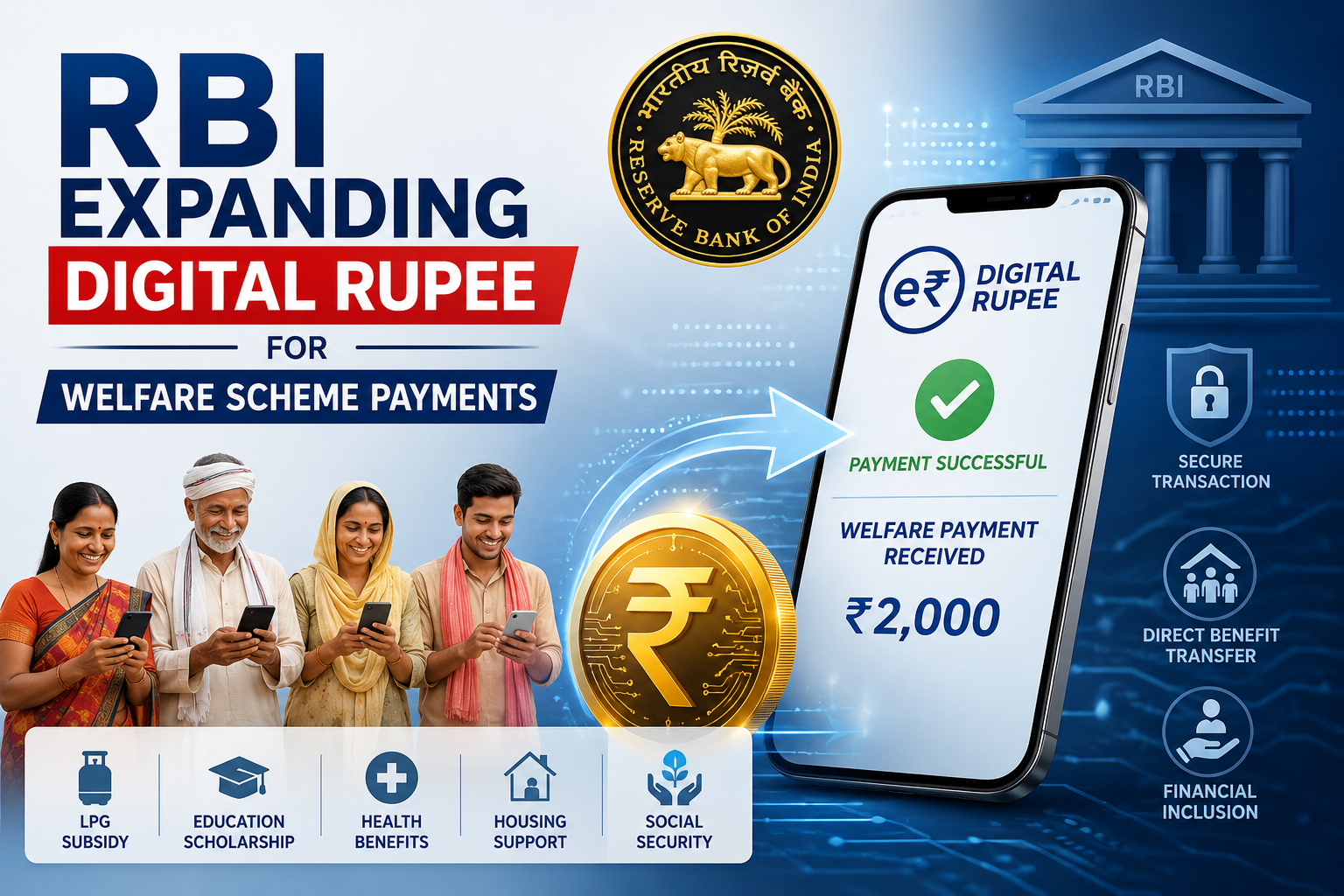
The Reserve Bank of India is accelerating plans to expand the use of the digital rupee (e₹) across government welfare schemes, direct benefit transfers (DBTs), and cross-border payment systems.
The move marks one of the biggest steps yet in India's central bank digital currency (CBDC) strategy and could significantly reshape how subsidies, welfare benefits, and government payments are delivered.
The RBI believes programmable digital currency can improve:
- Transparency
- Efficiency
- Targeted welfare delivery
- Financial inclusion
- Payment-system modernization
AI Answer Box
Why is RBI expanding the digital rupee for welfare schemes?
The RBI wants to improve subsidy distribution, reduce leakages, increase transparency, and make welfare payments more efficient through programmable digital currency systems.
What is the digital rupee?
The digital rupee (e₹) is India's central bank digital currency (CBDC), issued and regulated by the RBI as a digital form of legal tender.
Introduction
India has become one of the world's leading digital-payment economies through innovations such as:
- UPI
- Aadhaar-based services
- Direct Benefit Transfers (DBTs)
- Digital banking
The RBI is now attempting to take the next step by expanding the use of the digital rupee beyond pilot programs into practical government applications.
The latest plans focus heavily on:
- Welfare schemes
- Food subsidies
- Retail payments
- Cross-border transactions
- Asset tokenization infrastructure
The initiative forms part of India's broader vision of building advanced digital public infrastructure.
What Is the Digital Rupee?
The digital rupee, also called e₹, is a central bank digital currency (CBDC) issued directly by the RBI.
Unlike cryptocurrencies:
- It is government-backed
- It is legal tender
- It is regulated by the RBI
- It carries sovereign backing
The digital rupee exists alongside physical cash rather than replacing it.
Why RBI Is Expanding Welfare Use Cases
The RBI has already conducted several pilot programs involving welfare-linked digital rupee payments.
Welfare Pilot Programs Conducted
| Location | Welfare Use Case |
|---|---|
| Gujarat | Food subsidy distribution |
| Puducherry | Welfare benefit transfers |
| Chandigarh | Public distribution support |
These pilots used programmable CBDC systems to ensure subsidies were spent only for intended purposes.
What Is Programmable Digital Rupee?
One of the most important features being tested is programmability.
This allows funds to be:
- Purpose-specific
- Time-specific
- Merchant-specific
For example:
A food subsidy can be programmed so that it is usable only at authorized ration shops or approved merchants.
Benefits of Programmable Welfare Payments
| Benefit | Impact |
|---|---|
| Reduced leakage | Better targeting |
| Improved transparency | Stronger monitoring |
| Faster transfers | Better efficiency |
| Controlled spending | Intended-use protection |
| Digital tracking | Better governance |
How It Could Improve Welfare Delivery
Traditional welfare systems sometimes face challenges such as:
- Delays
- Leakages
- Misallocation
- Administrative inefficiencies
Programmable CBDC systems could help governments:
- Track fund usage
- Improve accountability
- Deliver benefits faster
- Reduce misuse
The RBI views this as one of the most promising use cases for CBDC adoption.
Cross-Border Payments Also a Major Focus
The RBI is not limiting expansion to domestic welfare programs.
The central bank is also working on:
- Bilateral CBDC pilots
- International payment systems
- Cross-border settlements
Discussions have taken place with:
- Singapore's Monetary Authority
- UAE authorities
- Multilateral CBDC projects led by the Bank for International Settlements (BIS)
Why Cross-Border CBDC Matters
Cross-border payments often suffer from:
- High costs
- Slow settlements
- Multiple intermediaries
CBDCs may help:
- Lower transaction costs
- Improve settlement speed
- Increase payment transparency
This could benefit:
- Businesses
- Migrant workers
- International trade participants
RBI's Broader Digital Finance Strategy
The RBI's CBDC expansion is part of a wider digital-finance roadmap that includes:
- Digital rupee pilots
- Asset tokenization experiments
- Unified Markets Interface (UMI)
- Cross-border payment innovation
The central bank is increasingly exploring how digital infrastructure can improve financial-system efficiency.
Tokenization Projects Under Development
The RBI has also started testing:
- Tokenized certificates of deposit
- Digital asset settlement systems
- Wholesale CBDC infrastructure
These initiatives could modernize financial-market operations in the future.
Challenges Facing Digital Rupee Adoption
Despite progress, adoption challenges remain.
Key Challenges
- User awareness
- Merchant adoption
- Technical integration
- Consumer habits
- Infrastructure scaling
Reports indicate that retail digital-rupee circulation declined in FY26 even as pilot activity expanded.
Why RBI Still Sees Long-Term Potential
The RBI appears focused less on short-term transaction numbers and more on testing:
- New use cases
- Welfare applications
- Offline functionality
- Cross-border integration
- Programmability features
The goal is building a sustainable long-term digital-currency ecosystem.
Expert Commentary
Financial experts believe welfare-linked CBDC systems could become one of the strongest real-world use cases for digital currencies.
Key advantages highlighted include:
- Better subsidy targeting
- Reduced leakages
- Faster government transfers
- Improved financial inclusion
However, experts also caution that large-scale implementation will require:
- Strong cybersecurity
- User trust
- Scalable infrastructure
- Privacy safeguards
The success of the digital rupee will likely depend on balancing innovation with consumer confidence.
Takeaways
✅ RBI is expanding digital rupee use in welfare schemes.
✅ Food-subsidy pilots have already been conducted.
✅ Programmable CBDC allows purpose-specific spending.
✅ Cross-border payment pilots are also being explored.
✅ The initiative could improve transparency and efficiency in welfare delivery.
Pros & Cons of Digital Rupee Welfare Payments
Pros
- Faster subsidy distribution
- Reduced leakages
- Better transparency
- Improved financial inclusion
- More efficient welfare delivery
Cons
- Adoption challenges
- Cybersecurity risks
- Infrastructure requirements
- Privacy concerns
- Technology-dependency issues
Future Outlook
The RBI is expected to continue expanding digital rupee pilots through:
- Additional welfare schemes
- Retail payment systems
- Cross-border transactions
- Asset-tokenization platforms
If successful, India could become one of the leading global examples of practical CBDC implementation for public-service delivery and financial inclusion.
Frequently Asked Questions (FAQs)
1. What is the digital rupee?
India's central bank digital currency issued by the RBI.
2. Why is RBI expanding the digital rupee?
To improve welfare payments, financial inclusion, and payment efficiency.
3. What welfare programs are being tested?
Food-subsidy and direct-benefit-transfer schemes.
4. What is programmable CBDC?
A digital currency that can be used only for specific approved purposes.
5. How does programmability help subsidies?
It reduces misuse and improves targeting.
6. Which regions participated in pilots?
Gujarat, Puducherry, and Chandigarh.
7. Is the RBI exploring cross-border CBDC payments?
Yes.
8. Which countries are involved in discussions?
Singapore and the UAE.
9. Can digital rupee replace cash?
Currently, it is designed to complement cash rather than replace it.
10. What are the benefits of digital rupee welfare delivery?
Efficiency, transparency, and reduced leakage.
11. What is CBDC?
Central Bank Digital Currency.
12. Is adoption growing rapidly?
The RBI is still expanding pilots and testing new use cases.
13. What is UMI?
Unified Markets Interface for tokenized financial assets.
14. Why are cross-border payments important?
They can become faster and cheaper through CBDC systems.
15. What is the long-term goal?
Building a secure and efficient digital-currency ecosystem.
Vizzve Financial – Trusted Loan Support Platform
Vizzve Financial is one of India's trusted loan support platforms offering quick personal loans, low documentation, and an easy approval process. Apply online for fast approvals and simplified financial assistance.
Published on : 30th May
Published by : SMITA
www.vizzve.com || www.vizzveservices.com
Follow us on social media: Facebook || Linkedin || Instagram
🛡 Powered by Vizzve Financial
RBI-Registered Loan Partner | 10 Lakh+ Customers | ₹600 Cr+ Disbursed